

Power Grid: what their latest filing actually means
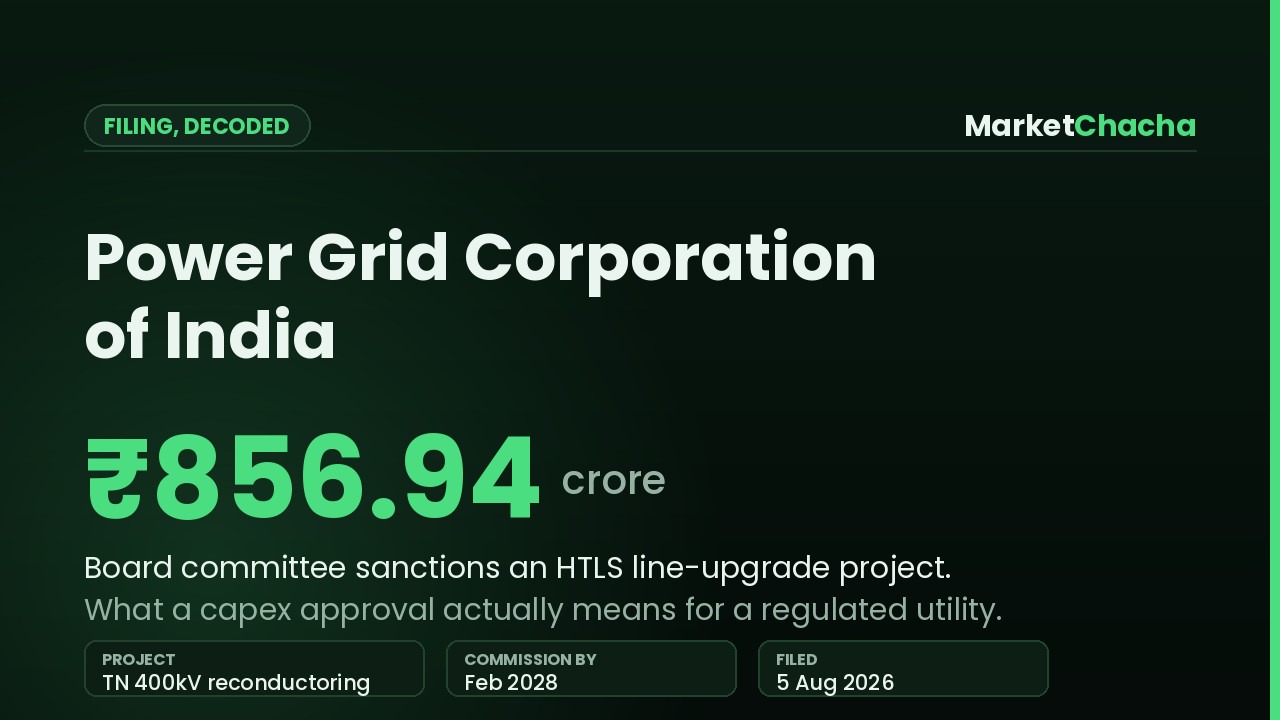
Power Grid Corporation of India told the exchanges that its "Committee of Directors on Investment on Projects" has sanctioned a ₹856.94 crore transmission project — reconductoring two 400 kV lines in Tamil Nadu with high-capacity conductor. In plain English: the board-level committee that green-lights capital spending has approved a specific new project, to be completed within 24 months.
What was announced
On 5 August 2026, Power Grid's investment committee approved capital expenditure for the project "Reconductoring of Tirunelveli–Udumalpet and Pugalur–Madurai 400 kV double-circuit lines with HTLS conductor." Key terms straight from the filing:
- Estimated cost: ₹856.94 crore, booked as Additional Capital Expenditure.
- Scope: replacing the wires on two existing 400 kV double-circuit lines in Tamil Nadu with HTLS (High-Temperature Low-Sag) conductor.
- Timeline: to be commissioned within 24 months of allocation, i.e. by 11 February 2028.
What this type of filing means
When you see "investment approval by the Committee of Directors on Investment on Projects," it simply means the company's internal spending committee has formally cleared money for a specific project. It's disclosed under Regulation 30 of SEBI's listing rules, which requires listed companies to promptly tell the market about decisions that could be price-sensitive. For a utility like Power Grid, these approvals are the routine building blocks of how the company grows — each one adds an asset it will earn a regulated return on.
"Reconductoring" means keeping the same towers and route but swapping out the old wires for better ones. HTLS conductor can run hotter with less sag, so the same line carries meaningfully more power — you upgrade capacity without acquiring fresh land or new right-of-way, which is faster and cheaper than building a brand-new line.
Why it matters / potential impact
Power Grid earns a regulated return: the electricity regulator (CERC) lets it recover its approved investment plus a fixed rate of return (broadly ~15.5% on equity) over the asset's life. So every rupee of approved, commissioned capex expands its "regulated asset base" and, in turn, its regulated earnings — this is why capex sanctions matter for a transmission utility. A ₹857 crore project is modest against Power Grid's roughly ₹2.6 lakh crore size, so on its own it won't move the needle much; what it signals is the steady drip of new investment that keeps the asset base growing.
There's also a grid-modernisation angle: Tamil Nadu is one of India's largest wind-and-solar states, and higher-capacity lines help evacuate that clean power. The project is funded through the company's normal mix of internal cash and debt, so there's no new share issuance and no dilution for existing shareholders. (This is not a prediction about the share price — just the mechanics of how the business grows.)
Is it expensive?
As reported by Screener.in / Trendlyne, Power Grid trades at a P/E of roughly 16.7x with a market capitalisation of about ₹2.64 lakh crore (share around ₹273). Compare that with its closest large listed PSU-utility peer, NTPC, at a P/E of about 12.3x and a market cap near ₹3.33 lakh crore. Power Grid's modest premium to NTPC is generally explained by the fact that transmission earnings are more annuity-like — a near-monopoly carrying power with almost no fuel-price or demand risk — whereas NTPC is a generator. Both look inexpensive versus the broader utility peer average (~39x, which is pulled up by higher-growth private names). Honest framing: ~16.7x is fair, not cheap and not stretched, for a low-risk regulated monopoly — no target price and no buy/sell call here.
The business
Power Grid is India's largest electric power transmission utility and a "Maharatna" central public-sector company. It owns and operates the backbone of the national grid — the high-voltage lines and substations that carry bulk electricity between states and regions — and handles a very large share of India's inter-regional transmission. Small side businesses include telecom (leasing spare fibre on its towers) and consultancy. Because this filing is about the core transmission business, it affects the main engine of the company, not a minor division.
Beginner takeaway
Power Grid didn't win a "contract" here — it approved its own spending on a specific upgrade project. For a regulated utility, that's how earnings grow: sanction capex, build the asset, then earn a regulated return on it for decades. One ₹857 crore project is a small brick in a very large wall, but it's a clean example of how a transmission utility actually compounds.
FAQ
Is a capex approval good news or bad news? Neither by itself — it's the normal way a regulated utility grows. It becomes value only once the asset is built and starts earning its regulated return; the approval is just step one.
Why "reconductoring" instead of building a new line? Getting land and right-of-way for a brand-new line is slow and contentious. Swapping in HTLS wire on existing towers boosts capacity far faster and cheaper.
Does this dilute my shares? No. It's funded by internal cash and borrowing, so no new shares are issued.
Will ₹857 crore change Power Grid's profits noticeably? Not on its own — it's tiny relative to the company's size. It matters as one of many steady additions to the regulated asset base over time.
As of 6 August 2026 (filing dated 5 August 2026). Source: official BSE/NSE filing — read it directly here. We summarise filings for education and may make errors, so always verify against the official document. Educational content only — not investment advice, not a buy/sell recommendation.
This article is for educational and informational purposes only. It is not financial advice, investment recommendation, or a solicitation to buy or sell securities. Investing involves significant risks. I am not a SEBI-registered investment advisor. Readers should consult their own financial advisor and conduct their own research before making any investment decisions.
Comments
Join the conversation
Sign in to join the conversation.
Follow replies, add your view, and take part in the discussion.
Sign in to commentLoading comments...