

Mahindra & Mahindra: what their latest filing actually means
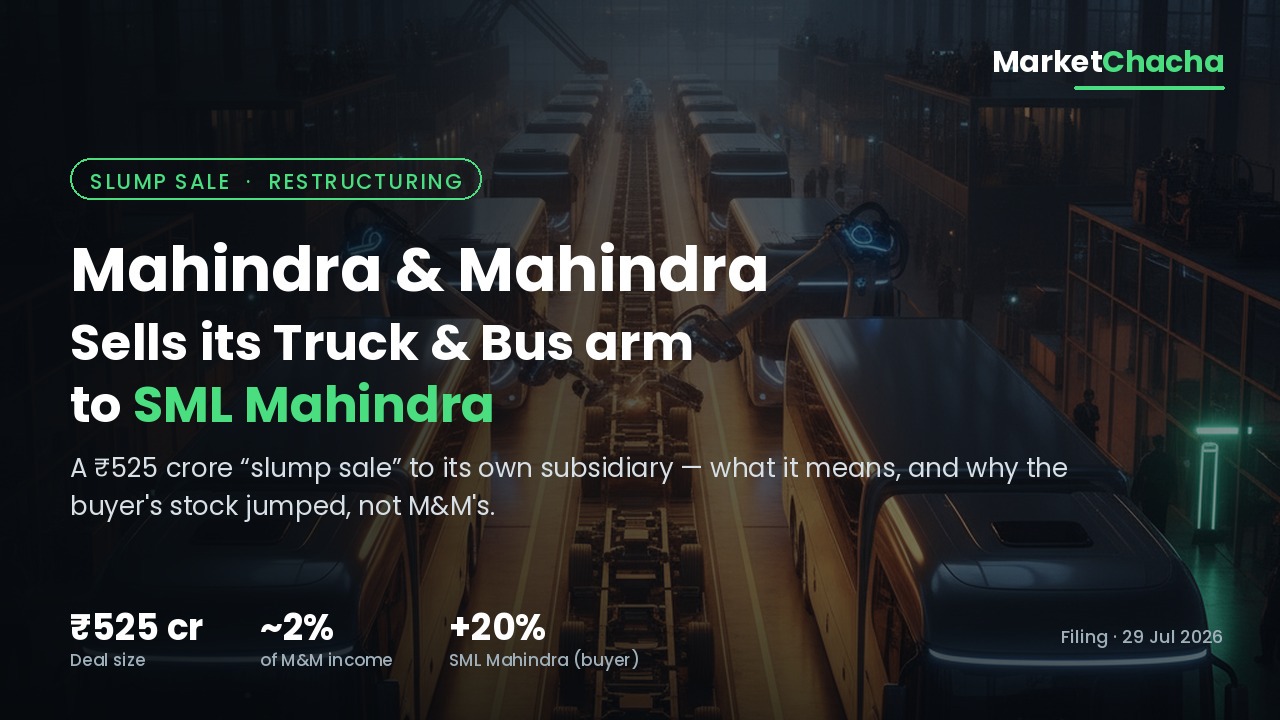
Mahindra & Mahindra (M&M) told the exchanges on 29 July 2026 that its board approved selling its Truck & Bus Division — the whole unit, employees, plants, brands and all — to SML Mahindra Limited, a listed company that M&M already controls. It is being sold on a “slump sale” basis for ₹525 crore. In plain terms, Mahindra is moving a small, sub-scale part of itself into the group’s dedicated commercial-vehicle company to build one bigger truck-and-bus business.
What was announced
M&M’s board approved the sale of its Truck & Bus Division (“MTBD Business Undertaking”) as a going concern to SML Mahindra Ltd under a Business Transfer Agreement (BTA). The key terms from the filing:
- Price: ₹525 crore, subject to working-capital adjustment. The number was set using a valuation report from GT Valuation Advisors.
- What the division is worth to M&M today: it produced total income of ₹2,989 crore in FY26 — only about 2.02% of M&M’s total income. M&M’s investment in it was ~₹481 crore, roughly 0.65% of net worth.
- Timeline: the BTA is to be signed on or before 7 August 2026; the sale is expected to complete on or before 31 January 2027, subject to approvals.
- Who is buying: SML Mahindra is a listed subsidiary of M&M (the former SML Isuzu, which Mahindra took control of in 2025). So this is a related-party transaction, done — the filing states — on an arm’s-length basis.
- Your M&M shares: the filing is explicit that the shareholding pattern of M&M does not change because of this.
What this type of filing means
This is a divestiture done as a “slump sale.” A slump sale means selling an entire business or division as a single going concern for one lump-sum price, without putting a separate value on each individual asset and liability. The whole unit — people, machinery, intellectual property, contracts — transfers together.
It is being executed through a Business Transfer Agreement, the contract that governs a slump sale. And because the buyer is a company M&M already controls, it is a related-party transaction: SEBI requires such deals to be disclosed and priced at “arm’s length” (as if between two unrelated parties) so minority shareholders are not shortchanged — which is why an independent valuer was used.
Why it matters / potential impact
The strategic logic is consolidation. Mahindra’s own truck-and-bus operation had struggled to reach scale. By folding it into SML Mahindra — which already has a strong position in intermediate and light commercial-vehicle buses — the group gets one focused truck-and-bus company spanning light, intermediate and heavy vehicles plus buses, with better scale and a fuller product line.
For M&M’s financials the direct impact is small: it is shedding a unit that was ~2% of income and ~0.65% of net worth, and receiving ₹525 crore — a rounding error next to M&M’s size. The far bigger reaction was in the buyer: SML Mahindra shares hit the 20% upper circuit on the news, because absorbing a much larger business is transformational for the smaller company. M&M’s own stock barely moved. This is a useful lesson: the same filing can be tiny for one side and huge for the other.
Is it expensive?
This filing is about M&M as a whole, so look at M&M’s valuation. M&M trades at roughly a P/E of ~22, with a market cap around ₹3.9 lakh crore and a price-to-book of ~4.2 (Screener/Trendlyne, late July 2026). That is a fair-to-full multiple for a large, diversified auto-and-farm major — not cheap, not stretched. For context, pure passenger-vehicle peer Maruti Suzuki trades near ~30x P/E with a ~₹4.3 lakh crore market cap, so M&M is noticeably cheaper on earnings, which reflects its heavier mix of lower-multiple tractor and farm-equipment businesses alongside its hot-selling SUVs. None of this is a target or a buy/sell call — just where the numbers sit.
The business
Mahindra & Mahindra is a diversified group with two big engines: mobility (SUVs like the Thar, Scorpio and XUV range, plus pick-ups and commercial vehicles) and farm solutions (Mahindra is one of the world’s largest tractor makers by volume, plus farm machinery). It also makes gensets and construction equipment. The Truck & Bus Division being sold is a small slice of the mobility side — so this deal touches one narrow segment, not the core SUV or tractor businesses that drive M&M’s profits.
Beginner takeaway
Think of this as portfolio housekeeping, not an earnings event. M&M is tidying up its structure by moving a small, sub-scale truck-and-bus unit into the group’s dedicated commercial-vehicle company to build scale. It doesn’t change your M&M shareholding, and it barely moves M&M’s numbers — the excitement was all in the buyer, SML Mahindra.
FAQ
What exactly is a “slump sale”? It’s selling a whole business or division as one going concern for a single lump-sum price, without assigning separate values to each asset and liability. Everything — staff, plants, brands, contracts — moves together.
Why would M&M sell a division to a company it already owns? To consolidate. Mahindra wants all its truck-and-bus operations under one focused, listed entity (SML Mahindra) so the combined business has more scale and a complete product range, from light vehicles to heavy trucks and buses.
Is ₹525 crore a big deal for M&M? Not really. It’s tiny next to M&M’s ~₹3.9 lakh crore market cap, and the division was only ~2% of income. The deal matters far more to the smaller buyer, SML Mahindra, whose shares jumped 20%.
Does “arm’s length” matter here? Yes. Because buyer and seller are related, SEBI requires the price to be fair as if set between strangers. M&M used an independent valuer (GT Valuation Advisors) to support the ₹525 crore figure and protect minority shareholders.
As of 29 July 2026. Source: official BSE filing dated 29 July 2026 — read it directly here. We summarise filings for education and may make errors, so always verify against the official document. Educational content only — not investment advice, not a buy/sell recommendation.
This article is for educational and informational purposes only. It is not financial advice, investment recommendation, or a solicitation to buy or sell securities. Investing involves significant risks. I am not a SEBI-registered investment advisor. Readers should consult their own financial advisor and conduct their own research before making any investment decisions.
Comments
Join the conversation
Sign in to join the conversation.
Follow replies, add your view, and take part in the discussion.
Sign in to commentLoading comments...