

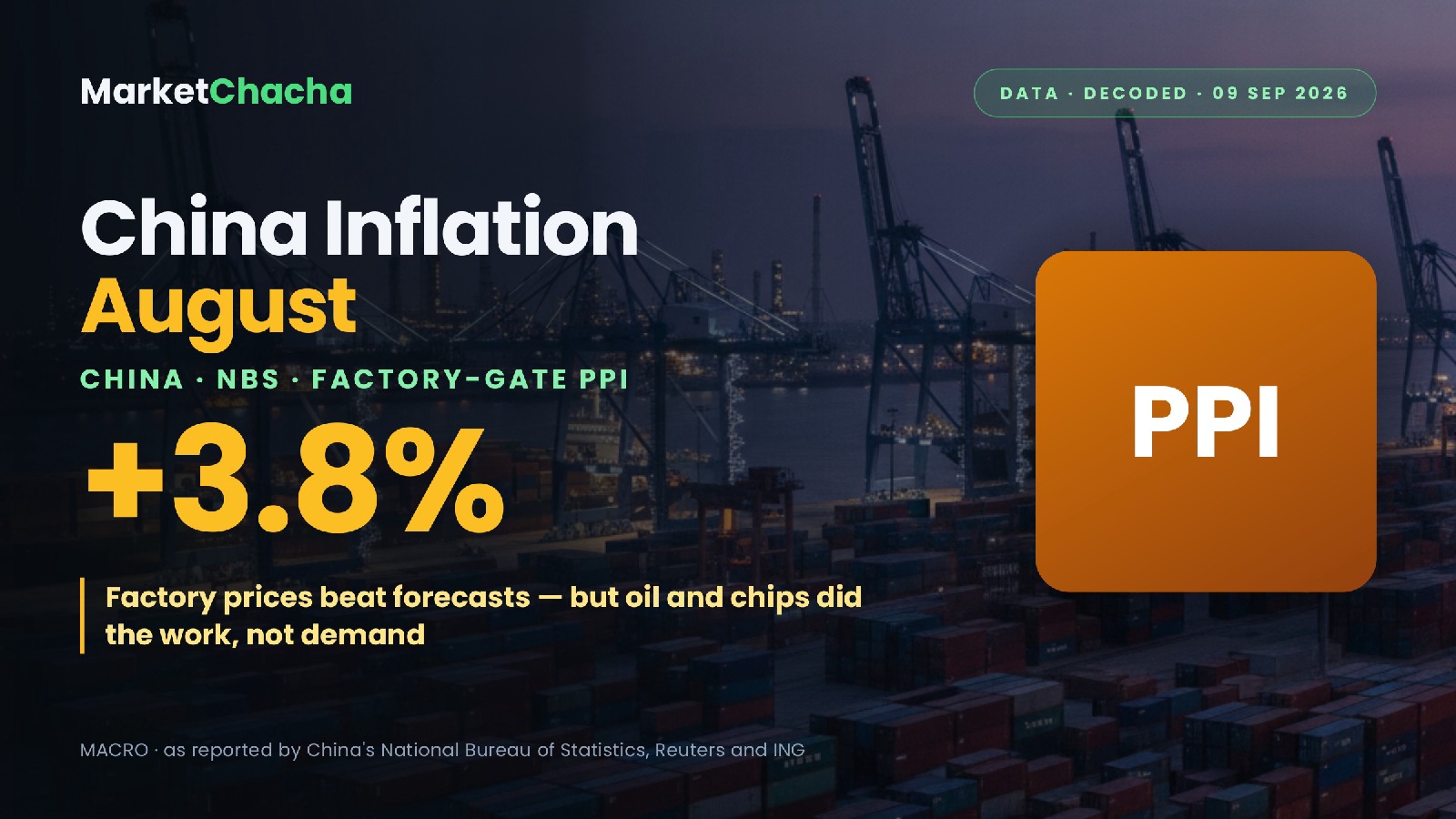
China's factory prices jumped 3.8% in August — but oil and chips did the work, not demand
China's August inflation numbers landed this morning and, on the headline, they look like the reflation story finally getting its legs back. Dig one layer down and it's mostly a barrel of oil and a shortage of memory chips.
The numbers
Consumer prices rose 0.8% year-on-year in August, up from 0.5% in July and exactly in line with the market forecast of 0.8%. Month-on-month, CPI rose 0.4% — the first monthly increase after three straight declines. Core CPI, which strips out food and energy, edged up to 1.0% from 0.9%.
The bigger surprise was at the factory gate. Producer prices rose 3.8% year-on-year against a consensus of 3.6%, up from 3.5% in July. On the month, PPI rose 0.4% — its first positive print in three months.
PPI is the price a factory charges when goods leave the gate, before wholesalers and shops add their cut. It's the upstream cousin of CPI, and it moves first.
What it means
The composition is the whole story. Per ING's breakdown of the NBS release, the lift came from inputs, not shoppers: ex-factory coal extraction prices spiked 26.6% on the month and crude oil extraction 10.5%, with non-ferrous metals mining still running 21.1% higher year-on-year. In the consumer basket, communication appliances jumped 10.6% — the memory-chip squeeze showing up in phone and laptop prices — and transport fuels rebounded 8.3%.
Everything demand-driven is still soft. Food prices were -1.4%, a fifth straight negative month, with pork down 11.8%. Rent was -0.6%, also a fifth month in the red. Food is roughly 30% of the CPI basket and housing another 22%, so more than half the basket is actively dragging.
Factory-gate prices tell the same split: food manufacturing -1.2%, beverages -5.3%, apparel -1.2%, pharmaceuticals -3.7% and autos -2.2% are all still deflating. Zhiwei Zhang of Pinpoint Asset Management put it bluntly to Reuters: he wouldn't read this as a sign of recovery.
Markets agreed it wasn't a turning point. The Shanghai Composite added 0.24% to 3,949.89 and the CSI 300 0.12% to 4,564.42, while the Hang Seng slipped about 0.2% to roughly 25,280 — with attacks on Saudi energy infrastructure pushing Brent toward $100 and stealing the session's attention.
Who it touches
- Metals and mining: Chinese non-ferrous mining prices running 21% above last year is the floor under global base-metal pricing that Indian producers sell into. Aluminium, zinc and copper names take their cue from this, not from domestic demand.
- Indian pharma and auto ancillaries: Chinese ex-factory pharma is still -3.7% and autos -2.2%. China is exporting price deflation in exactly the lines Indian exporters compete in — cheaper for Indian buyers of APIs and components, tougher on realisations for anyone selling against them.
- Oil-linked India: the same crude spike that lifted China's PPI hits India's import bill, the rupee and oil marketing company margins. When one country's inflation is imported through a barrel, so is everyone else's.
- Rate expectations: cost-push inflation is the awkward kind — it lifts prices without lifting growth, so it narrows what central banks can do without any of the demand that would justify staying tight.
What to watch
Two things settle this. First, China's August activity data — industrial production, retail sales and fixed-asset investment — due mid-September; if retail sales stay flat while PPI climbs, the cost-push read is confirmed. Second, the oil tape. ING still sees full-year Chinese CPI near 0.9%, below the 2% target set at the Two Sessions, and Capital Economics expects producer prices to slide back into deflation next year. Both assume crude calms down. If Brent holds near $100, that assumption breaks — and so does the forecast.
As of 3:00 PM IST, 9 September 2026. Sources: ING THINK, CNBC, Business Recorder / Reuters, National Bureau of Statistics of China. For discussion and education only — not investment advice. Verify before acting.
This article is for educational and informational purposes only. It is not financial advice, investment recommendation, or a solicitation to buy or sell securities. Investing involves significant risks. I am not a SEBI-registered investment advisor. Readers should consult their own financial advisor and conduct their own research before making any investment decisions.
Comments
Join the conversation
Sign in to join the conversation.
Follow replies, add your view, and take part in the discussion.
Sign in to commentLoading comments...