

Coinbase Global (COIN): the full file — the numbers, the owners, and what the filings actually show

Coinbase Global runs the largest US-listed crypto exchange: it charges consumers and institutions a fee to buy and sell crypto assets, and it earns a second, quieter stream by holding customer assets — custody fees, staking rewards, interest on customer cash, and a share of the interest earned on the reserves backing the USDC stablecoin. In FY2025 those two streams were 59% and 41% of net revenue respectively.
The record shows a company that earned $7.18bn of revenue and $1.26bn of net profit in FY2025 — and then reported net losses in each of the three quarters that followed. It safeguards $245.9bn of customer crypto that appears nowhere on its balance sheet, it has no headquarters, it moved its state of incorporation from Delaware to Texas in December 2025, and one person controls roughly half the votes. Every figure below is taken from a primary filing, all of which are linked at the end.
Origin — the company's birth certificate
The 10-K is precise about the paperwork. Coinbase, Inc. was incorporated in Delaware in May 2012. In January 2014, Coinbase Global, Inc. was incorporated as a Delaware corporation to act as the holding company, and in April 2014 a reorganisation made Coinbase, Inc. a wholly-owned subsidiary of it. Coinbase Global's principal assets are its equity interests in its subsidiaries.
Class A common stock began trading on the Nasdaq Global Select Market under the symbol COIN on 14 April 2021, by direct listing rather than an IPO — meaning no new shares were sold and no money was raised on the day. Nasdaq set a reference price of $250; the stock opened at $381 and closed its first session at $328.28.
The most recent entry in the birth certificate is dated 15 December 2025: the company "effected a reincorporation from the State of Delaware to the State of Texas." Coinbase Global, Inc. is today a Texas corporation. Supplemental indentures were executed on 12 December 2025 for each of the four convertible note series to reflect the change; the filing states the reincorporation did not adjust any conversion rate or trigger repurchase rights. A handful of large US companies have made the same move in recent years; Texas created a specialised business court in 2024. The company did not state a reason in the 10-K, and we did not find one; the Information Statement it filed on 24 November 2025 is the document to read on this.
There is no promoter group in the Indian sense, but there is a founder with control — see the ownership section.
The business — what they actually sell
FY2025 net revenue of $6,883.4m splits into two reported buckets (total revenue of $7,181.3m includes other items):
| Revenue line (FY2025) | US$ m | vs FY2024 | Change |
|---|---|---|---|
| Consumer transaction revenue, net | 3,322.8 | 3,430.3 | −3% |
| Institutional transaction revenue, net | 479.7 | 345.6 | +39% |
| Other transaction revenue, net | 252.9 | 210.2 | +20% |
| Total transaction revenue | 4,055.4 | 3,986.1 | +2% |
| Stablecoin revenue | 1,348.8 | 910.5 | +48% |
| Blockchain rewards | 677.4 | 705.8 | −4% |
| Interest and finance fee income | 247.0 | 265.8 | −7% |
| Other subscription and services | 554.8 | 425.1 | +31% |
| Total subscription and services | 2,828.0 | 2,307.1 | +23% |
Transaction revenue was 59% of net revenue in FY2025, down from 63%. Within it, consumer fees fell despite volume rising: the MD&A attributes a $384.4m decrease to a lower average blended fee rate "due to changes in the mix of Trading Volume from Simple users to Advanced and Coinbase One users who pay lower average fees," offset by $277.0m from a 7% volume increase. In plain terms, the company grew volume by charging less per trade.
Spot trading revenue by asset in FY2025: Bitcoin 27% (30% in FY2024), XRP 14% (6%), Ethereum 12% (13%), other assets 47%. No other single asset exceeded 10%.
Who actually buys from them
Coinbase does not disclose a customer-concentration note, and no single customer is identified as more than 10% of revenue. Its buyers are millions of retail accounts: Monthly Transacting Users were 7.6 million in Q2 2026, down from 8.7 million a year earlier.
But there is a concentration, and the company flags it itself in the risk factors: "Within transaction revenue and subscription and services revenue, a meaningful concentration is from transactions in Bitcoin and Ethereum and stablecoin revenue in connection with USDC, respectively."
That stablecoin revenue — $1,348.8m, or 19.6% of FY2025 net revenue — flows from a single commercial counterparty. Circle Internet Financial, LLC issues USDC; Coinbase partnered with Circle in 2018 and entered an updated arrangement in August 2023 (the "Circle Agreement") to share in the economics of the reserves backing USDC both on and off the Coinbase platform. The 10-K states the Circle Agreement "has an initial three-year term." Coinbase does not hold the reserves and does not set the rate; Circle earns the interest and pays Coinbase. The company discloses the sensitivity: a hypothetical 150 basis-point move in average interest rates applied to daily USDC reserve balances would have moved interest earned on those funds by $143.2m in 2025.
So roughly a fifth of net revenue depends on one contract, with one counterparty, whose economics are set by the level of US interest rates. That is a fact, disclosed, and legal. The benign reading is that it is a genuine partnership in a product Coinbase co-created and distributes, and that Coinbase's own balances drive part of the payment. The material reading is simply that the term is finite and the rate is not in Coinbase's control.
Where it is actually made — infrastructure and dependencies
Item 2 Properties is unusually short, and worth quoting: "We are a remote-first company... As a result of this strategy, we do not maintain a headquarters, but do currently lease physical offices in select major cities." The address on the 10-K cover — One Madison Avenue, Suite 2400, New York — is accompanied by a footnote saying it is included "solely for the purpose of satisfying the Securities and Exchange Commission's request." Shareholder meetings are virtual. As of 31 December 2025 the company had 4,951 employees.
There are no factories. The physical assets are software and equipment of $264.6m at FY2025 — under 1% of total assets. The real operational dependency is custody: crypto assets held in cold storage, accessible only by whoever holds the private keys. Deloitte designated this its critical audit matter, and describes testing it by "decoding cryptographic messages signed using selected private keys or through observing the movement of selected crypto assets."
The other dependency is third-party infrastructure — data centres, banking partners, blockchain networks — which the 10-K discusses at length in the risk factors but does not name. Named suppliers are not disclosed. Non-cancellable purchase obligations, primarily for technology services, total $670.4m through 2029.
Five years of numbers
| US$ m | FY2021 | FY2022 | FY2023 | FY2024 | FY2025 |
|---|---|---|---|---|---|
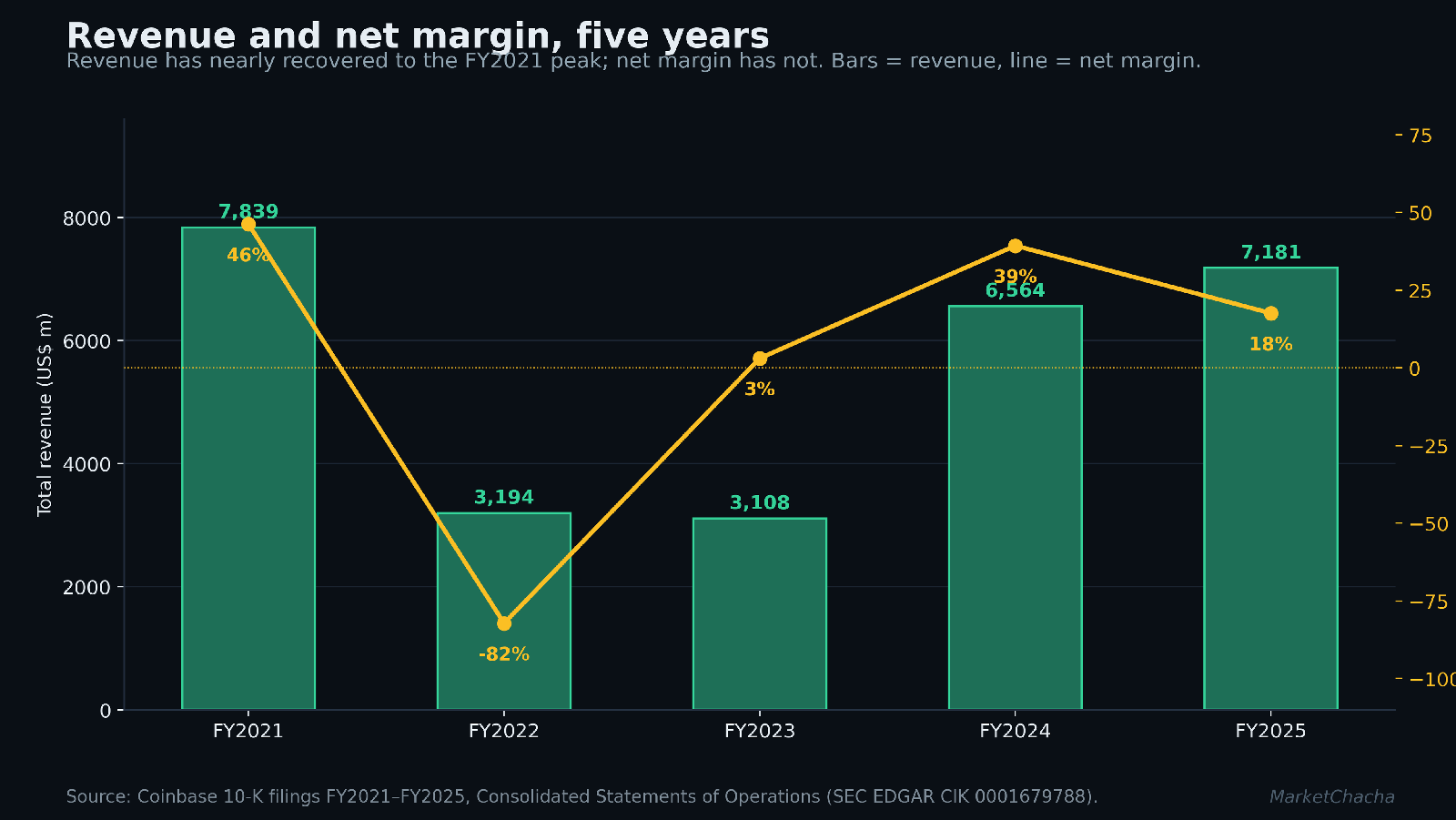
| Total revenue | 7,839.4 | 3,194.2 | 3,108.4 | 6,564.0 | 7,181.3 |
| Operating income (loss) | 3,076.6 | (2,710.2) | (161.7) | 2,307.2 | 1,435.4 |
| Net income (loss) | 3,624.1 | (2,624.9) | 94.9 | 2,579.1 | 1,260.3 |
| Net margin | 46.2% | −82.2% | 3.1% | 39.3% | 17.5% |
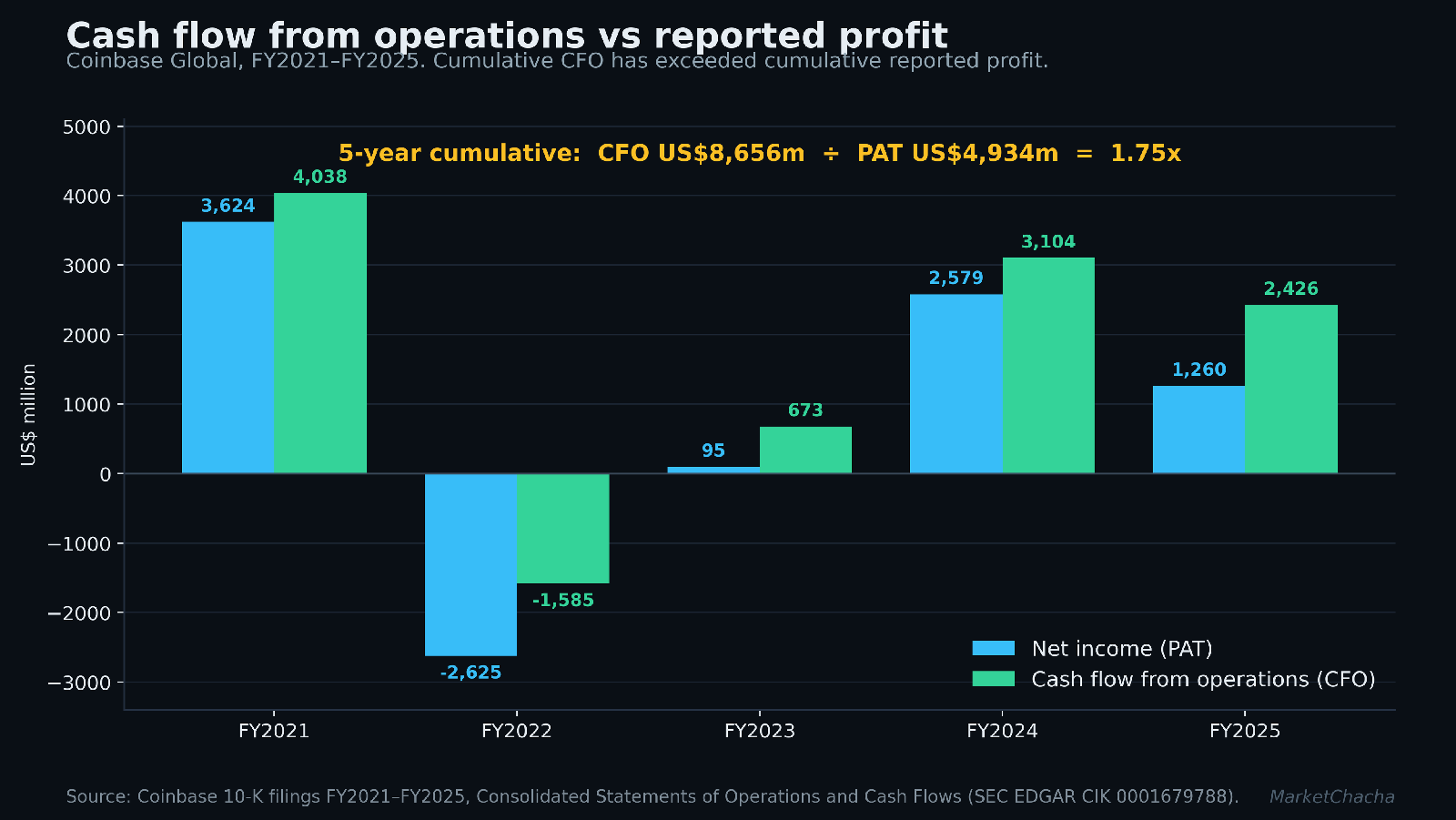
| Cash from operations | 4,038.2 | (1,585.4) | 673.4 | 3,103.9 | 2,426.4 |
| CFO ÷ PAT | 1.11 | 0.60 | 7.10 | 1.20 | 1.93 |
| Diluted EPS (US$) | 14.50 | (11.83) | 0.37 | 9.48 | 4.45 |
The arithmetic. Revenue CAGR FY2021→FY2025: (7,181.3 ÷ 7,839.4)^(1/4) − 1 = −2.2%. Net income CAGR over the same span: −23.2%. Diluted EPS CAGR: (4.45 ÷ 14.50)^(1/4) − 1 = −25.6%. Measured from FY2023 instead, revenue CAGR is +52.0% — the answer depends entirely on which year you start from, which is the defining feature of a business tied to the crypto cycle.
Five-year price return. First close $328.28 on 14 April 2021; close of $191.45 on 14 September 2026. That is −41.7% over about 5.4 years, a CAGR of −9.3%. Over the same period revenue fell 8.4% and the share count rose.
Income statement — FY2025 vs FY2024
| US$ m | FY2025 | FY2024 | Change | % |
|---|---|---|---|---|
| Total revenue | 7,181.3 | 6,564.0 | +617.3 | +9.4% |
| Transaction expense | 1,020.2 | 897.7 | +122.5 | +13.6% |
| Technology and development | 1,670.6 | 1,468.3 | +202.4 | +13.8% |
| Sales and marketing | 1,058.6 | 654.4 | +404.1 | +61.8% |
| General and administrative | 1,619.6 | 1,300.3 | +319.4 | +24.6% |
| Other operating expense, net | 356.1 | 7.9 | +348.2 | +4,389% |
| Total operating expenses | 5,745.9 | 4,256.9 | +1,489.0 | +35.0% |
| Operating income | 1,435.4 | 2,307.2 | −871.7 | −37.8% |
| Interest expense | 85.4 | 80.6 | +4.8 | +5.9% |
| Losses (gains) on crypto held for investment | 528.9 | (687.1) | +1,215.9 | n.m. |
| Other income, net | (700.9) | (29.1) | +671.8 income | n.m. |
| Profit before tax | 1,522.1 | 2,942.6 | −1,420.6 | −48.3% |
| Tax | 261.7 | 363.6 | −101.8 | −28.0% |
| Net income | 1,260.3 | 2,579.1 | −1,318.7 | −51.1% |
| Diluted EPS (US$) | 4.45 | 9.48 | −5.03 | −53.1% |
| Net margin | 17.5% | 39.3% | −21.8 pp | — |
| Memo: Adjusted EBITDA (company-defined) | 2,808.5 | 3,347.5 | −539.0 | −16.1% |
| Memo: stock-based compensation | 839.4 | 912.8 | −73.4 | −8.0% |
Balance sheet — FY2025 vs FY2024
| US$ m | 31 Dec 2025 | 31 Dec 2024 | Change | % |
|---|---|---|---|---|
| Cash and cash equivalents | 11,285.5 | 9,308.3 | +1,977.2 | +21.2% |
| Loan receivables | 1,354.7 | 644.2 | +710.5 | +110.3% |
| Crypto assets held for investment | 1,998.9 | 1,553.0 | +445.9 | +28.7% |
| Strategic investments | 623.0 | 374.2 | +248.8 | +66.5% |
| Goodwill | 4,169.0 | 1,139.7 | +3,029.3 | +265.8% |
| Intangible assets, net | 1,397.8 | 46.8 | +1,351.0 | +2,886% |
| Deferred tax assets | 570.8 | 941.3 | −370.5 | −39.4% |
| Total assets | 29,671.8 | 22,542.0 | +7,129.9 | +31.6% |
| Customer custodial fund liabilities | 5,347.4 | 6,158.9 | −811.5 | −13.2% |
| Total borrowings (LT + current + short-term) | 7,658.7 | 4,608.3 | +3,050.4 | +66.2% |
| Total liabilities | 14,878.8 | 12,265.1 | +2,613.7 | +21.3% |
| Additional paid-in capital | 8,566.9 | 5,366.0 | +3,200.9 | +59.7% |
| Retained earnings | 6,221.2 | 4,960.9 | +1,260.3 | +25.4% |
| Total shareholders' equity | 14,793.1 | 10,276.8 | +4,516.2 | +43.9% |
Cash flow — FY2025 vs FY2024
| US$ m | FY2025 | FY2024 | Change |
|---|---|---|---|
| Cash from operating activities | 2,426.4 | 3,103.9 | −677.6 (−21.8%) |
| Cash used in investing activities | (2,049.6) | (201.0) | −1,848.5 |
| Cash from financing activities | 740.3 | 2,903.1 | −2,162.8 (−74.5%) |
| Free cash flow | Not computable from the filing — see note below | ||
What moved, and what it means. Revenue rose 9.4% but net income halved. Three things did that. First, operating expenses rose 35% against 9% revenue growth: sales and marketing was up 61.8%, and "other operating expense, net" jumped from $7.9m to $356.1m — of which $345.2m is identified in the Adjusted EBITDA reconciliation as "Data Theft Incident losses, net" (see the regulatory section). Second, the crypto Coinbase holds on its own book swung from a $687.1m gain in FY2024 to a $528.9m loss in FY2025 — a $1.2bn swing that has nothing to do with customers trading. Third, a $700.9m credit in "other income, net" partly offset it. Balance-sheet growth is almost entirely acquisition: goodwill and intangibles together rose $4.38bn, and equity rose 43.9% mainly because $3.2bn of shares were issued, not because profit was retained.
Earnings quality. Of FY2025's $1,522.1m pre-tax profit, $700.9m came from "other income, net" — non-operating. Strip it out and pre-tax profit is $821.2m. Cash conversion, by contrast, is strong: CFO of $2,426.4m is 1.93× reported net income. Free cash flow cannot be computed: the FY2025 cash-flow statement does not present a separate "purchases of property and equipment" line. Software and equipment, net rose from $200.1m to $264.6m while depreciation and amortisation was $188.4m, but the gross capex figure is not disclosed. We state that as a gap rather than estimate it.
The latest quarter, decoded
| US$ m | Q2 FY26 | Q1 FY26 | QoQ % | Q2 FY25 | YoY % |
|---|---|---|---|---|---|
| Total revenue | 1,220.1 | 1,413.0 | −13.7% | 1,497.2 | −18.5% |
| — Transaction revenue | 599.2 | 755.8 | −20.7% | 764.3 | −21.6% |
| — Subscription and services | 555.1 | 583.5 | −4.9% | 632.2 | −12.2% |
| of which stablecoin revenue | 292.1 | 305.4 | −4.4% | 308.9 | −5.4% |
| of which blockchain rewards | 83.3 | 100.8 | −17.3% | 144.5 | −42.3% |
| Total operating expenses | 1,333.6 | 1,434.4 | −7.0% | 1,521.9 | −12.4% |
| — Technology and development | 472.8 | 525.6 | −10.0% | 387.3 | +22.1% |
| — Restructuring | 52.4 | — | n.m. | — | n.m. |
| Operating loss | (113.5) | (21.4) | n.m. | (24.7) | n.m. |
| Losses (gains) on crypto held for investment | 209.5 | 482.4 | — | (362.1) | n.m. |
| Other expense (income), net | 49.9 | (61.6) | — | (1,506.9) | n.m. |
| Profit (loss) before tax | (395.4) | (464.7) | — | 1,823.8 | n.m. |
| Net income (loss) | (359.5) | (394.1) | — | 1,428.9 | n.m. |
| Diluted EPS (US$) | (1.36) | (1.49) | — | 5.14 | n.m. |
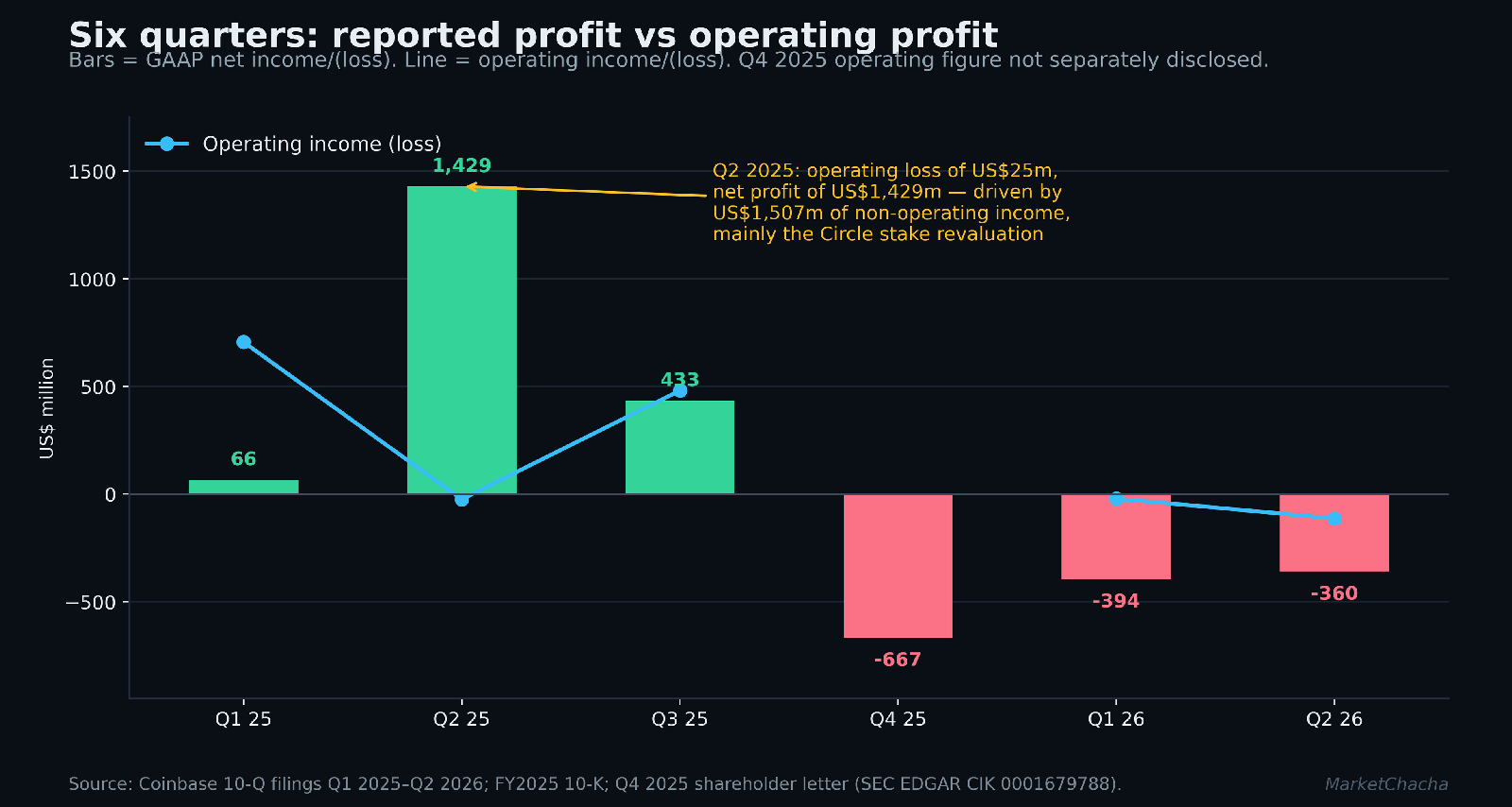
Q2 FY2026 is the third consecutive quarter of GAAP net loss: $(666.8)m in Q4 2025 (per the Q4 shareholder letter), $(394.1)m in Q1 2026, $(359.5)m in Q2 2026. Revenue fell 18.5% year on year, driven by transaction revenue down 21.6%: consumer spot trading volume fell 38%, partly offset by derivatives (Deribit) and newly launched prediction-markets trading. MTUs fell from 8.7m to 7.6m. Blockchain rewards fell 42.3%.
The earnings-quality point is on the other side of the comparison. In Q2 FY2025, Coinbase reported an operating loss of $24.7m and a net profit of $1,428.9m. The gap is $1,506.9m of "other expense (income), net" — which the Q2 2026 10-Q attributes primarily to "the fair value remeasurement of our investment in Circle Internet Group, Inc. following its initial public offering" in June 2025, plus a $362.1m gain on crypto held for investment. Almost none of that quarter's headline profit came from operating the exchange. The same mechanism runs in reverse now: Q1 and Q2 FY2026 carry $691.9m of combined crypto revaluation losses. Investors reading either quarter's net income line in isolation would be reading the crypto market, not the business.
Two other items belong in the quarter. On 5 May 2026 the company announced a restructuring cutting approximately 700 employees, substantially complete in Q2, costing $52.4m. And beginning Q2 FY2026 Coinbase stopped reporting Trading Volume as a key metric, stating the spot-focused metric "no longer reflects the breadth of our business" and that it does not believe a total trading volume metric would fully represent the business. That is the company's stated reason; the practical effect is that a series investors used to track quarter to quarter ends here.
Who owns it — and where those owners are registered
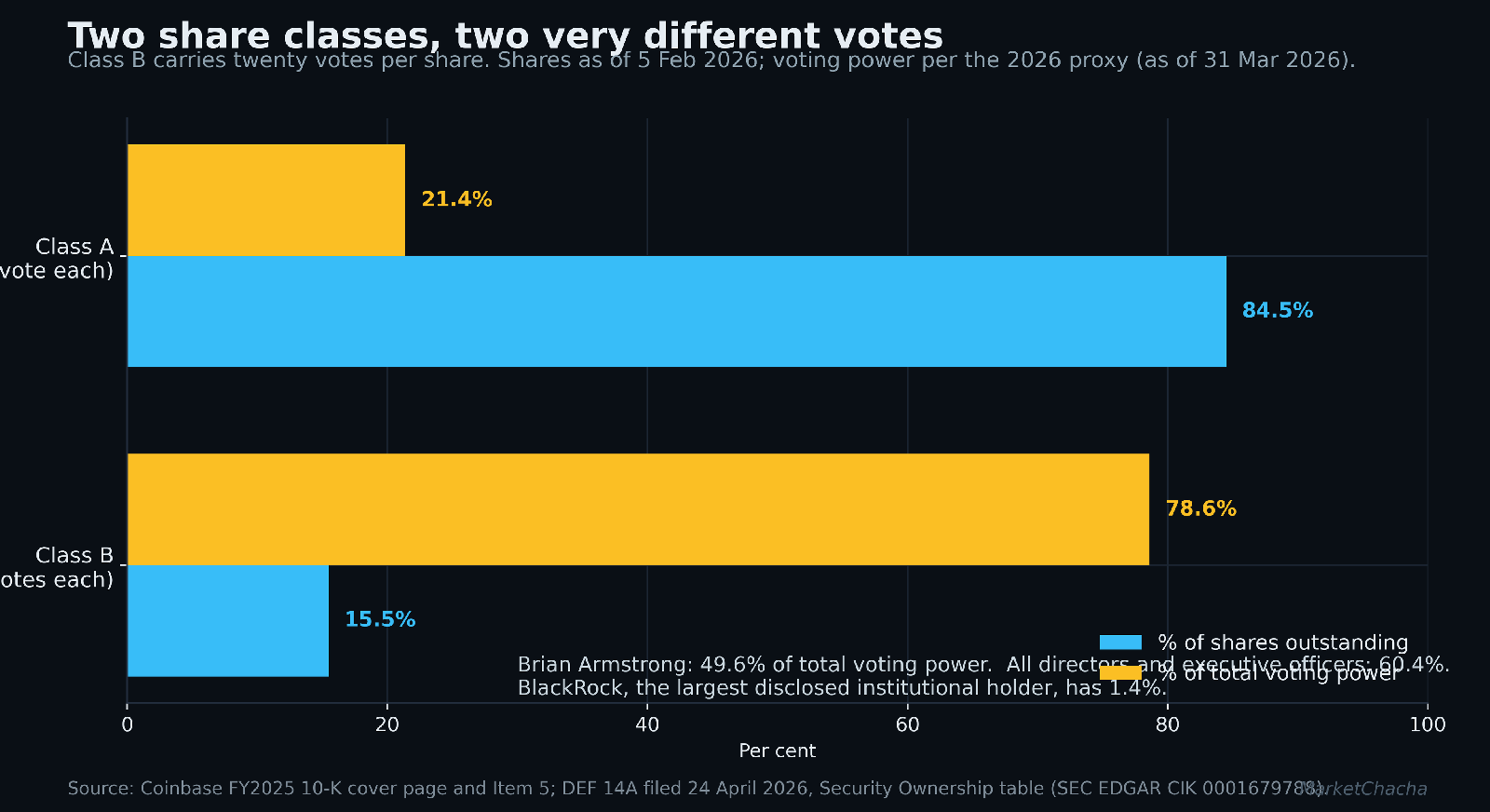
There are two share classes. As of 5 February 2026: 223,041,278 Class A shares (one vote each, listed) and 41,033,891 Class B shares (twenty votes each, not listed on any exchange). Class B is 15.5% of the shares and 78.6% of the votes. There were 294 registered holders of record of Class A and 9 of Class B — a low count reflecting street-name custody, not a small shareholder base. No dividend has ever been paid.
From the 2026 proxy (beneficial ownership as of 31 March 2026):
| Holder | Class A | Class B | % of total voting power |
|---|---|---|---|
| Brian Armstrong (Chairman & CEO) | 8,167,972 | 25,639,618 | 49.6% |
| Trusts/entities established by Brian Armstrong (independent trustee) | — | 9,865,967 | 18.9% |
| Frederick Ernest Ehrsam III (co-founder, director) | 11,881 | 5,511,848 | 10.6% |
| BlackRock, Inc. | 14,618,089 (6.6% of Class A) | — | 1.4% |
| All directors and executive officers (14 persons) | 12,718,146 | 31,161,466 | 60.4% |
Separately, Vanguard Capital Management LLC reported 16,327,137 Class A shares (7.32%) as of 31 March 2026 — but sole voting power over only 2,197,116 of them. Four affiliated Susquehanna broker-dealer entities jointly reported 9,347,209 shares (4.2%) as of 31 March 2025, of which options to buy 8,942,500 shares.
The structural fact: the two largest institutional shareholders own roughly 14% of the listed class between them and command roughly 3% of the votes. Dual-class structures are legal, common among founder-led US technology companies, and fully disclosed here; the 10-K risk factors state plainly that Class B holders "are expected to continue to control a significant percentage of the combined voting power" until Mr Armstrong's Class B holding falls below 25% of the total, among other triggers.
Insider transactions. We parsed every Form 4 filed by Coinbase insiders in the twelve months to 15 September 2026 — 90 filings, of which 86 parsed cleanly. They record 255 open-market sale transactions totalling 1,301,164 Class A shares for approximately US$324.1m, and zero open-market purchases (transaction code P). The largest reported sellers: Frederick Ehrsam ($113.2m), CFO Alesia Haas ($74.7m), Brian Armstrong ($74.6m), Emilie Choi ($31.1m), Fred Wilson ($15.9m). Most such sales at US companies are executed under pre-arranged Rule 10b5-1 plans adopted months in advance, which is the ordinary and benign explanation; the individual plan details are in each Form 4 footnote. The fact stated here is only the aggregate, and that no insider bought on the open market in the window.
Jurisdictions
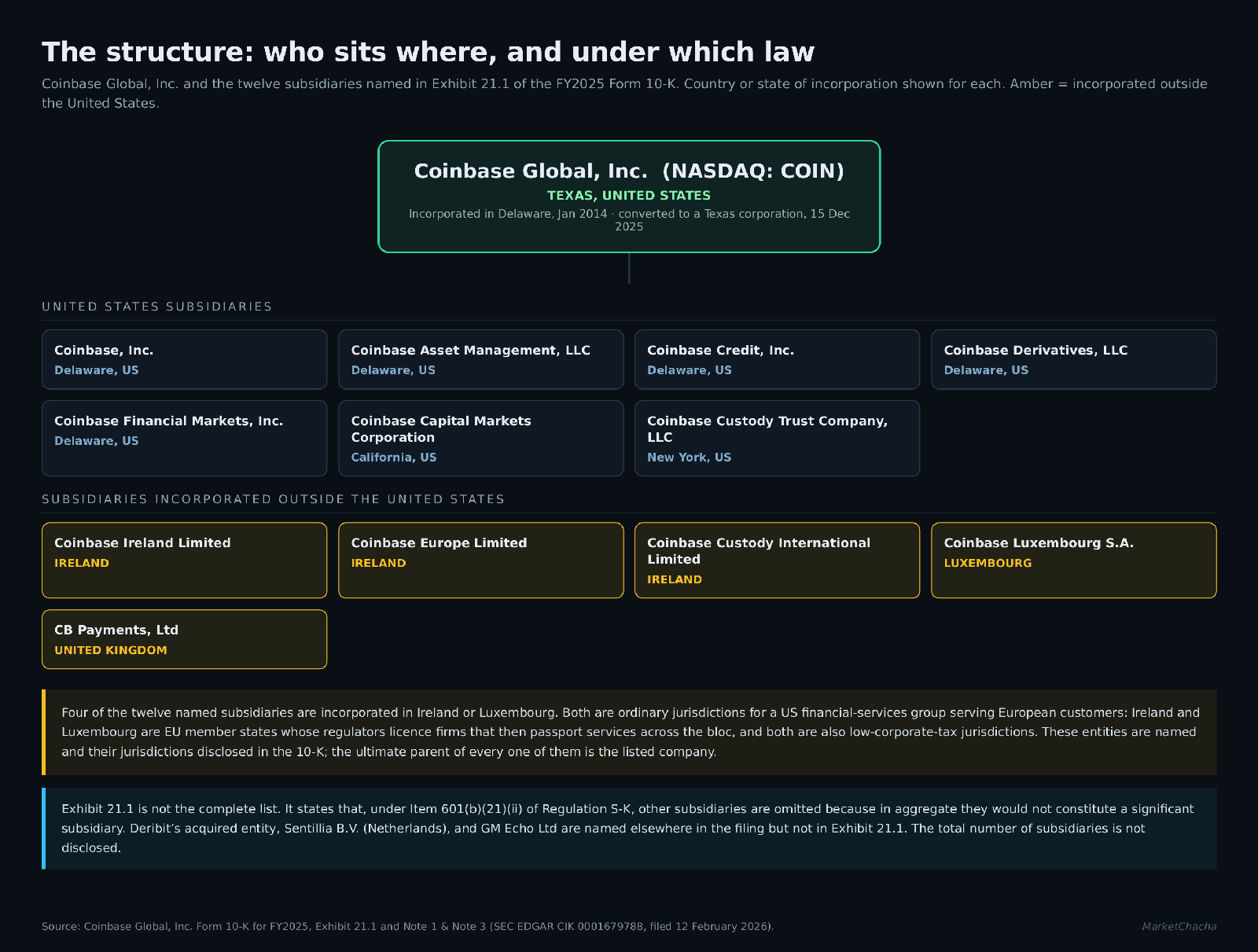
Exhibit 21.1 of the FY2025 10-K names twelve subsidiaries. Seven are US (five Delaware, one California, one New York). Five are not: Coinbase Ireland Limited, Coinbase Europe Limited and Coinbase Custody International Limited (Ireland), Coinbase Luxembourg S.A. (Luxembourg), and CB Payments, Ltd (United Kingdom). Ireland and Luxembourg are EU member states whose regulators licence financial firms that then passport services across the bloc, and both are also low-corporate-tax jurisdictions; an EU-facing structure of this shape is standard for a US financial-services group. The entities are named, their jurisdictions disclosed, and the listed company is the ultimate parent of each.
What is not disclosed: Exhibit 21.1 states that other subsidiaries are omitted under Item 601(b)(21)(ii) of Regulation S-K as not significant in aggregate. Deribit's acquired entity Sentillia B.V. (Netherlands) and GM Echo Ltd appear elsewhere in the filing but not in Exhibit 21.1. The total number of subsidiaries is not disclosed.
Capital history — every time they raised or returned money
- 14 April 2021 — direct listing, not an IPO. No new shares issued, no capital raised. Reference price $250; first close $328.28.
- 2021–2024 — four convertible note series plus senior notes: the 2026, 2029, 2030 and 2032 Convertible Notes, with capped-call transactions purchased alongside the 2026 notes (May 2021) and the 2030 and 2032 notes (March 2024). Total borrowings reached $7,658.7m at 31 December 2025.
- FY2025 — $2,957.1m of net proceeds from issuances of convertible senior notes; $224.3m spent on capped calls; $303.5m of long-term debt repaid.
- FY2025 — first buyback: $790.2m of common stock repurchased under the Repurchase Program.
- 14 August 2025 — Deribit (Sentillia B.V.) acquired for $4,294.6m: $721.5m cash and $3,573.1m in Class A stock, including a $150.0m indemnity escrow. Of the consideration, $2,818.8m was allocated to goodwill and $1,390.0m to intangibles — 98.0% of the total price. That is normal for an exchange whose value is its customer relationships and technology, and it is also why the balance sheet grew without much hard asset behind it.
- 8 October 2025 — GM Echo Ltd acquired (terms in Note 3). A further $180.5m of commitments from definitive agreements to acquire interests in entities was outstanding at 31 December 2025, payable within 2026.
- No dividend has ever been paid.
Net dilution. Shares issued and outstanding went from 253,640k at FY2024 to 267,836k at FY2025 — up 5.6%, despite the $790.2m buyback, because the Deribit stock consideration and stock-based compensation issued more than the buyback retired. Stock-based compensation was $839.4m, or 11.7% of revenue. A further $402.8m of cash went on taxes for net share settlement of equity awards.
Who runs it, and the wider web
Brian Armstrong is Chairman and CEO; his 2025 total compensation was $9,713,000, against a median employee figure of $217,526 — a pay ratio of about 45:1. Alesia J. Haas is CFO. The board put nine directors up for election at the 16 June 2026 virtual annual meeting: Armstrong, Marc L. Andreessen, Christa Davies, Frederick Ernest Ehrsam III, Kelly A. Kramer, Chris Lehane, Tobias Lütke, Gokul Rajaram and Fred Wilson. Paul Clement did not stand for re-election (8-K, 10 April 2026). On 1 September 2026 the board was expanded to ten and Anthony Armstrong was appointed to it and to the Audit and Compliance Committee; the 8-K states there are no family relationships between him and any director or officer.
Senior departures in 2026. Chief Legal Officer and Secretary Paul Grewal stepped down effective 31 July 2026 (8-K, 9 July 2026); Chief People Officer Lawrence Brock stepped down effective 17 August 2026 (8-K, 23 July 2026). Both signed three-month advisor agreements with a lump sum equal to three months' base salary and continued RSU vesting. The CFO and CEO are unchanged, and no 8-K reporting a change of accountants (Item 4.01) has been filed.
Auditor: Deloitte & Touche LLP, San Francisco, serving since 2020. The FY2025 opinion dated 12 February 2026 is unqualified, as is the separate opinion on internal control over financial reporting. It carries an emphasis paragraph headed "Change in Accounting Principle": the company elected to change its method of accounting for payment stablecoins (USDC, EURC, PYUSD) to classify them as cash equivalents, applied to FY2024 and FY2023. FY2025 fees: audit $9.588m, audit-related $1.765m, tax $0.080m, other $0.022m — total $11.455m, of which 16.3% was non-audit work.
Related-party transactions are small. Revenue from directors, officers and principal owners using the platform was $9.6m in FY2025 — 0.13% of revenue (FY2024: $22.7m). Strategic investments of $14.2m went into investees in which related parties held over 10%. G&A costs from related-party activities were $0.1m. Two named arrangements are disclosed in the proxy: a June 2025 USDC payments partnership with Shopify, Inc., whose CEO Tobias Lütke sits on the Coinbase board, amended in April 2026 with each side contributing $250,000 to a rewards programme; and the Q1 2025 listing of ResearchCoin on the retail platform, created by ResearchHub Technologies, Inc., of which Mr Armstrong is a co-founder and CEO and in which he "holds a significant percentage of ResearchCoin's market capitalization." Coinbase recognised approximately $201,273 of revenue from ResearchCoin in FY2025. The proxy states the listing was approved by the digital asset support group in accordance with the company's published digital-asset support policies, and that the Audit and Compliance Committee reviews related-party transactions.
The regulatory and surveillance record
- SEC v. Coinbase, Inc. et al. — concluded. On 28 February 2025 the company, Coinbase, Inc. and the SEC jointly stipulated to dismissal with prejudice. The 10-K states: "The case is now concluded."
- State securities regulators (staking). In June 2023 ten states — Alabama, California, Illinois, Kentucky, Maryland, New Jersey, South Carolina, Vermont, Washington and Wisconsin — issued notices, show-cause orders or cease-and-desist letters over staking services. Agreements followed in California, New Jersey, South Carolina, Wisconsin (July 2023) and Maryland (October 2023) pausing new staking. In March–April 2025, Alabama, Kentucky, Illinois, South Carolina and Vermont dismissed, vacated, rescinded or withdrew their actions. Matters remain live elsewhere; the company disputes the claims and says an adverse resolution "could have a material impact."
- Underwood et al. v. Coinbase Global, Inc. — purported class action filed October 2021 (SDNY). Dismissed in full February 2023; the Second Circuit affirmed on the Exchange Act claims and reversed on the Securities Act and state claims (April 2024); the District Court denied judgment on the pleadings on 7 February 2025 and the case proceeds to bifurcated discovery. Outcome uncertain; the company cannot estimate the impact.
- Material cybersecurity incident — 8-K Item 1.05, filed 15 May 2025. On 11 May 2025 Coinbase received an extortion demand from a threat actor claiming customer account information and internal documentation. The 8-K states the actor "appears to have obtained this information by paying multiple contractors or employees working in support roles outside the United States." Data taken included names, addresses, masked SSN last-four, masked bank identifiers, government-ID images and balance/transaction history. Passwords and private keys were not compromised and no customer funds were accessible. Coinbase did not pay. The FY2025 accounts book $345.2m of "Data Theft Incident losses, net".
- Ongoing inquiries. Item 3 discloses investigative subpoenas and demand letters from various state agencies, attorneys general and regulators covering asset-listing processes, classification of listed assets, staking programmes, and stablecoin and yield products. Coinbase says it intends to cooperate fully and that the examples given "are not exhaustive."
- No auditor change, no going-concern qualification, no restatement in the period reviewed. (US exchanges do not operate an ASM/GSM surveillance regime of the kind Indian exchanges use, so there is no equivalent status to report.)
Forensic checks — what the accounts show
| Check | What we found | Source | A benign explanation |
|---|---|---|---|
| 5-yr cumulative CFO ÷ PAT | $8,656.5m ÷ $4,933.5m = 1.75×. Positive every year except FY2022. | 10-K cash-flow statements FY2021–25 | Well above the 0.8–1.2 healthy band. Reported profit is converting to cash; non-cash charges (SBC, crypto revaluation) inflate the gap. |
| Cash pile vs interest earned | $11,285.5m of cash at FY2025. Interest income on corporate cash is not separately disclosed — it sits inside "other income, net." | 10-K balance sheet; Note 17 | US filers are not required to break this out. The disclosed rate sensitivity relates to USDC reserves, not corporate cash. |
| Implied interest rate on debt | $85.4m ÷ average borrowings of ~$5,720m = 1.49% (FY2024: 2.24%). | 10-K income statement and balance sheets | Unusually low because most of the debt is convertible notes, which carry low or zero coupons in exchange for equity conversion rights. Not anomalous. |
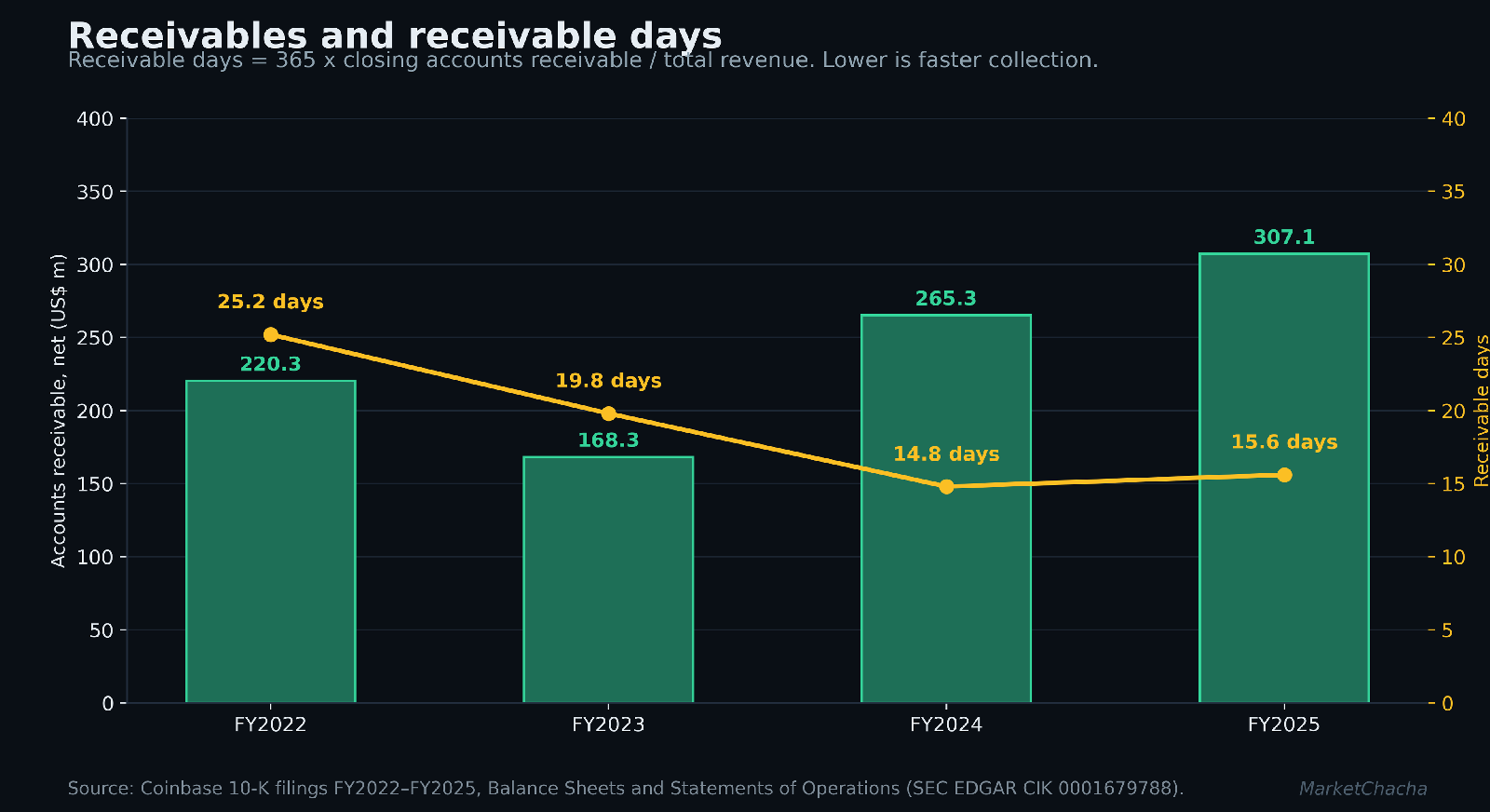
| Receivable days | 25.2 → 19.8 → 14.8 → 15.6 days (FY2022–FY2025). Receivables $307.1m on $7,181.3m revenue. | 10-K balance sheets and income statements | Falling, then flat. An exchange settles most trades near-instantly; there is no ballooning-receivable pattern here. |
| Related-party transactions | Revenue $9.6m = 0.13% of revenue. Named arrangements: Shopify (director is CEO); ResearchCoin (~$201,273 revenue; CEO is co-founder). | 10-K Note 22; DEF 14A 2026 | Immaterial in size and disclosed with counterparties named. Audit committee approval process described in the proxy. |
| Insider net selling (12 months) | 1,301,164 shares sold for ~$324.1m across 255 transactions; zero open-market purchases. | Forms 4 filed Sep 2025–Sep 2026 | Most US insider sales run through pre-scheduled Rule 10b5-1 plans and reflect diversification, not a view. No purchases in a falling market is still a fact worth knowing. |
| Auditor | Deloitte & Touche LLP since 2020. Unqualified opinion. No Item 4.01 8-K. Emphasis paragraph on a change in accounting principle (stablecoins as cash equivalents). | 10-K audit report; EDGAR 8-K index | No resignation, no qualification. The accounting change was elected and disclosed, and applied retrospectively. |
| Subsidiaries and jurisdictions | 12 named: 7 US, 3 Ireland, 1 Luxembourg, 1 UK. Total count not disclosed. | 10-K Exhibit 21.1 | An EU-licensed structure is standard for serving European customers. Omission of non-significant subsidiaries is permitted by Regulation S-K. |
| Dilution | Shares +5.6% in FY2025 despite a $790.2m buyback. SBC $839.4m = 11.7% of revenue. $3,573.1m of stock issued for Deribit. | 10-K balance sheet, cash-flow statement, Note 3 | Paying for acquisitions in stock is normal and preserves cash; the cost falls on existing holders through the share count. |
| Other income as % of PBT | $700.9m of $1,522.1m = 46.0% of FY2025 pre-tax profit came from "other income, net." | 10-K income statement | Much of it is fair-value movement on the Circle stake and other investments — real gains, but not from operating the exchange, and they reverse. |
| Capex vs depreciation | D&A $188.4m; software and equipment, net rose $200.1m → $264.6m. Gross capex not separately presented in FY2025. | 10-K cash-flow statement | An asset-light business with no factories; the line falls below the disclosure threshold. We do not estimate it. |
| Off-balance-sheet customer assets | $376.1bn at 31 Dec 2025; $245.9bn at 30 Jun 2026. Not recognised as assets or liabilities. 12.7× and 9.3× respectively the total assets that are recognised. | 10-K Note 21; 10-Q Note 15 | Correct accounting: the customer owns the asset, Coinbase holds the keys. The filing says the risk of loss is remote and no contingent liability was recognised. The exposure is operational, not balance-sheet. |
Valuation, for reference only. At the 14 September 2026 close of $191.45 and 263.4m shares (31 March 2026), market capitalisation is approximately $50.4bn. Against FY2025 net income of $1,260.3m that is 40.0×; against shareholders' equity of $13,080m at 30 June 2026 it is 3.86× book. A trailing-twelve-month P/E is not meaningful: the last four reported quarters sum to a net loss of about $988m. For a named listed peer, Robinhood Markets (HOOD) earned $1,883m in FY2025 against a market capitalisation of roughly $101bn on 14 September 2026 — about 53.7× on the same basis. (Market-capitalisation figures are from market data providers, not filings.) Goodwill and intangibles of $5,458m are 41.7% of shareholders' equity.
What we could not verify
- Gross capital expenditure for FY2025 and FY2024 — not presented as a separate cash-flow line, so free cash flow cannot be computed from the filing.
- Interest income earned on corporate cash — not disclosed separately; it is inside "other income, net."
- The full subsidiary list and total count — Exhibit 21.1 names only significant subsidiaries, as permitted.
- The stated reason for the Delaware-to-Texas reincorporation — the 10-K records the fact, not the rationale. The Information Statement filed 24 November 2025 is the place to look.
- The renewal terms of the Circle Agreement — the 10-K discloses an initial three-year term from August 2023 but not the economics on renewal.
- Named suppliers and data-centre providers — discussed as a risk category, never named.
- Four of 90 insider Form 4 filings in the 12-month window did not parse; the insider totals quoted are therefore a floor, not a ceiling.
- Institutional ownership beyond 5% — 13F holdings below the Schedule 13G threshold are not captured here.
What would change the picture
- The Q3 FY2026 10-Q. A fourth consecutive net loss, or a return to profit, and specifically whether operating income turns positive — that line is the one that strips out crypto revaluation.
- Stablecoin revenue and the Circle Agreement. The initial three-year term from August 2023 has now run. Watch for disclosure of renewal, and watch the line against US policy rates: $143.2m of revenue per 150bp, on the company's own 2025 sensitivity.
- The Deribit goodwill. $2,818.8m of goodwill was booked in August 2025 when crypto derivative volumes were higher. Any impairment test outcome will appear in the FY2026 10-K.
- Insider Form 4s. Whether the twelve-month pattern of sales without a single open-market purchase changes.
- The next proxy. Whether Mr Armstrong's voting power stays near 50%, and whether any Class B conversion trigger comes into view.
- The remaining state staking actions and the Underwood discovery schedule.
- Data Theft Incident costs. $345.2m was booked in FY2025; whether further losses, claims or regulatory action follow.
Sources
- Coinbase Global, Inc. — Form 10-K for FY2025, filed 12 February 2026 (CIK 0001679788).
- Exhibit 21.1 — Subsidiaries of Coinbase Global, Inc. (FY2025 10-K).
- Form 10-Q for the quarter ended 30 June 2026, filed 30 July 2026.
- Form 10-Q for the quarter ended 31 March 2026, filed 7 May 2026.
- Definitive Proxy Statement (DEF 14A), filed 24 April 2026.
- Q4 2025 Shareholder Letter (Form 8-K exhibit, 12 February 2026).
- Form 8-K, Item 1.05 — Material Cybersecurity Incident, filed 15 May 2025.
- Form 8-K, Item 2.05 — restructuring, filed 5 May 2026.
- Form 8-K — resignation of Chief Legal Officer, filed 9 July 2026.
- Form 8-K — resignation of Chief People Officer, filed 23 July 2026.
- Form 8-K — appointment of director, filed 2 September 2026.
- Form 8-K — director not standing for re-election, filed 10 April 2026.
- Schedule 13G — Vanguard Capital Management LLC, filed 29 April 2026.
- Schedule 13G/A — Susquehanna entities, filed 15 May 2026.
- SEC XBRL company facts — Coinbase Global, Inc. (five-year financial series).
- Forms 4 — Coinbase insider transactions, September 2025 to September 2026.
- SEC XBRL — Robinhood Markets, Inc. net income (peer comparison).
- Share price reference — COIN and HOOD, 14 September 2026 (market data, not a filing).
FAQ
Is Coinbase profitable? It reported net income of $1,260.3m in FY2025. It then reported net losses in each of the next three quarters: $(666.8)m in Q4 2025, $(394.1)m in Q1 2026 and $(359.5)m in Q2 2026. Its operating result was also negative in Q1 and Q2 2026.
Why do Coinbase's profits swing so violently? Because the company holds crypto assets and equity stakes on its own balance sheet and marks them to fair value through the income statement. In Q2 2025 that produced $1,506.9m of non-operating income (largely the Circle stake after Circle's IPO) on top of an operating loss. In Q1 and Q2 2026 the same mechanism produced $691.9m of combined revaluation losses.
What is the $376 billion figure? That is the fair value of customer crypto assets and payment stablecoins for which Coinbase held full keys at 31 December 2025 (down to $245.9bn at 30 June 2026). These belong to customers and are not recognised on the balance sheet, with a matching unrecognised obligation. Coinbase's own recognised total assets were $29.7bn.
Who controls Coinbase? Brian Armstrong, Chairman and CEO, held 49.6% of total voting power as of 31 March 2026; all directors and executive officers together held 60.4%. Class B shares carry twenty votes each. BlackRock, the largest disclosed institutional holder of Class A, holds 1.4% of the votes.
Where is Coinbase incorporated and headquartered? It reincorporated from Delaware to Texas on 15 December 2025. It has no headquarters at all — the 10-K states it is remote-first and maintains no headquarters, listing a New York address solely to satisfy an SEC requirement.
Has Coinbase ever been sued by the SEC? Yes. SEC v. Coinbase, Inc. et al. was dismissed with prejudice by joint stipulation on 28 February 2025 and the 10-K states the case is concluded. Separate state-level actions over staking services remain partly open, and several states withdrew their actions in March–April 2025.
Independent research for education and discussion only. Not investment advice, not a recommendation, and not a rating — we issue no buy/sell calls and no target prices. Every figure is sourced from the primary documents linked above; figures can be restated and we can make mistakes, so always verify against the original. Nothing here alleges wrongdoing by any company or individual: where a fact raises a question we state the fact, cite it, and give the benign explanation alongside. Offshore holding structures, pledging and preferential allotments are all legal and common — they are disclosed here as facts, not as accusations.
This article is for educational and informational purposes only. It is not financial advice, investment recommendation, or a solicitation to buy or sell securities. Investing involves significant risks. I am not a SEBI-registered investment advisor. Readers should consult their own financial advisor and conduct their own research before making any investment decisions.
Comments
Join the conversation
Sign in to join the conversation.
Follow replies, add your view, and take part in the discussion.
Sign in to commentLoading comments...