

Why is crude knocking on $100? The rally is a war premium, not a demand story
What happened
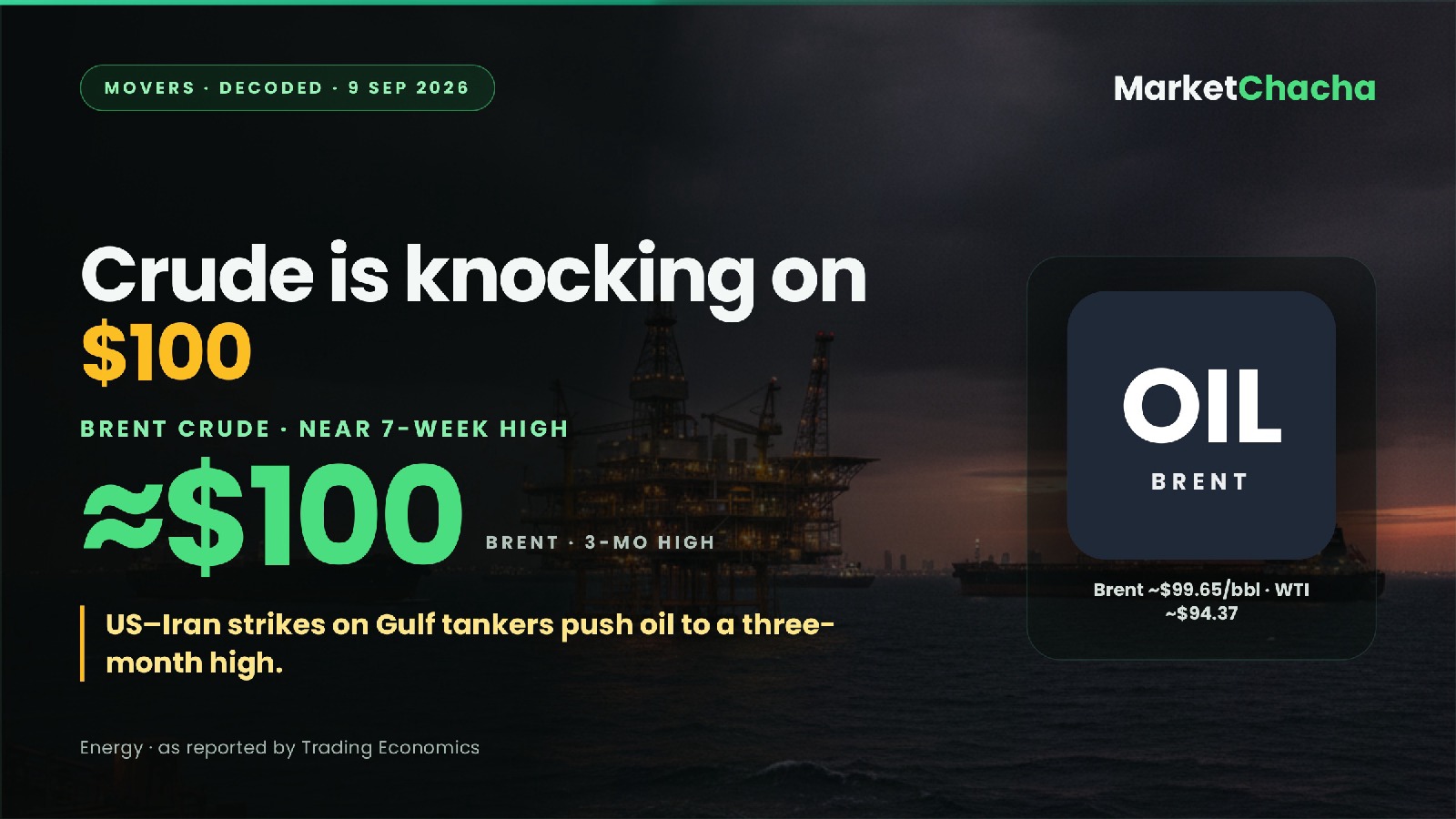
Brent crude pushed to the edge of $100 on Wednesday — trading around $99.65 a barrel, up about 1.8% on the day and its highest in nearly seven weeks, as reported by Trading Economics. US benchmark WTI sat at $94.37, up ~1.4% and its highest since June 3 — a three-month peak. The single-day tick is modest; the real story is the grind. Crude is now up roughly 15% in a month and about 48% over the past year (Trading Economics), and it got there for one reason: a shooting war is now being fought on the tankers themselves.
Why it moved
This isn't a demand story or an OPEC story. It's a supply-fear story, and the fear is specific. Over recent days the US military said it destroyed five Iranian tankers near Kharg Island — the terminal that loads roughly 90% of Iran's crude exports. Iran said it hit two American vessels and eight oil tankers in the Gulf, fired ballistic missiles toward Jordan, and told tanker crews near Kuwaiti and Bahraini ports to abandon their ships (Trading Economics news stream, Reuters). Separately, Iran-backed Houthi forces struck the 400,000-barrels-a-day Jazan refinery in southern Saudi Arabia.
Here's the mechanism a regular investor should hold onto: oil's price isn't really about barrels pumped today — it's about the risk that barrels can't reach a ship tomorrow. Around a fifth of the world's oil moves through the Strait of Hormuz. When missiles start landing near that lane, traders pay up front for insurance against a closure that may never come. That premium is the rally.
Who it touches
India is on the wrong side of this one. It imports the vast majority of the crude it burns, and oil is its single biggest import bill — so a sustained move toward $100 lands straight on the economy:
- Oil marketing companies (BPCL, HPCL, IOC) get squeezed — they buy crude at world prices but can't freely raise pump prices, so marketing margins thin.
- Upstream producers (ONGC, Oil India) are the natural winners — they sell the crude they pump at higher realisations.
- Airlines (IndiGo), paints (Asian Paints), tyres and other crude-derivative users watch input costs climb.
- The rupee and inflation: a costlier import bill widens the current-account gap and pressures the rupee, which was near ₹95/$ today (Trading Economics). India's Sensex actually fell ~0.5% as oil rose.
What to watch
Two levels and one lane. First, whether Brent decisively clears $100 — a round number that tends to draw headlines and momentum money. Second, any sign the Strait of Hormuz is genuinely disrupted rather than just threatened; an actual closure is the scenario that would send this sharply higher. The one thing that flips it the other way: a ceasefire or credible de-escalation, at which point the war premium can drain as fast as it built. Note too that OPEC+ holds real spare capacity — the market is pricing transit risk, not a shortage of oil in the ground.
As of 2:30 PM IST, 9 Sep 2026. Sources: Trading Economics — Brent, Trading Economics — WTI. For discussion and education only — not investment advice. Verify before acting.
This article is for educational and informational purposes only. It is not financial advice, investment recommendation, or a solicitation to buy or sell securities. Investing involves significant risks. I am not a SEBI-registered investment advisor. Readers should consult their own financial advisor and conduct their own research before making any investment decisions.
Comments
Join the conversation
Sign in to join the conversation.
Follow replies, add your view, and take part in the discussion.
Sign in to commentLoading comments...