

Adani Energy Solutions: what their latest filing actually means
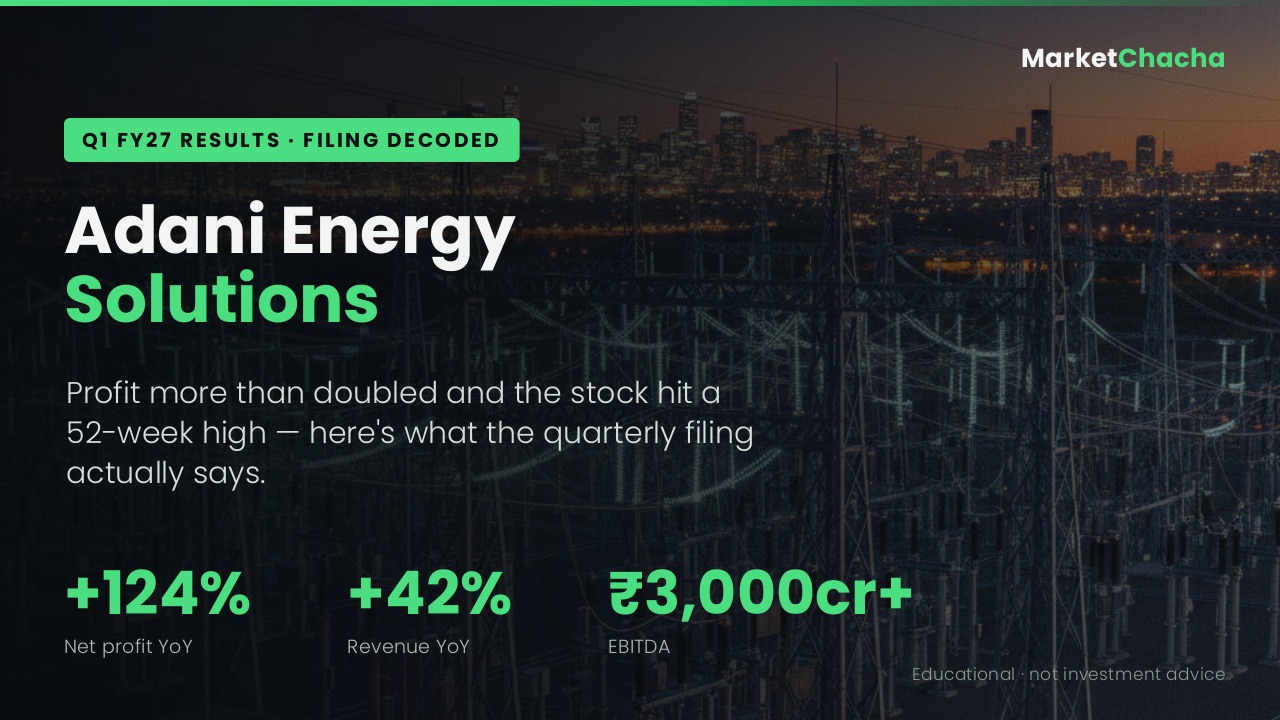
Adani Energy Solutions filed its Q1 FY27 results (quarter ended 30 June 2026) with the exchanges, and they were strong: net profit attributable to shareholders more than doubled and revenue jumped over 40%. The stock reacted by touching a 52-week high. Here's what the filing actually says and what each part means.
What was announced
For the April–June 2026 quarter, on a consolidated basis:
- Net profit (attributable to shareholders) of about ₹1,149 crore, up ~124% year-on-year from ~₹512 crore a year ago. Total consolidated profit (including minority stakes) was around ₹1,237 crore.
- Revenue from operations of about ₹9,711 crore, up ~42% year-on-year from ~₹6,819 crore.
- EBITDA (operating profit before interest, tax and depreciation) crossed ₹3,000 crore.
- The company also flagged a proposed acquisition of IntelliSmart, a step to scale up its smart-metering business.
The company released this both as a formal results filing and an investor presentation — the presentation is management's own slide deck explaining the numbers.
What a "quarterly results" filing actually means
Every listed Indian company must report its financial performance to the stock exchanges four times a year. This "Q1" filing covers the first quarter of the financial year (April to June). It is the single most important scheduled disclosure a company makes, because it shows — with real audited or limited-reviewed numbers — whether the business is actually growing, and how profitably.
Three terms worth knowing: Revenue is total sales. EBITDA is the profit from core operations before financing and accounting charges — useful for a capital-heavy utility because it strips out the large interest and depreciation costs. Net profit attributable to shareholders is what's left for the company's own owners after everything, including the slice that belongs to minority partners in subsidiaries.
Why it matters
A profit that doubles on 42% higher revenue tells you the growth is broad-based, not a one-off. For a regulated utility, revenue growth usually comes from commissioning new transmission lines, distributing more power, and adding new revenue streams like smart metering — all of which are visible here. Crossing ₹3,000 crore of EBITDA also signals the operating engine is scaling.
The honest caveats: a utility of this size carries substantial debt to fund its assets, so interest costs and the pace of new project execution matter as much as the headline profit. One strong quarter does not, by itself, change the long-run picture — it's one data point in a trend. And a proposed acquisition (IntelliSmart) is a plan, not a completed deal, so its benefits are still ahead.
Is it expensive?
As reported by data providers around the filing, Adani Energy Solutions had a market capitalisation of roughly ₹2.08 lakh crore and traded on a trailing P/E of roughly 70–90x (the exact number varies by source and method), with a price-to-book (P/B) of about 8x. On plain valuation terms, that is a rich, high-growth-priced multiple, not a cheap one.
Compare that with its closest large listed peer, Power Grid Corporation of India — the state-owned transmission giant — which is actually larger (market cap ~₹2.65 lakh crore) yet trades on a P/E of only about 16–17x. In other words, the market is paying a big premium for Adani Energy Solutions because it expects faster growth (private transmission wins, Mumbai distribution, smart metering), whereas Power Grid is valued as a steadier, slower, regulated-return business. Neither multiple is a "buy" or "sell" signal by itself — a high P/E simply means a lot of future growth is already built into the price, which raises the bar the company has to keep clearing.
The business
Adani Energy Solutions (formerly Adani Transmission), part of the Adani group, runs three main businesses, so this result reflects the whole company, not one small slice:
- Transmission — India's largest private-sector power-transmission network, moving high-voltage electricity across states.
- Distribution — Adani Electricity Mumbai, which supplies power directly to homes and businesses in Mumbai.
- Smart metering — installing smart electricity meters for utilities, a newer growth arm that the proposed IntelliSmart deal is meant to expand.
Beginner takeaway
Adani Energy Solutions had a genuinely strong quarter — profit up ~124% and revenue up ~42% — and the market rewarded it with a 52-week high. But the stock already trades at a premium valuation (P/E far above peer Power Grid), which means expectations are high and future quarters have to keep delivering. Read the trend across several quarters, not just this one number.
FAQ
What is Q1 FY27? It's the first quarter (April–June 2026) of the financial year running April 2026 to March 2027. Indian companies report results four times a year.
Profit was quoted as both ₹1,149 crore and ₹1,237 crore — which is right? Both. About ₹1,237 crore is total consolidated profit; ~₹1,149 crore is the part that belongs to the company's own shareholders after removing minority partners' shares. The shareholder figure is the one most commonly headlined.
Why is the P/E so much higher than Power Grid's? Investors expect Adani Energy Solutions to grow faster, so they pay more per rupee of current earnings. A high P/E is a bet on future growth, not proof the stock is good or bad value.
Does a 52-week high mean I should buy? No — a 52-week high just describes where the price has been, not where it's going. This post is educational and does not make any recommendation.
As of 22 July 2026. The results were filed with BSE/NSE on 21 July 2026. Source: official BSE filing — read it directly here. We summarise filings for education and may make errors, so always verify against the official document. Educational content only — not investment advice, not a buy/sell recommendation.
This article is for educational and informational purposes only. It is not financial advice, investment recommendation, or a solicitation to buy or sell securities. Investing involves significant risks. I am not a SEBI-registered investment advisor. Readers should consult their own financial advisor and conduct their own research before making any investment decisions.
Comments
Join the conversation
Sign in to join the conversation.
Follow replies, add your view, and take part in the discussion.
Sign in to commentLoading comments...