

Salesforce Q2 FY27 results: what the numbers say
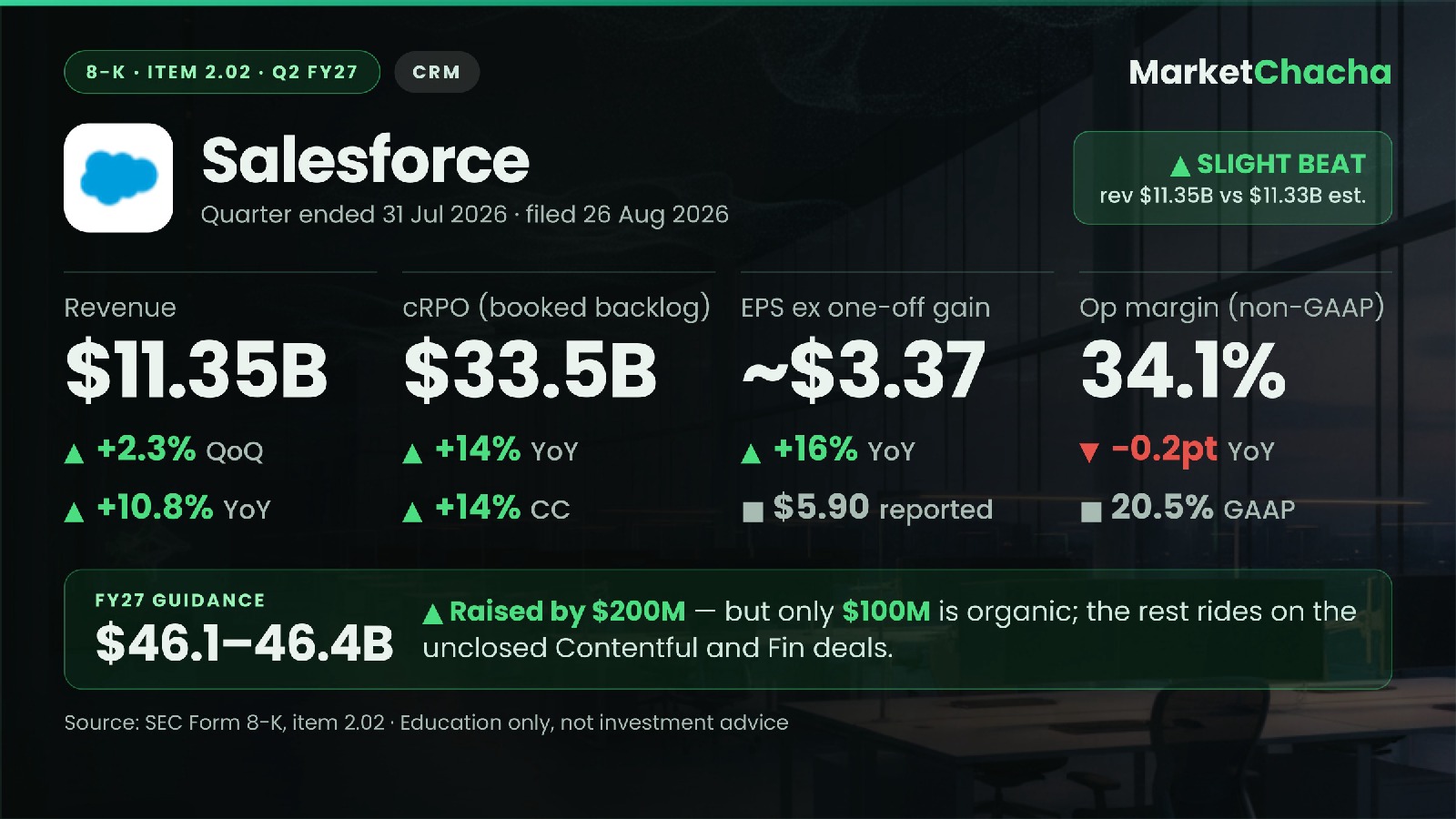
Salesforce filed an 8-K after the closing bell on 26 August 2026 announcing its second-quarter fiscal 2027 results (the three months ended 31 July 2026). Revenue was $11.35bn, up 11% year on year, and the company raised its full-year revenue guidance by $200m — but the headline earnings per share number is flattered by a $2.6bn paper gain on its venture portfolio, so it needs unpacking before it means anything.
The numbers
- Revenue: $11.345bn, up 10.8% from $10.236bn a year ago (11% in constant currency). Analysts were looking for roughly $11.33bn, so a slight beat. Subscription & support revenue was $10.82bn, up 12%. Around $456m of total revenue came from the newly acquired Informatica.
- EPS as reported: GAAP diluted EPS $4.29 (up 119%); non-GAAP diluted EPS $5.90 (up 103%). Consensus was about $3.27 on an adjusted basis.
- The catch: the filing states that gains on strategic investments added $2.43 to GAAP EPS and $2.53 to non-GAAP EPS this quarter, versus $0.00 a year ago. Strip that out and adjusted EPS is roughly $3.37 — a modest beat, not a doubling.
- The metric the market actually watches: current remaining performance obligation (cRPO) of $33.5bn, up 14% year on year and in constant currency — an acceleration from 13% last quarter and 10% a year ago.
- AI line items: Agentforce and Data 360 annual recurring revenue reached nearly $3.9bn, up over 210%; Agentforce ARR alone passed $1.5bn, up over 240% (the definition was widened this quarter to include Slackbot and Headless 360).
- Margins: GAAP operating margin 20.5% (down from 22.8%); non-GAAP operating margin 34.1% (down from 34.3%). Interest expense jumped to $473m from $67m a year ago, reflecting borrowing tied to acquisitions and the buyback.
- Guidance: FY27 revenue raised to $46.1bn–$46.4bn (+11–12%). The company says the $200m raise is $100m organic, $200m from the pending Contentful and Fin acquisitions, less a $100m currency headwind. Q3 guidance: revenue $11.42bn–$11.50bn and non-GAAP EPS $3.42–$3.44.
What was filed: the 8-K item 2.02
An 8-K is the "something happened" form. Unlike the 10-Q and 10-K, which arrive on a fixed calendar, an 8-K is filed within four business days of a specific triggering event. Each 8-K is tagged with numbered items that tell you what kind of event it was.
Item 2.02 — Results of Operations and Financial Condition is the one companies use to release quarterly results. In practice the 8-K itself is a short cover page; the actual numbers live in an attached exhibit (usually EX-99.1, the press release), which is why the filing also carries Item 9.01 — Financial Statements and Exhibits. Two things worth knowing:
- The item 2.02 press release is furnished, not filed — a legal distinction that gives it slightly lighter liability treatment than the audited statements in the 10-Q that follows weeks later.
- Because it is a press release rather than a full financial statement, it is where non-GAAP measures live. US rules require any non-GAAP number to be reconciled to the nearest GAAP number in the same document — which is exactly where the strategic-investment footnote above came from.
Why it matters
The paper gain is the biggest reading trap here. Salesforce holds a portfolio of stakes in private companies, carried at fair value. When those marks go up, the increase flows straight through the income statement as a gain even though no cash changed hands and nothing was sold. The portfolio grew to $11.3bn from $7.6bn a year earlier. Unusually, this gain sits inside the non-GAAP EPS as well as the GAAP figure, so an investor comparing $5.90 to a $3.27 estimate would conclude something wildly different from what the operating business actually did. Those marks can reverse in a future quarter just as easily.
Underneath it, the operating story is about backlog and AI attach. cRPO — contracted revenue expected to be recognised in the next 12 months — is the cleanest read on demand for a subscription business, because it reflects deals already signed rather than revenue already collected. Accelerating from 10% to 14% growth over four quarters suggests bookings are improving, not just prior contracts unwinding. The Agentforce ARR figures grow from a small base and had their definition widened this quarter, so treat the percentage as directional rather than precise.
Watch the composition of the guidance raise and the share count. Of the $200m increase, only $100m is described as organic; the rest comes from acquisitions that have not closed yet, and the guidance is explicitly conditional on them closing. Separately, diluted shares fell to 821m from 962m a year ago on the back of a $25bn accelerated share repurchase — roughly 15% fewer shares means EPS rises even if profit is flat. Rising interest expense and falling GAAP margin are the other side of that ledger: buybacks and acquisitions funded with debt are not free.
Beginner takeaway
When a company reports a headline EPS that looks unbelievably good, the first thing to check is what sits between operating profit and net income. Here, a single non-cash investment mark accounts for more than half the reported earnings per share, and the company tells you so in a footnote. The durable signals in this filing are the revenue growth rate, the cRPO acceleration, and the margin trend — all of which are solid but nothing like "up 103%".
FAQ
What does "cRPO" actually mean? Current remaining performance obligation is the value of contracts already signed that the company expects to turn into revenue over the next 12 months. It is a forward-looking demand indicator, which is why software investors often watch it more closely than reported revenue.
Why does a gain on investments count as earnings if nothing was sold? Accounting rules require equity stakes to be carried at fair value, with changes running through the income statement each period. It is a real change in the value of an asset, but it is unrealised — no cash arrived, and the mark can go down next quarter.
Isn't non-GAAP EPS supposed to strip out one-offs like that? Usually, yes — but non-GAAP is defined by each company, not by regulators. In this quarter's reconciliation the add-backs are amortisation, stock-based compensation, restructuring and tax effects; the investment gain is not removed, which the company discloses in a footnote.
Where can I check any of this myself? Open the 8-K on EDGAR and click through to exhibit 99.1. The income statement and the GAAP-to-non-GAAP reconciliation tables are near the end of that document.
As of 26 August 2026. Source: official SEC filing — read it directly here. We summarise filings for education and may make errors, so always verify against the official document. Educational content only — not investment advice, not a buy/sell recommendation.
This article is for educational and informational purposes only. It is not financial advice, investment recommendation, or a solicitation to buy or sell securities. Investing involves significant risks. I am not a SEBI-registered investment advisor. Readers should consult their own financial advisor and conduct their own research before making any investment decisions.
Comments
Join the conversation
Sign in to join the conversation.
Follow replies, add your view, and take part in the discussion.
Sign in to commentLoading comments...