

Why did Intermex (IMXI) jump ~25% today? New York cleared its Western Union buyout
What happened
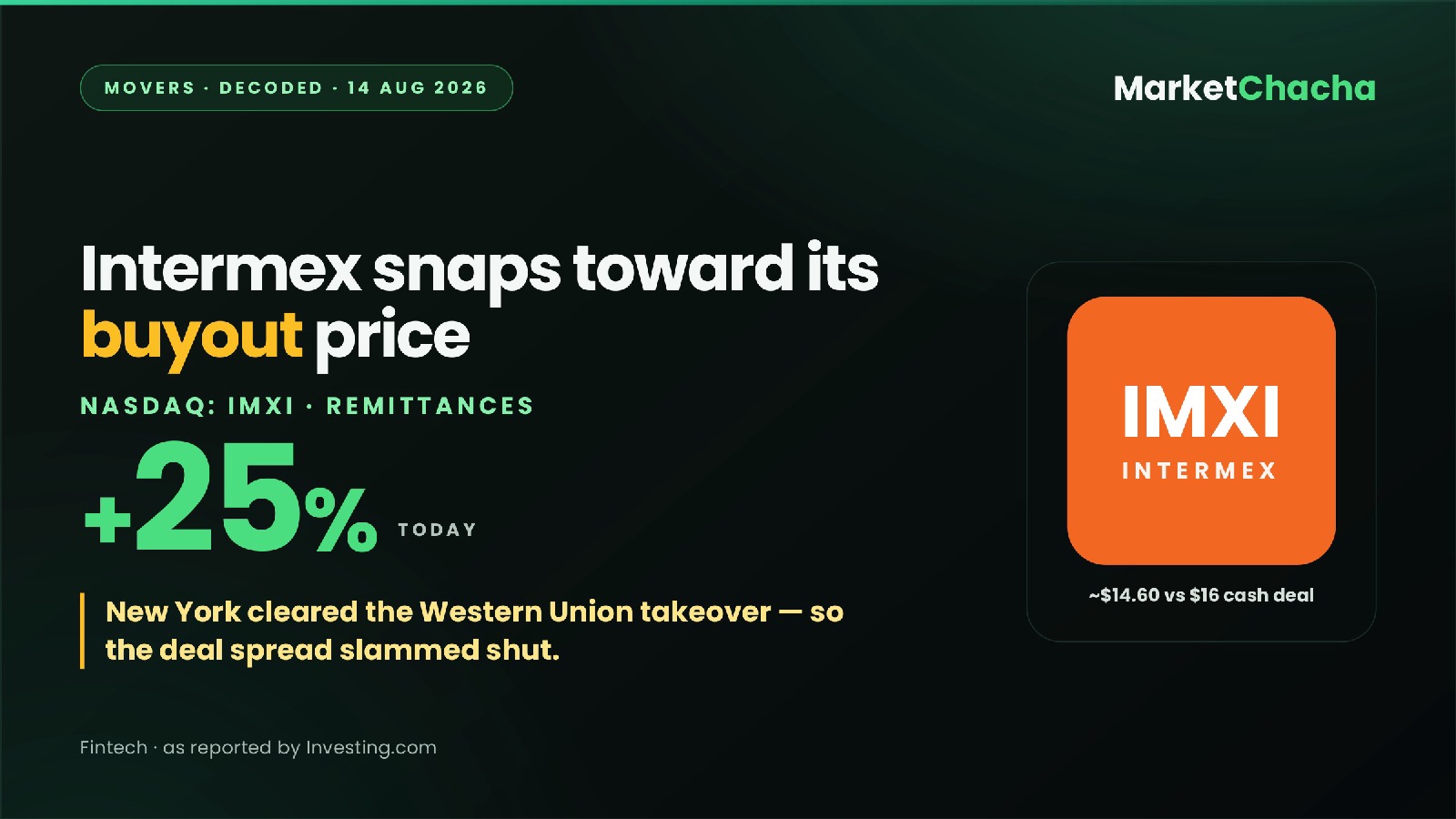
International Money Express (NASDAQ: IMXI) — the money-transfer firm that operates as Intermex — jumped about 25% to roughly $14.60 (as reported by Investing.com), one of the day's standout gainers; Seeking Alpha clocked it up as much as ~35% intraday. The trigger wasn't earnings or a new contract. It was a single regulator saying "yes."
Why it moved
Intermex is being bought. Western Union agreed back in August 2025 to acquire it for $16.00 a share in cash — a deal worth roughly $500 million. When a company is being taken over for cash at a fixed price, its shares should drift up toward that price as the deal nears the finish line. But IMXI had been stuck well below $16 because the takeover kept snagging on regulators. On August 14, New York's financial regulator (the NYDFS) approved the deal, clearing a major hurdle — so the stock snapped upward toward the payout.
This is a textbook case of merger arbitrage. The gap between the market price and the agreed $16 buyout is simply the market's live bet on whether the deal actually closes: good news shrinks the gap, bad news widens it. And there's a real twist here — just one day earlier, on August 13, California's regulator (the DFPI) suspended its own approval, saying it wanted more time to review the deal's impact in the state. So even after New York's green light, IMXI at ~$14.60 still sits about $1.40 (~9%) below the $16 price — that leftover gap is the market pricing the California risk and the remaining closing conditions. Both companies say they'll work with California to get reinstated and close promptly. Intermex shareholders, for their part, already approved the merger (21.2 million votes for, about 5,500 against).
The business
Intermex moves money for people sending remittances from the US to Latin America — heavily Mexico and Guatemala — through a large network of retail agent locations (think corner stores and check-cashing counters) plus a growing app and online channel. It's a cash-heavy, agent-based model with a loyal customer base — exactly the kind of established franchise Western Union wants to fold into its own network.
Is it expensive?
On fundamentals, Intermex is cheap: it traded around an 8.7x price-to-earnings (P/E) multiple (per multiples.vc), a low number that reflects fears that slick app-based rivals are steadily eating the old cash-remittance business. For comparison, digital-native Remitly (RELY) trades near 44x trailing earnings at a ~$4.5 billion market cap, while Western Union (WU) itself sits around 6x. But here's the crucial point: once a cash buyout is signed, a stock stops trading on its P/E and starts trading on deal-completion odds. The $16 price is the anchor now, not the earnings multiple — "cheap versus Remitly" is why Western Union wanted it, but it no longer drives the day-to-day price.
Who it touches
- Merger-arbitrage funds: the natural holders here, pocketing the spread to $16 as each regulatory box gets ticked.
- Western Union (WU): the buyer — ~$500 million to deepen its US-to-Latin-America remittance footprint.
- Remitly (RELY): the digital rival whose growth is the exact reason legacy cash-remittance names trade cheaply.
What to watch
One thing flips this: California. If the DFPI reinstates its approval, the remaining gap to $16 should close and holders get paid. If California digs in — or blocks the deal — the spread widens and the stock slides back toward where it languished. The deal, not the business, is the whole story now.
As of early trading Friday, August 14, 2026 (ET). Figures as reported by: Investing.com, Seeking Alpha, StockTitan. For discussion and education only — not investment advice. Verify before acting.
This article is for educational and informational purposes only. It is not financial advice, investment recommendation, or a solicitation to buy or sell securities. Investing involves significant risks. I am not a SEBI-registered investment advisor. Readers should consult their own financial advisor and conduct their own research before making any investment decisions.
Comments
Join the conversation
Sign in to join the conversation.
Follow replies, add your view, and take part in the discussion.
Sign in to commentLoading comments...