

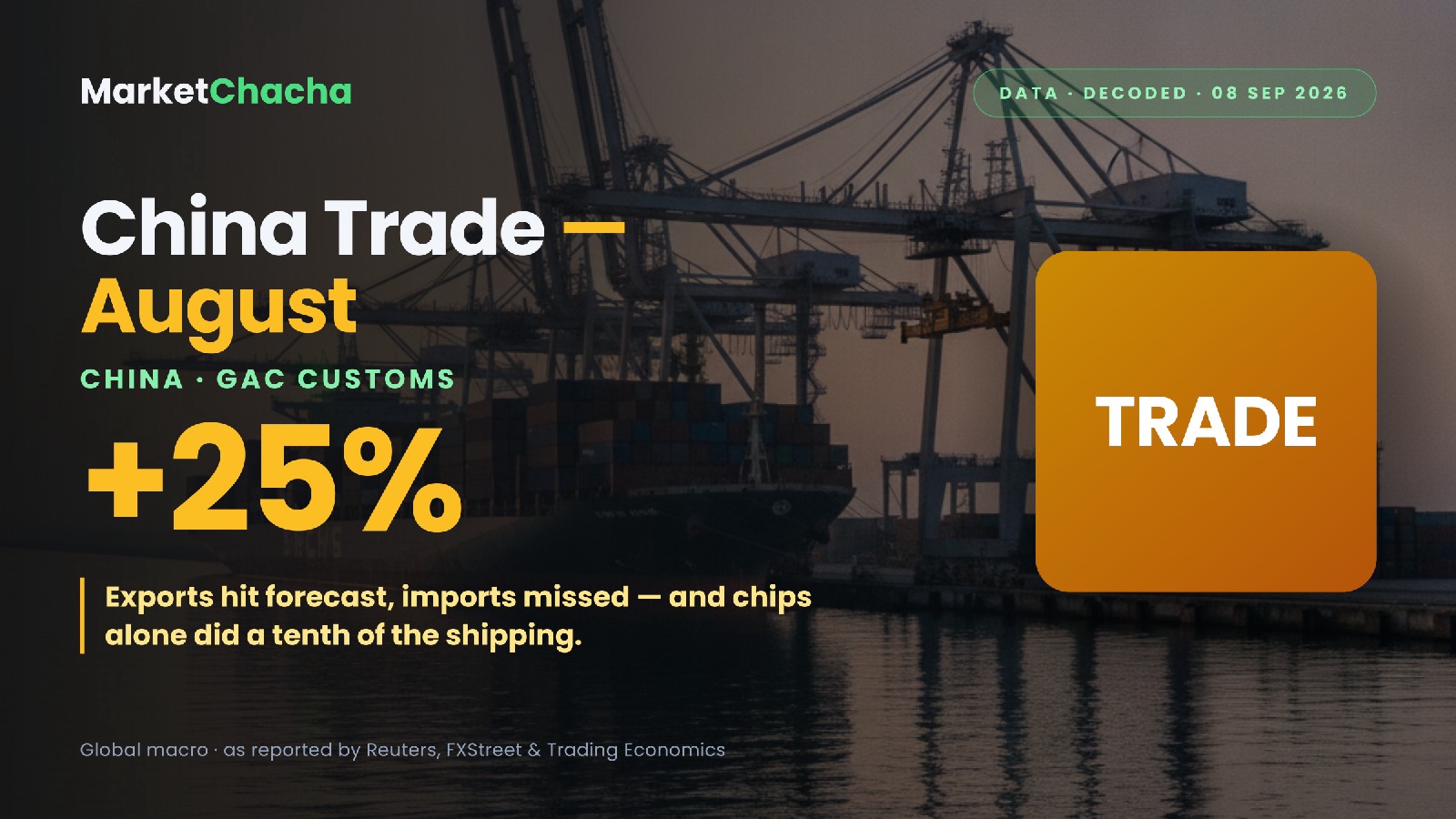
China's exports jumped 25% in August — and $40.7bn of it was just chips
China's customs administration put out its August trade numbers early Tuesday, and the headline did exactly what economists had pencilled in. The interesting part is underneath it.
The numbers
Exports rose 25.0% year-on-year in August, matching the 25% Reuters poll consensus and accelerating from July's 23.9%, as reported by Reuters and FXStreet. In dollars that's $401.44 billion of goods shipped in a single month, per Trading Economics.
Imports rose 28.2% against a 30% forecast — the one line that missed — up from 27.5% in July. The trade surplus widened to $119.09 billion from July's $112.5 billion, essentially bang on the $119.1 billion estimate, per FXStreet.
Two breakdowns matter more than the headline. Exports to the United States rose 34.4% to $42.5 billion, while exports to the European Union grew just 6.6%, per Trading Economics. And semiconductors: China shipped $40.73 billion of integrated circuits in August alone, with January–August IC exports at $256.75 billion, up 103.9% year-on-year, according to customs figures reported by Global Times.
What it means
Do the division. Chips were roughly a tenth of everything China exported in August, and that category has doubled in a year. This isn't the old story of cheap goods leaving Chinese ports — it's memory and logic chips riding the global AI hardware build-out, at prices that have themselves been climbing. Strip the semiconductor line out and the export boom looks a lot more ordinary.
The import miss is the honest caveat. Imports growing 28% sounds like a roaring domestic economy, but a large slice of what China buys is components and equipment it re-exports after assembly. When exports beat and imports lag, it usually means processing trade is doing the heavy lifting rather than Chinese households spending. That's why a record surplus is not automatically a bullish signal about Chinese demand.
And a surplus this size is a political number as much as an economic one. A monthly gap of $119 billion — with shipments to the US up a third — is precisely the statistic that keeps tariff files open in Washington and Brussels. The 6.6% EU figure against 34.4% for the US shows the two blocs are pulling in different directions right now.
Who it touches
- Global AI hardware: the IC export line is a live demand read on chips and AI infrastructure — a useful cross-check on what Korean and Taiwanese exporters have been reporting.
- Indian metals and chemicals: a China exporting hard and importing less than expected is the classic setup for cheap goods looking for a home. Indian steel, chemicals and solar producers watch this line for pricing pressure and dumping risk.
- Commodity exporters: imports still growing 28% keeps the bid under industrial metals and energy — but the miss versus forecast is the first small dent in that story.
- Shipping and logistics: record export volumes mean container demand holds up into the year-end peak season.
- Currency watchers: a widening surplus is structurally supportive for the yuan, which matters for every Asian currency that trades in its shadow — the rupee included.
What to watch
China's August CPI and PPI land on Wednesday, 9 September, with consensus around 0.5% CPI year-on-year. That's the tell. If exports are booming while domestic prices sit near zero, the picture is confirmed: China is selling to the world and not to itself — and the deflation it exports lands on everyone else's producers. A CPI print that surprises upward would be the first real evidence the domestic side is finally waking up.
As of 6:45 PM IST, 8 September 2026. Sources: Reuters, FXStreet, Trading Economics, Global Times. For discussion and education only — not investment advice. Verify before acting.
This article is for educational and informational purposes only. It is not financial advice, investment recommendation, or a solicitation to buy or sell securities. Investing involves significant risks. I am not a SEBI-registered investment advisor. Readers should consult their own financial advisor and conduct their own research before making any investment decisions.
Comments
Join the conversation
Sign in to join the conversation.
Follow replies, add your view, and take part in the discussion.
Sign in to commentLoading comments...