

Premier Energies: what their latest filing actually means
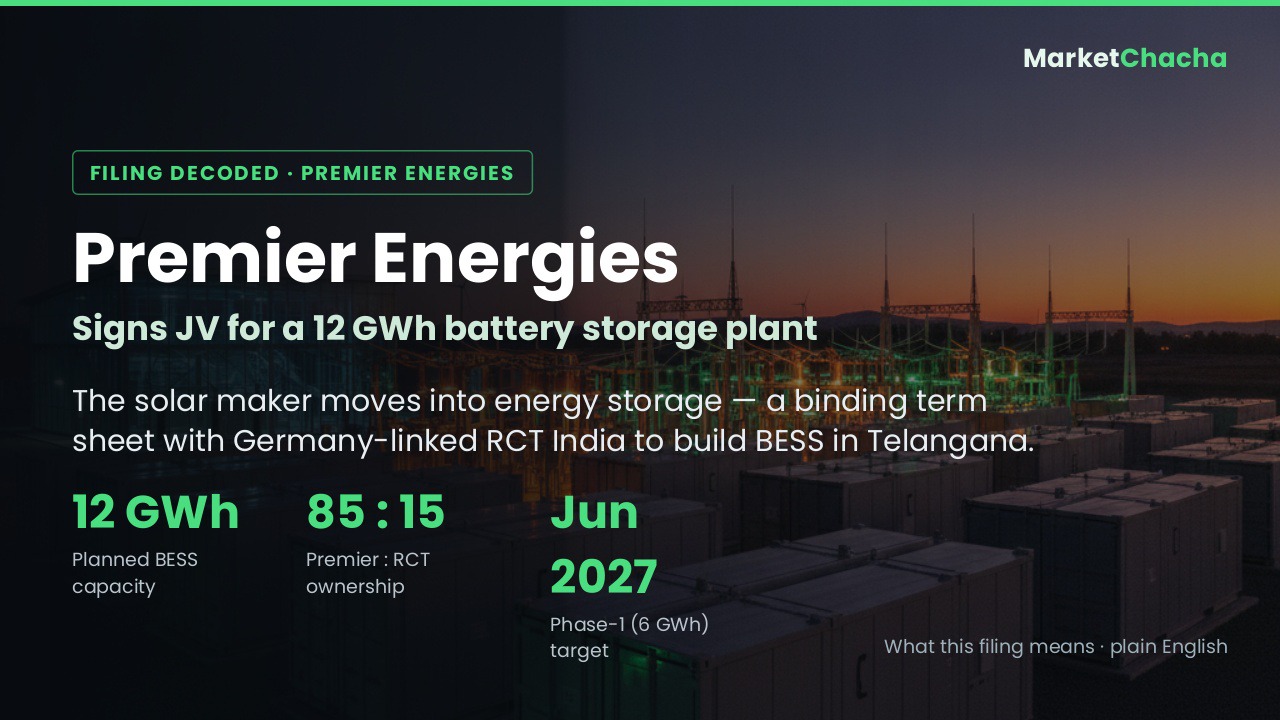
Premier Energies — one of India's largest solar cell and module makers — told the exchanges it has signed a binding term sheet to form a joint venture with RCT India (part of Germany's RCT Solutions Group) to build a 12 GWh battery energy storage system (BESS) manufacturing facility in Telangana. In plain terms: a solar company is stepping into the battery-storage business.
What was announced
The JV will be housed under Premier's subsidiary, Premier Battery Technologies. Proposed ownership starts at 85% Premier Battery Technologies : 15% RCT India, subject to definitive agreements. The plan is a 12 GWh BESS plant, with the first 6 GWh phase targeted to go live by June 2027. RCT brings global energy-sector engineering and supply-chain experience; Premier brings large-scale Indian manufacturing. The output is aimed at commercial, industrial and utility-scale storage demand in India and export markets.
Note the wording: a binding term sheet is a commitment to proceed, but "subject to definitive agreements" means the detailed contracts, final ownership and funding are still to be locked. It is a firm intent, not yet a finished, fully-signed deal.
What this type of filing means
This is a Regulation 30 press-release / material-event disclosure — the rule that forces a listed company to tell all investors, at the same time, about anything that could reasonably move the stock. A JV of this size qualifies. A joint venture means two companies pool money and expertise into a shared entity rather than one buying the other. A BESS (battery energy storage system) is essentially large-scale batteries that store electricity — increasingly needed because solar and wind are intermittent, so the grid needs somewhere to park power for when the sun isn't shining.
Why it matters / potential impact
Premier's core business today is solar cells and modules, a market with heavy competition and shifting margins. Energy storage is the natural adjacent bet — every solar and grid project increasingly pairs with batteries. If executed, this diversifies Premier beyond one product line and plants it in a fast-growing category. The flip side: batteries are a new domain for Premier (technology, chemistry, supply chains it hasn't run before), the plant needs large capital, and demand/pricing for domestically-made BESS is still developing. A term sheet is the start of the journey, not the finish — the real test is on-time, on-budget execution of Phase 1 by mid-2027.
Is it expensive?
As reported around 11 Sep 2026, Premier Energies traded near ₹972, a market cap of roughly ₹43,900 crore, on a trailing P/E of about 296× (52-week range ₹660–₹1,134). That is a very rich multiple — it prices in a lot of future growth and leaves little room for disappointment. For contrast, listed solar peer Waaree Energies is larger (market cap ~₹73,900 crore) yet trades near a P/E of ~19×. Two solar-linked names, wildly different multiples — usually a sign of very different current earnings bases and growth expectations, not that one is simply "10× better." This is context, not a target or a buy/sell call — always check the latest figures on Screener.in, Trendlyne or Moneycontrol yourself.
The business
- Solar cells & modules — Premier's main business; it is among India's largest integrated solar-cell manufacturers, supplying panels and cells for domestic and export projects.
- EPC / solar solutions — engineering and project work around solar.
- New: battery storage (BESS) — the segment this JV creates, via Premier Battery Technologies.
So this filing affects a new, future division — not today's revenue. It's about where Premier is heading, not what it earns right now.
Beginner takeaway
A leading Indian solar maker is expanding into battery storage through a JV with a German-linked partner — a strategic bet on the clean-energy shift. It's a promising direction, but it's an early-stage term sheet in a business Premier hasn't run before, and the stock is already priced very richly. Watch execution of the first 6 GWh phase (targeted June 2027) before assuming the story is proven.
FAQ
What exactly is a BESS? A battery energy storage system — large-scale batteries that store electricity and release it when needed, helping balance a grid that increasingly runs on intermittent solar and wind.
Does this add to Premier's profits now? No. It's a plan for a new facility; the first phase is only targeted for June 2027, and the JV agreements aren't fully signed yet. Any earnings impact is years out, if it lands.
Why does Premier own 85% but partner with RCT for just 15%? Premier is putting in the manufacturing muscle and most of the capital; RCT contributes global engineering and supply-chain know-how. The split reflects who brings what — and it can still change before final agreements.
Is a P/E of ~296 a red flag? It's very high and means the market expects large future growth, so the stock is sensitive to any stumble. It isn't automatically "bad," but it leaves little margin for error. Compare it against peers and the company's own earnings trend before drawing conclusions.
As of 11 September 2026. Filing dated 10 September 2026. Source: official BSE filing — read it directly here. We summarise filings for education and may make errors, so always verify against the official document. Educational content only — not investment advice, not a buy/sell recommendation.
This article is for educational and informational purposes only. It is not financial advice, investment recommendation, or a solicitation to buy or sell securities. Investing involves significant risks. I am not a SEBI-registered investment advisor. Readers should consult their own financial advisor and conduct their own research before making any investment decisions.
Comments
Join the conversation
Sign in to join the conversation.
Follow replies, add your view, and take part in the discussion.
Sign in to commentLoading comments...