

India's biggest stockbrokers by active clients (2026) — and how to actually choose one
India now has over 4.5 crore active demat clients, and a handful of brokers serve most of them. Here's the current pecking order by active NSE clients — and, more usefully, a framework for choosing the right one for you, because the biggest broker is not automatically the best fit.
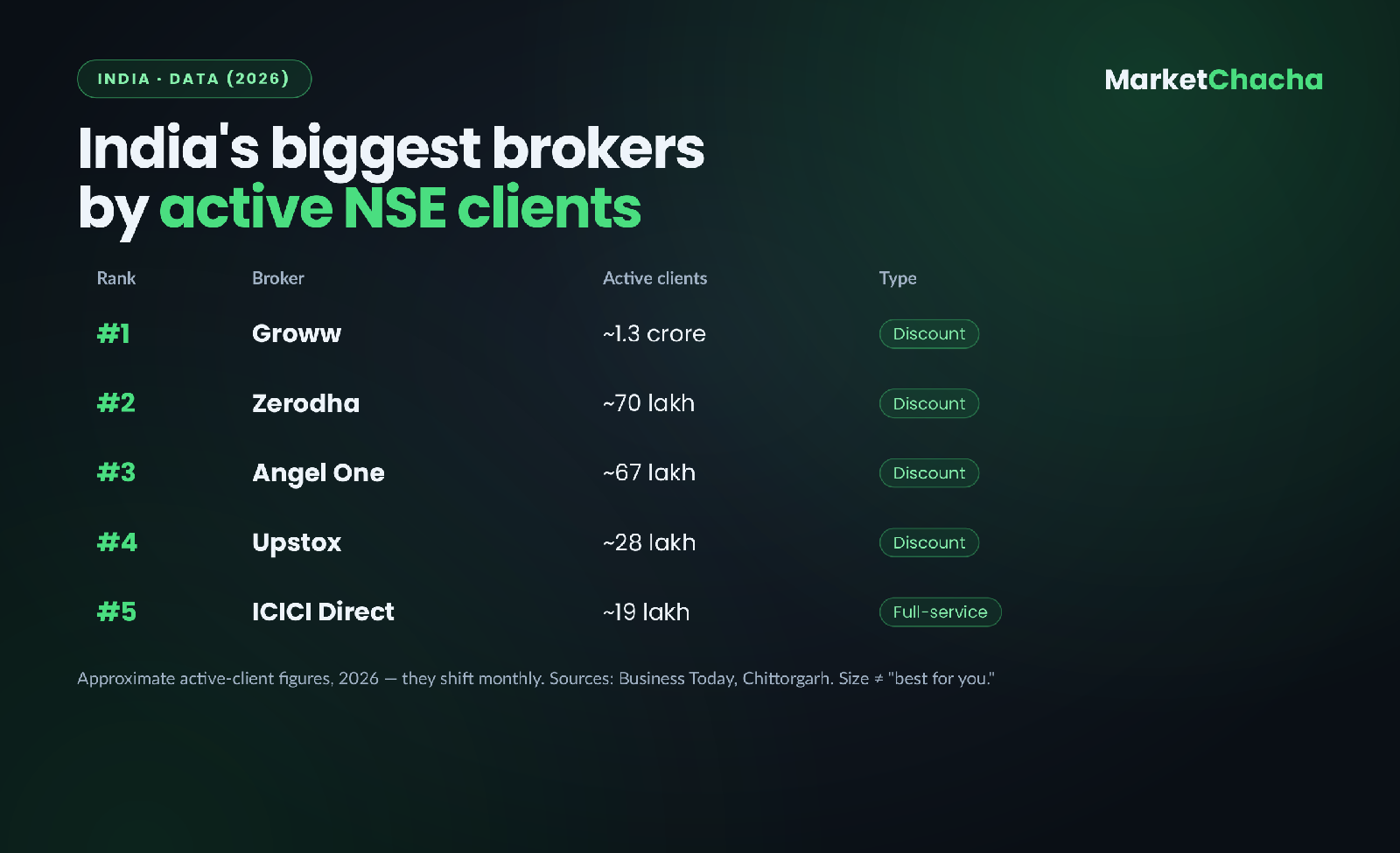
The leaders by active clients (2026)
- #1 Groww — ~1.3 crore active clients. A simple, mobile-first discount broker that won over first-time investors.
- #2 Zerodha — ~70 lakh. The pioneer of discount broking in India; popular with active traders for its Kite platform and low costs.
- #3 Angel One — ~67 lakh. A former full-service house that reinvented itself as a discount broker with strong research add-ons.
- #4 Upstox — ~28 lakh. Tech-focused discount broker with notable backers.
- #5 ICICI Direct — ~19 lakh. A leading full-service broker with integrated 3-in-1 banking, broking and research.
These are approximate active-client figures for 2026 and shift every month; check the latest NSE/Chittorgarh data before relying on exact numbers.
Discount vs full-service — the first real decision
Discount brokers (Groww, Zerodha, Upstox, Angel One) charge little or nothing on delivery trades and a flat fee (often ~₹20) on intraday and F&O. You get a clean app and you make your own decisions. Best for self-directed investors and most beginners.
Full-service brokers (ICICI Direct, HDFC Securities, Kotak, Motilal Oswal) charge more but bundle research, advisory, relationship managers and integrated banking. Best for those who want hand-holding and don't mind paying for it.
How to actually choose — a checklist
- Safety first. Is the broker SEBI-registered and a member of NSE/BSE? Your shares sit in a CDSL/NSDL demat account, not with the broker — but a regulated, reputable broker still matters.
- Total cost, not just headline brokerage. Compare account-opening fees, annual maintenance (AMC), brokerage on the segments you'll actually use, plus DP charges and payment-gateway fees.
- The segments you trade. Delivery-only investor? Almost any discount broker works. Heavy F&O trader? Compare per-order pricing and margin policies carefully.
- Platform stability. A broker whose app freezes during a volatile session can cost you far more than a few rupees of brokerage. Read recent reviews.
- Support quality. When something breaks with your money, how fast and how human is the help?
The honest takeaway
"Biggest" simply means most popular, not best for your situation. A long-term SIP investor and a full-time options trader should rationally pick different brokers. Match the broker to how you invest — costs, segments, safety, and platform reliability — rather than to a leaderboard.
Educational content only — not investment advice, and not a recommendation to buy or sell anything. No guaranteed returns exist in markets. Always do your own research.
This article is for educational and informational purposes only. It is not financial advice, investment recommendation, or a solicitation to buy or sell securities. Investing involves significant risks. I am not a SEBI-registered investment advisor. Readers should consult their own financial advisor and conduct their own research before making any investment decisions.
Comments
Join the conversation
Sign in to join the conversation.
Follow replies, add your view, and take part in the discussion.
Sign in to commentLoading comments...