

What is the 50/30/20 budget rule — and why do most people get it wrong?

The 50/30/20 rule is a simple way to split your take-home pay: send 50% to needs, 30% to wants, and 20% to savings and paying off debt. It was popularised by U.S. Senator (then Harvard bankruptcy professor) Elizabeth Warren and her daughter Amelia Warren Tyagi in their 2005 book All Your Worth: The Ultimate Lifetime Money Plan. The appeal is that you only have to track three buckets instead of forty line items — but that simplicity is exactly why most people quietly get it wrong. This guide walks through what the three buckets really contain, a full worked example with the arithmetic, how to set it up in ten minutes, where the rule breaks down, and how the same idea maps onto an Indian salary.
What the 50/30/20 rule actually is
It is a spending framework, not a savings target you hit once. Every month you divide your income into three jobs. Needs (50%) are the things you genuinely cannot skip without a real-world consequence — a roof, power, food, insurance, transport to work, and the minimum payment on any debt. Wants (30%) are everything that makes life nicer but that you could pause if you had to: eating out, streaming, travel, hobbies, and the upgraded version of a need. Savings and debt payoff (20%) is money that builds your future — an emergency fund, retirement contributions, investing, and any extra you throw at debt beyond the minimum. The percentages are ceilings for the first two buckets and a floor for the third: keep needs at or below 50%, wants at or below 30%, and save at least 20%.
First, get your "after-tax income" right — this is where people slip
The rule runs on after-tax income, not your gross salary. Start with your total pay and subtract only the taxes — income tax plus payroll taxes (in the U.S., Social Security and Medicare). The number you are left with is what the three buckets divide up. Using gross income is the single most common setup error: it inflates all three buckets and quietly hands you a budget you can't actually fund.
There is one nuance worth getting exactly right. The cleanest version of the method uses income after taxes but before voluntary paycheck deductions like your 401(k) or pre-tax health premium — because those items then get sorted into the buckets themselves (your 401(k) into savings, your health premium into needs). Many people instead just use their net "take-home" figure, which already has the 401(k) and premiums removed. Both can work; the trap is mixing them. If you use take-home pay, remember your 401(k) is already saved and doesn't need to come out of the 20% again. Pick one method and stay consistent.
A worked example: splitting $5,000 a month
Say your after-tax income is $5,000 a month. The three caps are simply 50%, 30% and 20% of that:
- Needs — $2,500: rent $1,500, groceries $450, utilities and a basic phone plan $250, commuting $200, insurance $100.
- Wants — $1,500: dining out $400, subscriptions $80, hobbies and shopping $520, a travel fund $300, gym $80, and a little slack $120.
- Savings and payoff — $1,000: emergency fund $300, 401(k) $500, and $200 of extra payments toward a credit card or student loan (on top of the minimum, which already sits in needs).
That last bucket is $1,000 a month, or $12,000 a year going to work for you. The picture below shows that clean split next to what usually happens in real life — needs and wants creep up, and the savings bucket is the one that collapses.
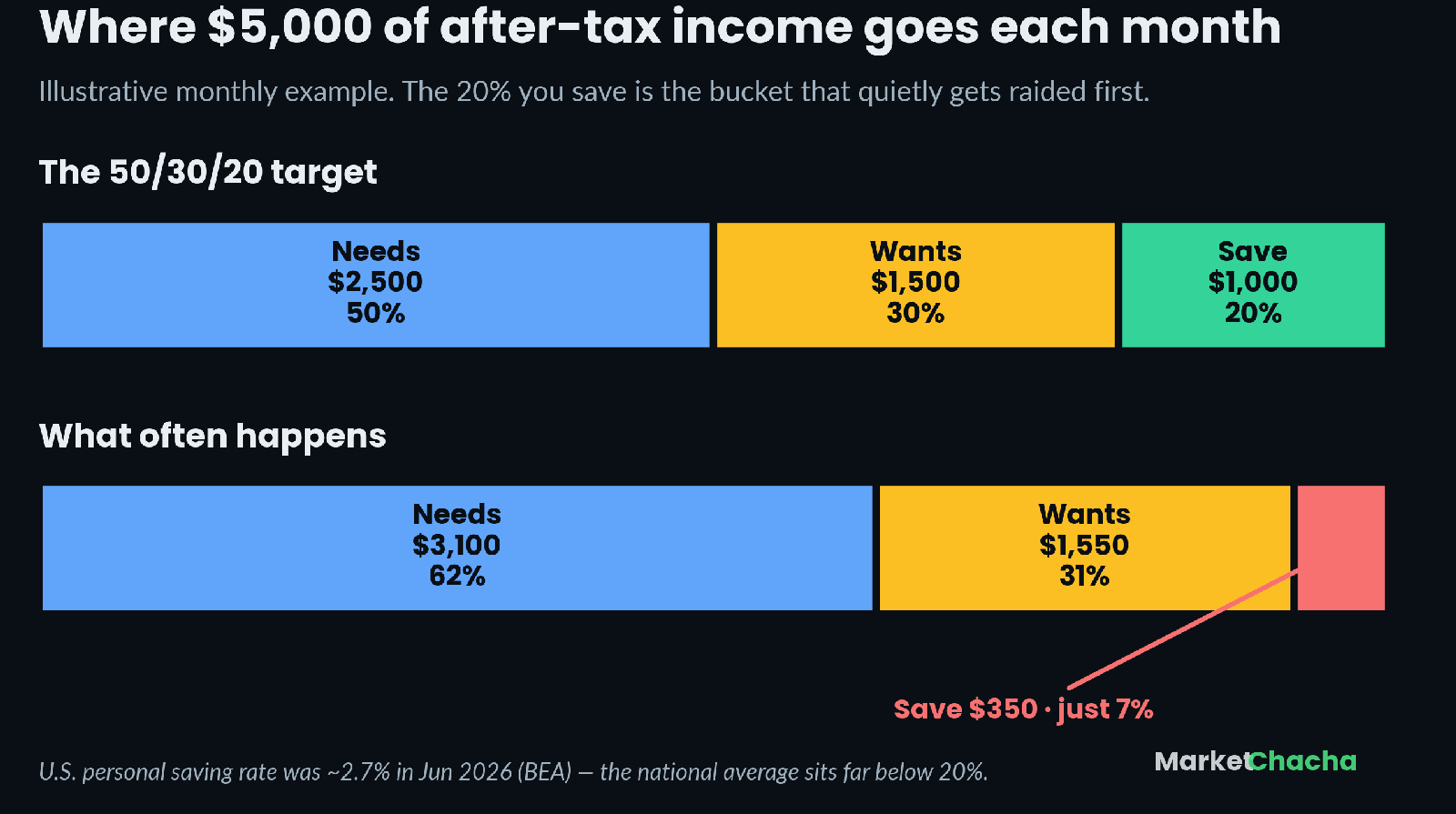
This is not a hypothetical worry. The U.S. personal saving rate was only about 2.7% in June 2026 (Bureau of Economic Analysis) — the national average sits nowhere near 20%. The rule works precisely because it forces that third bucket to be a decision, not a leftover.
What counts as a need, a want, and savings
Most of budgeting is just sorting expenses correctly. The reference below shows where common items land. The trickiest calls are the "nicer version of a need" (a car and a basic phone plan are needs; the luxury SUV and the top-tier unlimited plan are wants) and debt (the minimum payment is a need; anything extra is savings).
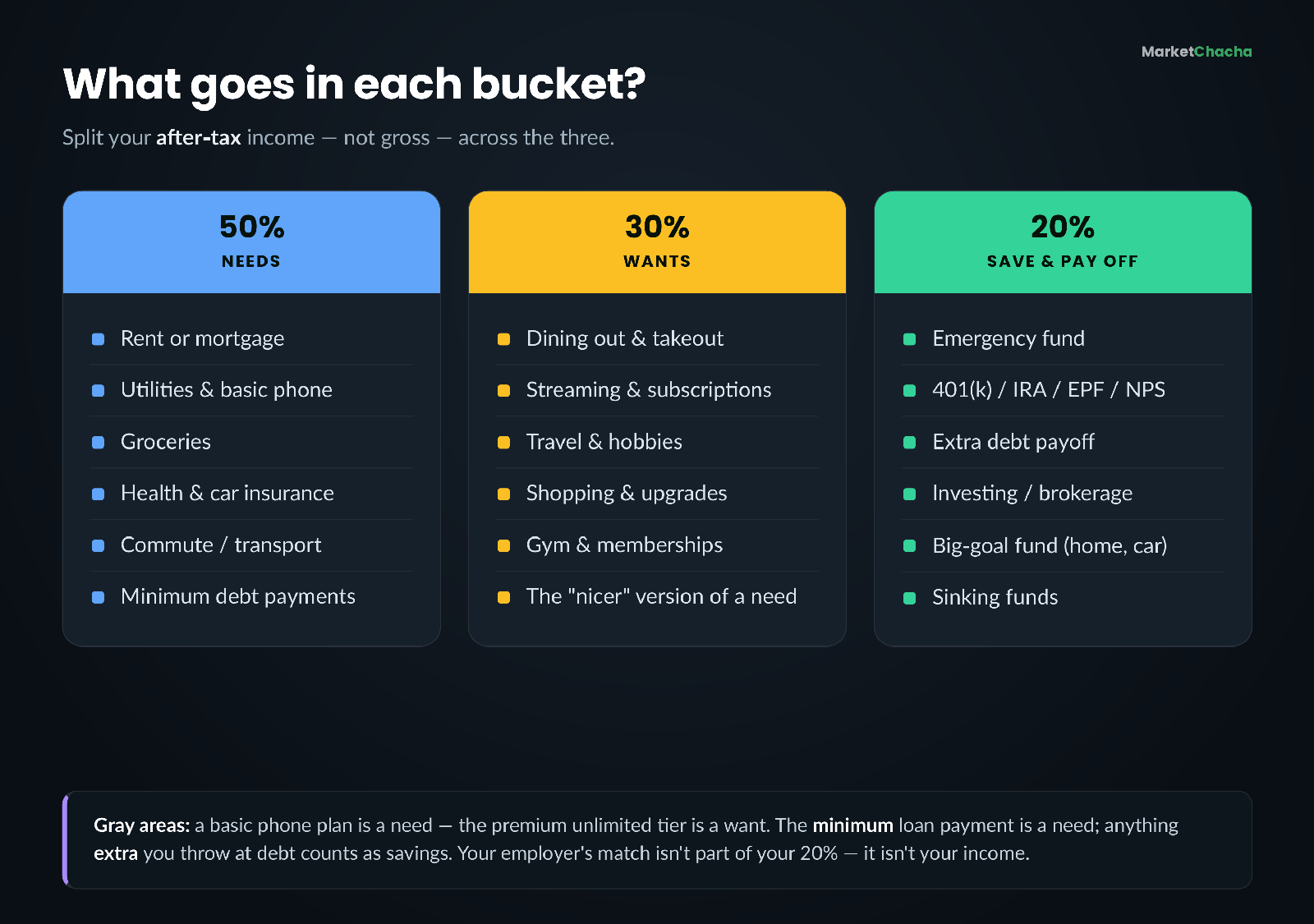
One more rule for the savings bucket: your employer's retirement match does not count toward your 20%, because it was never your income in the first place. Take the full match — it is one of the few genuinely free things in personal finance — but measure your 20% against money that actually landed in your pay.
How to actually set it up (step by step)
You can build this in about ten minutes:
- 1. Find your monthly after-tax income. Use your pay stub; if you're paid every two weeks, multiply one cheque by 26 and divide by 12 rather than doubling it, or you'll miss two paycheques a year.
- 2. Set your three caps. Multiply that income by 0.50, 0.30 and 0.20.
- 3. Tag your last two or three months of spending as need, want, or savings. Bank and card statements do most of the work.
- 4. Compare actual vs. target and find the overshoot — it is almost always in "wants" wearing a "needs" costume.
- 5. Automate the 20% first. Set an automatic transfer to savings and retirement on payday so the future bucket is funded before you can spend it. This "pay yourself first" step is the difference between a rule that works and a rule you admire.
- 6. Revisit quarterly. Raises, rent changes and new subscriptions all shift the mix.
The catch: where 50/30/20 breaks down
The rule is a starting line, not a law of nature. In an expensive city, rent alone can eat 40–50% of after-tax pay, which makes a 50% needs ceiling impossible for now — and that's fine; a realistic 60/30/10 or 60/20/20 beats an aspirational 50/30/20 you abandon in week two. The rule also says nothing about the order of your savings: whether to build an emergency fund, grab the employer match, or kill a 24% credit card first matters enormously, and 50/30/20 lumps all of that into one bucket. Finally, it assumes a steady monthly paycheque, so freelancers and commission earners need to budget off a conservative "baseline" month and treat surplus months as top-ups.
Common mistakes beginners make
- Budgeting off gross pay instead of after-tax income, which inflates every bucket.
- Counting the employer match as part of your own 20%.
- Letting "needs" absorb wants — the newer car, the bigger apartment, the premium everything.
- Treating all debt payments as a need (only the minimum is) or all of them as savings.
- Setting it once and never revisiting, so lifestyle creep silently pushes wants past 30%.
- Leaving the 20% as a leftover at month-end instead of automating it up front.
How this works in India
The framework travels perfectly; only the plumbing changes. Start from your in-hand salary — what actually reaches your bank after TDS and your EPF contribution — not your CTC, which includes employer contributions and benefits you never see as cash. On an illustrative in-hand of ₹60,000 a month, the caps are ₹30,000 for needs, ₹18,000 for wants, and ₹12,000 for savings and extra loan prepayment.
Your savings bucket in India is the EPF already deducted from your salary, plus voluntary vehicles like PPF, ELSS, index or mutual-fund SIPs and NPS, an emergency fund in a sweep FD or liquid fund, and any prepayment on a home or education loan beyond the EMI. The big-city reality check matters even more here: in Mumbai, Bengaluru or Delhi, a young earner's rent can blow straight through the 50% needs ceiling, so it is normal to begin nearer 60/20/20 and steer back toward 50/30/20 as income rises.
One tax note, because it changes the maths. Some of that 20% can also cut your tax bill under Section 80C (up to ₹1.5 lakh a year, unchanged for FY 2025–26) through PPF, ELSS, EPF, life-insurance premiums and the like, with an extra ₹50,000 available for NPS under Section 80CCD(1B). But 80C deductions apply only under the old tax regime — the new regime, which is now the default, does not allow them. So decide your regime first, and never buy an investment purely for a deduction you may not be able to claim.
FAQ
Is the 50/30/20 rule based on gross or net income? Net — specifically your after-tax income. Subtract taxes from your pay first, then split what's left 50/30/20. Using gross salary is the most common mistake and leaves you short every month.
What's the difference between a need and a want? A need has a real consequence if you skip it — housing, food, utilities, insurance, transport to work, minimum debt payments. A want makes life nicer but is pausable: dining out, subscriptions, travel, and the upgraded version of any need.
Does my 401(k) or EPF count toward the 20%? Yes — retirement contributions you make are savings and sit in the 20% bucket. Your employer's matching contribution does not count, because it was never part of your income; take it anyway, it's free money.
Where does paying off debt go — needs or savings? Both, split by type. The minimum required payment is a need (in the 50%). Any extra you pay to clear the balance faster counts as part of your 20%.
What if my rent alone is more than half my income? Then 50% needs isn't realistic yet, and that's okay. Use a version that fits — say 60/20/20 — and move back toward 50/30/20 as your income grows or housing costs fall. The exact ratio matters less than consistently funding savings.
Is 50/30/20 better than a zero-based budget? It's simpler but blunter. A zero-based budget assigns every rupee or dollar a job and is more precise, but it takes more effort. 50/30/20 is a great on-ramp; you can graduate to zero-based later if you want tighter control.
Educational content only — not investment, tax or financial advice, and not a recommendation of any product. Rates, limits and tax rules change — always check current terms before acting. Sources: Elizabeth Warren & Amelia Warren Tyagi, All Your Worth: The Ultimate Lifetime Money Plan (2005); U.S. Bureau of Economic Analysis — Personal Saving Rate; NerdWallet 50/30/20 budgeting; Income Tax India / Section 80C (FY 2025–26). Always do your own research.
This article is for educational and informational purposes only. It is not financial advice, investment recommendation, or a solicitation to buy or sell securities. Investing involves significant risks. I am not a SEBI-registered investment advisor. Readers should consult their own financial advisor and conduct their own research before making any investment decisions.
Comments
Join the conversation
Sign in to join the conversation.
Follow replies, add your view, and take part in the discussion.
Sign in to commentLoading comments...