

High-yield savings vs money-market funds vs CDs: where should you actually park your cash?

If you have cash you don't want to invest in stocks — an emergency fund, a house down-payment, next year's tuition — the three main places to park it are a high-yield savings account (HYSA), a money-market fund (MMF), and a certificate of deposit (CD). They all pay you interest for holding cash, and as of July 2026 the best of each pay in the same ballpark — roughly 4% a year. The real decision isn't "which pays the most this week"; it's a trade-off between how easily you can get your money out and whether your rate is locked or floating. This guide explains exactly how each one works, walks through the arithmetic on $10,000, and shows you how to choose.
The one-line difference between the three
A high-yield savings account is a bank savings account that pays a much higher rate than a normal one — as of July 2026 the top nationally-available HYSAs paid around 4.1% APY, versus a national average savings rate near 0.38%. Your money stays fully liquid and the rate is variable: the bank can change it any day.
A money-market fund is not a bank account at all — it's a type of mutual fund that holds very short-term, high-quality debt like Treasury bills and repurchase agreements. You buy it inside a brokerage account. Its yield (quoted as a "7-day yield") floats daily, and as of July 2026 government money-market funds were yielding roughly 3.5%–4.1%.
A CD is a time deposit: you agree to leave a fixed sum with a bank for a fixed term (say 12 months) and in return the bank locks in a fixed rate for the whole period. Top 1-year CDs paid around 4.1%–4.3% APY as of July 2026. The catch: you're supposed to leave it untouched until it matures.
A worked example: $10,000 for one year
Put $10,000 in each and hold for a year (APY already includes compounding, so the maths is simple):
- HYSA at 4.10% APY → about +$410, giving $10,410 — if the rate holds. Because it's variable, if the bank cuts to 3.5% halfway through, you earn less.
- Government MMF at ~3.9% → roughly +$390, giving about $10,390 — an estimate, not a promise, because the 7-day yield moves every day.
- 1-year CD at 4.15% APY → exactly +$415, giving $10,415 — guaranteed, provided you hold it to maturity.
Notice the CD pays a touch more and guarantees it — but only because you gave up access to the money for a year. That single fact is the whole decision.
The trade-off that decides everything: floating vs locked
Here's why "which pays most today" is the wrong question. A HYSA and an MMF both float — their yields rise and fall with short-term interest rates set by the Federal Reserve. A CD is locked. So the answer depends on where rates go next:
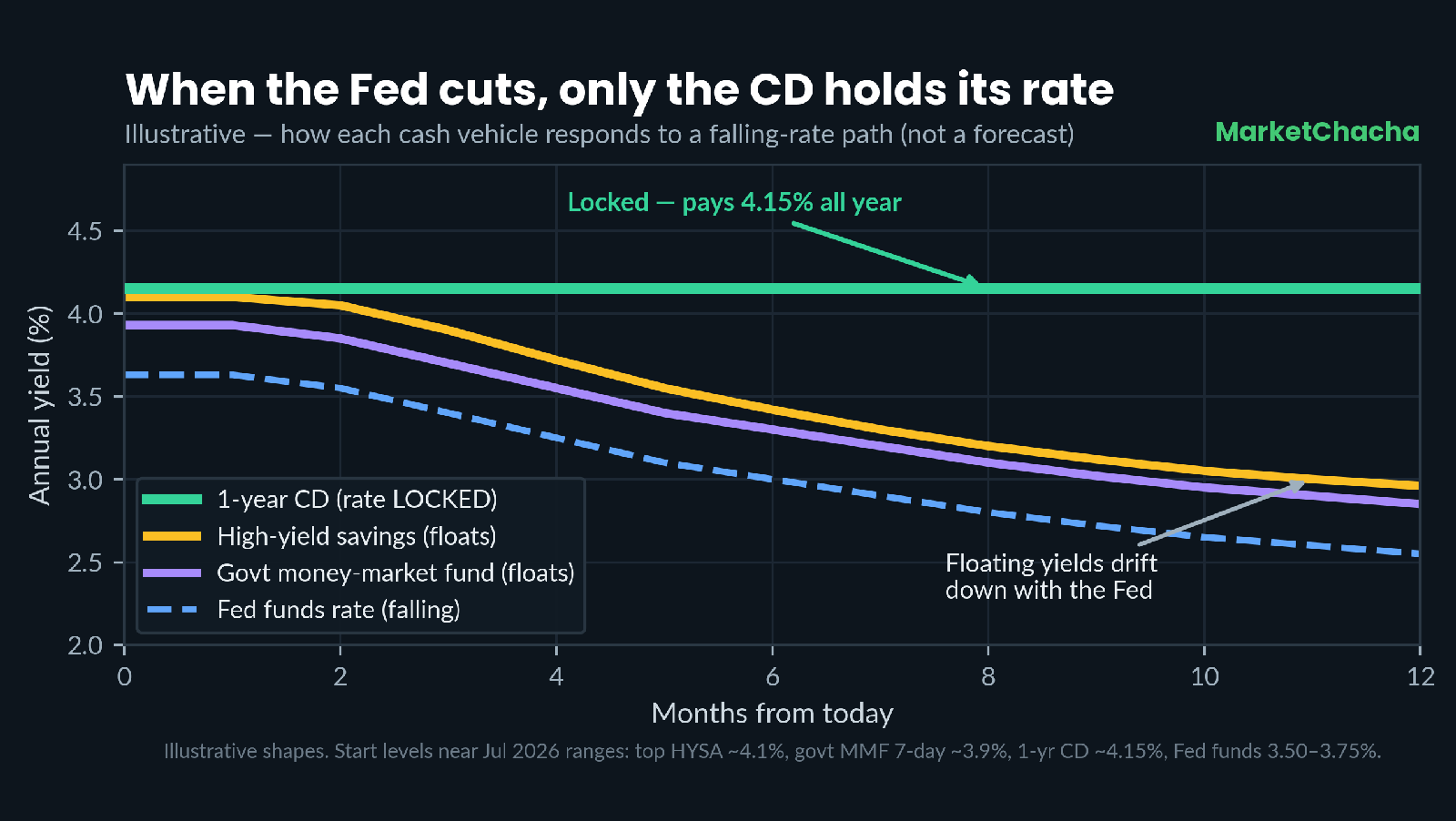
In a falling-rate world (like the illustration above), the CD wins: it keeps paying its locked rate while the HYSA and MMF drift down with the Fed. In a rising-rate world it's the opposite — the floating accounts climb while your CD is stuck at the old, lower rate. Nobody knows which way rates will go, which is exactly why many people keep some cash liquid (HYSA/MMF) and lock only the portion they're sure they won't need (CD). The Fed's target range was 3.50%–3.75% as of July 2026.
Safety: what "insured" actually means — and what it doesn't
This is where the three genuinely differ, and it matters more than a few tenths of a percent of yield.
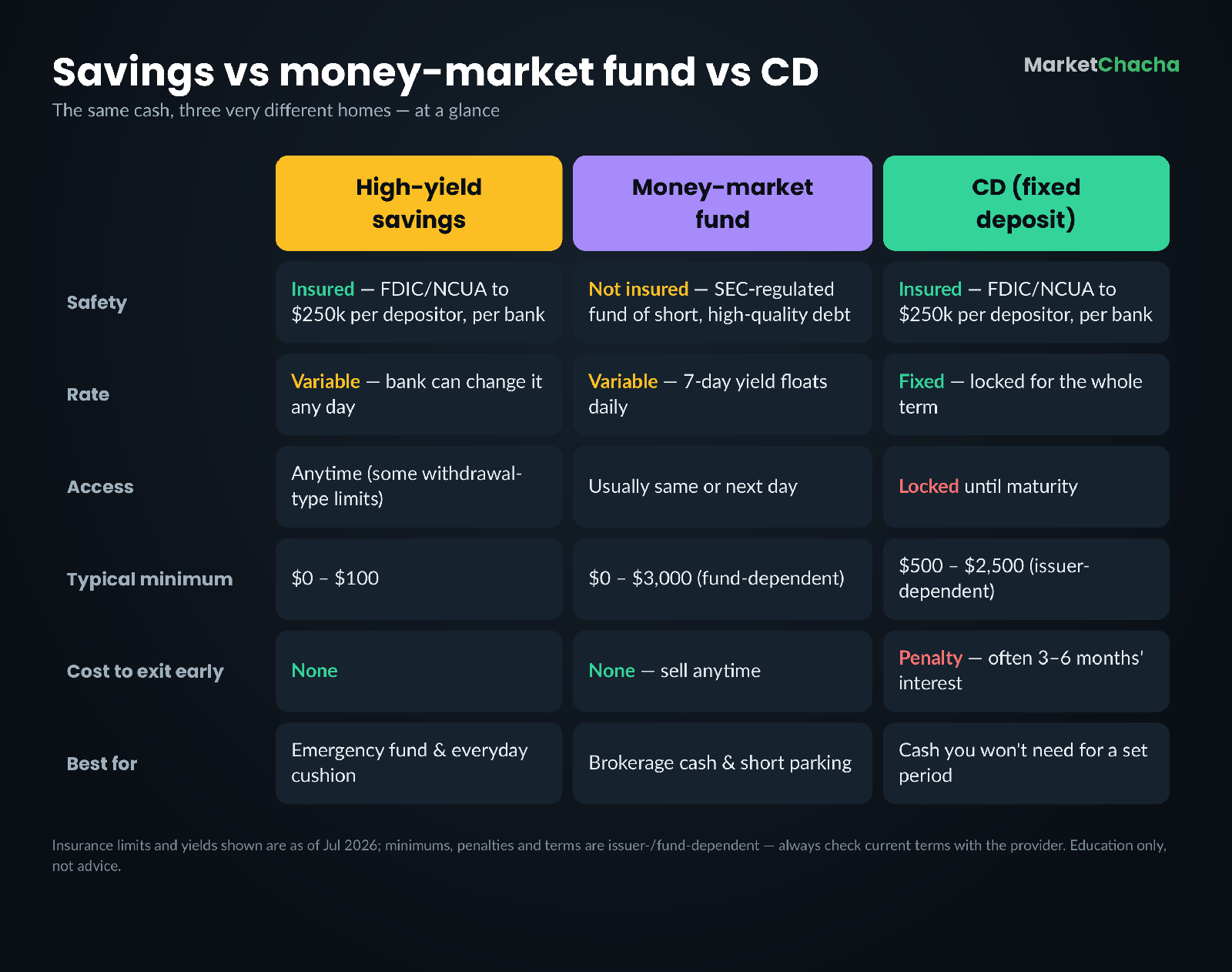
A HYSA and a CD are bank products. At an FDIC-insured bank (or an NCUA-insured credit union) your money is protected up to $250,000 per depositor, per insured institution, per ownership category. If the bank fails, the government makes you whole up to that limit. This has been the standard limit since 2010.
A money-market fund is not FDIC-insured — it's an investment, regulated by the SEC, not a guaranteed deposit. If you hold it at a brokerage, SIPC protects you if the brokerage fails, but SIPC does not cover the fund losing value. Government money-market funds are considered very safe because they hold Treasury-backed debt, but they are not guaranteed: in rare stress events a fund's price can dip below $1 per share — "breaking the buck" — which last happened notably in 2008. For most people this risk is small, but it is not zero, and that's the honest distinction.
The confusing name: money-market FUND vs money-market ACCOUNT
These sound identical and are constantly mixed up. A money-market deposit account (MMDA) is a bank account — FDIC-insured, often with limited check-writing. A money-market fund (MMF) is a mutual fund you buy through a brokerage — not insured. Same two words, completely different protection. Before you move money, check which one you're actually looking at: if the word "FDIC" appears, it's a bank account; if it's a fund with a ticker and a "7-day yield," it's the investment.
How to actually do it (step by step)
Opening any of these takes minutes online:
- HYSA: Open an account with an FDIC-insured online bank, link your checking account, and transfer money in. Confirm the bank is FDIC-insured (look it up on the FDIC's BankFind) and read whether they cap certain withdrawal types.
- Money-market fund: Inside a brokerage account, buy a government money-market fund the way you'd buy any fund. At many brokers, uninvested cash already sits in one automatically. Check the fund's "7-day yield" and its expense ratio.
- CD: Choose a term you're confident you won't need the money for, then open the CD at a bank or through your brokerage ("brokered CDs"). Read the early-withdrawal penalty before you commit.
Use this quick comparison to match the vehicle to the job:
What it costs you: the catch with each
The HYSA's catch is that the rate can drop without warning — today's headline 4.1% is not a promise for next month. The MMF's catch is that it's not insured and carries a small tail risk, plus an expense ratio that quietly shaves a little off the yield. The CD's catch is the sharpest: an early-withdrawal penalty. Suppose you break that 4.15% one-year CD after just two months. You'd have earned about $69 in interest, but a typical penalty of three months' interest is about $104. Because the penalty exceeds the interest earned, many banks deduct the shortfall from your principal — so you could get back roughly $9,965, less than the $10,000 you deposited. Penalty rules vary by issuer, so always read them first.
Common mistakes beginners make
- Chasing the top rate and ignoring liquidity. Locking your emergency fund in a CD for 0.1% more yield can backfire the day you actually need the cash.
- Assuming a money-market fund is insured. It usually isn't — only the bank versions (HYSA, MMDA, CD) carry FDIC/NCUA coverage.
- Leaving cash in a big-bank "regular" savings account paying near 0.4% when top HYSAs pay roughly ten times that.
- Keeping more than $250,000 at one bank and losing insurance on the excess.
- Forgetting CDs auto-renew. Many roll into a new term at maturity unless you act during the short grace window.
How this works in India
The same three-way choice exists, just with different names. The HYSA equivalent is your savings bank account: fully liquid, interest calculated on the daily balance and paid quarterly, typically around 2.7%–3.5% at large banks (some small-finance and neo-banks pay more). Deposits are insured by the DICGC up to ₹5 lakh per depositor, per bank.
The money-market-fund equivalent is a liquid fund or money-market mutual fund — a debt mutual fund holding very short-term instruments. Returns float, it is not covered by deposit insurance, and since April 2023 gains on debt funds are taxed at your income-slab rate, so factor tax in. The CD equivalent is the classic fixed deposit (FD): a locked rate for a fixed tenure, DICGC-insured to ₹5 lakh, with a premature-withdrawal penalty (often a 0.5%–1% rate reduction). As of July 2026 the RBI's repo rate was 5.25% and bank FD rates ranged roughly 2.5%–8.1% depending on bank, tenure and whether you're a senior citizen.
FAQ
Which is safest — a high-yield savings account, a money-market fund, or a CD? The HYSA and CD are the safest because they're bank products insured by the FDIC/NCUA up to $250,000 per depositor, per bank. A money-market fund is not insured, though government money-market funds are still considered very low risk.
Is a money-market fund the same as a money-market account? No. A money-market account (MMDA) is an FDIC-insured bank account; a money-market fund is an uninsured mutual fund you buy through a brokerage. The names are almost identical but the protection is not.
Can I lose money in a CD? Not from market losses if you hold to maturity and stay under the insurance limit. But if you withdraw early, the penalty can be larger than the interest you've earned, which can leave you with slightly less than you deposited.
Why does a CD sometimes pay more than a savings account? Because you give up access. In exchange for locking your money for a set term, the bank offers a fixed rate — useful when rates are falling, risky when they're rising.
Where should I keep my emergency fund? Somewhere liquid and safe — most people use a high-yield savings account or a government money-market fund so the cash is available the day they need it, rather than locked in a CD.
What is a 7-day yield? It's a standardised figure that annualises a money-market fund's income over the past seven days, so you can compare funds. Because it's based on a rolling week, it moves as short-term rates move.
Educational content only — not investment, tax or financial advice, and not a recommendation of any product. Rates, fees and rules change, and insurance limits, minimums and penalties are issuer-, fund- and jurisdiction-dependent — always check current terms with the provider. [Sources: Federal Reserve, FDIC, U.S. SEC, NerdWallet, Bankrate, RBI, DICGC]. Always do your own research.
This article is for educational and informational purposes only. It is not financial advice, investment recommendation, or a solicitation to buy or sell securities. Investing involves significant risks. I am not a SEBI-registered investment advisor. Readers should consult their own financial advisor and conduct their own research before making any investment decisions.
Comments
Join the conversation
Sign in to join the conversation.
Follow replies, add your view, and take part in the discussion.
Sign in to commentLoading comments...