

What is a T-bill and how do you actually make money from it?
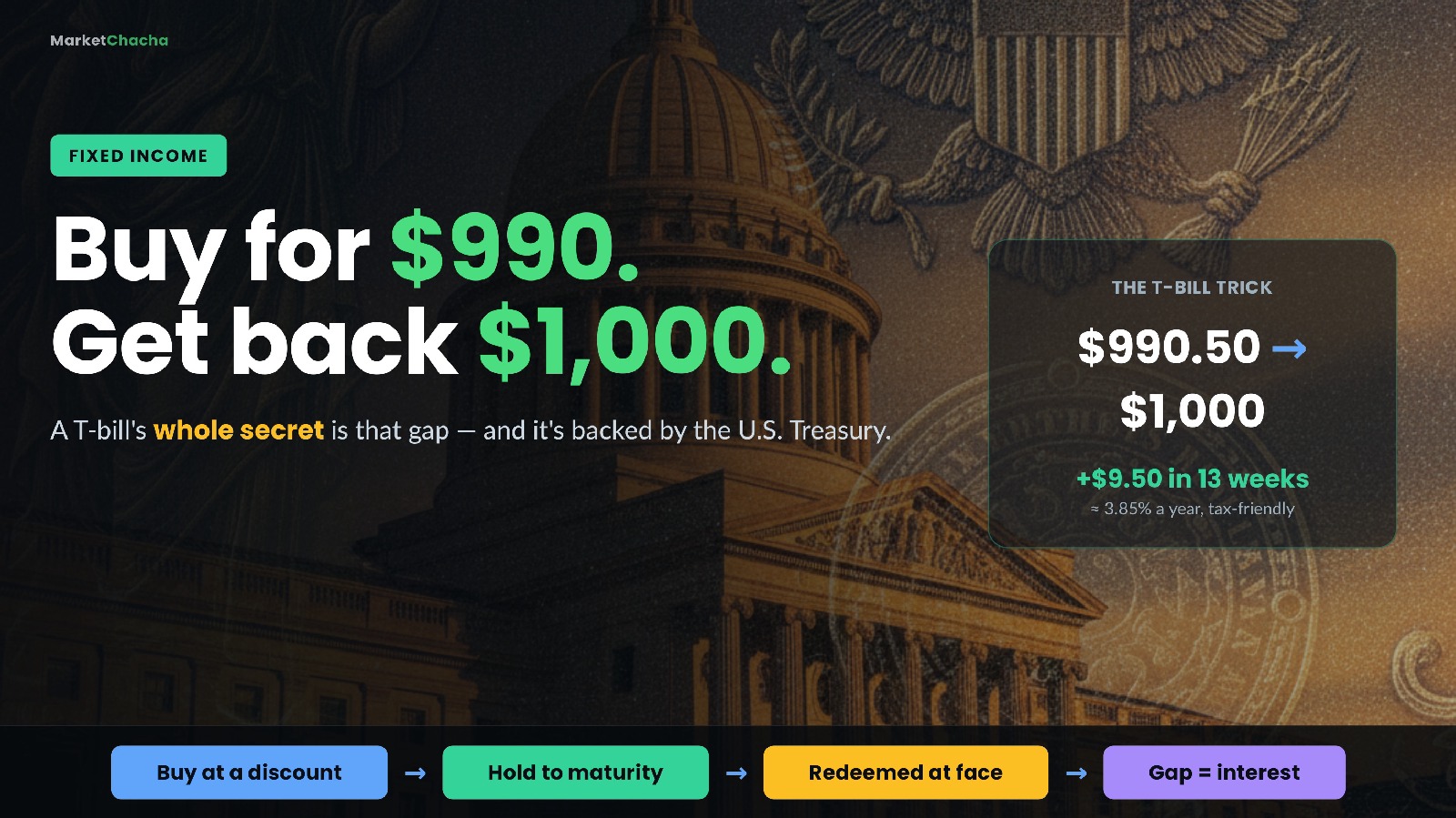
A Treasury bill (T-bill) is a short-term loan you make to the U.S. government for a year or less. Here is the part that confuses almost every beginner: a T-bill pays you no interest cheque along the way. Instead, you buy it for less than its face value, and when it matures the government pays you the full face value. That gap between what you pay and what you get back is your interest. Buy a $1,000 bill for $990.50, collect $1,000 thirteen weeks later, and that $9.50 is what you earned.
This guide walks through exactly how that works: the discount mechanic with a worked example, the two "yield" numbers you'll see quoted, how to actually buy one, what the catch is, how T-bills stack up against CDs and high-yield savings, the mistakes beginners make, and how the same idea works in India.
What a Treasury bill actually is
A T-bill is one of three kinds of "marketable" debt the U.S. Treasury sells to fund the government. Bills mature in one year or less; notes run 2–10 years; bonds run 20–30 years. What makes bills special is that they are zero-coupon — they don't pay periodic interest. They are sold at a discount to face value and redeemed at face value, and the whole return shows up as that single difference at the end.
Because they are backed by the "full faith and credit" of the U.S. government and mature so quickly, T-bills are widely treated as the closest thing to a risk-free place to park cash. They are where money-market funds, banks and large institutions keep short-term money — which is exactly why an individual can use them the same way.
How you actually make money: the discount, step by step
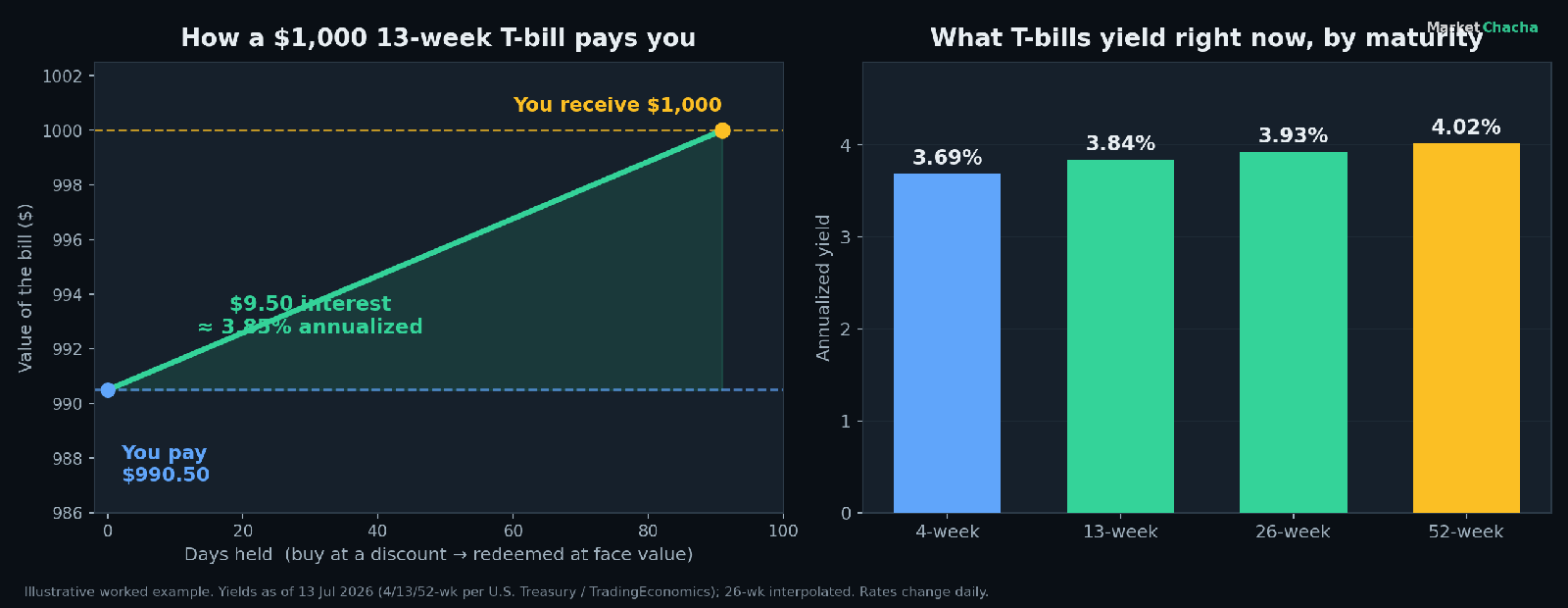
Let's make it concrete with a worked example. Suppose the going rate on a 13-week (about 3-month) bill is roughly 3.8% a year, which is close to where the 13-week bill sat in mid-July 2026.
- You buy a $1,000 face-value 13-week T-bill. Because it's discounted, you pay about $990.50 today.
- You wait 91 days. There are no monthly payments — nothing happens in your account until maturity.
- At maturity the Treasury pays you the full face value: $1,000.
- Your interest is $1,000 − $990.50 = $9.50.
To turn that into an annual rate, work out the return over the 91 days and scale it to a year: $9.50 ÷ $990.50 = 0.959% earned in 91 days. Annualised, 0.959% × (365 ÷ 91) ≈ 3.85% a year. That's the "how do T-bills pay you?" answer in one line: you're paid the discount, and the shorter the bill, the sooner you collect it.
Discount yield vs the real yield you earn
When you look up a bill you'll often see two different rates, and beginners mix them up. The discount rate (or "discount yield") is the old-fashioned way of quoting a bill: it measures the discount against the face value and uses a 360-day year. The investment rate (also called the coupon-equivalent or bond-equivalent yield) measures your gain against the price you actually paid and uses a 365-day year — so it's the number that reflects what you truly earn, and it's the one to compare against a savings account or CD.
The takeaway: when you compare a T-bill to other cash options, use the investment / coupon-equivalent yield, not the discount rate. The discount rate always looks a touch lower because it's measured against the bigger number (face value).
The maturities — and how often T-bills are sold
The Treasury issues bills in a handful of standard terms: 4, 8, 13, 17, 26 and 52 weeks (plus occasional "cash-management" bills). Most are auctioned every week; the 52-week bill is auctioned every four weeks. In an ordinary interest-rate environment, longer bills pay a little more than shorter ones, which is why a 52-week bill (about 4.02% in mid-July 2026) yielded more than a 4-week bill (about 3.69%). But that relationship isn't guaranteed — when markets expect rate cuts, short bills can actually out-yield longer ones.
How to actually buy a T-bill
You have three practical routes, from most hands-on to most convenient:
- TreasuryDirect.gov — buying straight from the government. Open a free account with your Social Security number and a bank account, go to the auction calendar, and place a noncompetitive bid (this simply means "I'll take whatever rate the auction sets," which guarantees you get the bill). Minimum purchase is $100, in $100 increments. No fees.
- A brokerage — Fidelity, Schwab, Vanguard and others let you buy new-issue bills at auction or existing bills on the secondary market, usually with no commission on Treasuries. Handy if you want your bills alongside your other investments and the option to sell early.
- A T-bill ETF — funds that hold a rolling ladder of short bills for you. You get instant diversification and daily liquidity, but you pay a small expense ratio and the "maturity date" is no longer fixed. Good if you never want to manage auctions.
If you want a steady stream of maturing cash, you can build a T-bill ladder — buy bills of staggered maturities (say some 4-week, some 13-week, some 26-week) so one is always coming due and can be spent or reinvested at the going rate.
What it costs you — the catch
T-bills are about as safe as investing gets, but they aren't magic. Know the trade-offs:
- Your money is committed until maturity. You can sell a bill early on the secondary market, but the price you get moves with interest rates — if rates rose after you bought, you might sell for slightly less than you paid.
- Reinvestment risk. When your bill matures, the new rate might be lower. Locking in today's rate only lasts as long as the bill.
- They can lag inflation. A "risk-free" 3.9% still loses purchasing power if inflation runs higher. T-bills protect your capital, not necessarily your buying power.
- Tax on the interest. The discount you earn is taxed as ordinary income at your federal rate — it does not get the lower long-term capital-gains rate. The one gift: T-bill interest is exempt from state and local income tax, which makes it especially attractive in high-tax states. Your broker or TreasuryDirect reports it on Form 1099-INT or 1099-OID.
T-bills vs CDs vs high-yield savings
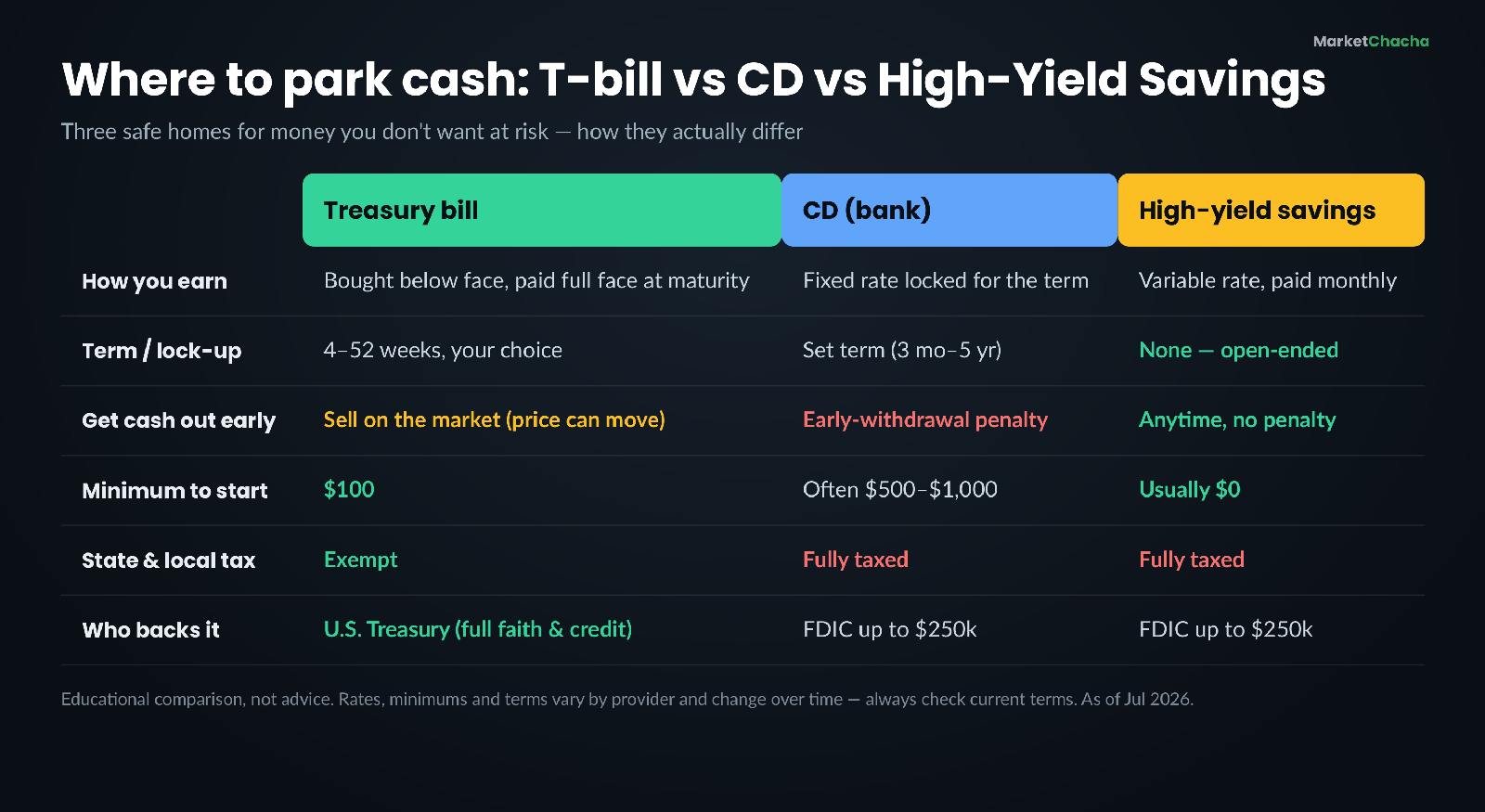
T-bills are one of three common "safe homes" for cash, and the right one depends on when you'll need the money and how much you value flexibility. A CD locks a fixed rate for a set term but penalises early withdrawal; a high-yield savings account stays fully flexible but its rate can drop at any time; a T-bill sits in between, with a state-tax edge and a $100 entry point. The reference card below lines them up side by side.
Common mistakes beginners make
- Expecting monthly interest. A T-bill pays nothing until maturity. If you need regular income, that's a note or a bond, not a bill.
- Comparing the discount rate to a savings APY. Always compare the coupon-equivalent (investment) yield — apples to apples.
- Buying a longer bill than your timeline. If you'll need the cash in six weeks, don't buy a 26-week bill and then be forced to sell early.
- Forgetting the tax angle. In a high-tax state, a T-bill's after-tax yield can beat a CD or savings account that looks higher on paper, because the T-bill skips state tax.
- Setting maturing bills to auto-roll and forgetting. Auto-reinvest is convenient, but check the rate you're rolling into rather than assuming it's still attractive.
How this works in India
India has almost the same instrument. The Reserve Bank of India (RBI) issues Treasury bills in three tenures — 91-day, 182-day and 364-day — and, just like their U.S. cousins, they are issued at a discount and redeemed at face value, with the difference being your return. There is no periodic interest.
The retail entry point is a little higher: the minimum is ₹10,000, in multiples of ₹10,000. The easiest way for an individual to buy is the RBI's Retail Direct portal — you open a free "Retail Direct Gilt (RDG)" account with your PAN, Aadhaar and a bank account, then bid in the weekly primary auctions and pay by UPI or net-banking. Most major brokers (Zerodha, Groww and others) also let you buy T-bills.
The tax treatment differs from the U.S.: in India the discount you earn on a T-bill is added to your income and taxed at your normal income-tax slab rate — there's no state-tax exemption, because income tax in India is levied centrally. For "where to park cash" comparisons, Indian savers typically weigh T-bills against bank fixed deposits (FDs), debt mutual funds, and government schemes like PPF, each with its own lock-in and tax rules.
FAQ
How do you actually make money on a T-bill if it pays no interest? You buy it below its face value and get the full face value back at maturity. That difference is your interest — for example, pay $990.50, receive $1,000, and you earned $9.50.
What is the minimum amount to buy a Treasury bill? On TreasuryDirect the minimum is $100, in $100 increments. In India, RBI T-bills start at ₹10,000 through the Retail Direct portal.
Are Treasury bills taxed? Yes. The interest is taxed as ordinary income at your federal rate, but it is exempt from state and local income tax in the U.S. In India, the gain is added to your income and taxed at your slab rate.
What's the difference between the discount rate and the investment yield? The discount rate measures the discount against face value using a 360-day year; the investment (coupon-equivalent) yield measures your gain against the price you paid using 365 days. Use the investment yield to compare against a savings account or CD.
Can I sell a T-bill before it matures? Yes, on the secondary market through a broker, but the price will move with interest rates, so you might get slightly more or less than you paid. Held to maturity, you always get full face value.
Are T-bills better than a high-yield savings account? It depends. T-bills can offer a state-tax advantage and a known payout, while a savings account is fully flexible but has a rate that can change any day. Match the choice to when you'll need the money.
Educational content only — not investment, tax or insurance advice, and not a recommendation of any product. Rates, fees and rules change — always check current terms with the provider or TreasuryDirect/RBI. [Sources: TreasuryDirect, U.S. Department of the Treasury, IRS, RBI Retail Direct]. Always do your own research.
This article is for educational and informational purposes only. It is not financial advice, investment recommendation, or a solicitation to buy or sell securities. Investing involves significant risks. I am not a SEBI-registered investment advisor. Readers should consult their own financial advisor and conduct their own research before making any investment decisions.
Comments
Join the conversation
Sign in to join the conversation.
Follow replies, add your view, and take part in the discussion.
Sign in to commentLoading comments...