

Why did SRG Housing Finance crash 20%? The NHB says a third of its loan book may not have real borrowers
What happened
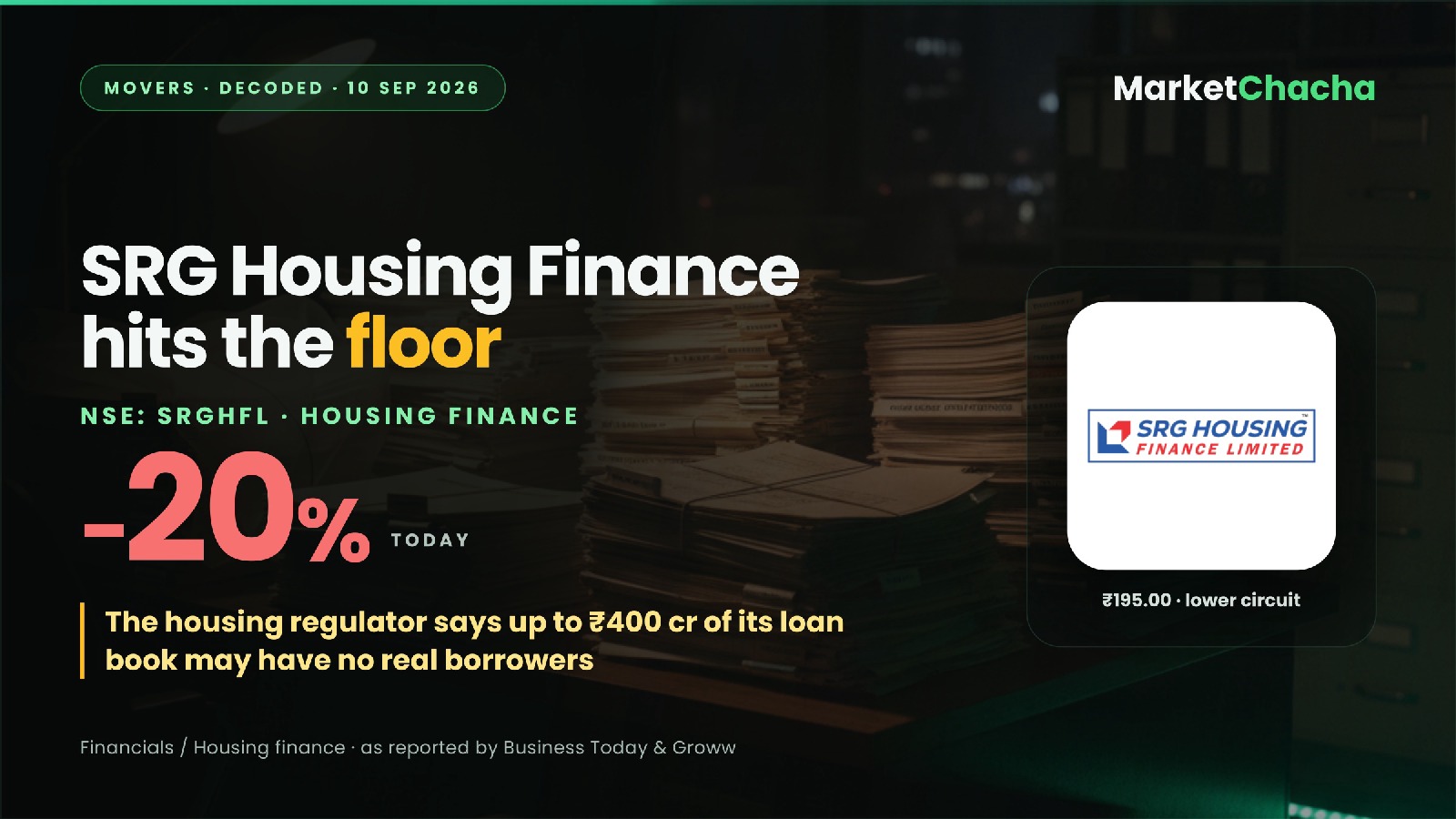
SRG Housing Finance (NSE: SRGHFL) is at its 20% lower circuit. Groww shows the stock at ₹195.00, down ₹48.75 or 20.00% from Wednesday's close of ₹243.75, taking market cap to about ₹374 crore.
The trigger is a Business Today report that the National Housing Bank (NHB) has flagged suspected fictitious loan accounts at the company worth ₹300–400 crore. Set that against the company's own reported AUM of ₹1,076 crore as of June and you get the number that did the damage: roughly one-third of the loan book is in question.
Why it moved
The specific finding, per the report, is not late repayment. It is that NHB found loans recorded as disbursed where the underlying customers could not be verified — accounts with no matching asset behind them. Alongside that: alleged evergreening, manipulation of NPA numbers, and money allegedly routed back to promoter-linked entities.
NHB has classified the account as a Red Flagged Account (RFA) and reported it to the RBI's Central Repository of Information on Large Credits (CRILC). That starts a 180-day clock in which the investigation either declares fraud or the flag comes off.
Groww notes the company has denied the allegations in BSE announcements, saying no adverse findings have been made. Nothing has been established as fraud. What has happened is a regulator putting a formal flag on the file.
Two words worth actually knowing
Evergreening is when a lender quietly hands a struggling borrower a fresh loan so the old one gets repaid on paper. The borrower is no healthier; the books look clean. It converts a bad loan into a good-looking one, which is why regulators hunt for it.
CRILC is the RBI's shared credit database. Once a name is flagged there, every other lender in the system sees it. That is the part that bites fastest — not a fine, but funding. SRG carried ₹857 crore of borrowings at FY26 (Screener.in), and a housing financier that cannot roll over bank lines cannot write new loans.
The business
- An NHB-registered housing finance company out of Rajasthan, lending to rural and semi-urban borrowers — home purchase, self-construction, and loan against property.
- 96 branches, more than 25,000 customers. FY26 revenue ₹199 crore, net profit ₹32 crore (Screener.in).
- Promoter group holds 59.02%; managing director Vinod Kumar Jain holds 20.5%.
There is no other division to fall back on. Small-ticket housing loans are the entire company, which is why a question about the loan book is a question about everything.
Is it expensive?
On the screen it looks cheap. Groww shows a trailing P/E near 11, a book value of ₹189 and a price-to-book of about 1.26 even after today's fall. Screener.in puts three-year ROE at 12.2%.
Compare Home First Finance, a larger affordable-housing lender: Screener.in shows it at a P/E of 21.6 and 2.89 times book, on a market cap of ₹12,547 crore with ROE of 15.7%. So SRG trades at less than half Home First's multiple of book.
The honest reading: for a lender, P/E and P/B are only as good as the asset side. Book value of ₹189 a share assumes the loans on the balance sheet are real loans. That is precisely the assumption NHB has put a flag on. A cheap multiple on a book that may be overstated is not cheap — it is unpriced.
Who it touches
- SRG's lenders. Business Today describes a diversified set of banks, financial institutions and NHB behind the company. Each now has to look at its own exposure while the RFA stands.
- Small housing financiers generally. The affordable-housing HFC story is built on trust in field-level verification at thousands of tiny tickets. One verification failure at one lender tightens diligence questions for the rest of the small-cap set.
- Minority shareholders. At a ₹374 crore market cap with a 20% band, there is no orderly exit on a day like this — the circuit removes the option to sell at all.
The one thing that flips this
The RFA is a suspicion, not a verdict, and it has a deadline. If the 180-day investigation clears the accounts and the flag is lifted, a lender trading near book with 12% ROE re-rates fast. If it goes the other way, the argument stops being about the multiple and starts being about how much of that ₹189 book value survives. Those two outcomes are very far apart, and today's price is not a considered view on either — it is the lower circuit.
As of 3:10 PM IST, 10 September 2026. Sources: Business Today, Groww, Screener.in, Screener.in (Home First Finance). For discussion and education only — not investment advice. Verify before acting.
This article is for educational and informational purposes only. It is not financial advice, investment recommendation, or a solicitation to buy or sell securities. Investing involves significant risks. I am not a SEBI-registered investment advisor. Readers should consult their own financial advisor and conduct their own research before making any investment decisions.
Comments
Join the conversation
Sign in to join the conversation.
Follow replies, add your view, and take part in the discussion.
Sign in to commentLoading comments...