

Why is TVS Motor up ~6% today — while Bajaj Auto's bigger numbers got shrugged off?
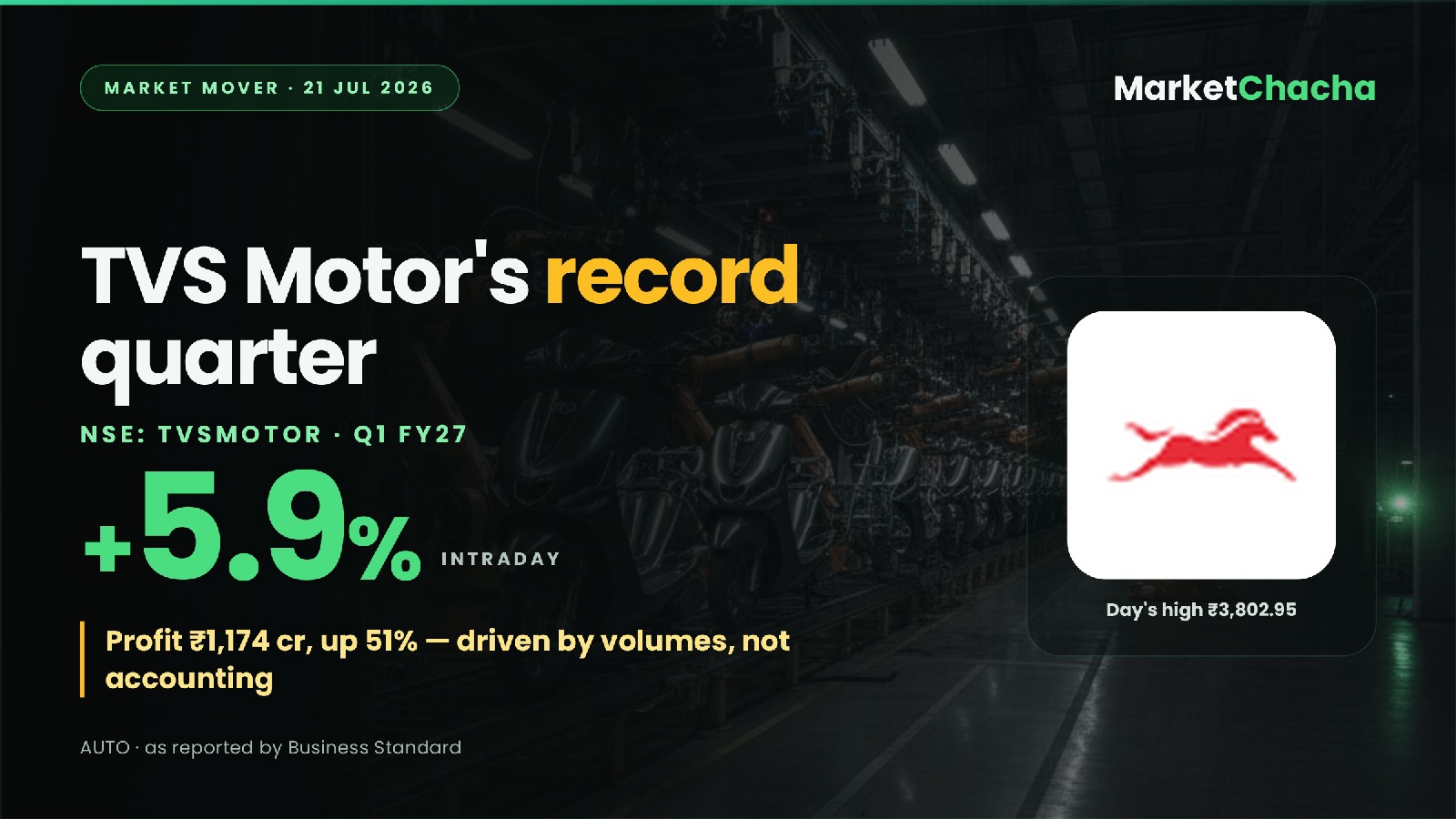
TVS Motor rose as much as 5.9% to an intraday high of ₹3,802.95 on Tuesday, against Monday's close of ₹3,591 — and it did it on a red day, with the Sensex down 0.30% at 77,475.24. Business Standard clocked the stock up 4.55% at 2:20 PM while the index was off 0.38%.
The trigger was Q1 FY27. On a standalone basis, net profit came in at ₹1,174 crore, up 51% from ₹776 crore a year ago — the company's highest-ever quarterly profit. Revenue rose 38% to ₹13,896 crore from ₹10,081 crore. On a consolidated basis, profit was ₹1,057.6 crore, up 64.5%, on revenue of ₹16,295.5 crore.
What actually did the work: units, not price
Two- and three-wheeler volumes hit 1.63 million units, up 28% from 1.28 million in the June 2025 quarter. Exports grew faster still — 0.47 million units, up 33% from 0.35 million. That's the number that matters, because it means the profit came from selling more vehicles rather than from charging more for the same ones.
The tell is the margin. EBITDA was a record ₹1,779 crore, up 41%, but the EBITDA margin moved just 30 basis points, to 12.8% from 12.5%. Revenue up 38% and margin up 0.3 points is a volume story, not a pricing-power story. TVS said as much: it faced commodity cost inflation and only partially offset it through price adjustments, cost work and scale.
The contrast nobody's putting in the headline
Bajaj Auto reported the same morning with a bigger-looking number — consolidated revenue up 65.1% to ₹21,688.83 crore and profit up 45.9% to ₹3,225.63 crore. But Bajaj itself told the exchanges those figures are not comparable to last year: it began consolidating BAIHAG (which owns ~74.9% of KTM AG and Bajaj Mobility) with a one-quarter reporting lag after taking control in November 2025. Its raw-material bill jumped to ₹13,261 crore from ₹8,042 crore and employee costs nearly tripled to ₹1,387 crore — that's a bigger company being bolted on, not a business suddenly growing 65%. Bajaj's stock spent the session climbing off its lows. TVS's popped. Same sector, same day, and the market priced organic units above accounting scope.
The one thing that flips this: commodity costs. That 12.8% margin only held because volumes were growing 28% and absorbing the fixed-cost base. TVS publishes monthly sales at the start of each month — if the 1 August volume print shows growth slowing toward the mid-teens while input costs keep climbing, the same margin arithmetic runs backwards and this quarter looks like the peak rather than the trend.
As of 21 Jul 2026, 3:30 PM IST. Sources: Business Standard, Business Standard (Bajaj Auto Q1), EquityBulls. For discussion and education only — not investment advice. Verify before acting.
This article is for educational and informational purposes only. It is not financial advice, investment recommendation, or a solicitation to buy or sell securities. Investing involves significant risks. I am not a SEBI-registered investment advisor. Readers should consult their own financial advisor and conduct their own research before making any investment decisions.
Comments
Join the conversation
Sign in to join the conversation.
Follow replies, add your view, and take part in the discussion.
Sign in to commentLoading comments...