

How do credit card rewards actually work — and who really pays for your cashback?
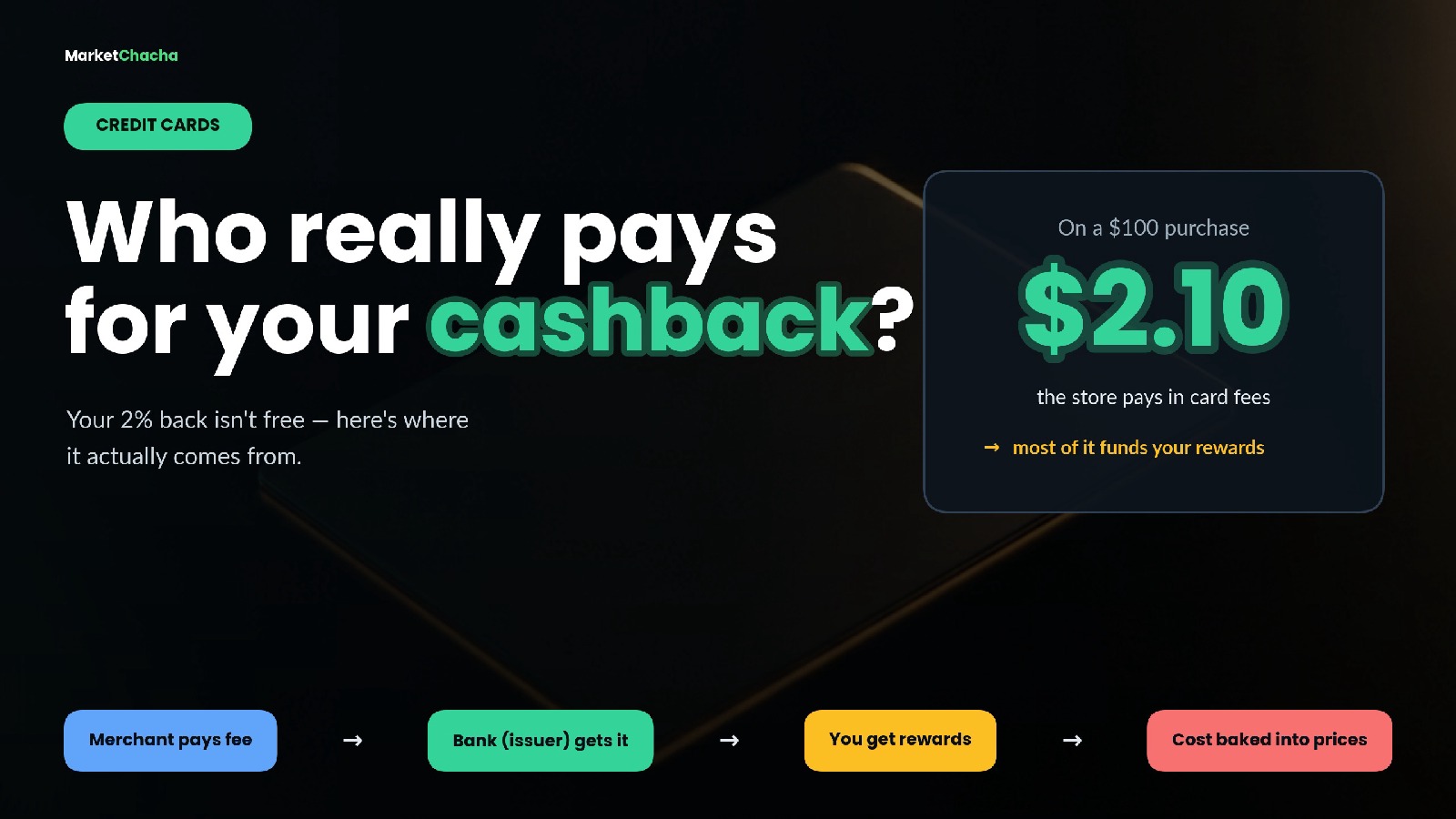
Credit card rewards are funded mainly by interchange — the "swipe fee" a merchant's bank pays your card's bank every time you pay by card. Your bank keeps some of that fee to run the card and hands a slice back to you as cashback, points or miles. So your "free" 2% back is not a gift from the bank; it is largely recycled out of the fee the store paid — and because stores tend to build that fee into their prices, a little of it is paid by everyone, including people who use cash. This guide walks through where the money actually comes from, who really foots the bill, how cashback, points and miles differ, and how to judge whether a rewards card (or its annual fee) is right for you — followed by how the same mechanics play out in India.
What "rewards" actually are
A reward is a rebate the card issuer gives you for spending on its card. It comes in three common shapes. Cashback is a straight percentage of your spend returned as statement credit or cash (typically about 1–2%). Points are a currency the issuer invents; their value depends entirely on how you redeem them (often around 1 cent each, sometimes less, sometimes more). Miles are points branded for travel, redeemable for flights or hotels. The crucial idea: the issuer can only afford to give this back because it is collecting money on the other side of your purchase. To see that, follow a single swipe.
Where the money comes from: one $100 swipe
Say you buy $100 of groceries on a card that pays 2% cashback. The store does not receive the full $100. It pays a card fee — illustratively about $2.10 on a rewards card (total processing fees generally run in the range of 1.5%–3.5% of a sale). That fee splits three ways, and the largest piece by far is the interchange, which goes to your card's issuing bank — not to Visa or Mastercard.
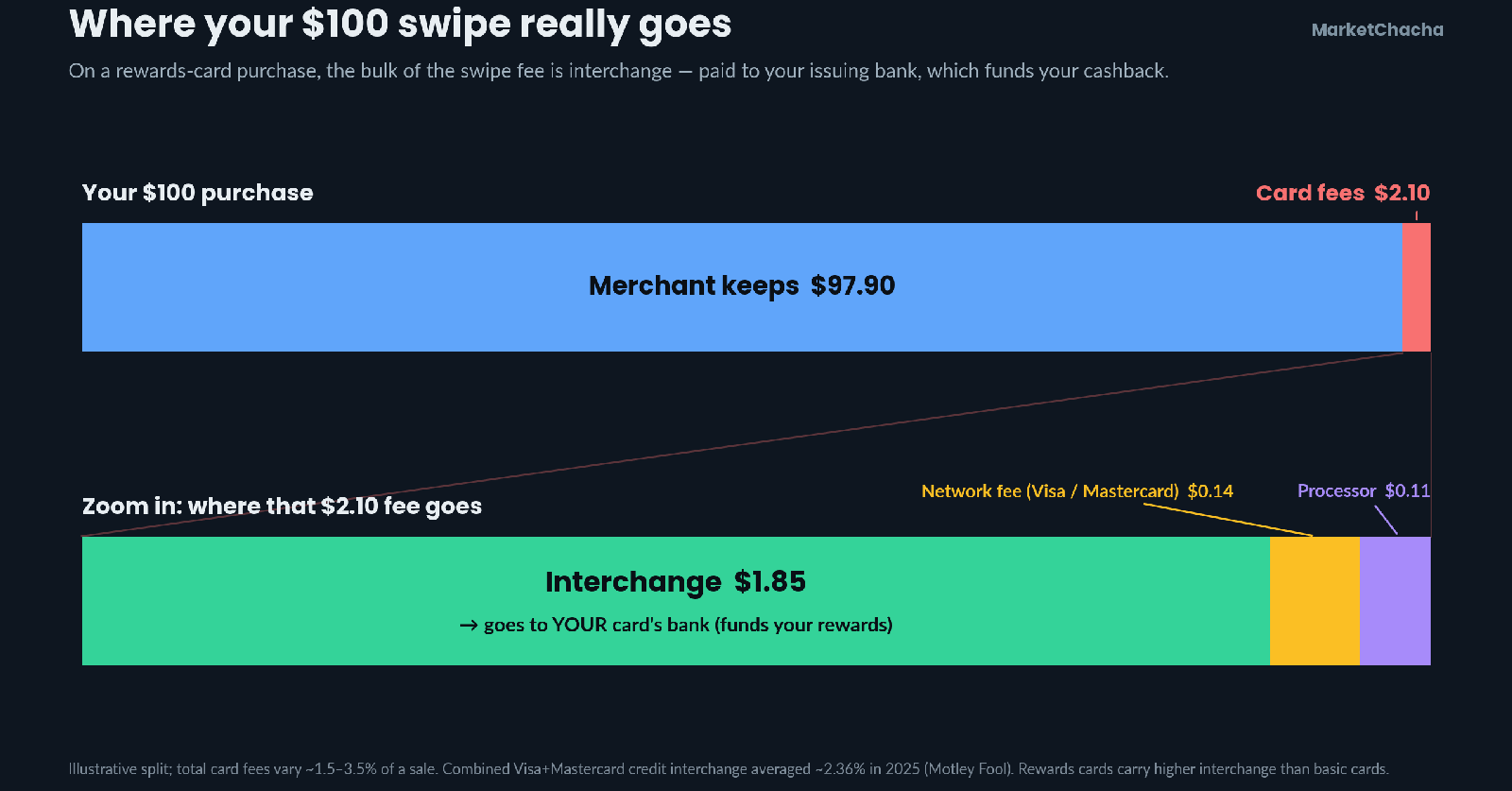
In this example the interchange is about $1.85. Your bank then pays you $2.00 in cashback. Notice something important: on a flat 2% card, the interchange barely covers — or is even less than — the reward it just handed you. That is not a mistake. On lower-rate cards (say 1%–1.5%) the interchange comfortably exceeds the reward, so the swipe fee alone is profitable. But on rich rewards cards, the issuer leans on other revenue to come out ahead. That is the real answer to "who pays for your cashback."
So who really pays for your cashback?
Three groups quietly fund the rewards pool. First, merchants — through interchange. Because businesses generally bake card acceptance costs into their shelf prices for all customers, Federal Reserve research has described card rewards as a transfer from people who pay cash (or use no-reward cards) to people who pay with reward cards. Second, and most powerfully, cardholders who carry a balance. Industry analysis finds that "revolvers" (people who don't pay in full) shoulder the vast majority of card interest and fees — one widely cited figure is around 94% — effectively subsidising the rewards enjoyed by "transactors" who pay in full each month. A 2023 U.S. Consumer Financial Protection Bureau (CFPB) review likewise found issuers earn the most from interest, then interchange, then fees. Third, forgetful cardholders — through "breakage," the industry term for points that are earned but never redeemed, which are pure profit for the issuer.
This is why a careful, pay-in-full cardholder can genuinely come out ahead on rewards: you collect the rebate without ever paying the interest that funds the system. But keep that ~22% figure you hear in headlines in perspective. As of late 2025 the Federal Reserve's G.19 data put the average rate on card accounts that are actually charged interest near 22.8%. That number only bites people who carry a balance; if you pay your statement in full, your purchase APR is irrelevant — you pay 0% on purchases thanks to the grace period.
Why some cards can afford richer rewards
Not all cards earn the issuer the same swipe fee. Premium and rewards cards carry higher interchange than basic cards, which is exactly why the richest reward cards are pushed hardest. There is also a regulatory reason credit rewards dwarf debit rewards in the U.S. The 2010 Durbin Amendment (implemented as the Federal Reserve's Regulation II) capped debit-card interchange for large banks at roughly 21 cents plus 0.05% per transaction. Credit-card interchange was left uncapped. With debit swipe fees squeezed to pennies, banks stopped funding generous debit rewards and poured the rewards budget into credit cards, where the fee — and therefore the reward pool — is far larger.
Cashback vs points vs miles: which is "better"?
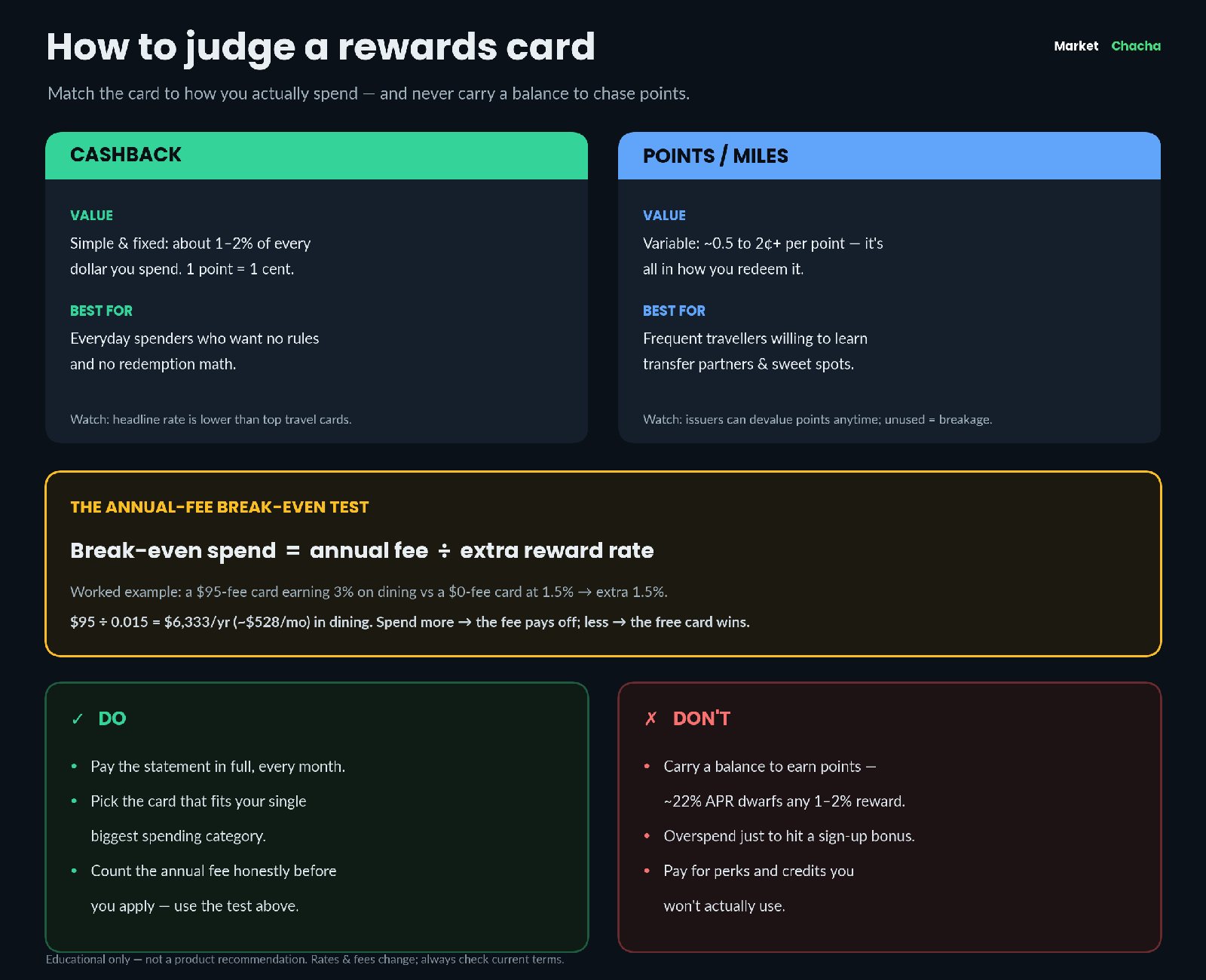
There is no universal winner; it depends on how much effort you'll put in and how you spend. Cashback is simple and predictable. Points and miles can be worth more if you redeem them well (premium travel redemptions can push a point above a cent), but their value is set by the issuer and can be cut at any time — so "1 point = 1 cent" is an assumption, not a guarantee. Use this quick comparison and the break-even test before you apply.
How to actually judge a rewards card, step by step
1. Start with how you pay, not the rewards. If you sometimes carry a balance, rewards are the wrong thing to optimise — chase the lowest APR instead, because interest will swamp any rebate. 2. Map your biggest spending categories (groceries, dining, travel, fuel). 3. Estimate the effective reward rate on your spend, not the headline number — a card that pays 5% on a category you rarely use is worse than a flat 2% card for most people. 4. Run the annual-fee break-even test: break-even spend = annual fee ÷ the extra reward rate over a free card. For a $95-fee card earning 3% on dining versus a no-fee card at 1.5%, the extra rate is 1.5%, so $95 ÷ 0.015 = about $6,333 of dining a year (~$528 a month) just to break even. Spend more than that in the category and the fee pays for itself; spend less and the free card wins. 5. Value fixed perks honestly — count a travel credit or lounge pass only at what you would actually use, not its sticker value. 6. If you travel, check the foreign-transaction fee (often around 3%), which can quietly erase rewards abroad.
What it costs you: the catch
The math only works if you never carry a balance. A 2% reward is trivial next to a ~22% APR: carry an average balance of $2,000 for a year and you'd pay roughly $440 in interest ($2,000 × 22%), erasing the rewards on $22,000 of spending. Rewards also nudge people to spend more — studies consistently find shoppers spend more on cards than with cash, and a bigger basket at 2% back is still a bigger basket. Watch out for store "deferred interest" offers (miss the payoff date and interest is charged retroactively from day one) and for chasing sign-up bonuses with spending you didn't need.
Common mistakes beginners make
Paying an annual fee you never earn back; carrying a balance "to keep the card active" or to bank points (the interest dwarfs the reward); hoarding points for years, only to see them devalued; assuming every point is worth exactly one cent; and opening more cards than you can comfortably pay in full each month. The single habit that separates people who win at rewards from people who lose: paying the statement balance in full, every month, automatically.
How this works in India
India's version of the swipe fee is the Merchant Discount Rate (MDR). For credit cards, MDR is not capped and typically runs around 2% or more, so Indian credit cards do fund cashback and reward points — though usually thinner than flashy U.S. cards. The bigger structural difference is at the debit/UPI end. Since January 2020, the government has mandated zero MDR on RuPay debit cards and BHIM-UPI transactions (via Section 10A of the Payment and Settlement Systems Act and Section 269SU of the Income-tax Act). Zero MDR means there is essentially no interchange pool to fund rewards — which is precisely why your everyday UPI payment doesn't hand you built-in cashback (bank or app promo offers aside). To keep those rails free for merchants, the government runs an incentive scheme to compensate banks, and as of mid-2025 the Finance Ministry has reiterated there is no plan to levy MDR on UPI. Debit-card MDR on other networks is capped by the RBI at up to 0.90%. As always, terms change — check current reward rates and fees with the issuer before you apply.
FAQ
Who actually pays for credit card rewards? Mostly merchants (through interchange swipe fees, which get built into prices for everyone) and cardholders who carry a balance and pay interest — that interest is the biggest single source of issuer profit and effectively subsidises the rewards of people who pay in full.
Is credit card cashback really free money? Not exactly. If you pay in full every month you can come out genuinely ahead, but the reward is funded by swipe fees (passed into prices) and by other cardholders' interest — so it's better described as a rebate than a gift, and it's easily wiped out if you ever carry a balance.
What is interchange? Interchange is the fee, set by the card networks, that a merchant's bank pays to the cardholder's issuing bank on each transaction. It is the largest part of the "swipe fee" and the main pool from which rewards are paid.
Why do debit cards barely have rewards but credit cards do? In the U.S., the Durbin Amendment capped debit interchange for large banks at about 21 cents plus 0.05%, while leaving credit interchange uncapped. Smaller debit fees mean a smaller reward pool, so banks concentrate rewards on credit cards.
Is a card's annual fee worth it? Only if the extra rewards and perks you'll actually use exceed the fee. Divide the annual fee by the extra reward rate over a free card to find the spending needed to break even, then compare it to how much you really spend in that category.
Do UPI and RuPay debit give rewards in India? Generally no built-in rewards, because MDR (the merchant fee) on RuPay debit and BHIM-UPI has been zero since January 2020, leaving no interchange pool to fund them. Any cashback you see there is usually a temporary bank or app promotion, not a structural reward.
Educational content only — not investment, tax or financial advice, and not a recommendation of any card or product. Rates, fees and rewards change constantly — always check current terms with the provider. [Sources: Federal Reserve — Regulation II, Federal Reserve — G.19 Consumer Credit, U.S. CFPB, Motley Fool — card processing fees, Press Information Bureau, India — zero MDR on RuPay/BHIM-UPI]. Always do your own research.
This article is for educational and informational purposes only. It is not financial advice, investment recommendation, or a solicitation to buy or sell securities. Investing involves significant risks. I am not a SEBI-registered investment advisor. Readers should consult their own financial advisor and conduct their own research before making any investment decisions.
Comments
Join the conversation
Sign in to join the conversation.
Follow replies, add your view, and take part in the discussion.
Sign in to commentLoading comments...