

Why did I get a bill after my insurance paid? In-network vs out-of-network and balance billing, explained
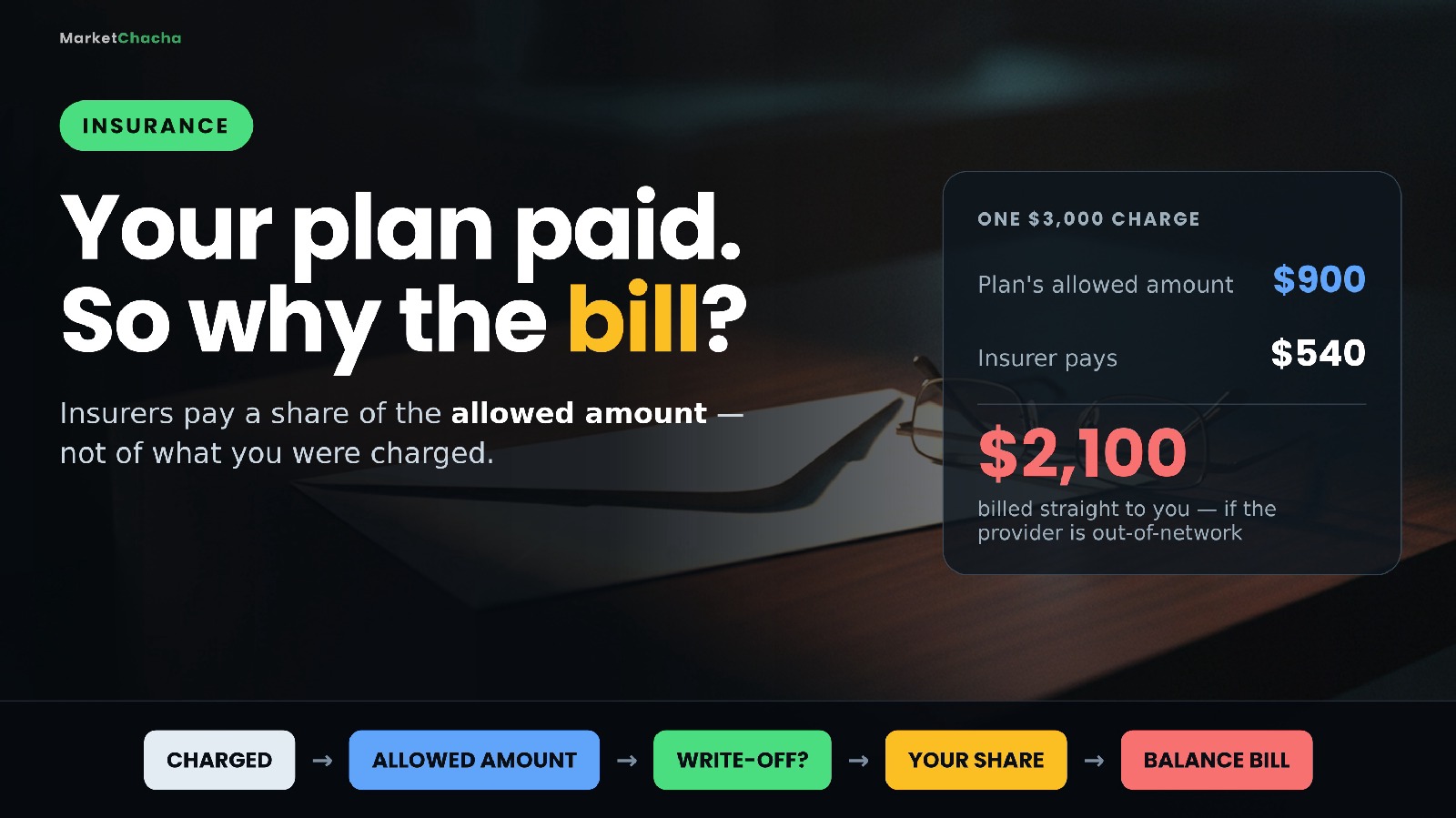
The short answer: your insurance company and your doctor were never arguing about the same number. Your plan does not pay a percentage of what the provider charges. It pays a percentage of the allowed amount — HealthCare.gov defines it as "the maximum amount a plan will pay for a covered health care service." When the provider is in-network, they have signed a contract agreeing to accept that allowed amount as payment in full, so the gap between their charge and the allowed amount simply disappears. When the provider is out-of-network, they signed nothing — so the gap becomes a bill with your name on it. That bill is called balance billing.
This article walks through the allowed amount and why it is the only number that matters, a full worked example with the arithmetic on both sides, the two out-of-network penalties almost nobody sees coming, the situations where federal law now makes balance billing illegal, how to read your Explanation of Benefits, a step-by-step routine to avoid the problem, and how the same mechanic shows up in India as network hospitals and cashless claims.
The allowed amount: the only number that matters
Three different dollar figures show up on any medical claim, and confusing them is the whole problem:
- The billed charge — what the provider lists on their chargemaster. This number is close to fiction. It is a starting price almost nobody pays.
- The allowed amount — the maximum your plan will pay for that service. HealthCare.gov notes it "may also be called 'eligible expense,' 'payment allowance,' or 'negotiated rate.'"
- Your cost sharing — the deductible, copay or coinsurance you owe, calculated on the allowed amount, never on the billed charge.
Here is the part that trips people up. Your coinsurance percentage is not the interesting variable. Eighty percent of a number the provider has agreed to accept is a completely different animal from sixty percent of a number the provider has not agreed to accept. Network status decides whether the leftover exists at all.
What being "in-network" actually buys you
A network is a set of contracts. A hospital, lab or physician group signs an agreement with an insurer: we will treat your members, you will send us volume, and we will accept your negotiated rate as full payment. That last clause is the entire benefit to you. HealthCare.gov states it directly: "A preferred provider may not balance bill you for covered services."
So when an in-network provider charges $3,000 and your plan's allowed amount is $1,200, the $1,800 difference is not forgiven out of kindness. It is contractually written off, because the provider agreed in advance that $1,200 is the price. You never see the $1,800 again.
An out-of-network provider has no such contract. They still send a claim, your plan still applies its own out-of-network allowed amount, and the provider is then perfectly entitled to invoice you for everything above it. HealthCare.gov defines balance billing as exactly this: when "a provider bills you for the difference between the provider's charge and the allowed amount."
Worked example: the same $3,000 charge, two networks
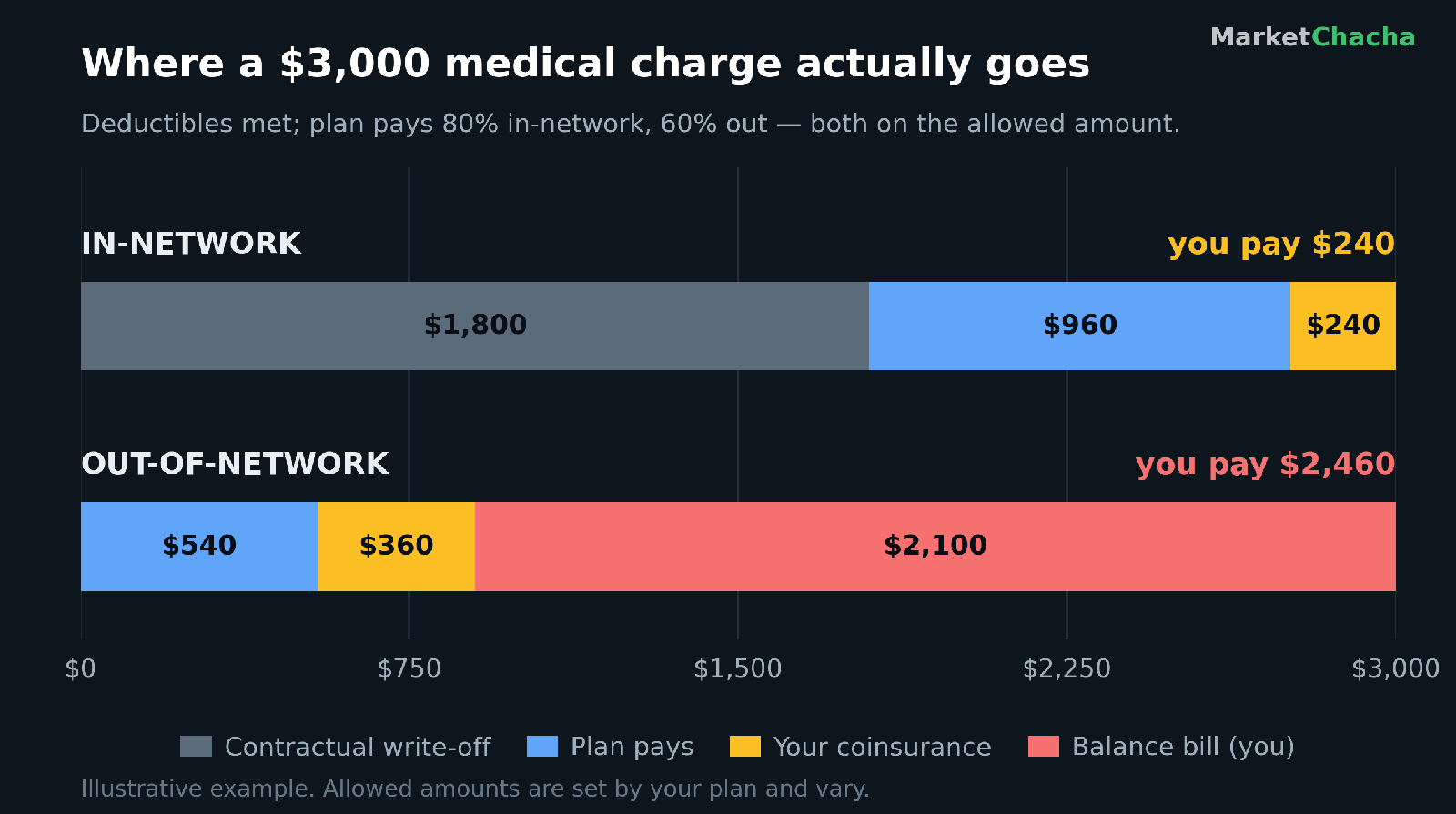
Assume your deductible is already met for the year, so we are only looking at coinsurance. Your plan pays 80% in-network (you pay 20%) and 60% out-of-network (you pay 40%). A specialist bills $3,000 either way.
Scenario A — the specialist is in-network. The plan's negotiated allowed amount is $1,200.
- Contractual write-off: $3,000 − $1,200 = $1,800, gone
- Plan pays 80% of $1,200 = $960
- You pay 20% of $1,200 = $240
Scenario B — the same specialist is out-of-network. Your plan sets its own out-of-network allowed amount for this service at $900 (plans typically benchmark this against something like a percentage of Medicare rates or a usual-and-customary schedule — it is set by the plan, not negotiated with the provider).
- Contractual write-off: $0 — there is no contract
- Plan pays 60% of $900 = $540
- Your coinsurance: 40% of $900 = $360
- Balance bill from the provider: $3,000 − $900 = $2,100
- Your total: $360 + $2,100 = $2,460
Same doctor, same procedure, same $3,000 charge. $240 versus $2,460 — a bit over ten times more — and the coinsurance percentage explains almost none of the difference. The write-off does.
The two out-of-network penalties almost nobody sees coming
First: a separate, usually much larger deductible. Plans that cover out-of-network care at all typically run two deductibles side by side, and spending against your in-network deductible does not chip away at the out-of-network one. (Plan designs vary — an HMO or EPO may not cover routine out-of-network care at all, in which case the plan pays nothing and the entire charge is yours.) In the example above we assumed both deductibles were met, which is generous.
Second — and this is the brutal one — your out-of-pocket maximum does not save you. That number is the promise that after you have spent enough, the plan pays 100%. But read HealthCare.gov's definition of what the out-of-pocket maximum excludes: "your monthly premiums," "anything you spend for services your plan doesn't cover," "out-of-network care and services," and "costs above the allowed amount for a service that a provider may charge."
Read that last line again. The $2,100 balance bill in our example is, by definition, a cost above the allowed amount. It does not count toward your out-of-pocket maximum. There is no ceiling on it at all. A person who has already hit their in-network out-of-pocket maximum and believes they are done paying for the year can still receive an uncapped five-figure balance bill.
When balance billing is illegal: the No Surprises Act
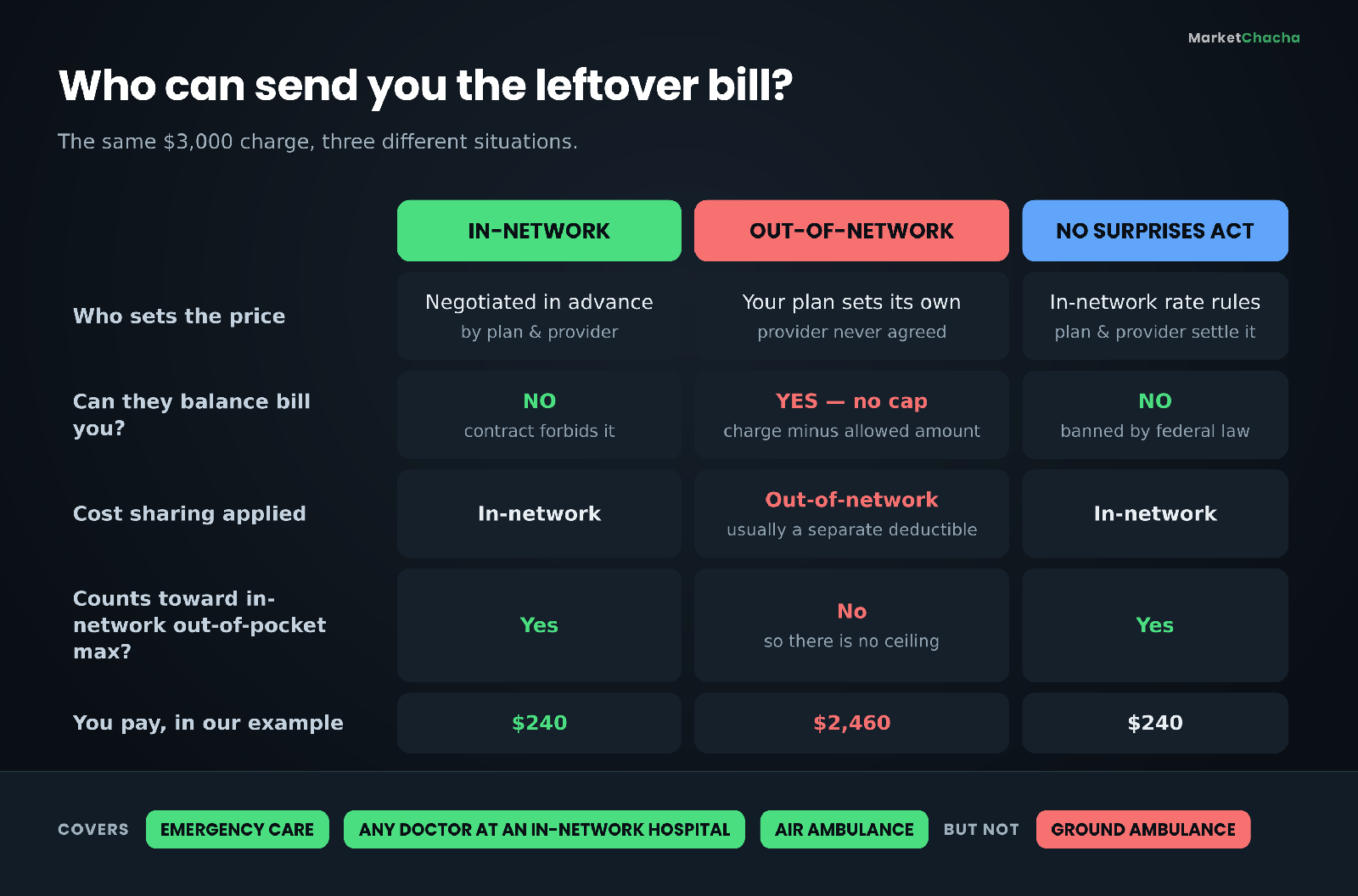
Since 1 January 2022, federal law closes the worst version of this trap — the one where you did nothing wrong. The CMS overview of the No Surprises Act bans balance billing in three situations:
- Emergency services, including post-stabilization services, from out-of-network providers or facilities.
- Non-emergency services from out-of-network providers at an in-network facility — the anesthesiologist, radiologist, pathologist or assistant surgeon you never chose, at a hospital, hospital outpatient department, critical access hospital or ambulatory surgical center that is in your network.
- Air ambulance services from out-of-network providers.
Where the protection applies, CMS says your cost sharing cannot exceed "the requirement that would apply if the item or service was provided in-network," and — importantly — those amounts count toward your in-network deductible and in-network out-of-pocket maximum. The plan and the provider then fight over the rest between themselves; you are out of it.
What the law does not cover is just as important. CMS is explicit that ground ambulance is generally excluded "unless a state law has different rules" — they "are still allowed to charge out-of-network rates." Also outside the protection: non-emergency care at an out-of-network facility, non-emergency care in non-facility settings such as an ordinary doctor's office or community clinic, and anything your plan simply does not cover. There is also a narrow notice-and-consent waiver: for certain non-emergency, non-ancillary services, a provider can ask you to sign away the protection in advance using standard federal forms. Signing is voluntary. If you think you were billed in violation of the rules, CMS runs a No Surprises Help Desk on 1-800-985-3059.
How to read your EOB before you pay anything
When a claim is processed, your insurer sends an Explanation of Benefits. CMS's own sample EOB carries the line "THIS IS NOT A BILL" at the top, and spells out that "an EOB is NOT A BILL." It is the receipt of a negotiation, and its columns are exactly the three numbers from earlier: Provider Charges, Allowed Charges, then Co Pay, Deductible, Coinsurance, Paid by Insurer, and finally What You Owe.
The single most useful habit in American health care: when a provider bill arrives, put it next to the EOB for the same date of service and compare the two "you owe" figures. If the provider is asking for more than the EOB's What You Owe column, you are looking at either a balance bill or a billing error — and you should find out which before sending money.
How to actually avoid this, step by step
- 1. Verify the network on the plan's side, not the provider's. Look the provider up in your insurer's own directory and call the number on your insurance card. A clinic saying "we take your insurance" can mean only that they will submit a claim to it.
- 2. Verify the facility and the people separately. An in-network hospital does not make the anesthesiologist in-network. For scheduled surgery, ask who else will bill you — anesthesia, pathology, radiology, assistant surgeon, the outside lab.
- 3. Ask for the CPT codes and get a written estimate. With the procedure codes in hand, your insurer can tell you the allowed amount and your expected share before anything happens.
- 4. Read anything you are asked to sign at check-in. A routine financial-responsibility form and a No Surprises Act notice-and-consent waiver are not the same document, and signing the second gives away a federal protection.
- 5. Never pay a provider bill before the EOB arrives, and match the two first.
- 6. If the numbers disagree, dispute it in writing — with the billing office and your insurer, and with the Help Desk or your state insurance regulator where a protection applies.
Common mistakes beginners make
- Assuming a low coinsurance percentage protects you. It is applied to the allowed amount. Without a network contract, the leftover is unlimited.
- Assuming "my plan has out-of-network benefits" means you are covered. It means the plan will pay something. It does not stop the balance bill.
- Trusting the out-of-pocket maximum out-of-network. HealthCare.gov excludes out-of-network care and above-allowed-amount charges from it.
- Paying the first invoice that arrives. Providers often bill before the claim finishes processing. Wait for the EOB.
- Thinking the No Surprises Act covers everything. Ground ambulance and non-emergency care at out-of-network facilities are the two big gaps — and signing a consent form at the front desk can waive the protection where it would otherwise apply.
How this works in India
India has the same underlying mechanic under different names. An insurer maintains a list of network hospitals with agreed tariffs, and treatment there can be cashless — the insurer settles directly with the hospital. Go outside the network and you typically pay the full bill yourself and file a reimbursement claim afterwards, settled against policy terms rather than a negotiated tariff. The cash-flow pain is different from the US (you front the money instead of receiving a surprise invoice), but the principle is identical: the network contract is what caps the price.
Two regulatory changes have moved the picture. The IRDAI Master Circular on Health Insurance Business dated 29 May 2024 requires insurers to decide a cashless authorisation request "immediately but not more than one hour of receipt of request," to grant final authorisation within "three hours of the receipt of discharge authorisation request from the hospital," and says every insurer "shall strive to achieve 100% cashless claim settlement in a time bound manner." Separately, the General Insurance Council launched "Cashless Everywhere" on 24 January 2024, extending cashless treatment to non-network hospitals — provided you inform the insurer at least 48 hours before an elective admission or within 48 hours of an emergency one. Note the caveat: it depends on the hospital agreeing to the insurer's tariff and documentation, so it is not an unconditional right to cashless care anywhere.
India's closest equivalent to the US "allowed amount" problem is the room-rent sub-limit and proportionate deduction. If your policy caps room rent at ₹5,000 a day and you take a ₹10,000 room, many policies scale down the associated medical expenses in the same 50% proportion — commonly doctor's fees, nursing, operating-theatre and similar room-linked charges. Take a five-day stay billed at ₹2,10,000 (₹50,000 room + ₹1,60,000 associated expenses): the insurer covers the eligible ₹25,000 of room rent plus 50% of ₹1,60,000 = ₹80,000, so it pays ₹1,05,000 and you carry ₹1,05,000. Charges hospitals bill at flat rates regardless of room category — pharmacy, implants, diagnostics, consumables and ICU — are commonly excluded from the deduction, but this varies by policy wording, so read your own schedule rather than assuming.
The practical checklist in India: confirm the hospital is in your insurer's current network list before a planned admission, understand your room-rent sub-limit and pick the room accordingly, notify the insurer inside the 48-hour windows, and keep every original bill and discharge summary if you are going the reimbursement route.
FAQ
Why did I get a bill after my insurance already paid? Because your plan paid a percentage of its allowed amount, not of what the provider charged. If the provider is out-of-network, they can bill you the difference between their charge and that allowed amount — this is called balance billing.
What is the difference between the allowed amount and the billed charge? The billed charge is the provider's list price. The allowed amount is the most your plan will pay for that service. In-network providers contractually write off the difference; out-of-network providers do not have to.
Is balance billing legal? It is legal in many out-of-network situations, but since 1 January 2022 the federal No Surprises Act bans it for most emergency care, for out-of-network providers working at in-network facilities, and for out-of-network air ambulance. Ground ambulance is generally not protected under federal law.
Does a balance bill count toward my out-of-pocket maximum? No. HealthCare.gov states the out-of-pocket maximum excludes out-of-network care and "costs above the allowed amount for a service that a provider may charge." That is exactly what a balance bill is, so there is no cap on it.
The hospital was in-network but the anesthesiologist was not — do I have to pay? In most cases no. The No Surprises Act specifically covers out-of-network providers delivering non-emergency services at an in-network hospital, hospital outpatient department, critical access hospital or ambulatory surgical center, unless you signed a valid notice-and-consent waiver.
What should I do the moment a surprise bill arrives? Do not pay it. Get the Explanation of Benefits for the same date of service and compare the provider's demand with the EOB's "What You Owe" column. If they disagree, dispute it in writing with both the billing office and your insurer, and where a federal protection applies you can contact the CMS No Surprises Help Desk on 1-800-985-3059.
Educational content only — not investment, tax or insurance advice, and not a recommendation of any product. All figures in the worked examples are illustrative. Rates, fees and rules change — always check current terms with your insurer and your own policy document. [Sources: HealthCare.gov — Allowed amount, HealthCare.gov — Balance billing, HealthCare.gov — Out-of-pocket maximum, CMS — No Surprises Act Key Consumer Protections, CMS — Know your rights with insurance, CMS — Sample Explanation of Benefits, CFPB — Surprise medical bills, IRDAI — Master Circular on Health Insurance Business, 29 May 2024, General Insurance Council — Cashless Everywhere] Always do your own research.
This article is for educational and informational purposes only. It is not financial advice, investment recommendation, or a solicitation to buy or sell securities. Investing involves significant risks. I am not a SEBI-registered investment advisor. Readers should consult their own financial advisor and conduct their own research before making any investment decisions.
Comments
Join the conversation
Sign in to join the conversation.
Follow replies, add your view, and take part in the discussion.
Sign in to commentLoading comments...