

Why did HFCL lock its 5% upper circuit today? Its order book more than doubled
What happened
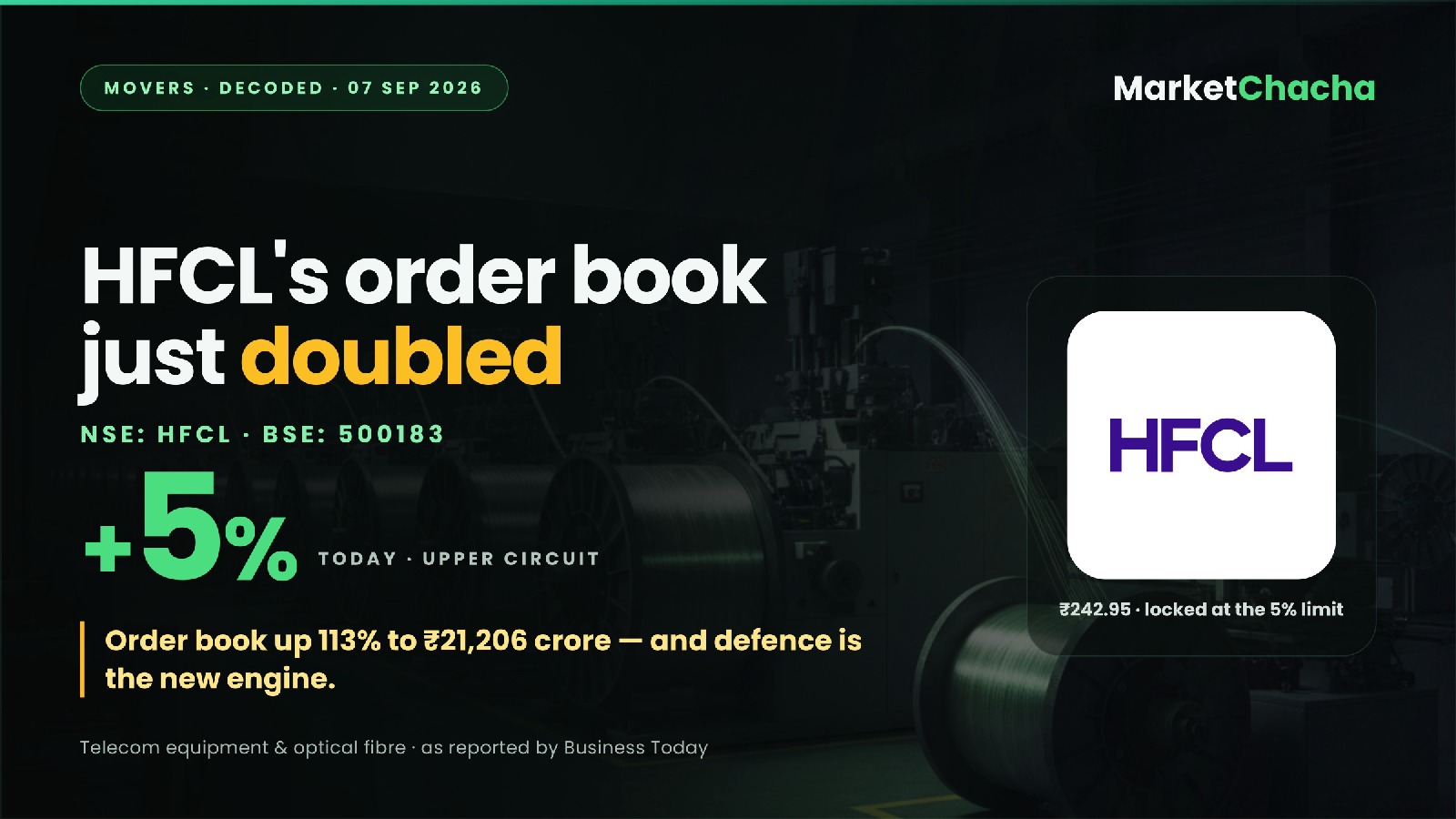
HFCL closed up 5% at ₹242.95, from a previous close of ₹231.40 — and it got there by locking its 5% upper circuit, as reported by Business Today. An upper circuit isn't just "the stock rose 5%." It means the exchange's daily price band was hit with buyers still queued and nothing left to buy. The move stopped because the rulebook stopped it, not because demand ran out.
It happened on a red day, too: the Sensex fell 382.62 points (-0.50%) to 76,132.81 and Nifty IT dropped over 2%, per Business Standard.
Why it moved
The trigger was paperwork. HFCL filed its FY26 annual report and 39th AGM notice on 5 September, and Monday was the first full session to trade it. The headline number: the order book stood at ₹21,206 crore at end-FY26, against ₹9,967 crore a year earlier — up 113%.
Here's what most coverage skipped: almost none of those figures were new. The ₹21,206 crore book, FY26 revenue of ₹4,949.27 crore (+21.77%) and PAT of ₹329.44 crore (+90.14%) all came out with the Q4 results. What the annual report did was gather the growth story and the defence ramp into one document, in the company's own words. Annual reports often move prices by collecting facts, not revealing them — useful to know before the next AGM season.
The one number that does reframe things is defence. HFCL did ₹77 crore of defence revenue in FY26 and is targeting ₹500 crore in FY27 — roughly a six-fold jump — with 1,000 acres allocated in Andhra Pradesh for manufacturing. It already holds ₹1,930 crore of confirmed defence export orders.
The business
HFCL is not a defence pure-play, and today's story is only one slice of it. The order book splits roughly like this:
- Optical fibre, cable and connectivity — ₹13,483 crore, of which ₹12,248 crore is export. This is still the company.
- EPC and system integration — ₹6,620 crore: turnkey network build-outs, lumpier and lower-margin than products.
- Defence and aerospace — ~₹2,230 crore of visibility, ₹1,930 crore of it confirmed export orders.
- Telecom equipment — ₹804 crore: radios, transport gear, broadband kit.
Two shifts underneath matter more than the total. Exports hit ₹2,047 crore, 41% of revenue in FY26, up from 12% in FY25. And private customers now make up about 84% of revenue — HFCL has largely stopped being a BSNL-cycle stock. That mix change is why EBITDA margin jumped from 12.47% to 16.70% while revenue grew only 21.77%.
Is it expensive?
Yes, on any normal reading. HFCL trades at a P/E of about 112 and P/B of 8.5 on a market cap near ₹34,892 crore, as reported by Tickertape, against a sector average P/E of 34. A P/E in the low 100s means paying roughly a hundred rupees for each rupee of last year's profit — that only works if profit keeps compounding near the 90% pace it just did, for years. The stock is already up 252% in 2026.
The peer comparison is more awkward than it looks. Sterlite Technologies, the obvious listed optical-fibre rival, trades at a P/E of about 578 on a market cap of ₹32,343 crore (Tickertape). That doesn't make HFCL cheap — it means both are priced off a fibre-and-defence order-book story rather than current earnings, and Sterlite's earnings base is simply more depressed.
Who it touches
- Optical fibre peers — Sterlite Technologies, Tejas Networks: a doubled order book at one player reads as a demand signal for the whole fibre chain.
- Telecom capex names — Vodafone Idea rose 4% to a 25-month high the same day (Business Standard); network spending is the shared upstream driver.
- Defence electronics incumbents — a new entrant chasing ₹500 crore adds competition, not just enthusiasm.
The one risk that flips this
Export concentration. ₹12,248 crore of the ₹13,483 crore fibre book is export business, and ₹1,930 crore of the defence book is too. An order book is a promise, not revenue — it converts on a schedule the customer controls, and export orders carry currency, tariff and geopolitical risk a domestic BSNL contract doesn't. At 112x earnings, two quarters of slower conversion costs far more than it would at 30x. Watch the Q1 FY27 execution rate against that ₹21,206 crore, and whether defence revenue actually clears its first few hundred crore.
As of 7 September 2026, 15:30 IST. Sources: Business Today, Business Standard, Communications Today, Investing.com (Q4 FY26 slides), Tickertape, BSE filings. For discussion and education only — not investment advice. Verify before acting.
This article is for educational and informational purposes only. It is not financial advice, investment recommendation, or a solicitation to buy or sell securities. Investing involves significant risks. I am not a SEBI-registered investment advisor. Readers should consult their own financial advisor and conduct their own research before making any investment decisions.
Comments
Join the conversation
Sign in to join the conversation.
Follow replies, add your view, and take part in the discussion.
Sign in to commentLoading comments...