

How much life insurance do you actually need? (the DIME method and the maths)

The honest answer is: enough to clear the debts your family would inherit and to replace the income they would lose — for as long as they would need it. A common rule of thumb is 10 to 12 times your annual income, but that is only a starting point. The DIME method (Debt, Income, Mortgage, Education) and the more rigorous Human Life Value approach give you a number that actually fits your life. This guide walks through all three, with the maths, so you can put a real figure on your own cover instead of guessing.
Why does this matter? Because most people guess badly. In its 2025 Insurance Barometer Study, LIMRA estimated that roughly 100 million American adults are uninsured or underinsured, with about 4 in 10 saying they need life insurance or need more of it. Part of the reason is fear of cost: LIMRA found that adults aged 18–30 overestimate the price of a $250,000, 20-year term policy by 10 to 12 times. Term cover, bought while you are young and healthy, is usually far cheaper than people assume — so the bigger risk is buying too little, not paying too much.
The short answer: what "enough" really means
Life insurance is not about your life — it is about the money other people depend on you for. So "enough" is the sum that lets the people you leave behind carry on without a financial shock. In practice that breaks into four buckets:
- Final expenses and debts — a funeral, medical bills, car loans, credit cards and any co-signed loans that would otherwise fall on your family.
- Income replacement — the paycheque your household would lose, covered for the number of years they would need it (until the kids are grown, or a spouse retires).
- Big future costs — most commonly the mortgage payoff (so the family keeps the home) and children's education.
- Minus what you already have — savings, investments, existing policies and any group cover from work.
Every method below is just a different way of adding up the first three buckets and subtracting the fourth.
Rule of thumb: 10 to 12 times your income
The fastest estimate is to multiply your gross annual income by 10 to 12. If you earn $80,000, that is $800,000 to $960,000 of cover. It is popular because it is quick, and it roughly captures "a decade of income for the family to regroup."
The catch is that a flat multiple ignores your actual balance sheet. It does not know whether you have a $250,000 mortgage or none, three kids heading to college or none, or $200,000 already sitting in a 401(k). Two people earning $80,000 can have wildly different real needs. Treat the multiple as a sanity check, not the final answer.
The DIME method: a truer number in four steps
DIME is an acronym for the four things you add up, and it fixes the main blind spots of the simple multiple:
- D — Debt (and final expenses): total your non-mortgage debts — car loans, credit cards, personal and student loans — plus a realistic figure for funeral and final costs.
- I — Income: multiply your annual income by the number of years your family needs it replaced. Many people use 7 to 10 years; use longer if you have very young children.
- M — Mortgage: add the amount left on your home loan, so your family can stay put without forced downsizing.
- E — Education: add the projected cost of educating your children (or anyone who depends on your plan).
Add the four together and you have a coverage target that reflects your real obligations, not an average stranger's.
A worked example: putting a real number on it
Meet Priya, 38, the main earner in her household, married with two young children. She earns $80,000 a year. Here is her DIME calculation:
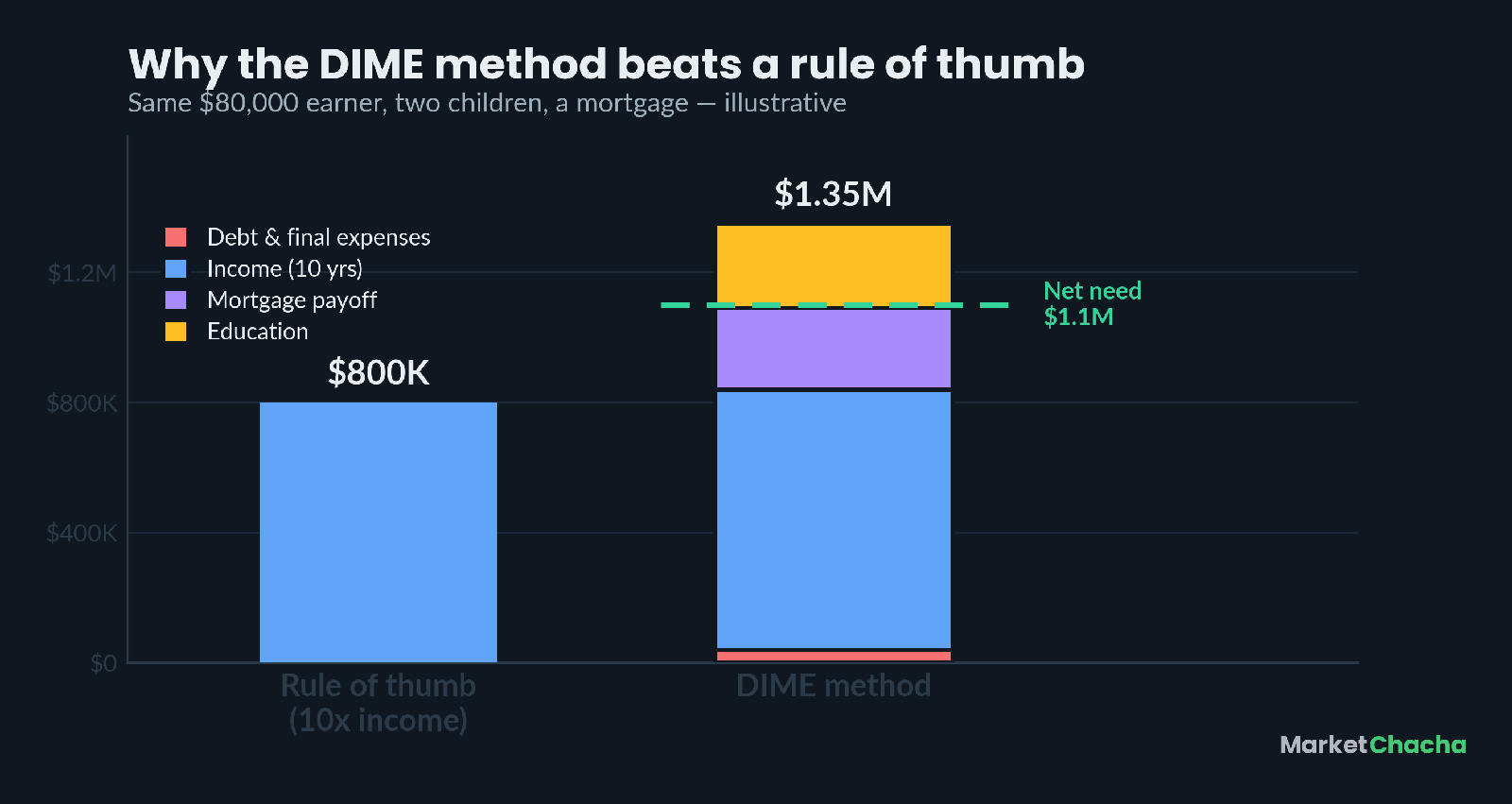
- D — Debt & final expenses: $18,000 car loan + $7,000 credit cards + $15,000 estimated final expenses = $40,000
- I — Income replacement: $80,000 × 10 years = $800,000
- M — Mortgage payoff: $250,000
- E — Education: two children × $130,000 each = $260,000
DIME total = $40,000 + $800,000 + $250,000 + $260,000 = $1,350,000.
Now subtract what Priya's family already has: employer group life of $160,000 (about 2× salary, a common workplace default) plus $90,000 in savings and investments = $250,000 already covered. So her true gap is $1,350,000 − $250,000 = about $1.1 million of new term cover.
Notice what the quick rule of thumb would have told her: $80,000 × 10 = $800,000. That is about $300,000 less than the $1.1 million of cover the DIME method says she actually needs to buy — because the flat multiple silently ignores the mortgage and the kids' education. That gap is exactly why the extra five minutes of DIME maths is worth it.
Human Life Value: the most rigorous approach
Human Life Value (HLV) is the method insurers and financial planners lean on when they want precision. Instead of round multiples, it estimates the present value of all the future income you would have earned for your family, net of what you spend on yourself. Conceptually, you: (1) estimate your future earnings to retirement, allowing for raises; (2) subtract your own living costs (often 25–35% of income) to isolate what actually reaches the household; (3) set the number of years to replace; and (4) discount those future amounts back to today's money using a discount rate that reflects inflation and expected investment returns.
Because it accounts for the time value of money and your full earning runway, HLV usually lands close to — or a little above — a well-done DIME number for a younger person with decades of earning left. It is more work and needs a calculator, but it is the most defensible figure. If you would rather not run the discounting yourself, DIME is a very reasonable proxy.
How to actually calculate your number (step by step)
You do not need software to get a solid figure. Do this in order:
- Step 1 — Add your debts. List every balance you owe plus an estimate for final expenses. That is your D.
- Step 2 — Replace your income. Decide how many years your household needs support (until the youngest child is independent is a common anchor) and multiply by your income. That is your I.
- Step 3 — Add the mortgage and education. Use the current payoff balance and a realistic per-child education cost. That is M + E.
- Step 4 — Subtract what you already have. Deduct savings, investments and any group or existing policies. Do not skip this — it is where people most often over-buy.
- Step 5 — Round up and choose a term. Pick a policy length that covers your highest-need years (often 20–30 years, until the mortgage is gone and the kids are grown).

The catch: what over- and under-buying cost you
Buying too little is the obvious danger — a shortfall shows up at the worst possible moment. But over-buying has a real cost too: every extra dollar of cover is an extra premium dollar you could have invested or spent. The goal is "right-sized," not "maximum." Two practical nuances: your need is not fixed — it is usually highest in your 30s and 40s (young kids, big mortgage) and falls as the mortgage shrinks, the children become independent and your savings grow. Some people "ladder" policies (for example, a 30-year and a 15-year term stacked) so their coverage steps down as their need does, keeping premiums lower. And remember this article is about the amount of cover — whether you buy term or whole life is a separate decision covered in our term-vs-whole guide.
Common mistakes beginners make
- Only insuring the higher earner. A stay-at-home parent's unpaid work (childcare, running the home) has a real replacement cost and often deserves cover too.
- Counting group life as enough. Employer cover is usually just 1–2× salary and vanishes if you change jobs — treat it as a top-up, not the plan.
- Forgetting to update it. A new baby, a bigger home or a jump in income all change your number. Revisit it every few years or after any big life event.
- Delaying because "it's expensive." Premiums rise with age and health problems. The cheapest cover you will ever be offered is the cover you buy today.
How this works in India
The logic is identical; only the products change. In India the workhorse is a pure term insurance plan, which pays a lump sum to your nominee if you die during the policy term and is strikingly cheap for large sums assured when bought young. The common rule of thumb is 10 to 15 times your annual income plus any outstanding liabilities (home loan, car loan, education loan) — a touch higher than the US multiple because term premiums are low and cover is meant to fully clear big loans.
The IRDAI (Insurance Regulatory and Development Authority of India) recognises the Human Life Value method as the most scientific way to size cover: net annual income (gross income minus your personal expenses, typically 25–35%) multiplied by a present-value factor that discounts future income at a rate reflecting inflation plus a risk premium. Practically, apply the same DIME buckets — outstanding loans, years of income to replace, home-loan balance and children's education (which in India can be a very large line item) — then subtract existing cover and savings, including any employer group term and your EPF corpus. Buy the term plan directly (online plans are cheaper), disclose your health and income honestly so the claim is not disputed later, and name a nominee.
FAQ
How much life insurance do I actually need? Enough to clear your debts and final expenses, pay off your mortgage, replace your income for the years your family depends on it, and fund your children's education — minus the savings and existing cover you already have. The DIME method adds those up; a quick check is 10–12× your income.
Is 10 times your income enough life insurance? It is a reasonable starting estimate, but it ignores your mortgage, other debts, education costs and any cover you already hold. For many families with a mortgage and young children the true DIME number is higher; for someone debt-free with grown kids it may be lower.
What is the DIME method? DIME stands for Debt, Income, Mortgage and Education. You add your non-mortgage debts plus final expenses, your income times the years to replace it, your remaining mortgage, and your children's education costs, then subtract your existing assets and cover to get your target.
Should I include my mortgage in my life insurance calculation? Yes. Adding the outstanding mortgage balance means your family can keep the home without being forced to sell or downsize, which is one of the biggest reasons a flat income-multiple can leave a gap.
Does a stay-at-home parent need life insurance? Often yes. The childcare, cooking and household work they do has a real cost to replace, so many families insure both partners even when only one earns a salary.
How much term cover do I need in India? A common guideline is 10–15 times your annual income plus outstanding loans, or the Human Life Value figure recommended by IRDAI. Because Indian term plans are inexpensive, buying a large enough sum assured to clear all loans and replace years of income is usually very affordable when bought young.
Educational content only — not investment, tax or insurance advice, and not a recommendation of any product. Rates, fees and rules change — always check current terms with the provider. Figures such as coverage-gap and cost-overestimate statistics are as of 2025 per LIMRA; the worked example uses illustrative numbers. [Sources: LIMRA 2025 Insurance Barometer Study, LIMRA on cost overestimation, Human Life Value method]. Always do your own research.
This article is for educational and informational purposes only. It is not financial advice, investment recommendation, or a solicitation to buy or sell securities. Investing involves significant risks. I am not a SEBI-registered investment advisor. Readers should consult their own financial advisor and conduct their own research before making any investment decisions.
Comments
Join the conversation
Sign in to join the conversation.
Follow replies, add your view, and take part in the discussion.
Sign in to commentLoading comments...