

Why did Syngene International sink ~9% to a 52-week low today?
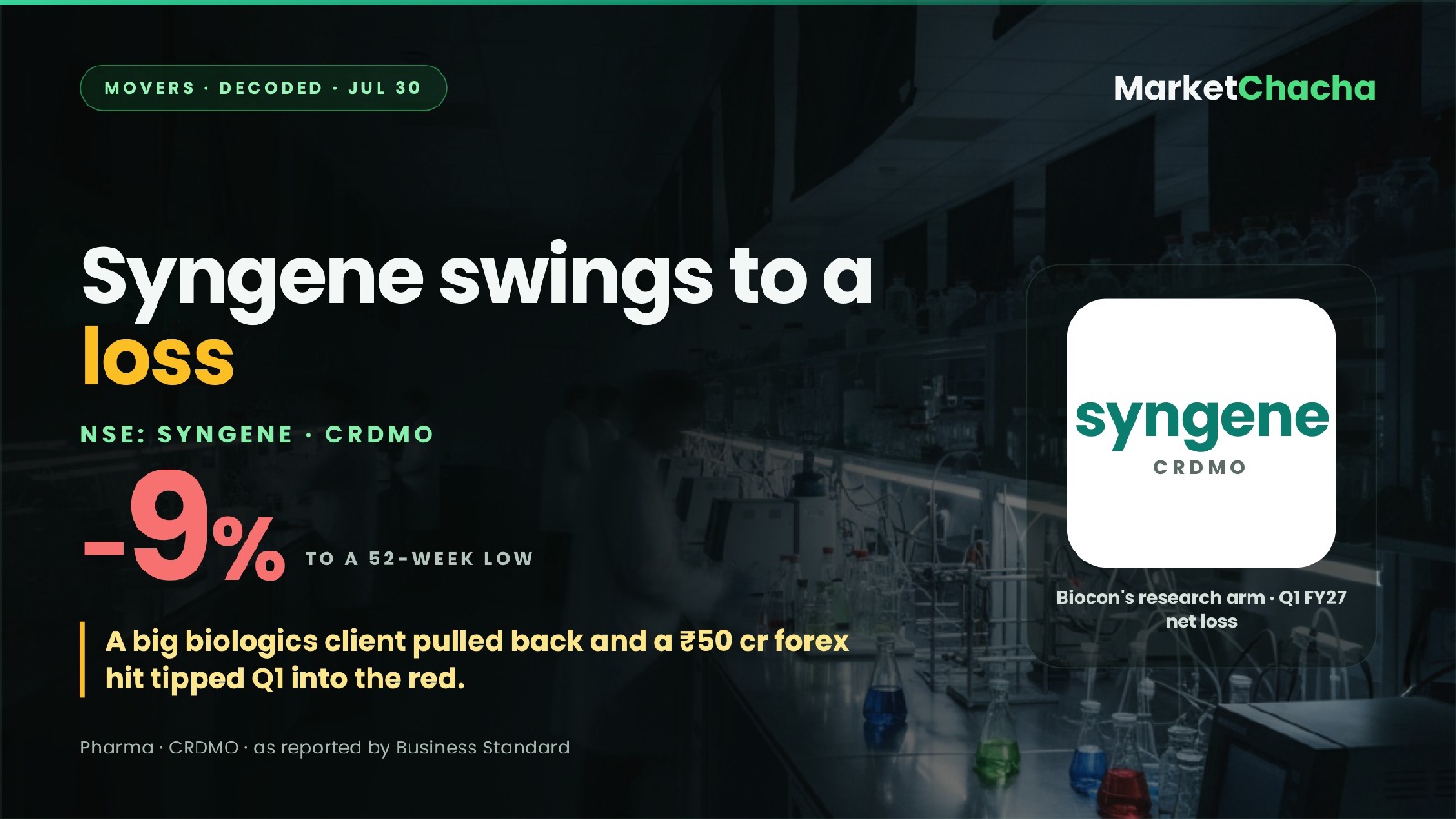
Syngene International — the Bengaluru research-and-manufacturing arm that Biocon controls — did something it almost never does: it lost money for a quarter. The market's reaction was quick and brutal.
What happened
On Thursday, Syngene (NSE: SYNGENE) fell as much as ~9% to a 52-week low of ₹375.25 — opening at ₹391 against Wednesday's ₹413.65 close and trading down 8.87% at ₹377.50 by late morning on roughly 2 million shares, per Business Standard. The trigger was its June-quarter (Q1 FY27) result, filed the same day.
Why it moved
The numbers were ugly for a company used to steady growth. Syngene swung to a net loss of ₹9 crore, from a ₹87 crore profit a year earlier. Strip out one-offs and it barely stayed in the black — pre-exceptional profit fell 98.9% to just ₹1 crore. Revenue from operations dropped 15.9% to ₹736 crore (from ₹875 crore) and was about 29% below the March quarter. Operating profit told the same story: EBITDA fell 48.2% to ₹116 crore and the EBITDA margin caved to 15.2%, from 25.1% a year ago.
Two things did the damage, and they're separate. First, demand: one large biologics client sharply cut its orders, and in a services business you can't instantly refill that booked capacity. Second, money: a net foreign-exchange loss of ₹50 crore (versus just ₹5 crore last year) on the company's currency hedges, plus a ₹13.5 crore one-off charge for employee separations. Management called it first-half pain and guided to a stronger H2, a single-digit revenue decline in rupee terms for the full year, and margins back in the mid-20% range. The quarter also formalised a leadership change — Kiran Mazumdar-Shaw as Executive Chairperson and Siddharth Mittal as MD & CEO.
The business
Syngene isn't a drugmaker — it's a CRDMO (contract research, development and manufacturing organisation). Global pharma and biotech firms pay it to run their early drug discovery, then develop and manufacture the molecules and biologics. It serves pharma, biotech, nutrition, animal health, consumer goods and specialty chemicals, and is one of India's largest integrated players in the space. That framing matters today: the miss came from one demand slice — a single biologics customer — plus currency, not the whole model breaking. During the quarter it also signed a research MoU with government body BRIC-THSTI and expanded its "Syn.AI" drug-design platform.
Is it expensive?
Here's the twist: even after a 9% fall, Syngene isn't cheap. It still trades around 50 times trailing earnings for a mid-cap worth roughly ₹16,000 crore — and that's on profits that just went backwards. In absolute terms a P/E near 50 already assumes years of clean growth. What Syngene has is a relative discount: the obvious listed comparables are pricier still — Divi's Laboratories near 70x and newly-listed Sai Life Sciences around 64x. So the whole CRDMO theme is priced for perfection; Syngene is the least-expensive name in an expensive group, not a bargain.
Who it touches
- Biocon — Syngene's majority owner. Its most valuable listed asset just posted a loss, so the value of that stake takes a knock.
- Indian CRDMO peers — Divi's Laboratories, Sai Life Sciences, Piramal Pharma, Anthem Biosciences — investors will read across to judge whether biotech client spending is softening broadly, or if this is Syngene-specific.
- The "China+1" pitch — the bull case that Western drugmakers are shifting research to India — gets a reality check when even the sector leader stumbles on one client.
What to watch
One thing flips this: whether that biologics client comes back and the promised H2 rebound actually lands. If it does, the loss reads as a one-quarter air pocket. If offtake stays soft, "temporary" becomes structural — and the number to hold is the mid-20% EBITDA margin management just re-committed to.
As of around midday IST, Jul 30, 2026. Sources: Business Standard, Business Standard (Q1 detail), Trade Brains. For discussion and education only — not investment advice. Verify before acting.
This article is for educational and informational purposes only. It is not financial advice, investment recommendation, or a solicitation to buy or sell securities. Investing involves significant risks. I am not a SEBI-registered investment advisor. Readers should consult their own financial advisor and conduct their own research before making any investment decisions.
Comments
Join the conversation
Sign in to join the conversation.
Follow replies, add your view, and take part in the discussion.
Sign in to commentLoading comments...