

Why did Persistent Systems crash ~9% today? Its big-bet Nagarro buyout, decoded
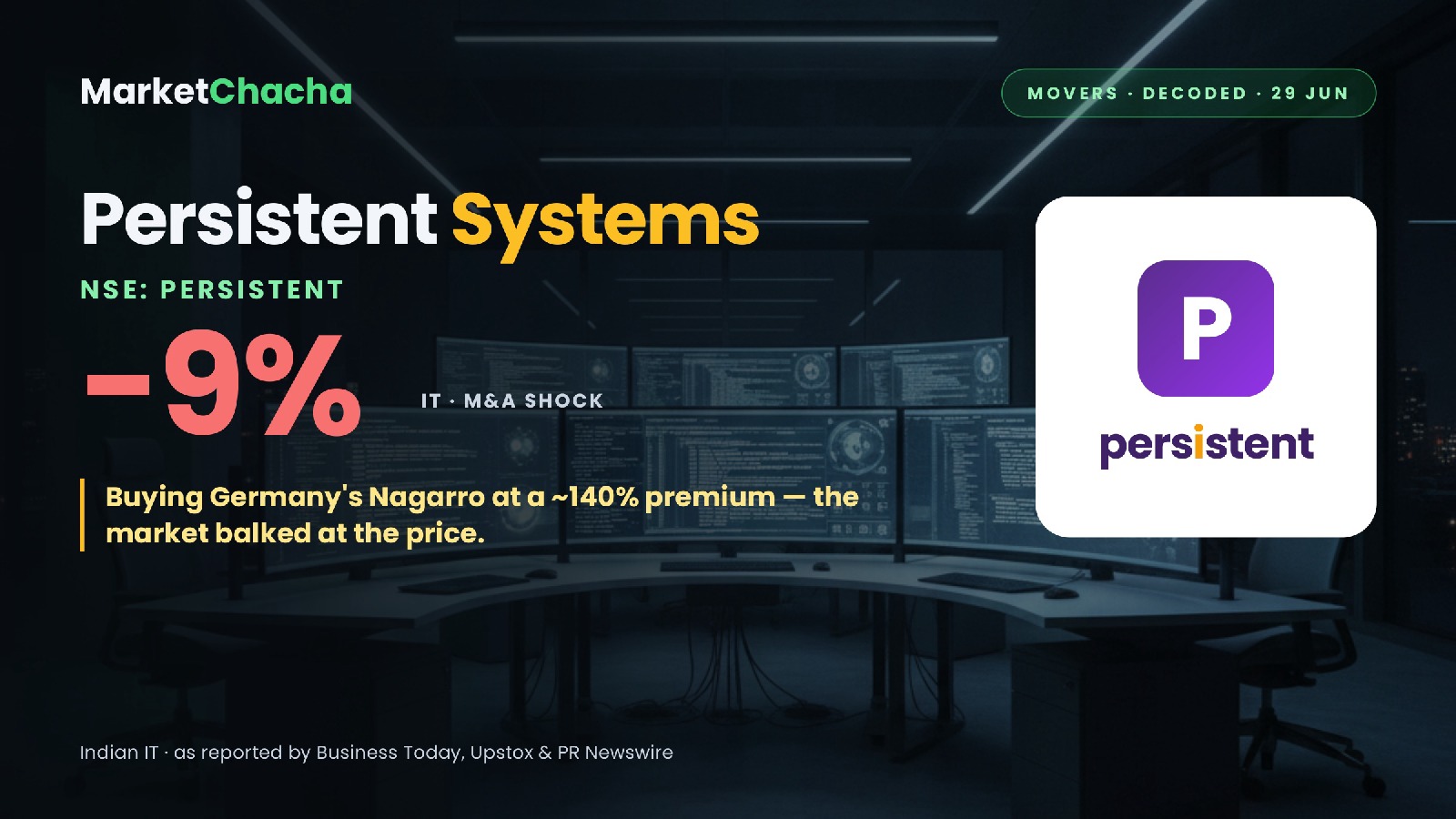
One of India's hottest IT names just had its worst day in ages — and the trigger wasn't bad results. It was a big, expensive deal. Persistent Systems is buying a German rival, and the market's first reaction was to mark Persistent down hard.
What happened
Persistent shares fell sharply on Monday. As reported by Upstox, the stock dropped about 9% to roughly ₹4,400 (from ₹4,841 at Friday's close); Business Today noted the intraday slide ran as deep as ~10–11%, dragging the stock to a fresh 52-week low and pushing its market value briefly below ₹70,000 crore.
Why it moved
Persistent (through a wholly-owned arm, Galaxy Germany Holding SE) launched a voluntary public takeover offer for Nagarro, a Frankfurt-listed German digital-engineering firm, at €81 a share. Here's the part that spooked people: that price is a premium of about 140% over Nagarro's undisturbed close on June 25, per the official release. In plain English, Persistent is paying up — a lot — to win Nagarro.
When a buyer pays a huge premium and funds it largely with debt (Persistent has lined up committed financing from Barclays), its own shareholders often worry first and cheer later. The combined group would have a ~$2.9 billion revenue run-rate, 46,000+ people across 40+ countries, and a much bigger Europe and AI-engineering footprint. Persistent has already locked in roughly a 21% stake in Nagarro from its largest holder; the deal is expected to close around Q4 2026 / Q1 2027.
The business
Persistent isn't a one-trick stock. It's a mid-cap Indian IT-services and digital-engineering company that builds software and runs technology for clients across three big buckets: Banking & Financial Services, Healthcare & Life Sciences, and Software, Hi-Tech & Emerging industries. It's been one of the fastest-growing names in the sector, leaning hard into cloud, product engineering and AI. So Nagarro isn't a side bet — it's a whole-company swing to scale up Europe and AI delivery.
Is it expensive?
This is the crux. Even after today's fall, Persistent trades at a trailing P/E near 54 with a market cap around ₹76,000 crore — pricey in absolute terms. A P/E in the low-50s already prices in years of fast, clean growth, which leaves little room for error if a big debt-funded deal stumbles. Compare it to peers: Coforge sits near a P/E of ~45 (market cap ~₹64,000 crore) and LTIMindtree is cheaper at roughly P/E ~35 (market cap ~₹1.1 lakh crore). On that math Persistent is the most richly valued of the pack — and Bank of America already rates it Underperform. None of that is a sell call; it's just why the market is nervous about it overpaying right now.
Who it touches
- Other mid-cap IT names — Coforge, LTIMindtree and Mphasis trade on the same "premium-growth" story, so sentiment here ripples to them.
- Nagarro shareholders — they're being offered a fat ~140% premium, and Nagarro's Frankfurt listing faces a possible delisting.
- Lenders & advisers — Barclays is financing the deal; integration and debt paydown become the next watch-items.
- Indian IT sentiment broadly, already soft amid a global tech/AI sell-off this month.
What to watch
The single thing that flips this: execution. If Persistent integrates Nagarro cleanly, brings down the debt as promised, and the Europe + AI-engineering scale actually shows up in margins, today's drop looks like a flinch. If integration drags or the global tech mood keeps souring, a richly-valued, debt-funded buyer has the least cushion. Next checkpoints: shareholder acceptance of the offer, regulatory clearances, and management's guidance on leverage.
As of ~13:30 IST on 29 Jun 2026. Sources: Business Today, Upstox, PR Newswire (deal release), Business Today (peer valuations). For discussion and education only — not investment advice. Verify before acting.
This article is for educational and informational purposes only. It is not financial advice, investment recommendation, or a solicitation to buy or sell securities. Investing involves significant risks. I am not a SEBI-registered investment advisor. Readers should consult their own financial advisor and conduct their own research before making any investment decisions.
Comments
Join the conversation
Sign in to join the conversation.
Follow replies, add your view, and take part in the discussion.
Sign in to commentLoading comments...