

BEML wins ₹5,400 cr NHSRCL bullet-train rolling stock order — what it means
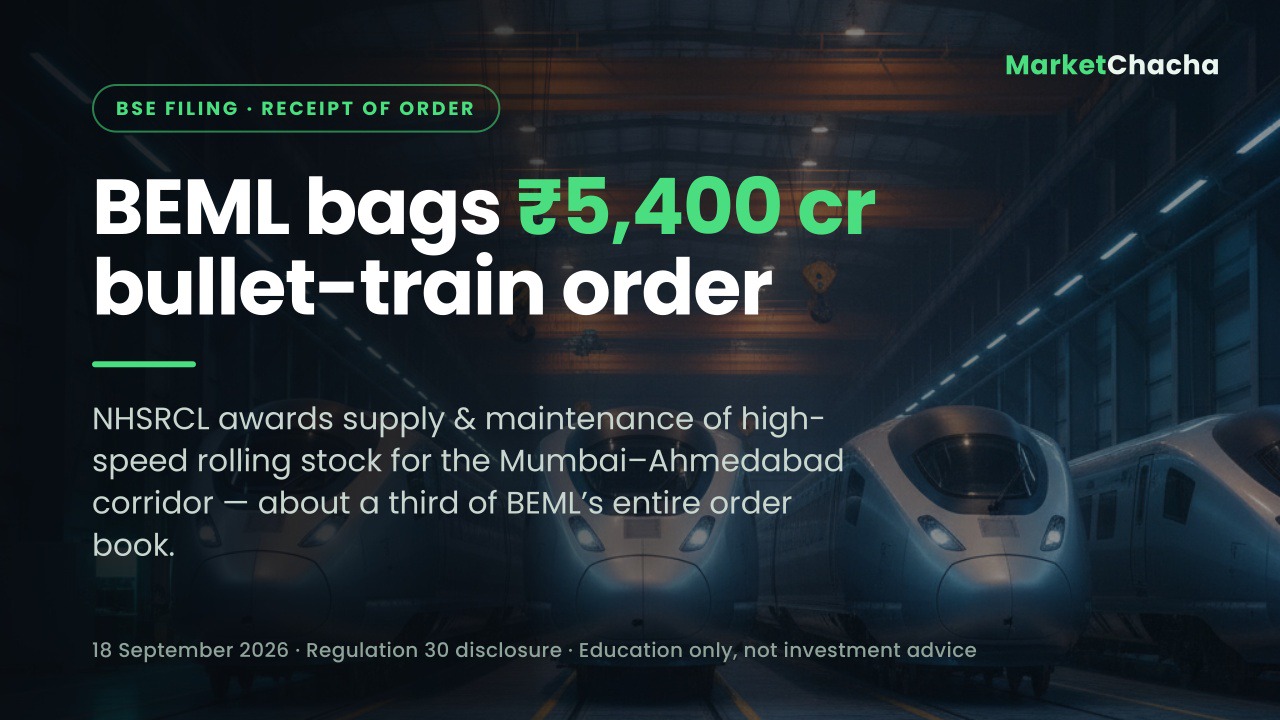
BEML told the exchanges before this morning's open that it has secured an order valued at over ₹5,400 crore from National High Speed Rail Corporation Limited (NHSRCL) for the supply and maintenance of high-speed rolling stock — the trainsets themselves — and allied works for the Mumbai–Ahmedabad High Speed Rail corridor.
What was announced
- Who: BEML Limited (BSE: 500048, NSE: BEML), a Bengaluru-based state-owned engineering company.
- What: "Valued at over ₹5,400/- Crores" — supply and maintenance of High Speed Rolling Stock and allied works.
- Filed: 18 September 2026, ref CS/SEs/869 — on the BSE feed at 09:17 IST.
- The company's own framing: "This is in normal course of business."
The filing is one page: no trainset count, no delivery schedule, no margin. For background only — NHSRCL had earlier issued a single-tender enquiry to BEML for rolling stock, and March 2026 press reports pointed to 16 indigenous trainsets beyond the two due by end-2026. That is reporting, not filing fact.
What this type of filing means
Regulation 30 of SEBI's LODR rules requires prompt disclosure of material events. Three things are worth internalising:
- An order is not revenue. Nothing reaches the profit-and-loss statement today. The ₹5,400 crore enters the order book and converts into revenue across an execution period that, for rolling stock, runs several years.
- The order book is a visibility number, not a profit number. It says how much work is contracted, never at what margin.
- "Supply and maintenance" is a meaningful phrase. Bundled long-term maintenance usually carries a steadier, often better-margin annuity tail than one-off supply. This filing does not split the two.
Why it matters
Scale is the point. BEML closed FY26 with a record order book of roughly ₹15,900 crore, about ₹16,700 crore as of June 2026. A single ₹5,400 crore award is close to a third of that base — a step-change in revenue visibility, not a top-up.
It arrives where the company needs it: FY26 revenue grew about 9%, but profit after tax was ₹148 crore, weighed down by roughly ₹250 crore of one-time legacy corrections and gratuity provisions, against a targeted 16% EBITDA margin. The counterweight belongs in the same breath — bullet-train rolling stock is first-of-its-kind work in India, so design, qualification and timeline risk are real, and a price struck years ahead of delivery absorbs input-cost movement. On the tape, the stock touched ₹2,121 (+5.4% over Thursday's ₹2,013.30 close) before easing to about ₹2,060, up ~2.3%, in the first half-hour — see today's movers.
The business
BEML is diversified, so it matters which slice this touches. By revenue the split runs roughly Mining & Construction 41%, Defence & Aerospace 35%, Rail & Metro 24%. This order sits entirely inside Rail & Metro, the smallest division — about a third of the group order book landing in a quarter of the business.
Valuation, as reported
- Size and multiple: market cap ~₹17,174 crore, price ₹2,062, P/E 96.2x, price/book 5.66x on book value ₹352, ROCE 7.66%, ROE 4.78%, dividend yield 0.84%; 52-week range ₹2,277 / ₹1,355 (Screener, consolidated).
- Its own range: no clean five-year P/E series is published by the sources checked; on current trailing EPS the 52-week price range implies roughly 63x–106x. stockanalysis.com shows trailing 83.5x against forward 30.5x.
- Named peer: Titagarh Rail Systems — market cap ~₹11,121 crore, P/E 57.3x, price/book 4.53x. Tickertape puts BEML at 119x versus a rail-sector average of 45x.
The gap between the trailing and forward multiples is the whole argument: the trailing figure sits on a depressed FY26 profit carrying one-time charges. Which number proves real is an execution question.
Beginner takeaway
A big order-win filing is news about the future delivered in the present tense: the cash arrives over years, at a margin nobody has disclosed. Read the order book next to the profit-and-loss statement, not instead of it — and note that on trailing earnings this is an expensive stock.
More order-win decodes: KEC International's ₹1,303 crore order haul, RailTel's ₹63.15 crore Doordarshan order, and Mazagon Dock's shipyard-cluster MoU.
FAQ
Does ₹5,400 crore get added to this year's revenue? No. It enters the order book and is recognised as revenue over the contract's execution period, which for high-speed rolling stock spans several years.
What does "in normal course of business" mean? It confirms the order is ordinary operating work, not a related-party transaction or an unusual one-off needing additional disclosure.
Why is the P/E so high if the company just won a huge order? A P/E uses past profit. FY26 profit was ₹148 crore after roughly ₹250 crore of one-time charges, so the denominator is small. This order affects future earnings, not trailing ones.
As of 18 September 2026. Source: official BSE/NSE filing — read it directly here. We summarise filings for education and may make errors, so always verify against the official document. Educational content only — not investment advice, not a buy/sell recommendation.
This article is for educational and informational purposes only. It is not financial advice, investment recommendation, or a solicitation to buy or sell securities. Investing involves significant risks. I am not a SEBI-registered investment advisor. Readers should consult their own financial advisor and conduct their own research before making any investment decisions.
Comments
Join the conversation
Sign in to join the conversation.
Follow replies, add your view, and take part in the discussion.
Sign in to commentLoading comments...