

Mazagon Dock MoU: anchor shipyard for a 1.2 million GT cluster — what it means
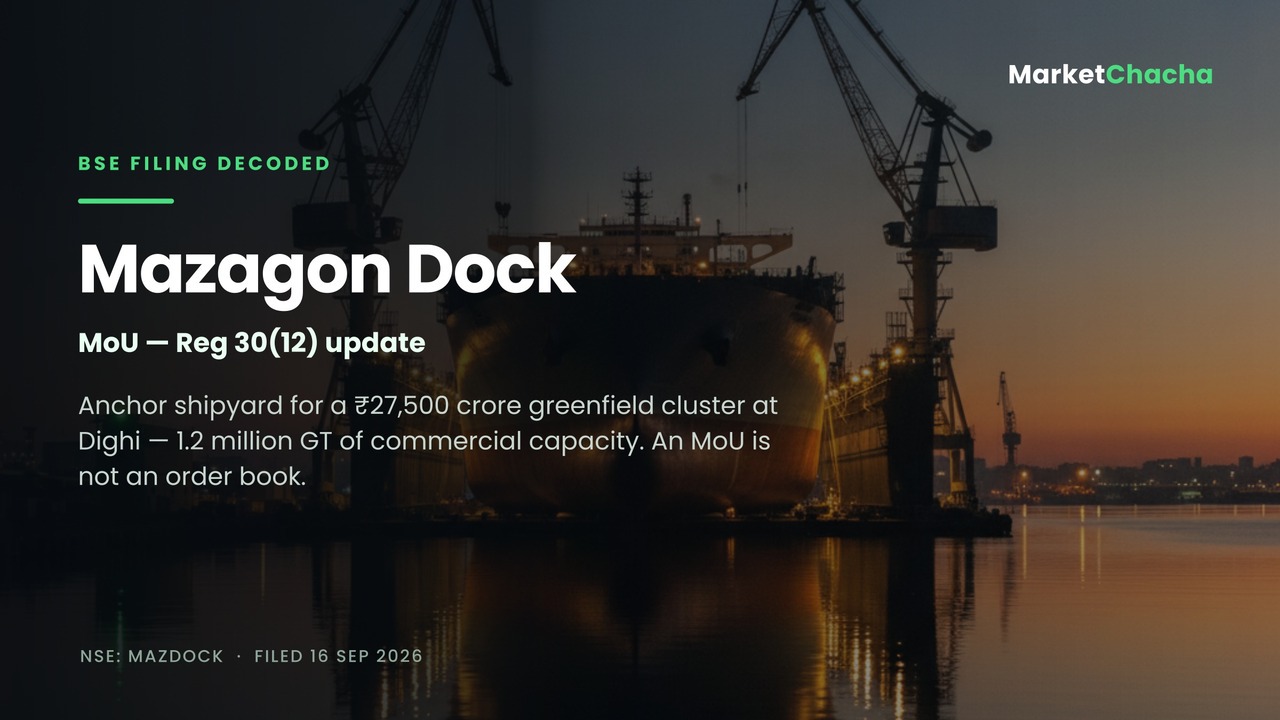
Mazagon Dock Shipbuilders told the exchanges on 16 September 2026 that it has signed a Memorandum of Understanding with National Shipbuilding & Heavy Industries Park Maharashtra Limited (NSHIPML) to act as the Anchor Shipyard in a proposed greenfield shipbuilding cluster at Dighi, Maharashtra — a yard the filing says is envisaged at at least 1.2 million Gross Tonnage of annual capacity. It is a statement of intent, not an order.
What was announced
The disclosure came under Regulation 30(12) of SEBI's LODR rules — the clause used for an update on a developing matter. In the company's own words, Dighi marks its "strategic expansion from its established strengths in warship and submarine construction into large-scale commercial shipbuilding," surrounded by ancillary industries, MSMEs and technology partners.
Two things the filing does not contain: a rupee figure and a timeline. Press coverage of the signing puts the total cluster outlay near ₹27,500 crore with Mazagon Dock's share around ₹15,000 crore, with NSHIPML reported as a special-purpose vehicle for the site. Those are reported numbers, not disclosed ones.
What an MoU filing actually means
Three things look alike here and mean very different things:
- MoU — an agreement to work together. Usually non-binding, no value, no delivery obligation. It signals direction.
- Letter of Intent — a customer has picked you and states an intended value. Closer to real, still conditional.
- Work order — firm, priced, enforceable. This is what enters the order book and eventually revenue.
Only the third is money. SEBI requires disclosure because the news is price-sensitive — but "disclosable" and "bankable" are different tests.
Why it matters
The strategic logic is real even with zero near-term P&L effect. Mazagon Dock's revenue is overwhelmingly defence — warships and submarines for one dominant customer, the Indian Navy — which means excellent margins and lumpy, politically-timed order flow. Commercial shipbuilding is the opposite: thinner margins, global competition, a far larger and steadier market. An anchor-yard role buys an option on that second engine.
The counterweights are capital and time: greenfield yards absorb cash for years before earning any, and a commitment reported near the company's current annual revenue would shift its risk profile. The reaction on 17 September was muted. the stock touched an intraday high of about ₹2,288.60, gave most of it back and traded near ₹2,210–₹2,230, roughly flat to slightly lower. That fade is the market pricing an MoU as an MoU. Track the day's moves on movers.
Valuation, as reported
On Screener's consolidated data, Mazagon Dock trades at a P/E of about 30.6 on a market capitalisation near ₹87,411 crore, price-to-book around 9.2x. FY26 revenue was ₹13,006 crore and net profit ₹2,578 crore; ROCE about 36%, ROE about 29%, government holding roughly 81%. It is down about 24% over a year, inside a 52-week range of ₹2,057–₹3,061. Trendlyne's historical band for the name, over its January 2024–January 2026 window, runs from a consolidated P/E near 16 to near 66 — today's multiple sits inside that range. Listed peer Cochin Shipyard is smaller — about ₹34,599 crore market cap, ₹5,022 crore revenue, ROCE near 16% — at a higher reported P/E of about 50.8. Its own recent filing is decoded here.
The business
- Warships — destroyers, frigates and corvettes for the Indian Navy; the historic core.
- Submarines — conventional diesel-electric boats built at Mumbai; its most distinctive capability.
- Ship repair and refit — smaller, steadier work alongside new builds.
Dighi touches none of these directly. It is a proposed fourth leg — commercial vessels at a new site — an addition to strategy, not a change to the current order book. Our longer file on the company's numbers and ownership is here.
Beginner takeaway
An MoU tells you where a company wants to go; an order book tells you where it already is. Nothing here changes Mazagon Dock's revenue, profit or backlog today. Watch for follow-through — a definitive agreement, a board-approved capex number, a funded SPV — because that is when intent starts costing money and earning it.
FAQ
Does this add to Mazagon Dock's order book? No. An MoU carries no value, scope or delivery obligation, so it does not enter the order book. Only a firm contract does.
What does 1.2 million Gross Tonnage of capacity mean? Gross Tonnage measures a ship's total enclosed volume, not its weight. A yard rated at 1.2 million GT a year can build vessels totalling that much volume annually.
Why disclose something non-binding at all? Regulation 30 requires disclosure of what a reasonable investor would find price-sensitive. Entering a new business line qualifies, whether or not rupees have moved.
As of 17 September 2026. Source: official BSE/NSE filing — read it directly here. We summarise filings for education and may make errors, so always verify against the official document. Educational content only — not investment advice, not a buy/sell recommendation.
This article is for educational and informational purposes only. It is not financial advice, investment recommendation, or a solicitation to buy or sell securities. Investing involves significant risks. I am not a SEBI-registered investment advisor. Readers should consult their own financial advisor and conduct their own research before making any investment decisions.
Comments
Join the conversation
Sign in to join the conversation.
Follow replies, add your view, and take part in the discussion.
Sign in to commentLoading comments...