

Roth vs Traditional IRA: which should you actually pick? (Beginner's guide with the math)

A Roth IRA and a Traditional IRA are both tax-advantaged retirement accounts you open yourself — the only real difference is when you pay the tax. With a Traditional IRA you usually get a tax deduction now and pay income tax later when you withdraw in retirement. With a Roth IRA you get no deduction today — you contribute money you have already paid tax on — but every dollar you withdraw in retirement, including all the growth, comes out completely tax-free. That single timing difference — tax now versus tax later — is the whole decision.
This guide explains what each account is, the one question that actually decides which is better for you, a worked example with the arithmetic, the rules that genuinely differ (income limits, withdrawals, RMDs), how to open and fund one step by step, the catches to watch, and how the same idea maps onto India's PPF, EPF, ELSS and NPS.
What a Roth and a Traditional IRA actually are
"IRA" stands for Individual Retirement Arrangement. It is not an investment itself — it is a wrapper you put around investments (index funds, ETFs, stocks, bonds) that changes how they are taxed. You open one at a brokerage, not through an employer, which is what makes it different from a 401(k).
A Traditional IRA is "tax-deferred." If you qualify, the money you put in is deducted from your taxable income for the year, so it lowers this year's tax bill. It then grows without any tax on dividends or gains along the way. The catch comes at the end: every withdrawal in retirement is taxed as ordinary income, as if it were salary.
A Roth IRA flips the timing. You contribute money you have already been taxed on, so there is no deduction and no reduction in this year's tax bill. In exchange, the account grows tax-free and — as long as you follow the rules — qualified withdrawals in retirement are 100% tax-free, growth included. You are pre-paying the tax in return for never paying it again.
The one question that decides it: your future tax rate
Here is the insight most beginners miss. If your tax rate is exactly the same when you contribute and when you withdraw, a Roth and a Traditional IRA give you the identical after-tax amount. This is just arithmetic: multiplying by the growth factor and by the tax rate can happen in either order and gives the same answer. Taxing the seed and letting it grow, versus letting the seed grow and taxing the harvest, land in the same place when the rate does not change.
So the choice is not "which account grows more." It is a bet on one thing: will your tax rate be higher or lower in retirement than it is today?
- If you expect a lower tax rate in retirement (common if you are a high earner now and will spend less later), the Traditional deduction is worth more — you skip tax at today's high rate and pay at a lower one.
- If you expect a higher tax rate later (common for young people early in their careers, or if you believe tax rates will rise), the Roth wins — lock in today's lower rate and never pay tax on decades of growth.
A worked example: same money, three retirement tax rates
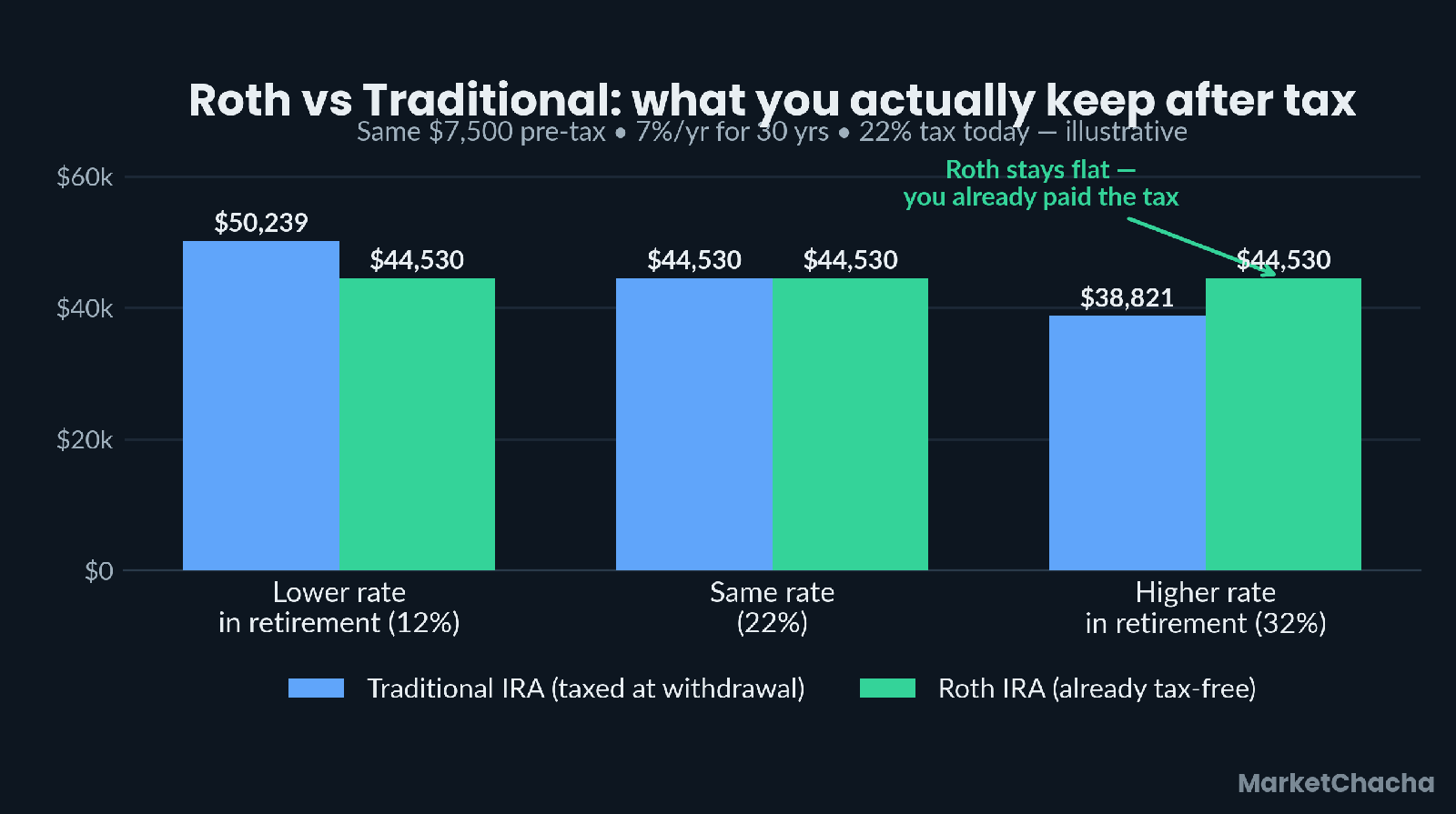
To compare fairly we start with the same pre-tax dollars: $7,500 of income you could either deduct into a Traditional IRA or pay tax on first and drop into a Roth. Assume you are in the 22% bracket today and the money grows at 7% a year for 30 years (a factor of about 7.6×). All figures are illustrative.
Traditional: the full $7,500 goes in (no tax now). It grows to about $57,090. You are taxed on the whole amount when you withdraw.
Roth: you pay 22% tax on the $7,500 first, leaving $5,850 to contribute. It grows to about $44,530 — and that is what you keep, tax-free.
Now apply three possible retirement tax rates to the Traditional balance and compare what you actually keep:
- Same rate (22%): Traditional $57,090 − 22% tax = $44,530. Roth = $44,530. A dead heat — proof of the arithmetic above.
- Lower rate (12%): Traditional $57,090 − 12% = $50,240. Roth = $44,530. Traditional wins by about $5,700.
- Higher rate (32%): Traditional $57,090 − 32% = $38,820. Roth = $44,530. Roth wins by about $5,700.
The Roth line never moves — you already settled up with the tax office. Only the Traditional outcome swings with your future bracket. That is the entire decision in one picture.
One honest nuance in the Roth's favour: the contribution cap ($7,500 for 2026) is a post-tax number for a Roth and a pre-tax number for a Traditional. So if you can afford to max a Roth, you are effectively sheltering more real money inside the same cap — a subtle edge that tilts many savers toward Roth when they can pay the tax comfortably from outside the account.
The rules that actually differ
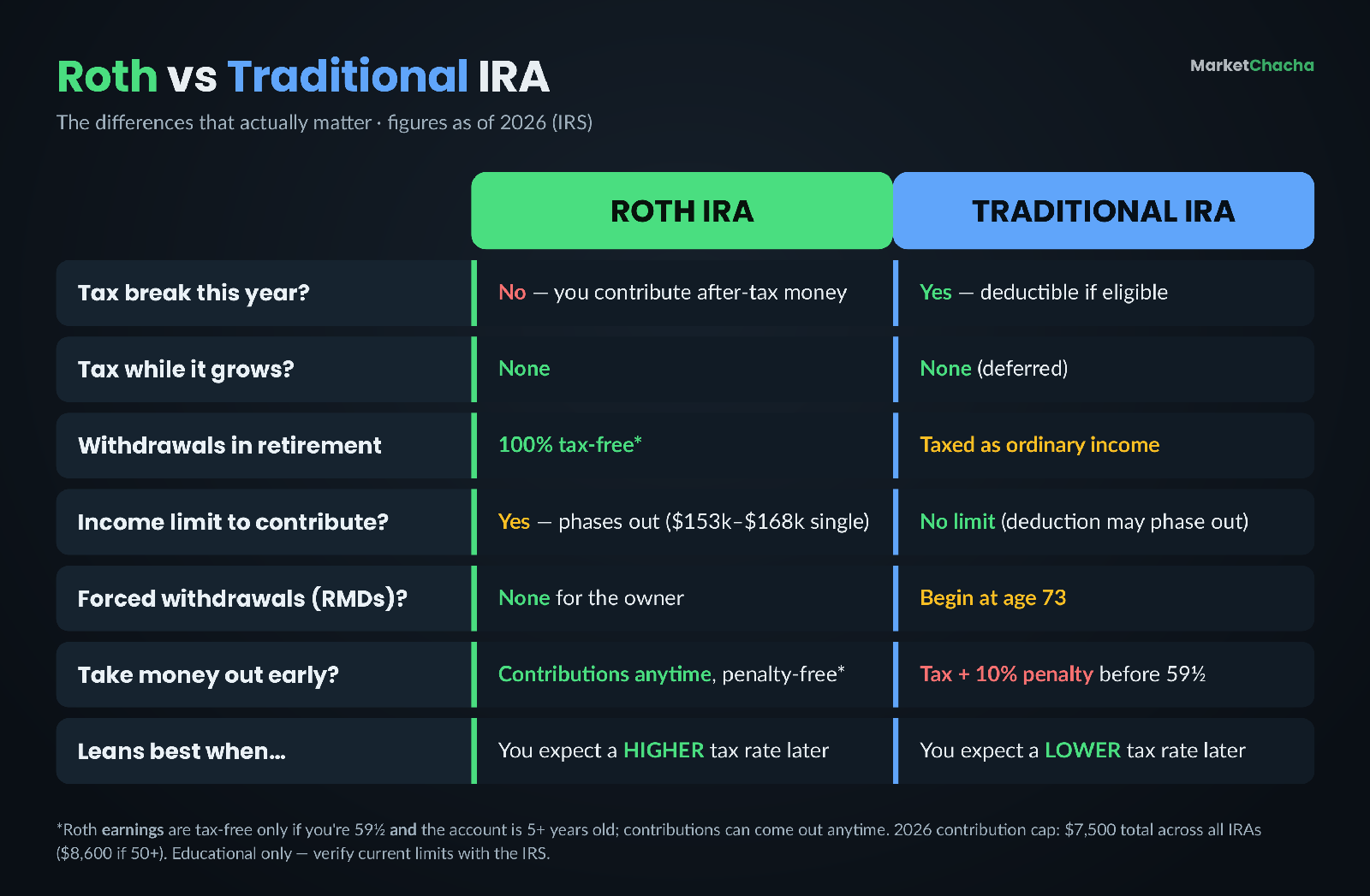
Beyond the tax timing, a handful of concrete rules separate the two. These figures are as of 2026, per the IRS (rates and limits change most years, so always check the current year).
Contribution limit (2026): $7,500 total across all your IRAs, or $8,600 if you are 50 or older (a $1,100 catch-up). You can split that between a Roth and a Traditional, but the combined total cannot exceed the cap. You also need earned income (a job or self-employment) to contribute.
Income limits — this is where they diverge:
- Roth: your ability to contribute directly phases out at higher incomes. For 2026 the modified-AGI phase-out is $153,000–$168,000 for single filers and $242,000–$252,000 for married-filing-jointly. Above the top of the range you cannot contribute to a Roth directly.
- Traditional: anyone with earned income can contribute at any income. Whether the contribution is deductible is the part that phases out, and only if you (or your spouse) are covered by a workplace retirement plan. For 2026 the deduction phase-out is $81,000–$91,000 for a covered single filer and $129,000–$149,000 for a covered joint filer. If neither spouse has a workplace plan, it is fully deductible at any income.
Required withdrawals (RMDs): a Traditional IRA forces you to start taking taxable Required Minimum Distributions at age 73. A Roth IRA has no RMDs for the original owner — you can let it grow untouched for life, which makes it a powerful tool for estate planning.
Early access: because you already paid tax on Roth contributions, you can withdraw the amount you put in (not the earnings) at any time, tax- and penalty-free. Traditional withdrawals before age 59½ are generally hit with income tax plus a 10% penalty (with some exceptions). To pull Roth earnings out tax-free you must be 59½ and have had a Roth open at least five years — the "5-year rule."
How to actually open and fund an IRA
The mechanics are simpler than the tax theory:
- 1. Confirm you have earned income. Wages or self-employment income for the year; you can't fund an IRA from investment income alone.
- 2. Pick the account type using the future-tax-rate logic above. If genuinely unsure, many people split — some to each.
- 3. Open the account at any major brokerage (online, usually 10–15 minutes, no fee to open).
- 4. Transfer money in, up to $7,500 for 2026. You have until the tax-filing deadline (mid-April) to make a contribution for the prior year — a useful bit of extra time.
- 5. Actually invest the cash. This is the most common rookie error: money sitting in an IRA as uninvested cash isn't working. Choose your funds — a low-cost broad index fund is the classic starting point.
- 6. Automate it so a set amount goes in every month. Consistency, not timing, does the heavy lifting.
What it costs you — the catch
Neither account is free money, and each has a downside. The Roth gives you no tax break today, so it stings more now, and high earners are locked out of contributing directly. The Traditional hands you a bill later — every withdrawal is taxed, and RMDs force you to take (and be taxed on) money at 73 whether you need it or not. Both share the same limits: a modest $7,500 annual cap, the earned-income requirement, and stiff penalties for tapping earnings early. The accounts reward patience and punish impatience by design.
Common mistakes beginners make
- Believing "Roth is always better." It usually suits young or lower-bracket savers, but a high earner in their peak years may keep more with the Traditional deduction.
- Spending the Traditional tax refund. The break-even math only holds if you invest the tax you saved. Spend it, and the Traditional loses its edge.
- Leaving the money in cash. Funding the account is only half the job — you still have to buy investments inside it.
- Assuming high income shuts you out. Earn too much for a direct Roth? A "backdoor Roth" (contributing to a Traditional and converting) is a legal, widely used route — worth researching or asking a professional about.
- Confusing an IRA with a 401(k). They are separate accounts; you can often contribute to both in the same year.
How this works in India
India does not have a clean "Roth versus Traditional" split, but the same tax-now-or-tax-later idea runs through its retirement products — with the twist that the old-versus-new tax regime now controls whether you even get an upfront break.
PPF, EPF and ELSS are broadly "EEE" — Exempt-Exempt-Exempt. Under the old tax regime, contributions qualify for a deduction under Section 80C (a shared ceiling of ₹1.5 lakh), the growth is tax-free, and the maturity proceeds are tax-free too. That is better than either US account on paper — a deduction now and tax-free withdrawals — but it is capped and, for PPF, locked up for 15 years. (EPF's tax-free status now carries fine print for very large annual contributions.)
NPS (National Pension System) is the closest thing to a "Traditional-style" deferral. You get a deduction now — within the ₹1.5 lakh 80C limit under Section 80CCD(1), plus an extra ₹50,000 under Section 80CCD(1B), plus any employer contribution under 80CCD(2). At age 60 up to 60% of the corpus can be withdrawn tax-free, but at least 40% must buy an annuity, and that pension income is taxed at your slab later — the tax-later trade-off in action.
The regime catch: from FY 2025-26 the new tax regime is the default, and it does not allow the 80C, PPF, ELSS or self-NPS 80CCD(1)/(1B) deductions — only the employer NPS deduction under 80CCD(2) survives. So if you choose the new regime for its lower slab rates, you invest in PPF/ELSS without an upfront deduction (more like funding a Roth), while their maturity stays tax-free. Choosing between the regimes is itself a "pay tax now or later" decision — exactly the muscle this article is trying to build. (Always confirm current limits and rules with the Income Tax Department, as they change with each Budget.)
FAQ
Is a Roth or Traditional IRA better? Neither is universally better — it depends on your tax rate now versus in retirement. Expect a higher rate later (or you're early-career and low-bracket now), and Roth usually wins; expect a lower rate later (you're a high earner today), and the Traditional deduction usually wins.
Can I contribute to both a Roth and a Traditional IRA in the same year? Yes, but your combined contributions across both can't exceed the annual limit ($7,500 in 2026, or $8,600 if you're 50 or older). Many people split to hedge their bets.
What is the 2026 IRA contribution limit? $7,500 total across all your IRAs, plus a $1,100 catch-up (so $8,600) if you're 50 or older, and you must have earned income to contribute. Source: IRS, Nov 2025.
Do I pay taxes when I withdraw from a Roth IRA? No — qualified withdrawals are completely tax-free, including all the growth, provided you're at least 59½ and have had a Roth open for at least five years. You can also withdraw your original contributions (not the earnings) any time, tax- and penalty-free.
What happens if I earn too much for a Roth IRA? Above the income phase-out you can't contribute to a Roth directly, but a "backdoor Roth" — contributing to a Traditional IRA and converting it — is a legal, commonly used workaround. It has tax nuances, so read up or consult a professional first.
What is the equivalent of a Roth IRA in India? There's no exact match. PPF, EPF and ELSS give tax-free maturity (like a Roth on the back end) and, under the old regime, a deduction now too; NPS behaves more like a Traditional account, with a deduction now and a taxable annuity later.
Educational content only — not investment, tax or retirement advice, and not a recommendation of any product. Rates, limits and rules change every year — always check current terms with the IRS (US) or the Income Tax Department (India) before acting. Sources: IRS (2026 limits), IRS (RMDs), ClearTax (PPF), Income Tax Department (India). Always do your own research.
This article is for educational and informational purposes only. It is not financial advice, investment recommendation, or a solicitation to buy or sell securities. Investing involves significant risks. I am not a SEBI-registered investment advisor. Readers should consult their own financial advisor and conduct their own research before making any investment decisions.
Comments
Join the conversation
Sign in to join the conversation.
Follow replies, add your view, and take part in the discussion.
Sign in to commentLoading comments...