

How does a Fed rate cut actually reach your savings account, your credit card and your mortgage?
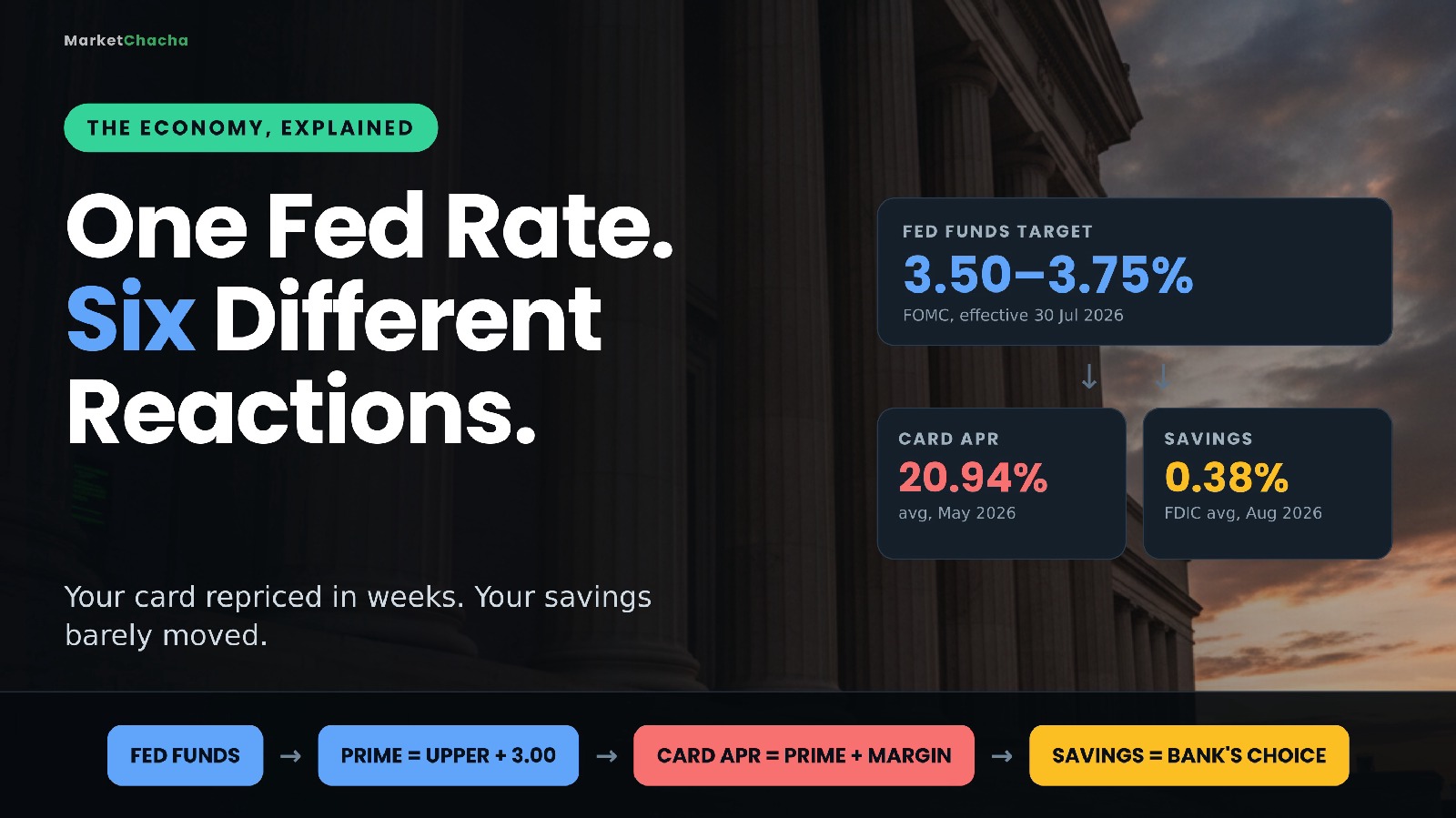
When people say "the Fed raised rates" or "the Fed cut rates", the Fed has changed exactly one thing: the target range for the federal funds rate — the rate banks charge each other to borrow cash overnight. As of the FOMC's 29 July 2026 meeting that range is 3.50%–3.75%. The Fed does not set your credit card APR, your savings rate, your car loan or your mortgage. Those are separate markets that react to the policy rate at wildly different speeds — some within a billing cycle, some at the bank's discretion, and some barely at all.
This article walks through each of those channels: what the Fed actually controls, a worked example showing what a quarter-point move does to a real credit card balance, why your savings rate is the one number the Fed genuinely cannot make your bank change, why mortgages sometimes move the opposite way, and how the same plumbing works in India.
What the Fed actually sets — and what it doesn't
The Federal Open Market Committee (FOMC) votes on a target range, currently 3.50%–3.75%. It then steers the actual market rate inside that range using administered rates: interest on reserve balances (3.65% as of 30 July 2026) and the overnight reverse repo offering rate (3.50%). The effective federal funds rate — the average rate actually transacted — was 3.63% in July 2026.
That's it. That is the Fed's direct lever. Everything you experience as "interest rates" is a chain of separate decisions made by banks, bond investors and lenders, each with its own logic:
- Banks decide what to charge borrowers and what to pay depositors.
- The bond market decides longer-term yields, based on where it thinks the policy rate will average over the next 2, 10 or 30 years.
- Lenders add a spread on top for credit risk, costs and profit.
The one mechanical link is the prime rate. The prime rate published by The Wall Street Journal is a survey of what large banks charge their best commercial customers, and in practice it has for years sat exactly 3.00 percentage points above the top of the Fed's target range. With the range topping out at 3.75%, prime is 6.75% (Federal Reserve H.15, July 2026). Prime is the index most US variable-rate credit cards are built on.
A worked example: what a quarter-point cut does to your credit card
Open your card's disclosure and you'll find a line like "your APR is the prime rate plus 14.00%". That 14.00% is the margin — your issuer's price for lending to you, based on your credit profile. Suppose that's your card:
- Today: prime 6.75% + margin 14.00% = APR 20.75%
- Fed cuts 0.25 points: target range becomes 3.25%–3.50%, prime falls to 6.50%, and your APR becomes 20.50%
Now put money on it. Carry a $5,000 balance for a full year:
- At 20.75%: roughly $1,037.50 in interest
- At 20.50%: roughly $1,025.00 in interest
- The Fed's cut saved you $12.50 — about a dollar a month
(Simplified: a real card bills monthly and most compute interest on your average daily balance, so the exact figure differs slightly. The proportions hold.)
That single comparison is the most useful thing in this article. The Fed's move is worth $12.50. Clearing the balance is worth $1,025. The prime-rate portion is roughly a third of your APR; your issuer's margin is the other two-thirds — and no FOMC vote will ever touch that margin.
One legal detail that surprises people: under Regulation Z §1026.55, a card issuer may raise your APR — including on balances you already carry — when a variable rate rises because its public index rose. A discretionary rate increase is far more restricted. So an index-driven increase reaches your existing debt in a way a "we've decided to charge you more" increase generally cannot.
The fast lane: what reprices in days or weeks
Three things move almost as fast as the Fed does:
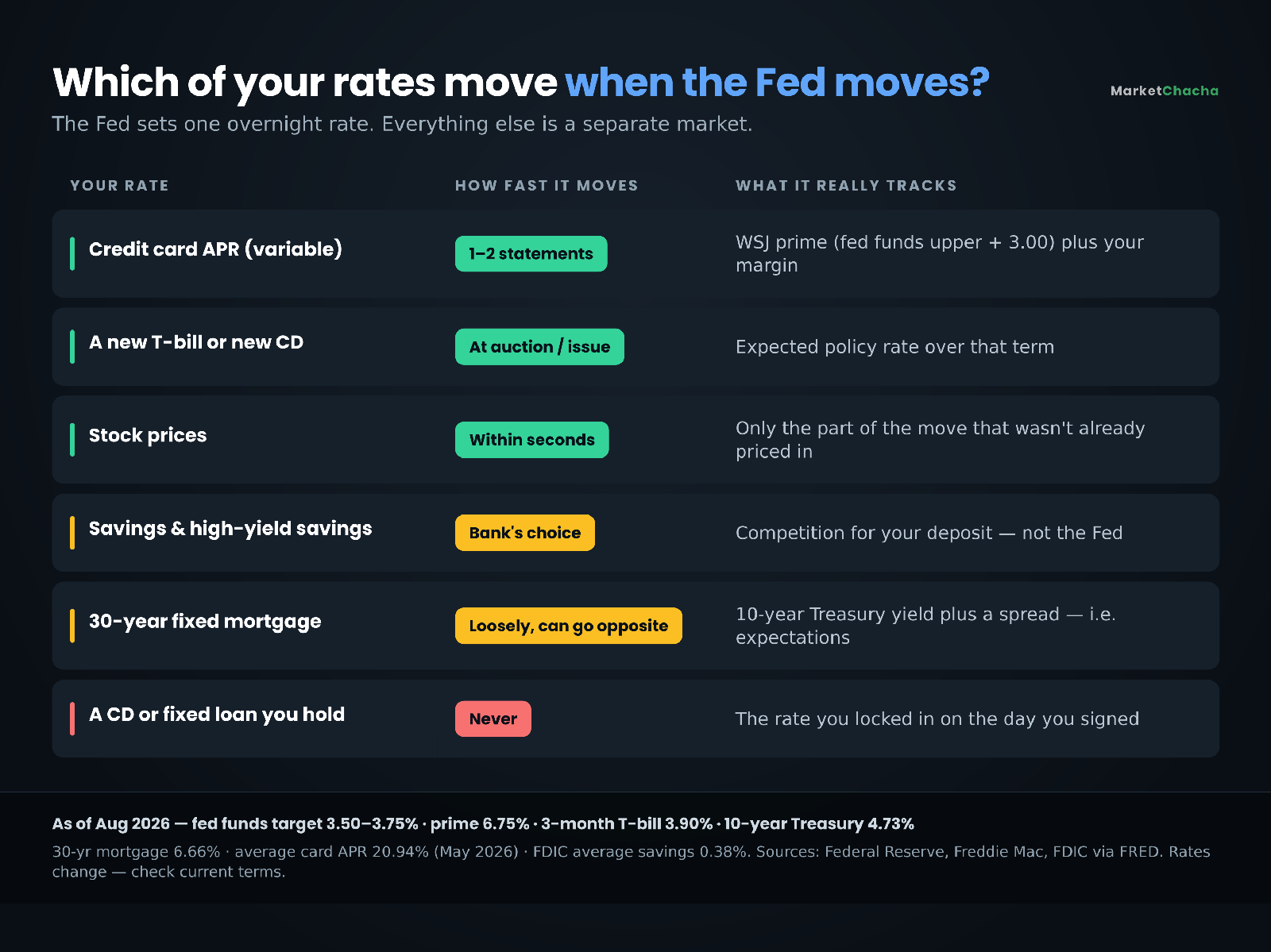
Variable credit card APRs. Tied to prime, they typically reset within one or two billing cycles of a prime change. Note who this actually affects: if you pay your statement balance in full within the grace period, you are charged no interest on your purchases at all (cash advances typically get no grace period), and your APR — whatever it is — is largely irrelevant to you. The Fed's G.19 release put the average APR across all card accounts at 20.94% in May 2026; across accounts that were actually assessed interest — that is, people carrying a balance — it was 22.15%. The scary number is a number about borrowers, not about cardholders in general.
New Treasury bills and new CDs. A T-bill's yield is set at auction, so it reprices immediately and continuously. The 3-month Treasury yielded 3.90% on 28 August 2026 — slightly above the top of the current policy range. A bill can sit a little above or below today's policy rate, because its yield embeds where the market thinks policy is heading over the life of that bill. Banks reprice new CD offers quickly too, since they compete with bills.
Anything already locked. The mirror image: a CD you already own, a fixed-rate car loan, a 30-year fixed mortgage you already signed. These never reprice. The rate you agreed to is the rate you have until maturity or refinancing. That is the whole point of "fixed".
The slow lane: your savings rate is your bank's decision, not the Fed's
Here is where most people's intuition breaks. Nothing obliges a bank to raise what it pays you. If a bank already has all the deposits it needs, a Fed hike is simply a bigger margin for the bank.
The evidence is stark. Between January 2022 and August 2023 the effective fed funds rate went from 0.08% to 5.33% — over five percentage points. The FDIC's national average savings rate reached 0.38% in August 2026 and has been stuck around there. Meanwhile the most competitive online savings accounts were paying around 4% APY as of 31 August 2026 (Bankrate). Same country, same Fed, same week — a roughly ten-fold difference decided entirely by which bank you happen to use.
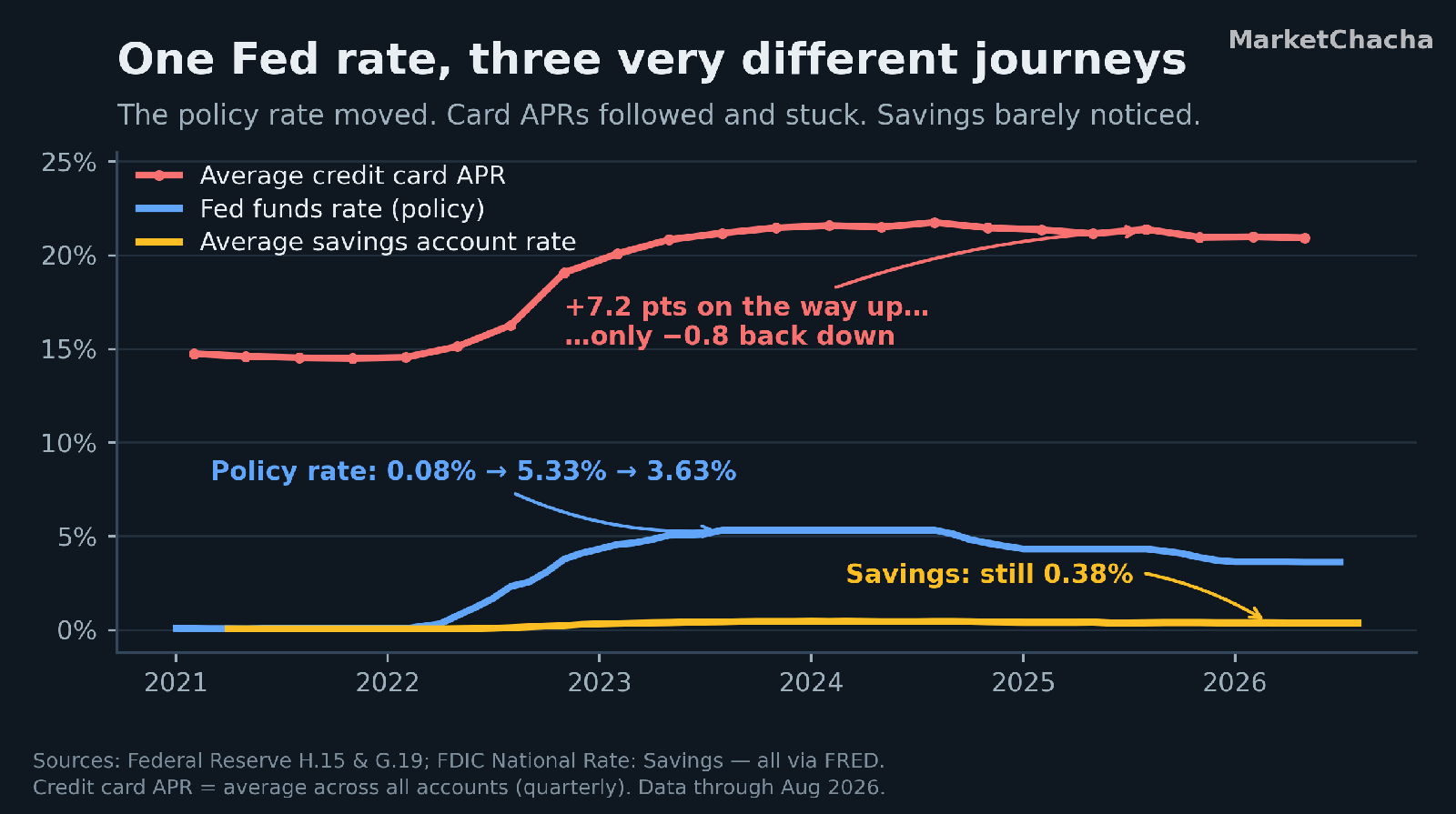
The chart shows the asymmetry that matters. From February 2022 to its August 2024 peak the average card APR rose 7.2 percentage points, from 14.56% to 21.76%. Since that peak, with the policy rate down about 1.7 points, the average card APR has fallen just 0.8 points, to 20.94%. Borrowing costs went up like a rocket and have come down like a feather; deposit rates, on average, never really left the ground.
Run the arithmetic on your own cash. $10,000 at the national average of 0.38% earns $38 in a year. The same $10,000 at 4.00% earns $400. That $362 difference is worth about 29 times the $12.50 our worked-example cardholder got from a Fed cut — and unlike the Fed's decision, it's entirely yours to make.
The rates the Fed doesn't really control: mortgages
A 30-year fixed mortgage is not priced off an overnight rate. It's priced off long-term yields — principally the 10-year Treasury — plus a spread that covers lender costs and compensates investors for the risk that you refinance early. As of 28 August 2026, the 10-year Treasury yielded 4.73% while the average 30-year fixed mortgage was 6.66% (Freddie Mac, week ending 27 August 2026): a spread of roughly two points.
Long-term yields are driven by expectations — of inflation, growth, government borrowing — not by today's overnight rate. That's why mortgage rates can move against the Fed. The Federal Reserve Bank of Atlanta's research notes exactly this: over September 2024 to January 2025, the fed funds rate fell about 80 basis points while the 10-year Treasury yield rose about 90. Homebuyers waiting for "the Fed to cut so mortgages get cheaper" watched rates go up.
Why stocks move the second the statement lands
Rates reach stock prices through two channels. First, discounting: a share is worth the present value of future cash flows, and a higher discount rate makes distant cash flows worth less today — which is why long-duration growth stocks tend to be more rate-sensitive than a steady dividend payer. Second, the economy: rates change borrowing costs for businesses and consumers, which eventually changes earnings.
But the crucial mechanic is that markets trade on the surprise, not the level. If a quarter-point cut is fully expected, it is already in the price before the announcement; the move happens when the decision, the projections, or the press conference differ from what was assumed. This is also why stocks sometimes fall on a cut: a cut delivered because growth is deteriorating is bad news for earnings, and the earnings channel can outweigh the discounting one.
The catch: long lags, and an asymmetry that costs you
Two honest caveats. First, timing: economists describe monetary policy as working with "long and variable lags". Your card may reprice in weeks, but the effect on hiring, inflation and the wider economy plays out over quarters. Anyone who tells you what a rate decision will do to the economy next month is guessing.
Second, direction: transmission is asymmetric and it is not in your favour. The rates you pay tend to follow hikes quickly and cuts slowly. The rates you earn tend to follow hikes slowly and cuts quickly. Nobody sends you a letter about it. This is not a conspiracy — it's what happens when one side of the transaction is contractually indexed and the other side is discretionary.
How to actually use this: a four-step check
- 1. Find out which of your rates are indexed. Read your card agreement for the words "prime" and "margin", and your loan documents for "fixed" or "variable". Indexed rates will move; fixed ones won't.
- 2. Check what your cash actually earns. Look up the APY on your savings account today. If it starts with a zero while short-term Treasury yields are near 4%, that gap is a decision your bank is making, and you can respond to it.
- 3. Separate the Fed's part from your part. On a card, the prime index is roughly a third of your APR and your issuer's margin is the rest. On savings, the Fed sets the ceiling of what's possible and competition decides whether you get it.
- 4. Don't build a plan around a forecast. Since long-term rates move on expectations, "waiting for the Fed" is a bet on something already priced in. Decide based on the rate you can get today.
Common mistakes beginners make
- Assuming the Fed sets mortgage rates. It doesn't. It sets an overnight rate; mortgages follow the 10-year Treasury.
- Waiting for a cut to make debt affordable. A quarter-point saves about $12.50 a year on $5,000 of card debt. Paying it down saves the other thousand dollars.
- Thinking a rising policy rate automatically means a better savings rate. It means a better rate is available somewhere — not that your bank will give it to you.
- Reading the 22% average APR as "what everyone pays". It's the average on accounts charged interest. Pay your purchase balance in full within the grace period and you pay none of it.
- Expecting stocks to rally on every cut. Only unexpected news moves prices, and a cut prompted by a weakening economy can cut both ways.
- Confusing an existing fixed CD or loan with a new one. Only new issuance reprices; what you hold is locked.
How this works in India
The Reserve Bank of India's Monetary Policy Committee plays the FOMC's role, setting the policy repo rate — the rate at which banks borrow from the RBI against government securities. The MPC left it unchanged at 5.25% with a neutral stance at its meeting on 5 August 2026. As in the US, that is the only rate the central bank directly sets.
But India's transmission to borrowers is far more mechanical than America's. Under an RBI circular effective 1 October 2019, all new floating-rate retail loans (home, auto, personal) and loans to micro and small enterprises must be linked to an external benchmark — most banks chose the repo rate itself — and the rate must be reset at least once every three months. So where a US homeowner's fixed mortgage never moves and a new one follows the 10-year Treasury, an Indian borrower on a repo-linked (EBLR) home loan sees the repo change flow into their EMI or tenure within a quarter, close to one-for-one. Loans still on the older MCLR or base-rate systems track the bank's own cost of funds instead and reprice much more slowly — which is why the RBI has repeatedly pushed banks on transmission, and why eligible borrowers are allowed to switch to an external benchmark.
The deposit side rhymes with the US. Savings account interest is deregulated: the bank chooses, and it is under no obligation to follow the repo rate. A fixed deposit behaves exactly like a US CD — the rate is contracted at the start and holds to maturity, so a repo cut only affects new FDs and renewals, not the one you already hold. Laddering FD maturities is the Indian version of the CD-ladder answer to that problem.
India's fast lane is the same as America's: the RBI auctions 91-day, 182-day and 364-day Treasury bills, and their cut-off yields track the policy corridor closely because they are re-auctioned constantly. Retail investors can bid through RBI Retail Direct or hold them via debt funds. If you want to see what the policy rate is really doing to Indian short-term money, watch T-bill cut-offs, not your savings account.
FAQ
If the Fed cuts interest rates, will my credit card interest go down? If your card carries a variable APR tied to the prime rate — most US cards do — then yes, usually within one or two billing cycles, and by roughly the size of the cut. The effect is small though: on a $5,000 balance a 0.25-point cut is worth about $12.50 a year, because your issuer's margin, not the Fed, sets most of your APR.
Why didn't my savings account rate go up when the Fed raised rates? Because no rule requires it. Deposit rates are each bank's commercial decision, and a bank with plenty of deposits has no reason to pay more. The FDIC's national average savings rate was just 0.38% in August 2026 while competitive online accounts paid around 4% — the gap is a choice your bank is making, and switching is how you respond.
Does the Federal Reserve set mortgage rates? No. The Fed sets an overnight bank-to-bank rate. A 30-year fixed mortgage is priced off long-term yields — mainly the 10-year Treasury — plus a spread, so it reflects expectations about inflation and growth. Mortgage rates can and do rise on days the Fed cuts.
What is the prime rate and how is it related to the fed funds rate? The prime rate is a benchmark banks publish for their most creditworthy borrowers. In practice it has sat 3.00 percentage points above the top of the Fed's target range for years — with the range at 3.50%–3.75%, prime was 6.75% in July 2026. Most US variable credit card APRs are quoted as "prime plus a margin".
Why do stocks sometimes fall when the Fed cuts rates? Because markets price in the expected decision beforehand, so only the surprise moves prices. And a cut delivered because the economy is weakening carries bad news about future earnings, which can outweigh the benefit of a lower discount rate.
How long does a Fed rate change take to affect me? Your variable card APR and new T-bill or CD yields move within days to a couple of billing cycles. Savings rates move whenever your bank decides. The effect on inflation, hiring and the wider economy plays out over quarters — economists call these "long and variable lags".
Educational content only — not investment, tax or insurance advice, and not a recommendation of any product. Rates, fees and rules change — always check current terms with the provider. [Sources: Federal Reserve FOMC Implementation Note, 29 July 2026, Federal Reserve H.15 & G.19 via FRED, FDIC National Rate: Savings, Freddie Mac PMMS, CFPB Regulation Z §1026.55, Federal Reserve Bank of Atlanta, Bankrate savings survey, 31 Aug 2026, RBI External Benchmark Based Lending circular, Business Standard on the RBI MPC, 5 Aug 2026] Always do your own research.
This article is for educational and informational purposes only. It is not financial advice, investment recommendation, or a solicitation to buy or sell securities. Investing involves significant risks. I am not a SEBI-registered investment advisor. Readers should consult their own financial advisor and conduct their own research before making any investment decisions.
Comments
Join the conversation
Sign in to join the conversation.
Follow replies, add your view, and take part in the discussion.
Sign in to commentLoading comments...