

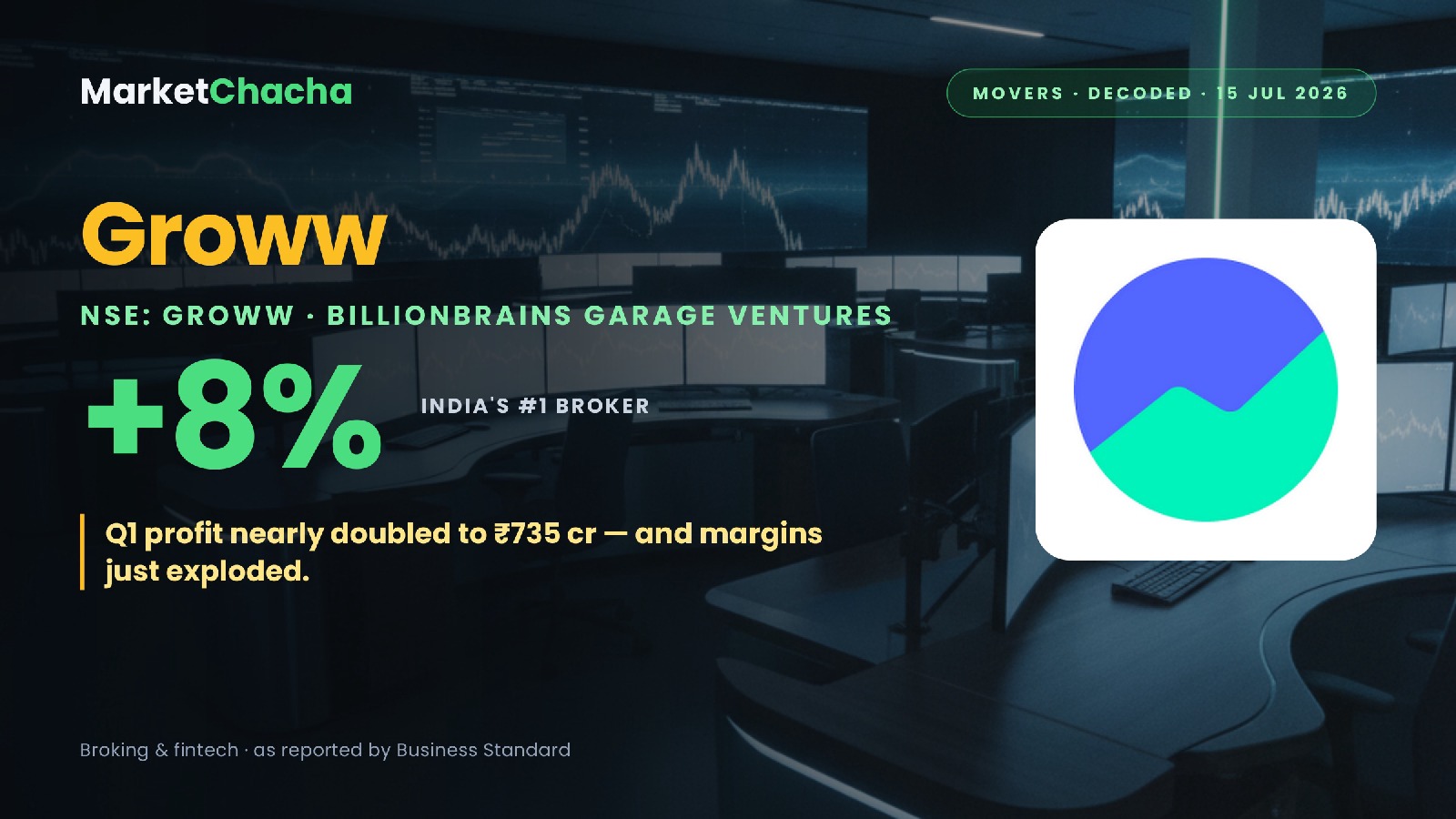
Why did Groww (NSE: GROWW) jump ~8% today? Q1 profit nearly doubled
What happened
Groww — which lists as Billionbrains Garage Ventures (NSE: GROWW) — climbed as much as ~8% on Wednesday, hitting an intraday high of ₹219.62 before easing back to around ₹211 by early afternoon, as reported by Business Standard. The trigger was simple: the numbers it dropped after Tuesday's close were a lot better than the street expected.
Why it jumped
Groww's first-quarter (Q1 FY27) profit nearly doubled. Net profit rose 94% year-on-year to ₹735 crore, up from ₹378 crore a year ago, on revenue that grew about 66%, per Upstox's results coverage. The really telling line is the margin. Operating profit (EBITDA) roughly doubled to ₹971 crore, and the PAT margin hit 47.5% — meaning nearly half of every rupee of revenue dropped to the bottom line.
Here's the mechanism in plain English: a broking platform is a fixed-cost business. The app, the servers, the compliance team, the brand — you pay for those whether 10 lakh people trade or 1.5 crore do. Once you've got the users, each extra trade is almost pure profit. That's "operating leverage", and it's exactly what showed up this quarter — costs grew far slower than revenue, so profit ran away from sales. When margins expand like that, the market re-rates the stock fast.
The business — it's not just a broking app
Most people know Groww as the place they buy stocks and mutual funds on their phone. But the listed company is wider than that: stock and derivatives (F&O) broking, mutual fund distribution plus its own asset-management arm, a margin-trading (MTF) book, bonds, and a growing consumer-credit / personal-loans arm. So today's blowout isn't one lucky order — it's the whole platform firing, with lending and F&O adding to plain-vanilla equity broking. Groww is now India's largest retail broker by active clients, having overtaken Zerodha (which isn't listed).
Is it expensive?
Short answer: yes, on any normal yardstick. Groww carries a market cap of roughly ₹1.3 lakh crore and trades at a P/E in the low-60s on Screener.in (some data providers put it as high as ~80), with a price-to-book near 13. A P/E in that zone means the market is already paying for many years of rapid growth up front — there's little room for a stumble.
The cleanest comparison is Angel One, the other big listed discount broker. Angel One trades at a P/E of about 23 with a market cap near ₹31,000 crore (Screener.in). So Groww is valued at roughly three times Angel One's earnings multiple and about four times its market cap. Investors are clearly paying a premium for Groww's No.1 position, faster growth and fatter margins — but you're buying that growth at a rich price, not a cheap one. (Not a view on where the stock goes next — just how the tag reads today.)
Who else this touches
- Listed broking peers — Angel One, Nuvama, ICICI Securities, Motilal Oswal: strong Groww numbers signal retail activity is still healthy, a read-across for the whole pack.
- Market plumbing — CDSL, CAMS and KFin Technologies earn on demat accounts and mutual-fund transactions; more retail trading generally means more volume for them.
- AMCs and distributors — Groww's own fund business is quietly taking share, which matters for the wider mutual-fund distribution pool.
The one real risk
A big slice of a discount broker's money comes from retail derivatives (options) trading. SEBI has been steadily tightening the screws on that — bigger contract sizes, fewer weekly expiries, stricter charge disclosures — precisely to cool speculative retail volumes. If the regulator clamps down harder, the most profitable part of the flywheel slows, and a stock priced at 60x-plus earnings has the furthest to fall. That's the scenario that would flip today's cheer.
As of ~1:10 pm IST, 15 Jul 2026. Sources: Business Standard, Upstox, Screener.in. For discussion and education only — not investment advice. Verify before acting.
This article is for educational and informational purposes only. It is not financial advice, investment recommendation, or a solicitation to buy or sell securities. Investing involves significant risks. I am not a SEBI-registered investment advisor. Readers should consult their own financial advisor and conduct their own research before making any investment decisions.
Comments
Join the conversation
Sign in to join the conversation.
Follow replies, add your view, and take part in the discussion.
Sign in to commentLoading comments...