

Should you pay off debt or invest first? The order to use your money, explained with the math
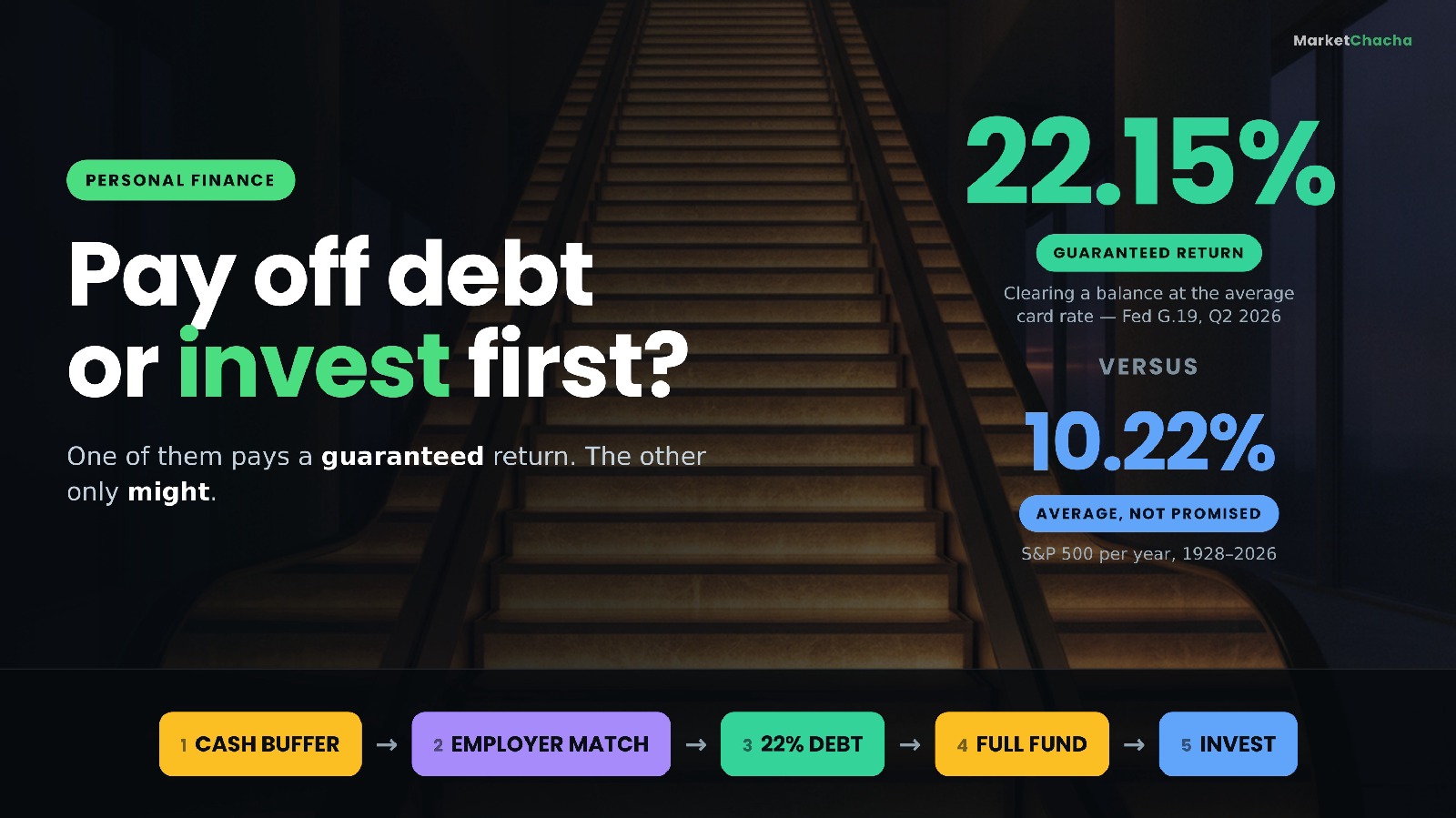
If you are carrying credit-card debt, pay it off before you invest. Clearing a balance at 22.15% is a guaranteed, tax-free 22.15% return, and nothing you can buy offers that with certainty. The one thing that jumps the queue is a full employer match on your 401(k), because 50 cents on every dollar is an instant 50% — bigger than the card rate, and gone forever if you skip that year. Everything else has an order too, and getting it right is worth more than picking good funds.
This guide walks through that order step by step: what comes first, why, the arithmetic behind each decision, the places the rule genuinely bends, and how the same logic maps onto EPF, PPF and Indian credit cards at the end.
The order of operations, in one list
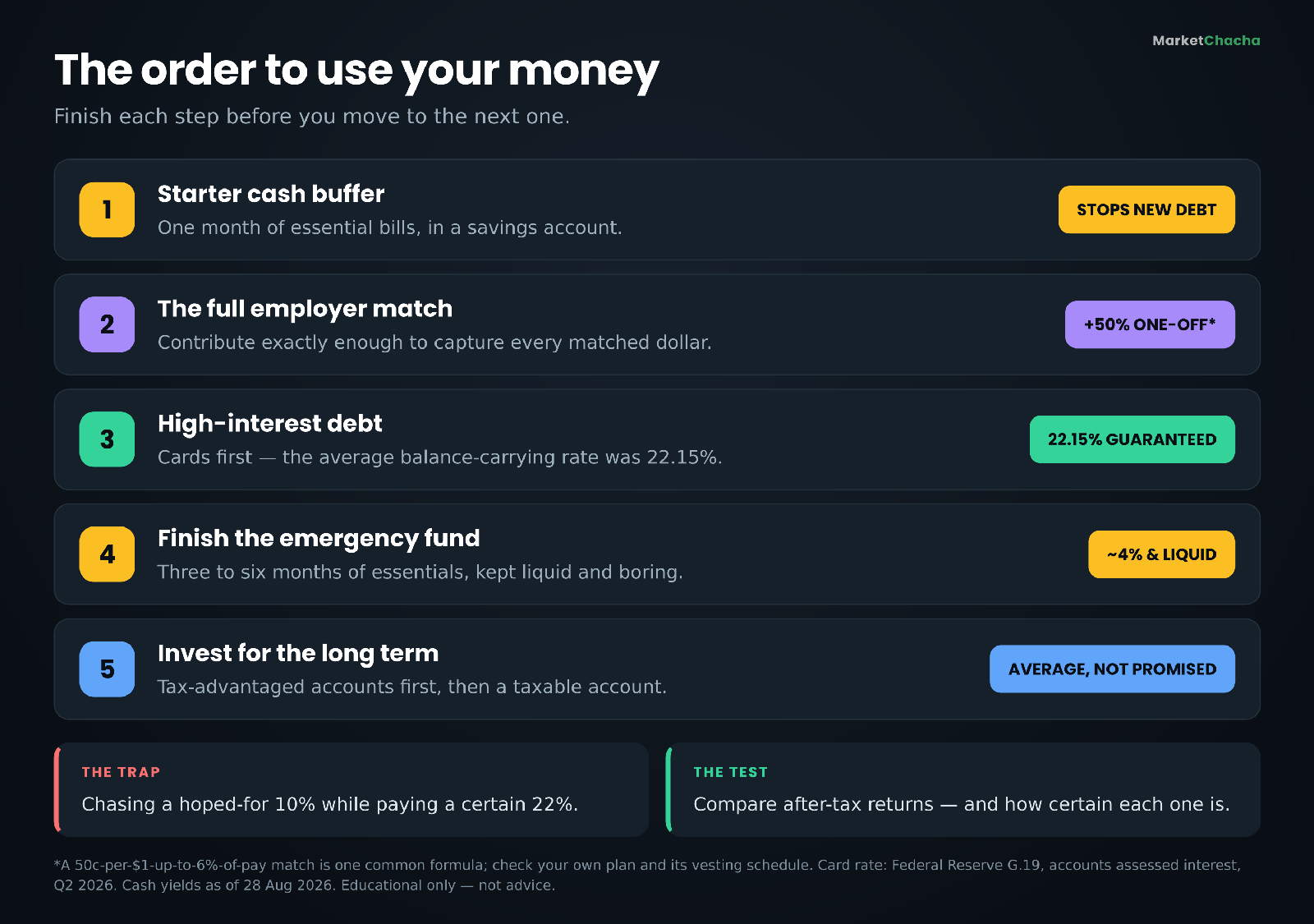
Personal finance has an unglamorous truth at its centre: the sequence matters more than the selection. Here is the order most of the maths supports, strongest claim on your money first:
- 1. A starter cash buffer — roughly one month of essential bills, in a savings account.
- 2. The full employer match — contribute exactly enough to capture every matched dollar, and no more yet.
- 3. High-interest debt — credit cards first, then anything else costing you double digits.
- 4. Finish the emergency fund — three to six months of essential expenses.
- 5. Invest for the long term — tax-advantaged accounts first, then a taxable account.
Each step outranks the one below it for a reason you can compute. Let's take them in turn.
Step 1 — Build a starter cash buffer first
Before anything else, put aside about one month of essential bills — rent or mortgage, food, utilities, transport, insurance, minimum debt payments. Not six months. One.
The reason is defensive rather than mathematical. If you throw every spare dollar at a credit card and then the car needs a new alternator, the repair goes straight back onto the card. You have not paid down debt; you have shuffled it and lost a month. A small buffer is what stops step 3 from unravelling every time life happens.
Keep it somewhere boring and instantly accessible. As of 28 August 2026 the best-advertised high-yield savings accounts were paying around 4.2% APY, against an FDIC national average savings rate of about 0.38% — so which savings account you use is worth a few minutes, even for a small buffer.
Step 2 — Take the full employer match
A 401(k) match is your employer paying you extra, on the condition that you save. A common formula is 50 cents per dollar on the first 6% of pay. Vanguard's How America Saves (2026 edition, 2025 plan data) reports employer contributions averaging 4.7% of pay across the plans it administers — real money that a lot of people leave on the table.
The arithmetic is blunt. On a $60,000 salary with a 50%-up-to-6% formula, contributing 6% means putting in $3,600 of your own money over the year. Your employer adds $1,800. Your $3,600 becomes $5,400 the moment it lands — a 50% gain before the market has done anything at all. That beats the 22.15% you would save by attacking the card first, and it beats it every single year you claim it.
Two things to check before you treat it as free money. First, vesting: your own contributions are always yours, but employer contributions can be forfeited if you leave early. Under US Department of Labor rules a plan can use cliff vesting (0% until three years of service, then 100%) or graded vesting (20% after two years, rising to 100% after six). If you are two months into a job with a three-year cliff, the match is not yet money you own. Second, the money is locked in a retirement account until age 59½ in most circumstances. It is worth 50%, but it is not spendable.
The precise instruction is: contribute exactly enough to get the full match, then stop and move to step 3. The 2026 IRS elective deferral limit is $24,500 ($8,000 extra if you are 50 or older, $11,250 for ages 60–63) — but filling that limit is a step-5 job, not a step-2 one.
Step 3 — Kill high-interest debt (the worked example)
First, a framing that matters. The Federal Reserve's G.19 release (published 7 August 2026) puts the average rate on credit card plans at 22.15% for accounts assessed interest in Q2 2026, versus 20.94% across all accounts. That 22.15% figure describes accounts that actually carry a balance. If you pay your statement in full every month, it does not apply to you at all — the CFPB notes you generally are not charged interest on purchases as long as you pay the balance in full by the due date. This step is only for people carrying a balance.
Now the maths. Maya has $6,000 sitting in her checking account and a $6,000 card balance at 22.15% APR.
- Option A — pay off the card. The balance goes to zero. If she would otherwise have carried that $6,000 for the next year, she avoids $6,000 × 22.15% = $1,329 of interest. That saving is guaranteed and it is not taxed.
- Option B — invest the $6,000 instead. At the S&P 500's long-run average of 10.22% a year (nominal, dividends reinvested, 1928–2026) she would expect about $6,000 × 10.22% = $613 in an average year. Meanwhile the card still charges her roughly $1,329.
- The gap. $613 − $1,329 = −$716. In an average year Option B leaves her about $716 worse off. In a bad year, considerably more.
And that comparison flatters investing, because the $613 is a pre-tax expectation while the $1,329 saving is certain and untaxed. Once you adjust for tax, the card wins by more.
Why a guaranteed return beats an expected one
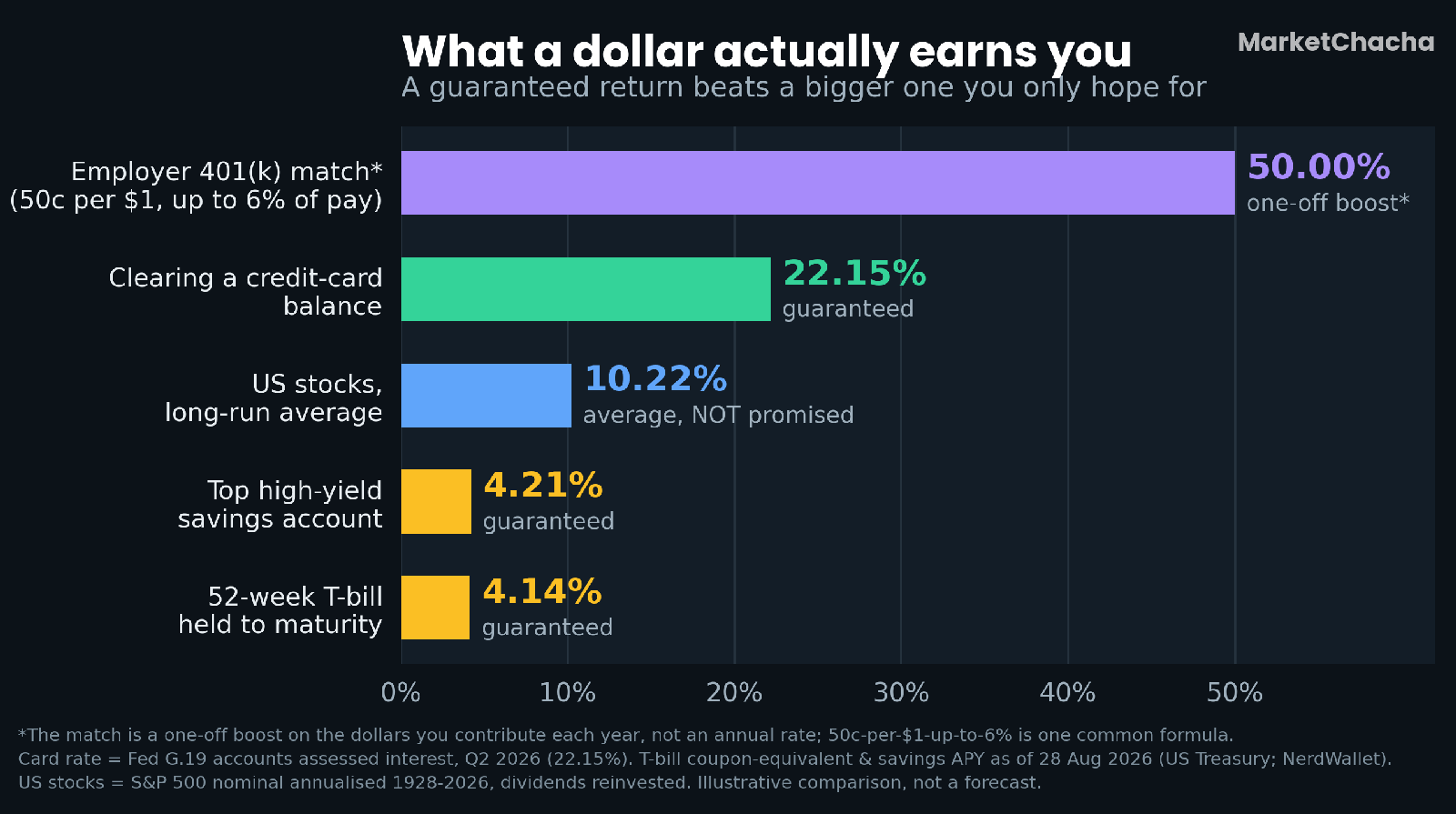
People compare 10% to 22% and still hesitate, because the 10% feels exciting and the 22% feels like admin. Three differences are worth internalising.
Certainty. 10.22% is an average across nearly a century, not a promise about next year. Individual years have been deeply negative. 22.15% is contractual: the issuer will charge it whether or not the market cooperates.
Tax. Investment gains are eventually taxed; interest you never pay is not income, so it is never taxed. A guaranteed 22.15% of avoided interest is worth more than a 22.15% pre-tax investment return.
Sequence. Interest on a card compounds against you month after month while you wait to be right about the market. There is no scenario where paying off a 22% balance "underperforms".
The comparison also tells you what "high-interest" means in practice: debt costing meaningfully more than what safe cash pays you. With 52-week T-bills at 4.14% and top savings accounts near 4.21% in late August 2026, a 22% card is obviously on the wrong side of that line. A 3% mortgage plainly is not. Between roughly 6% and 9% it becomes a judgement call about risk tolerance rather than a rule.
Step 4 — Finish the cushion, then invest for the long term
With expensive debt gone, top the buffer up to three to six months of essential expenses. Three months is defensible if you have stable income and a second earner in the household; six or more if your income is variable, commission-based, or you are the only earner. Keep it in cash-like instruments — a high-yield savings account, a money-market fund, short T-bills or a short CD ladder — not in stocks, because the whole point is that it is there on a bad day, which is exactly the day markets tend to be down.
Only then does long-term investing start in earnest: raise the 401(k) contribution beyond the match, use an IRA (the 2026 limit is $7,500, plus $1,100 if you are 50 or over), and after that a plain taxable brokerage account. This is also where a long horizon does its work, because a 10.22% long-run average is a reasonable planning assumption over decades even though it is a terrible prediction for any single year.
How to actually do it, step by step
- Write down every debt — balance, interest rate, minimum payment. Rate is the column that decides the order; balance is the one that decides how long it takes.
- Calculate one month of essentials from your last three bank statements, not from what you think you spend. Automate a transfer into a separate savings account until you hit it.
- Open your 401(k) portal and find the match formula. It is usually written as "X% of the first Y% of pay". Set your deferral to exactly Y. While you are there, find the vesting schedule.
- Pay minimums on everything, and throw every remaining dollar at the highest-rate debt (the avalanche method — mathematically fastest). If motivation is the binding constraint, smallest-balance-first works too; it just costs a little more in interest.
- Set the date you check back. Rates and balances move. Rerun the comparison every few months.
What each step costs you. The buffer costs you the interest you could have saved by paying the card sooner — a real price, worth paying for the stability. The match costs you liquidity: that money is locked until 59½ and may not be vested. The debt-payoff phase costs you time out of the market, which stings emotionally when stocks are rising. And the emergency fund permanently earns a low return by design — that is the fee you pay for having cash on the worst day.
Common mistakes beginners make
- Investing while carrying a card balance because "the market returns 10%". It returns an average of about 10%; the card charges its rate with certainty.
- Skipping the match to clear debt faster. The match is worth more per dollar than the interest you save, and each year's match expires.
- Building a twelve-month emergency fund before touching 22% debt. Cash earning 4% while debt costs 22% is a guaranteed loss of about 18 points a year on every dollar held.
- Draining the buffer to zero to make one heroic payment, then reaching for the card the next time something breaks.
- Treating all debt as one thing. A 22% card and a 3% mortgage are not the same problem and do not belong in the same step.
- Ignoring the vesting schedule when you are about to change jobs, which is precisely when it matters most.
How this works in India
The logic transfers; the instruments change. The biggest structural difference is that there is no employer match to opt into — EPF is statutory. An employee and employer each contribute 12% of basic pay plus dearness allowance (part of the employer's share is routed to the pension scheme, EPS), and it happens whether or not you engage with it. The government ratified an EPF interest rate of 8.25% for FY 2025-26, credited in June 2026. So for most salaried Indians, step 2 is already done for them and the order effectively becomes: buffer, then debt, then long-term investing.
Step 3 is if anything more urgent in India, because card rates are far higher. ICICI Bank, for example, publishes a rate of up to 3.75% per month, which it states as 45% per annum, on revolving balances (issuer-specific — check your own card's schedule of charges, and remember that cash withdrawals attract interest from day one with no interest-free period). Against a 45% cost of carry, no investment argument survives contact with a calculator.
For steps 1 and 4, the cash equivalents are a savings account with a sweep facility, a short bank FD, a liquid fund, or RBI 91/182/364-day T-bills bought through RBI Retail Direct. For step 5, the long-term options are PPF (7.1% for the July–September 2026 quarter), NPS, ELSS and equity mutual funds; other small-savings rates for the same quarter were NSC 7.7%, SCSS 8.2%, SSY 8.2% and the 5-year post office time deposit 7.5%.
One tax nuance changes the old playbook. The new tax regime has been the default since AY 2024-25, and under it Section 80C and 80CCD(1B) deductions are not available — so "saving tax" is no longer the reason to pick PPF or ELSS for anyone on the new regime; pick them on their merits instead. Section 80CCD(2), the deduction for your employer's NPS contribution (up to 14% of salary), does survive under the new regime — which makes corporate NPS the closest Indian analogue to "free money from your employer", if your company offers it.
FAQ
Should I pay off debt or invest first? Pay off high-interest debt first — anything in double digits, and credit cards especially. The exception is a full employer 401(k) match, which is worth more per dollar than the interest you would save, so capture that before attacking the debt.
Is it ever worth investing while carrying credit card debt? Only up to the employer match. Beyond that, you would be swapping a certain 22.15% cost (the Fed's Q2 2026 average for accounts carrying a balance) for an uncertain long-run average of about 10% — a losing trade in most years and a much worse one in a bad year.
How much emergency fund do I need before I start investing? A starter buffer of about one month of essential bills before you tackle debt, then three to six months once the expensive debt is gone. Three months suits stable dual incomes; six or more suits variable or single incomes.
What counts as "high-interest" debt? Debt costing meaningfully more than safe cash pays you. With T-bills and top savings accounts around 4.1–4.2% in late August 2026, a 22% card clearly qualifies and a 3% mortgage clearly does not; roughly 6–9% is a judgement call.
Should I still contribute to my 401(k) if I might leave the job soon? Your own contributions are always yours. The employer's contributions depend on the vesting schedule — up to a three-year cliff or six-year graded schedule under Department of Labor rules — so check where you sit before assuming the match is money you own.
Does this order work in India? Yes, with EPF replacing the employer match automatically at 8.25% for FY 2025-26, and step 3 mattering even more because Indian card rates run far higher — ICICI Bank, for instance, publishes up to 3.75% per month (45% a year) on revolving balances.
Educational content only — not investment, tax or insurance advice, and not a recommendation of any product. Rates, fees and rules change — always check current terms with the provider. [Sources: Federal Reserve G.19 (7 Aug 2026), FRED TERMCBCCINTNS, CFPB, IRS 2026 limits, US Department of Labor, US Treasury daily bill rates, Vanguard How America Saves, Income Tax Department (India), Business Today (small savings, Jul–Sep 2026), ICICI Bank]. Always do your own research.
This article is for educational and informational purposes only. It is not financial advice, investment recommendation, or a solicitation to buy or sell securities. Investing involves significant risks. I am not a SEBI-registered investment advisor. Readers should consult their own financial advisor and conduct their own research before making any investment decisions.
Comments
Join the conversation
Sign in to join the conversation.
Follow replies, add your view, and take part in the discussion.
Sign in to commentLoading comments...