

Why did my card charge extra abroad? Foreign transaction fees and DCC, explained
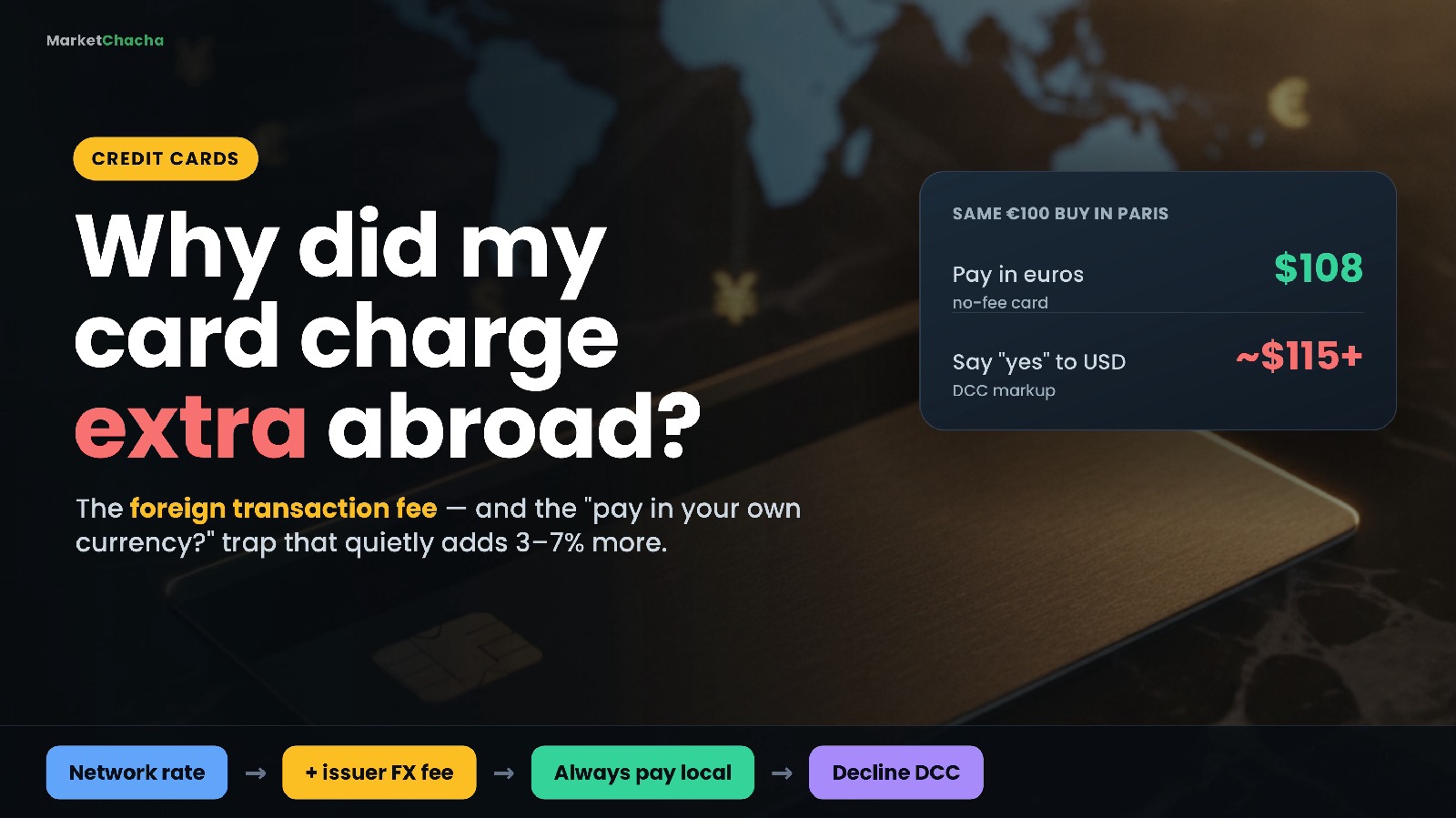
If your credit card statement showed a charge that was bigger than the price on the tag when you shopped or travelled abroad, two hidden costs are usually to blame: a foreign transaction fee your card adds (often around 3%), and a sneakier one called Dynamic Currency Conversion (DCC) — the moment a shop terminal or overseas website asks, "Would you like to pay in your home currency instead?" Saying yes to that question can quietly add another 3–7% on top. This article explains exactly how each cost works, walks through the arithmetic on a single purchase, and shows the one habit that makes most of it disappear.
What a foreign transaction fee actually is
A foreign transaction fee is a percentage your card charges whenever a purchase is processed outside your home country or in a foreign currency. It is charged on top of the exchange rate, so it is pure cost to you. In the US, this fee is typically between 0% and 3% of the transaction, and roughly 3% is the most common figure on standard cards (as of Sep 2026, per WalletHub and Forbes Advisor).
The fee usually has two parts. The card network — Visa or Mastercard — charges about 1% for handling a cross-border or foreign-currency transaction. Your card issuer (the bank whose name is on the card) can then add its own margin, commonly another 1% or 2%. Add them together and you get the "~3%" you see quoted. Crucially, many travel-focused and premium cards waive the issuer's part entirely and absorb the network part, advertising "no foreign transaction fees" — meaning the whole 3% can legitimately be zero if you carry the right card.
What the "network exchange rate" is (and why it's good)
When you let the transaction settle in the local currency, Visa or Mastercard convert it using their own daily exchange rate. That rate is set close to the wholesale (interbank) market rate, with only a very small spread. It is transparent, applies equally to everyone, and is almost always the best rate a consumer can get at the point of sale. This matters because the entire DCC trap below is about who gets to do the conversion: your card's network (cheap) or a middleman standing at the terminal (expensive).
What Dynamic Currency Conversion (DCC) is — the "pay in your own currency?" trap
DCC is a service offered by the merchant's payment terminal or an overseas website, not by your bank. When it detects a foreign card, it offers to show and bill the purchase in your home currency so you "know exactly what you're paying." It feels helpful. The catch is that the DCC provider — not your card network — sets the exchange rate, and they build a markup into it. Industry sources put that embedded margin at roughly 3% to 7% (per Stripe and Adyen guidance, as of Sep 2026), which is worse than the rate your card network would have used.
Worse still, choosing DCC does not always cancel your card's own foreign transaction fee. Many issuers decide that fee based on where the merchant is located, not what currency you paid in — so a DCC purchase billed to you in dollars can still attract your card's 3% on top of the DCC markup. Whether that happens is issuer-dependent, which is exactly why the safe move is to never opt into DCC in the first place.
A worked example: the same €100 purchase in Paris
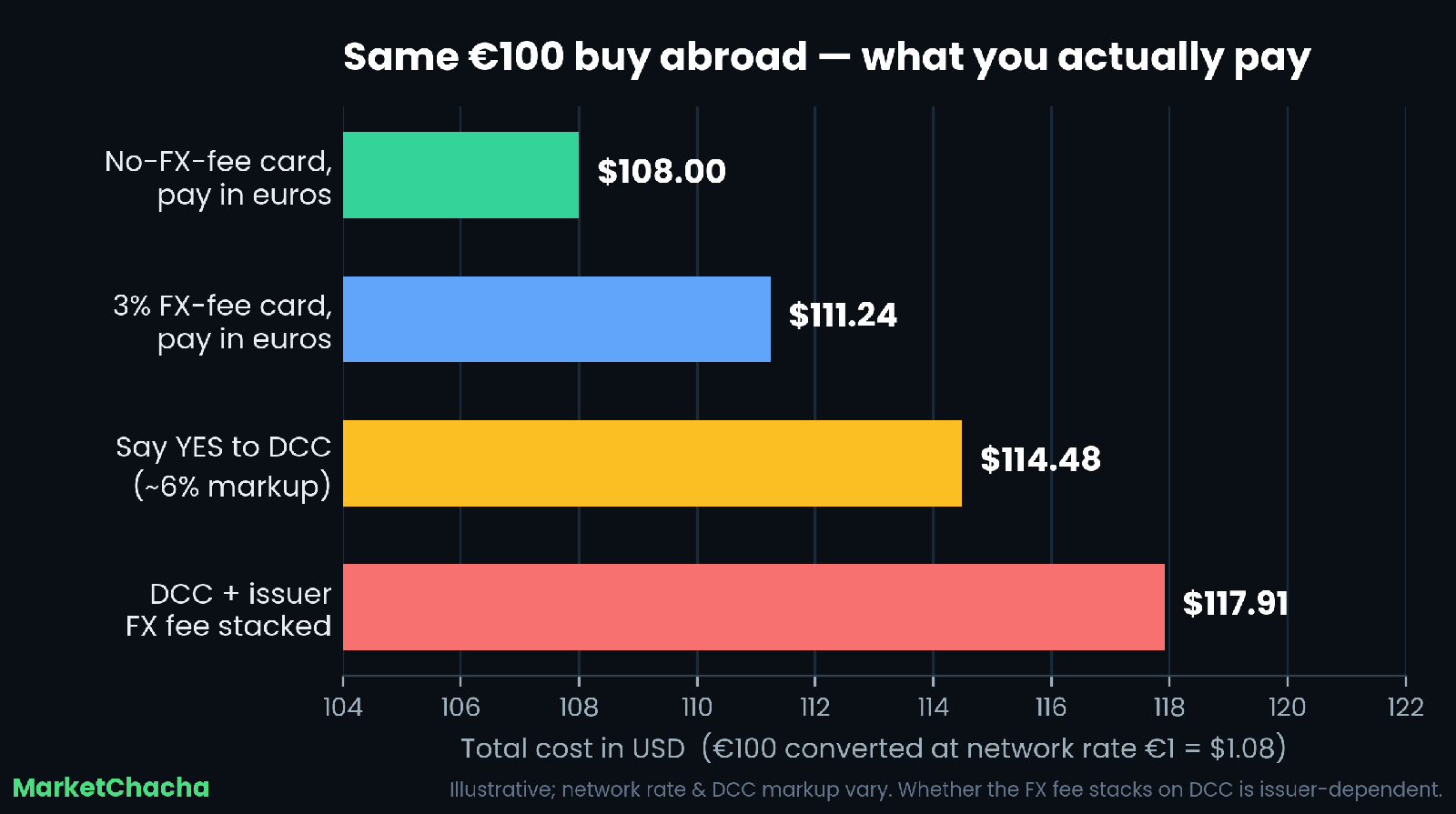
Suppose you buy something priced at €100 and Visa's network rate that day is €1 = $1.08, so the "fair" cost is $108.00. Here is what you actually pay under four scenarios:
- No-foreign-fee card, pay in euros: the network converts €100 at $1.08 → $108.00. Nothing added. This is the floor.
- Card with a 3% foreign fee, pay in euros: $108.00 × 1.03 → $111.24. The extra $3.24 is your card's foreign transaction fee.
- You tap "yes" to DCC (≈6% markup): the terminal converts €100 at its own marked-up rate → about $114.48. You handed the conversion to the shop's provider.
- DCC and your card's 3% fee both apply: $114.48 × 1.03 → about $117.91. The worst case, and it is issuer-dependent.
Same purchase, and the gap between the best and worst outcome is nearly $10 on a $108 buy — roughly 9%. Scale that across a two-week trip and it is real money.
How to actually avoid these fees (step by step)
You do not need to be an expert to dodge almost all of this. Four habits cover it:
- Before the trip, check your card's foreign transaction fee (it is in the terms, usually listed as a percentage). If it charges one and you travel often, consider getting a card that advertises no foreign transaction fees for travel spending.
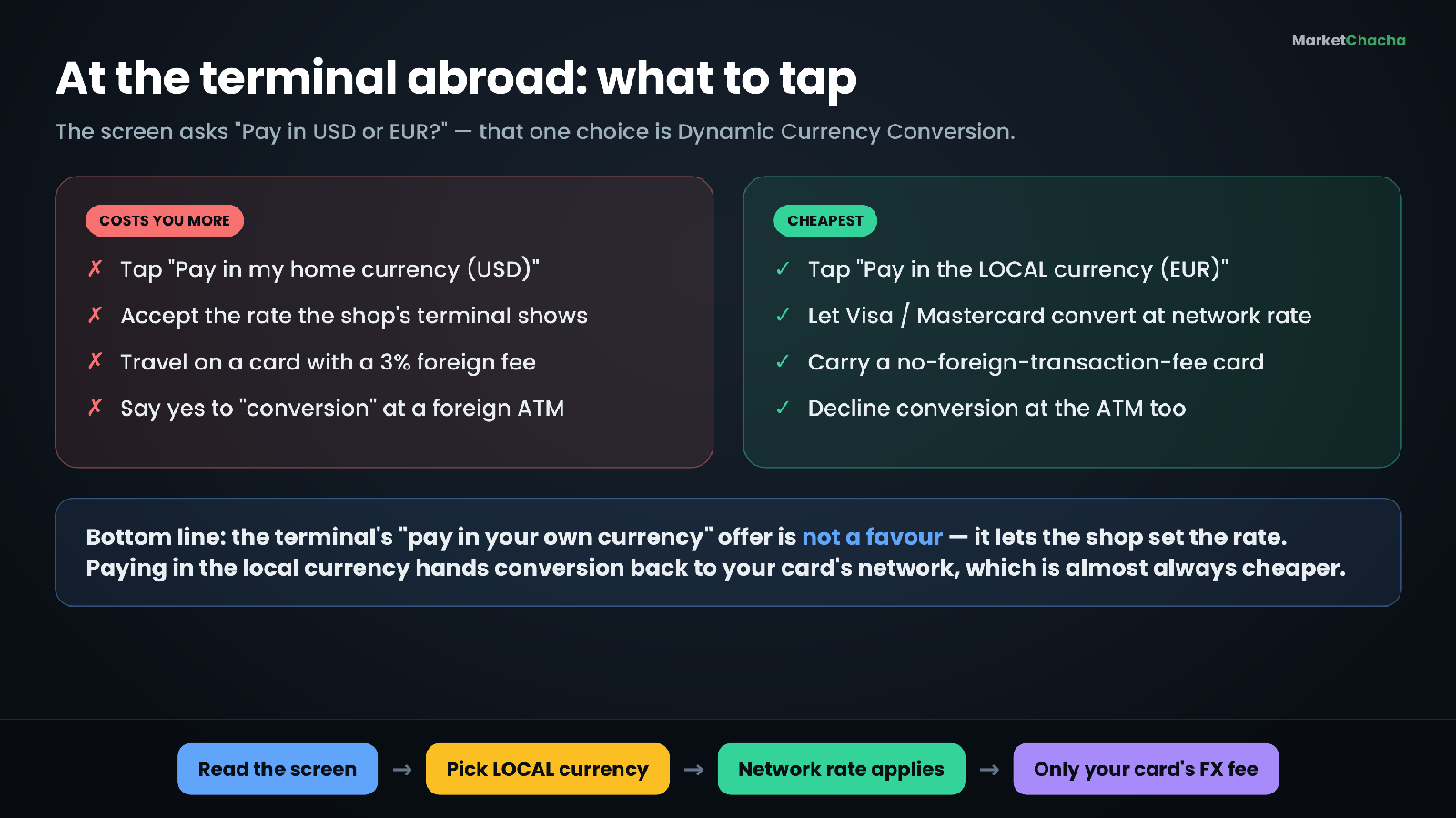
- At the card machine, when it asks whether to charge in your home currency or the local currency, always choose the local currency (euros in France, yen in Japan, and so on). That single tap declines DCC and sends the conversion to your card's network.
- At foreign ATMs, the same prompt appears — "with conversion" or "without conversion." Choose without conversion so your bank converts, not the ATM operator.
- Online, on an overseas site, if it offers to bill you in your home currency, pick the site's local currency instead where you can.
What it costs you — and the catch
The honest nuance: paying in the local currency is almost always cheaper, but not by a fixed amount. Your saving depends on how big the DCC markup was that day and whether your card charges a foreign fee at all. If you carry a no-foreign-fee card and always decline DCC, your all-in cost is essentially just the network rate — the best a traveller can do. If your only card charges 3%, you cannot avoid that 3% (it is your card's fee), but you can still avoid the extra DCC markup by choosing local currency. The catch with "no foreign fee" travel cards is that some carry an annual fee, so they pay off mainly if you spend abroad enough for the saved fees to beat that cost.
Common mistakes beginners make
- Thinking DCC is a courtesy. Being shown the price in your own currency feels transparent, but that convenience is exactly where the markup hides.
- Assuming "pay in dollars" avoids the foreign fee. It usually does not — many issuers still charge the fee based on the merchant's country.
- Only checking the fee, not the rate. Two costs are in play: your card's fee (fixed by your card) and the conversion rate (fixed by whoever converts). Declining DCC fixes the second one.
- Using a debit card with a flat foreign fee for big trips when a no-foreign-fee card would have been free.
How this works in India
Indian cardholders face the same DCC prompt abroad, so the "always pay in the local currency" rule is identical. The fee structure has its own labels, though. Instead of a "foreign transaction fee," Indian issuers charge a forex markup, commonly in the 1.5%–3.5% range, with about 3.5% still typical on many mass-market cards (as of Sep 2026, per BankBazaar and Paisabazaar). On top of that markup, 18% GST applies to the markup fee itself — not to your whole purchase.
Worked example: spend the equivalent of ₹10,000 abroad on a card with a 3.5% markup. The markup is ₹350, and 18% GST on that ₹350 is ₹63, so the extra cost is about ₹413 over the network rate. A growing set of "zero forex markup" cards waive the 3.5% (you still get the Visa/Mastercard rate, which carries only a tiny spread), and GST then has almost no markup to apply to. As with US cards, some of these carry an annual fee, so they make sense mainly for frequent international spenders. (Note: rules on TCS and other levies for overseas spending change periodically — check current RBI and income-tax guidance before a big trip.)
FAQ
Should I pay in the local currency or my home currency when a card machine abroad asks? Always choose the local currency of the country you are in. That declines Dynamic Currency Conversion and lets your card's network convert at its cheaper rate.
Does paying in dollars abroad avoid the foreign transaction fee? Usually not. Many issuers base the fee on where the merchant is located, not the currency you paid in, so a purchase billed in dollars can still carry the fee — and adds a DCC markup on top.
What is a normal foreign transaction fee? In the US it is typically 0% to 3%, with around 3% being common; many travel cards charge nothing. In India the equivalent forex markup is often 1.5%–3.5% plus 18% GST on that markup.
Is Dynamic Currency Conversion ever worth it? Rarely for the consumer. The DCC provider embeds roughly a 3%–7% margin, which is almost always worse than your card network's rate. Its only real benefit is seeing the exact home-currency amount upfront, which you pay dearly for.
How can I avoid these fees completely? Carry a card with no foreign transaction fee, always tap "local currency" at terminals and "without conversion" at ATMs, and pick the local currency on overseas websites.
Do these fees apply to online shopping on foreign websites too? Yes. Buying from a site based in another country or priced in a foreign currency can trigger your card's foreign fee, and some sites offer DCC at checkout — choose their local currency where possible.
Educational content only — not investment, tax or financial advice, and not a recommendation of any card or product. Fees, rates and rules change and are issuer- and country-dependent — always check your card's current terms and the "how we calculate charges" disclosures before you rely on them. [Sources: WalletHub, Forbes Advisor, Stripe, BankBazaar, Paisabazaar]. Always do your own research.
This article is for educational and informational purposes only. It is not financial advice, investment recommendation, or a solicitation to buy or sell securities. Investing involves significant risks. I am not a SEBI-registered investment advisor. Readers should consult their own financial advisor and conduct their own research before making any investment decisions.
Comments
Join the conversation
Sign in to join the conversation.
Follow replies, add your view, and take part in the discussion.
Sign in to commentLoading comments...