

Why did PNB Housing Finance hit a 52-week high today — on just 4.5% profit growth?
What happened
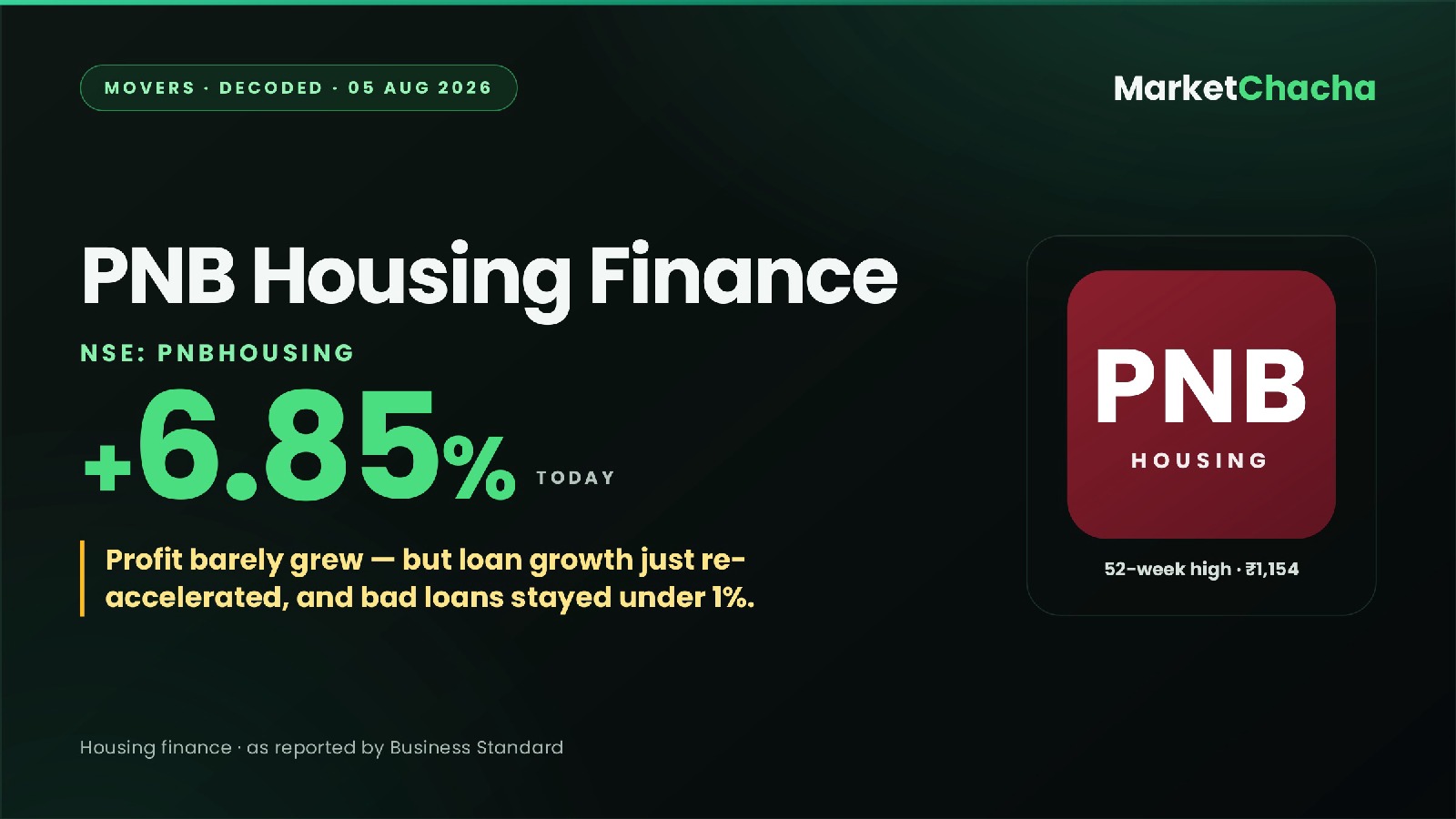
PNB Housing Finance jumped as much as 6.85% this morning to a fresh 52-week high of ₹1,154 on the NSE, before paring some of the gain. The trigger was its June-quarter (Q1 FY27) results — but here's the odd part: net profit rose only about 4.5%, to ₹557 crore. A single-digit profit bump doesn't usually push a stock to a record. So what did the market actually like?
Why it moved
The profit line is the least interesting number in the release. Buyers rewarded three things sitting underneath it:
- Growth re-accelerated. Assets under management crossed ₹93,021 crore, up 13% year-on-year, and the retail loan book grew 16% to ₹89,178 crore. For a lender that spent years deliberately shrinking a risky corporate book, getting back to steady double-digit retail growth is the real story.
- The higher-margin engine is firing. The affordable + emerging-markets segment grew 27% YoY and now makes up 41% of the retail book — that's the "Roshni" affordable-home push, where loan yields run higher than plain prime home loans.
- Bad loans stayed tiny. Gross NPAs were 0.95%, still under the 1% line — one of the cleanest books in the sector. Fast growth with no visible stress is exactly what investors pay up for.
Management also kept its full-year guidance intact: 18–20% loan-book growth for FY27 and 50–60% growth in affordable housing. So the pop is a small re-rating — the market deciding this is a growth lender, not a sleepy PSU-parented one.
The business
PNB Housing is a housing-finance company — an HFC, not a bank — with Punjab National Bank as its largest shareholder. It lends across three retail buckets: prime home loans, affordable (the Roshni brand) and emerging markets (smaller towns), while an old corporate/wholesale book keeps running down. Retail is now roughly 97% of loans, so today's growth-and-asset-quality story is about the core engine, not one small slice.
Is it expensive?
At today's level the stock trades around a P/E of ~11 and roughly 1.2 times book value, for a market cap near ₹30,000 crore, as reported by Screener. That's neither cheap nor rich — it's mid-pack. For context, sector giant LIC Housing Finance is far cheaper at a P/E around 5–6 and below book value, but it grows slowly. The pure affordable-housing plays like Aavas Financiers sit north of a P/E of 20 and about 3x book. PNB Housing is being priced as something in between — a mid-teens grower with clean credit — which is exactly the re-rating today's move is chasing.
The one risk that flips it
Margins. Net interest margin slipped to 3.50% as funding costs stayed elevated. If margins keep compressing, faster loan growth won't convert into faster profit growth — and faster profit growth is the entire bull case. That's the tension a record-high price now has to earn.
Who it touches
- Other housing financiers — LIC Housing Finance, Can Fin Homes, Aavas, Home First Finance — a clean, growth-y print here lifts sentiment across the affordable-housing space.
- Punjab National Bank, the largest shareholder, gains from a stronger, better-valued associate.
- Banks and NBFCs chasing the same home-loan borrower feel the same funding-cost squeeze that's pressuring everyone's margins.
As of ~12:15 PM IST, Aug 5, 2026. Sources: Business Standard, ScanX, PSU Connect, Investing.com. For discussion and education only — not investment advice. Verify before acting.
This article is for educational and informational purposes only. It is not financial advice, investment recommendation, or a solicitation to buy or sell securities. Investing involves significant risks. I am not a SEBI-registered investment advisor. Readers should consult their own financial advisor and conduct their own research before making any investment decisions.
Comments
Join the conversation
Sign in to join the conversation.
Follow replies, add your view, and take part in the discussion.
Sign in to commentLoading comments...