

Why did Urban Company jump ~18% today on a quarter it lost ₹92 crore?
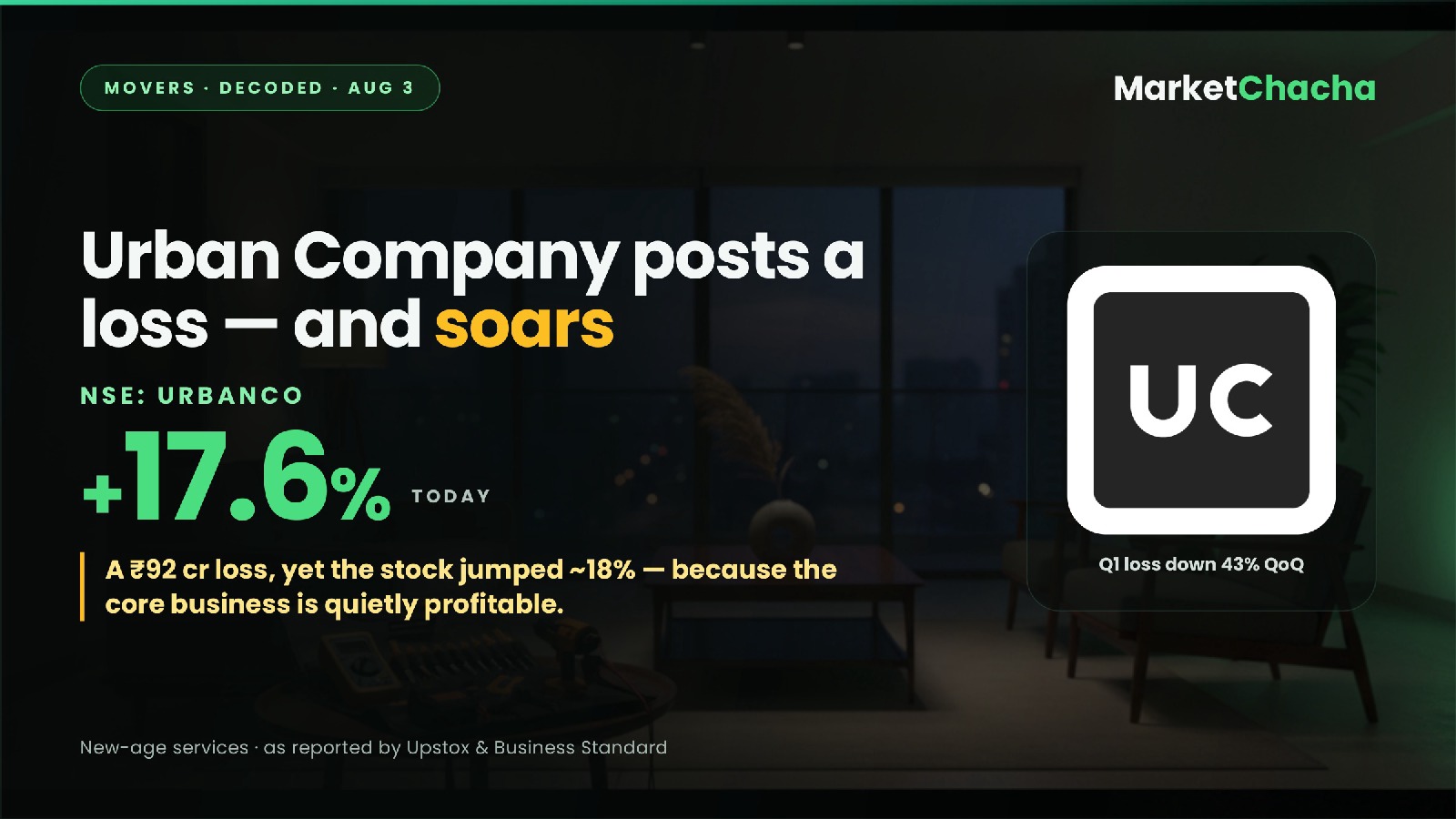
Here's a puzzle. Urban Company reported a net loss of ₹92.12 crore for the June quarter — a company that made a small ₹6.94 crore profit in the same quarter last year. And the stock jumped as much as 17.6% to ₹152.21, from its previous close of ₹129.39. A bigger loss, a soaring share price. Let's decode why.
What happened
Urban Company — the app most people know for booking a salon session or an AC repair at home — put out its Q1 FY27 numbers over the weekend. Headline revenue rose 43.86% year-on-year to ₹528.34 crore. Net Transaction Value (the total value of services booked on the platform, i.e. its GMV) grew 42% to ₹1,465 crore. But the bottom line slipped into the red. On Monday the shares opened sharply higher anyway and led the new-age pack.
Why it moved
Two things flipped the loss from a red flag into a green light.
First, the loss is shrinking fast. The ₹92 crore loss was actually 43% smaller than the ₹161.16 crore loss the previous quarter (Q4 FY26). So the trend is the opposite of what the headline suggests.
Second — and this is the real insight — the loss is a choice, not a sign the business is broken. Strip out one experimental bet called InstaHelp and the rest of Urban Company made money: adjusted operating profit (adjusted EBITDA) excluding InstaHelp rose 116% to ₹67 crore, more than double the ₹31 crore a year earlier. The core marketplace is now a real profit engine.
InstaHelp is where the cash is going. It's a newer, on-demand "instant help" service, and it burned an adjusted EBITDA loss of ₹132 crore on revenue of just ₹11.22 crore this quarter. That single line explains the entire consolidated loss. In return, the company added a record 1.2 million new users — its first quarter ever above one million additions. Management is spending heavily now to grab the market, and it reaffirmed a path to consolidated breakeven by Q3 FY28. Investors decided the land-grab is working.
The timing helped too: Monday was a broad risk-on day (crude down ~6%, a firmer rupee, active foreign buyers) — but that lifted the Nifty under 1%. Urban Company's ~18% jump was its own story.
The business
Urban Company runs three things: its core home-and-beauty services marketplace (salon-at-home, cleaning, plumbing, appliance and AC repair) — the profitable engine; a growing own-brand products line; and InstaHelp, the loss-making on-demand bet it's scaling. Today's good news is about the whole company's trajectory, with InstaHelp the swing factor — so this isn't a one-product theme stock.
Is it expensive?
Yes, on any normal yardstick. Because the company is loss-making, its P/E is meaningless (screens show it at roughly -102), and its price-to-book is about 17 — steep. The cleaner gauge for a growth name is price-to-sales: a market cap near ₹23,200 crore against annualised sales of about ₹2,100 crore is roughly 11 times sales. For context, Eternal (Zomato) — the market's favourite new-age name and vastly larger — trades near 3.7 times sales. So Urban Company is priced at a big premium to even the sector's star — the market is paying up front for years of fast growth and a clean turn to profit. (It's up ~48% from its September-2025 IPO price of ₹98–103, yet still ~24% below its ₹201 high.) Not a valuation call — just the honest picture.
Who it touches
- Other new-age listed names: a "loss-maker on a clear path to profit" print helps sentiment for peers like Swiggy, Eternal and FirstCry, and for India's pipeline of startup IPOs.
- Its service partners: tens of thousands of gig professionals earn on the platform — record user adds and InstaHelp's scale-up mean more work flowing to them.
- Pre-IPO and anchor investors: the stock sitting well above its issue price keeps early backers in the money and shapes how the next batch of IPOs gets priced.
What to watch
One number: InstaHelp's ₹132 crore quarterly burn on ₹11 crore of revenue. That's fine while user growth is exploding and unit economics keep improving. If growth stalls or the losses stop narrowing, the consolidated loss stays fat, the FY28 breakeven target drifts, and a stock trading at ~11x sales — versus ~3.7x for a giant like Eternal — has very little cushion. Fast growth is doing the heavy lifting here; the day it slows is the day this re-rates.
As of ~12:20 pm IST, 3 August 2026. Figures as reported by the sources below, not a live quote feed. Sources: Upstox, Business Standard, Inc42, StockAnalysis. For discussion and education only — not investment advice. Verify before acting.
This article is for educational and informational purposes only. It is not financial advice, investment recommendation, or a solicitation to buy or sell securities. Investing involves significant risks. I am not a SEBI-registered investment advisor. Readers should consult their own financial advisor and conduct their own research before making any investment decisions.
Comments
Join the conversation
Sign in to join the conversation.
Follow replies, add your view, and take part in the discussion.
Sign in to commentLoading comments...