

Augmont listed 22% up on a 106x book — but the grey market wanted 36%. What is this company actually worth?
Monday was a red day. Business Standard's live blog had the Sensex down about 400 points at 76,864 (-0.52%) and the Nifty at 24,022.75 (-0.63%), with midcaps off 0.92% and smallcaps off 1.03%. Into that, Augmont Enterprises listed — and went up 22% anyway.
What happened
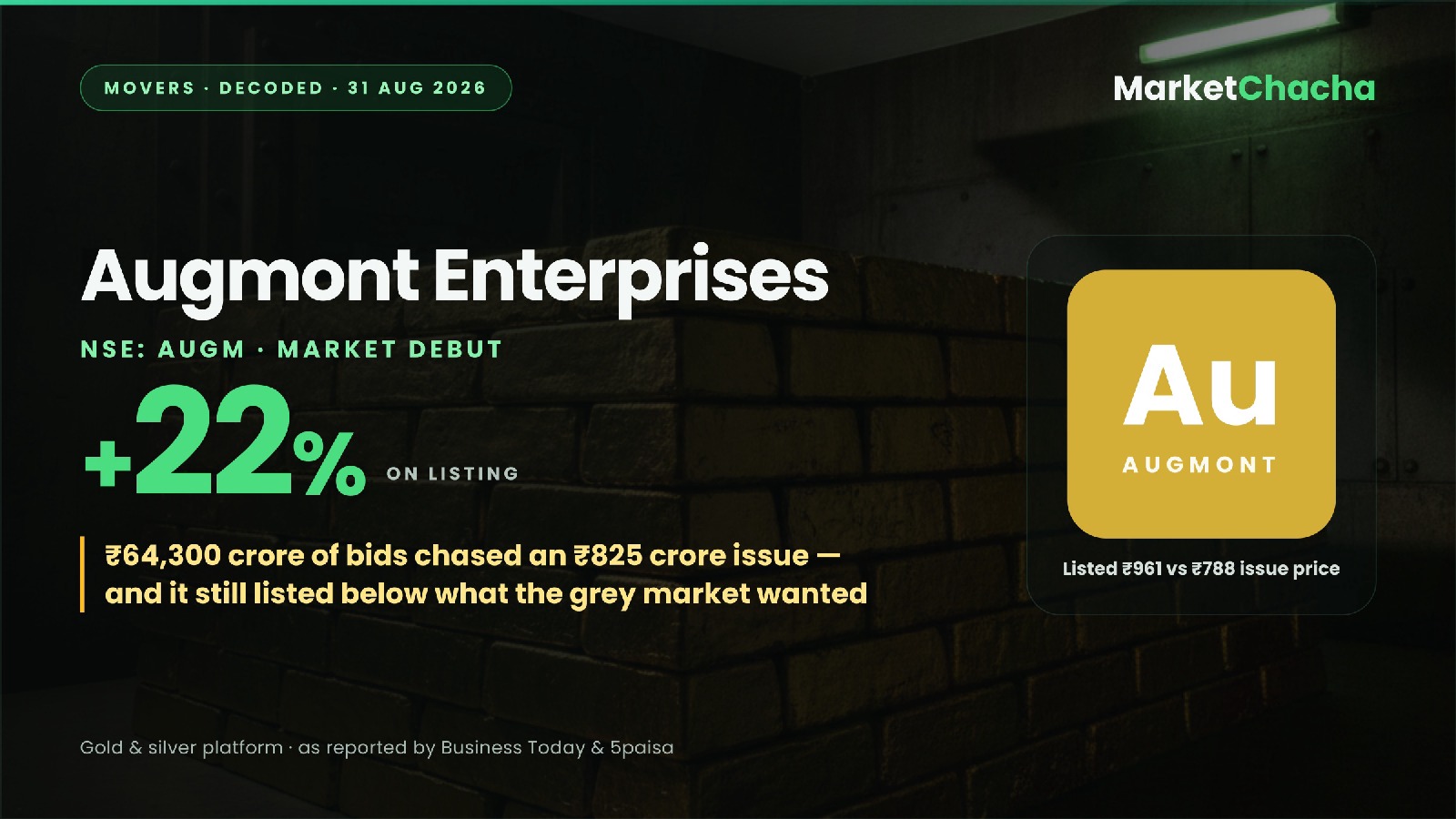
Augmont's IPO was priced at ₹788 a share. It opened on the NSE at ₹961, a 21.95% premium, and on the BSE at ₹956 (+21.32%). It then ran to a high of ₹1,019.80, about 29% above the issue price. On a lot of 19 shares, that's roughly ₹3,300 of listing profit for a retail applicant who got one.
The book behind it was enormous. The ₹825 crore issue was subscribed 105.78 times, drawing 54.98 lakh applications and about ₹64,300 crore of bids. Institutions were the hungriest: QIB 226.96x, non-institutional 121.47x, retail 30.98x.
Why the pop was smaller than it looks
Here's the part the "22% premium" headline buries: Business Today reported the grey market had been indicating 36-37%. So the listing came in roughly 14 points below what unofficial pre-listing pricing expected. Anyone who bought grey-market rights near those levels was underwater at the open. A 22% debut on a 106x book is a decent outcome, not a blowout — the demand was for the allotment, and a lot of it was flippers.
The business — and the number that will mislead you
Augmont is an integrated gold and silver platform, not a jeweller. It runs four things that stack on each other: procurement and refining of bullion, bullion trading, digital gold, and jewellery manufacturing. It sells to businesses through Augmont SPOT and to consumers through Augmont Gold For All.
Now the number. FY26 revenue was ₹94,282 crore. That is a staggering figure — larger than most of the Nifty. FY26 net profit was ₹348 crore. Do the division and the net margin is about 0.37%. That is not a broken business; it is what bullion looks like. You buy metal, you sell metal, and you keep a sliver of the spread on colossal turnover. Anyone valuing this on its sales line will get it badly wrong.
The growth is real, though: revenue went ₹34,949 crore (FY24) → ₹66,252 crore (FY25) → ₹94,282 crore (FY26), and profit ₹76 crore → ₹227 crore → ₹348 crore. That's PAT up 53% in FY26 on revenue up 42%, so the spread widened slightly rather than shrinking with scale.
Is it expensive?
At the ₹788 issue price the company was valued at about ₹7,200 crore, a post-issue P/E of 20.67x on EPS of ₹38.12 (Chittorgarh's IPO data), with a return on net worth of 49.52% — high, because the equity base is small relative to the throughput. At the ₹961 listing price that same math lifts the multiple to roughly 25x and the market cap to about ₹8,800 crore.
Compare that with the obvious listed name in India's gold economy: Kalyan Jewellers trades near a P/E of 44x on a market cap of about ₹63,000 crore, earning roughly ₹1,435 crore over the trailing twelve months. So Augmont listed at close to half Kalyan's multiple — but they are not the same animal. Kalyan is a branded retailer earning retail margins on a showroom network; Augmont is largely a wholesale metal business with a thin, high-velocity spread. A lower multiple on a lower-margin, more commoditised model isn't automatically a bargain.
Who else it touches
- Jewellery retailers — Titan (market cap about ₹4,58,549 crore), Kalyan Jewellers (₹63,559 crore) and Senco Gold (₹5,811 crore). Augmont sits upstream of them as a bullion supplier, so a listed wholesaler gives the market a read on gold volumes that retail same-store numbers don't provide.
- The digital-gold market — Augmont's consumer arm sells fractional gold directly. Until now that whole segment has been privately held, so quarterly disclosures from a listed player will be the first public numbers many investors get on it.
- The IPO pipeline — a 106x book that still listed under its grey-market indication is a data point for every issuer pricing a book this quarter.
The one thing that flips it
The margin. On a 0.37% net margin, small changes in realisation, hedging cost or inventory losses swing profit hard — and the fresh issue of ₹620 crore is going largely into ₹465 crore of working capital for inventory and procurement, which in this business means holding more metal. That's operating leverage in both directions. Watch the spread per quarter, not the revenue headline.
As of 15:30 IST, 31 Aug 2026. Sources: Business Today, 5paisa, Chittorgarh IPO data, Business Standard, CompaniesMarketCap. For discussion and education only — not investment advice. Verify before acting.
This article is for educational and informational purposes only. It is not financial advice, investment recommendation, or a solicitation to buy or sell securities. Investing involves significant risks. I am not a SEBI-registered investment advisor. Readers should consult their own financial advisor and conduct their own research before making any investment decisions.
Comments
Join the conversation
Sign in to join the conversation.
Follow replies, add your view, and take part in the discussion.
Sign in to commentLoading comments...