

Short-term vs long-term capital gains tax: how are your investment profits actually taxed?
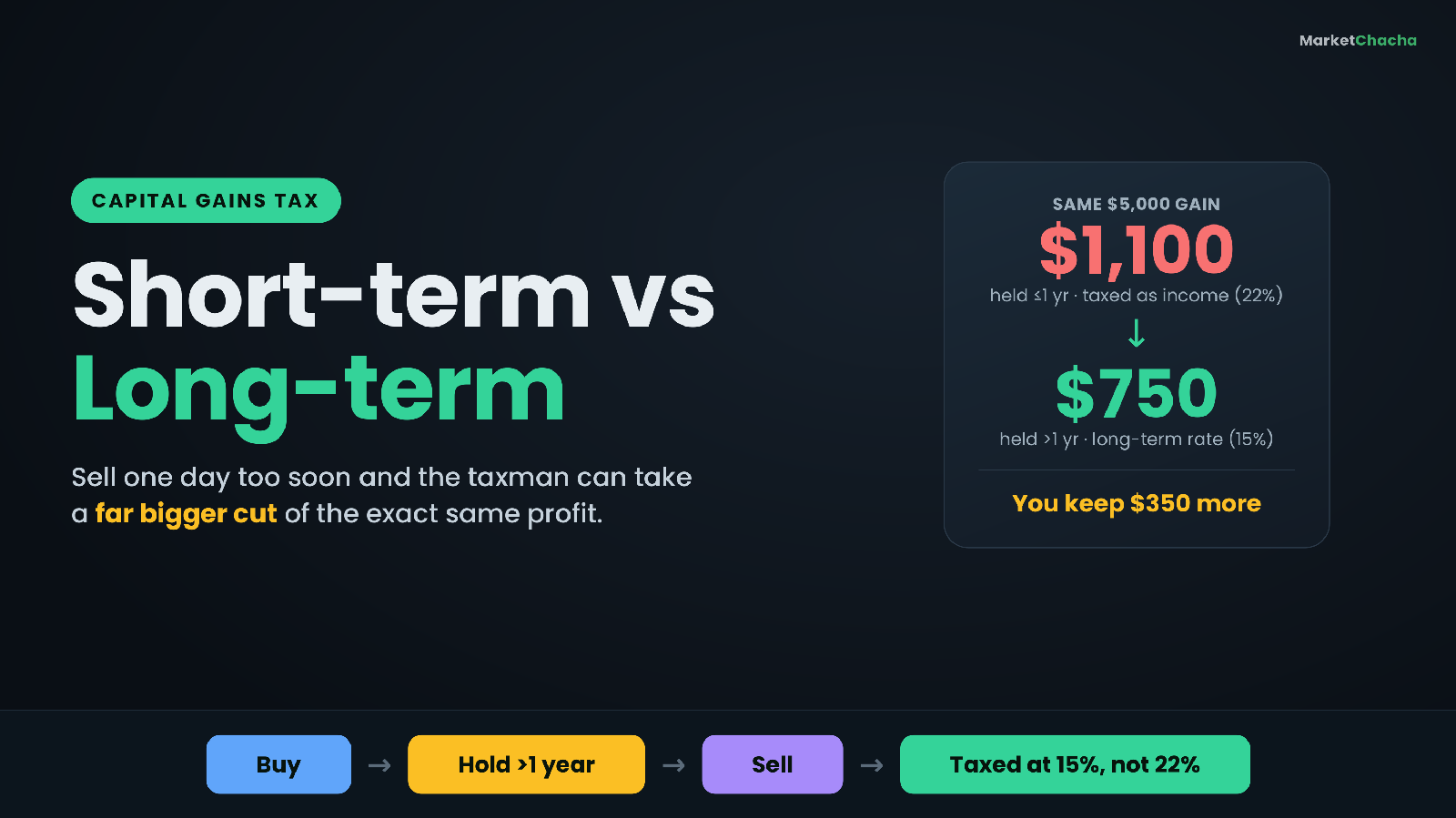
A capital gain is the profit you make when you sell an investment — a stock, a fund, a property — for more than you paid for it. How much tax you owe on that profit is decided mostly by one thing: how long you held the asset before selling. Hold it for one year or less and the gain is short-term, taxed at your ordinary income tax rate (10% to 37% in the US). Hold it for more than a year and the gain is long-term, taxed at a special, lower rate of 0%, 15% or 20%. That one distinction can mean hundreds or thousands of dollars on the exact same profit.
This guide walks through what a capital gain actually is, the one-year line that changes your rate, a full worked example with the arithmetic, the current US rates and thresholds, how your "gain" is really calculated, how to report and legally lower it, the mistakes beginners make — and a closing section on how all of this works in India.
What is a capital gain? Realized vs unrealized
A capital gain is simply your sale price minus your cost basis (what you originally paid). If you buy a share for $100 and sell it for $150, you have a $50 capital gain. If you sell for $70, you have a $30 capital loss.
The crucial catch is that a gain is only taxed once it is realized — that is, once you actually sell. If your stock climbs from $1,000 to $1,500 but you keep holding it, that $500 is an unrealized gain (a "paper profit"). You are wealthier on screen, but you owe $0 in tax until you sell and lock the profit in. This is why long-term investors can let winners compound for years without a tax bill: no sale, no taxable event.
Short-term vs long-term: the one-year line that changes everything
The single most important number in capital gains tax is one year. In the US, the holding-period clock starts the day after you buy and runs through the day you sell.
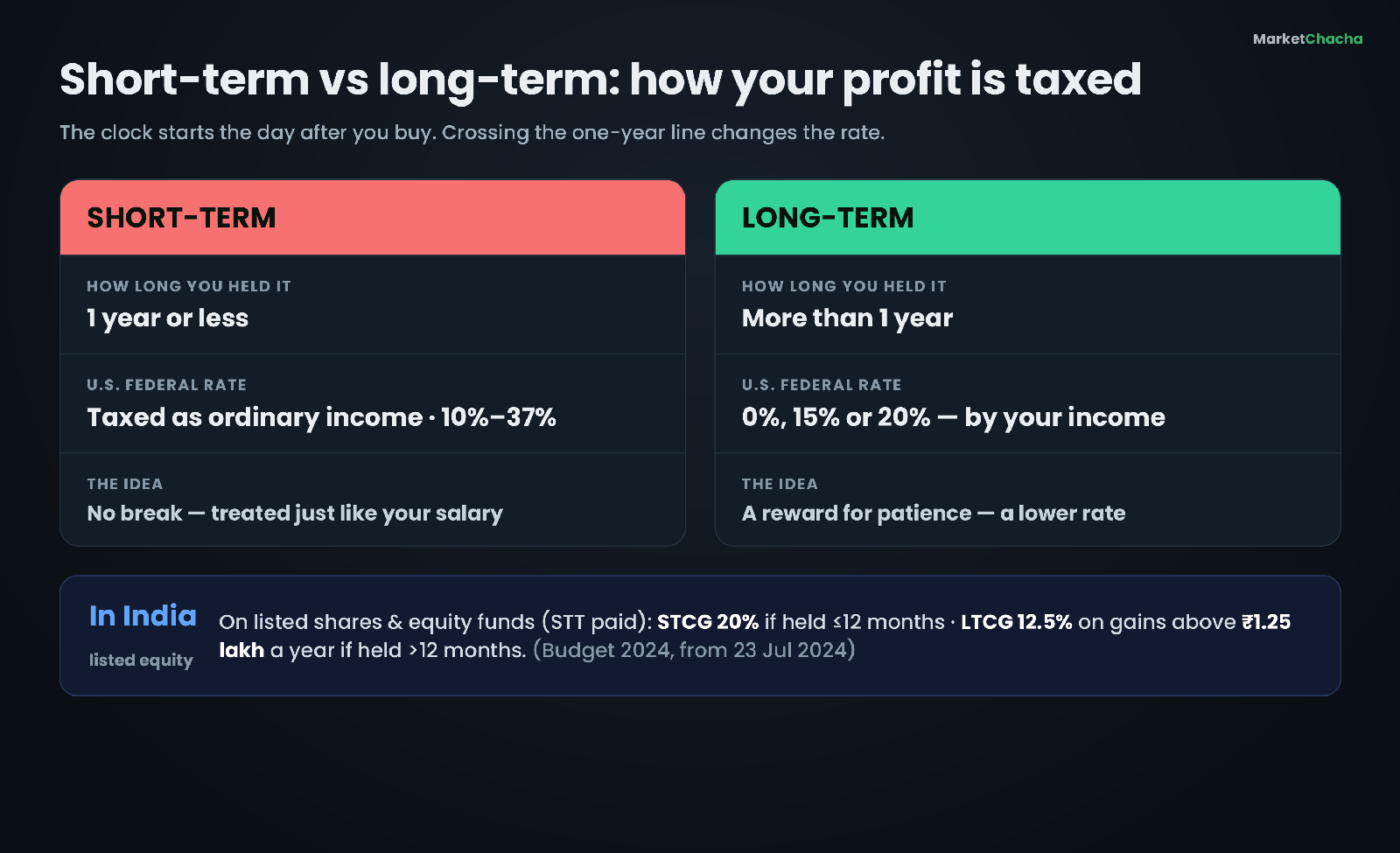
If you sell after holding for one year or less, it is a short-term gain, and the government taxes it exactly like your salary — at your ordinary income tax rate, which can be as high as 37%. If you sell after holding for more than a year (a year and a day counts), it becomes a long-term gain and qualifies for the preferential 0%/15%/20% rates. The logic is deliberate: the tax code rewards patient, long-term investing over rapid trading.
A worked example: the same $5,000 gain, two very different tax bills
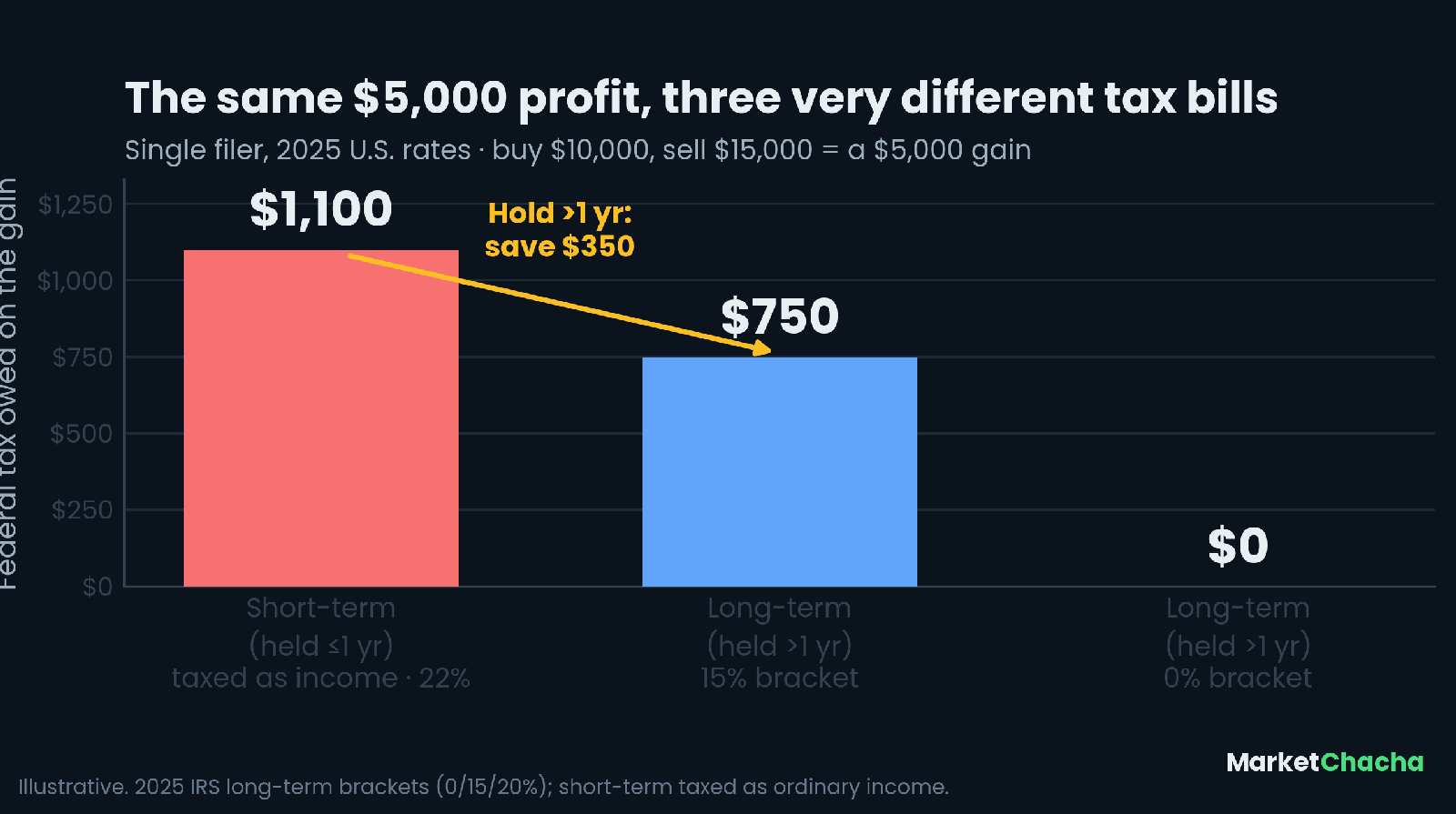
Say you buy 100 shares of a company at $100 each — a $10,000 investment. Months later the price hits $150, so your stake is worth $15,000. You sell. Your capital gain is $15,000 − $10,000 = $5,000. Now assume you are a single filer whose income puts you in the 22% ordinary bracket (and therefore the 15% long-term bracket).
Scenario A — you sold at 11 months (short-term): the $5,000 is taxed as ordinary income at 22%. Tax = $5,000 × 22% = $1,100.
Scenario B — you waited and sold at 13 months (long-term): the $5,000 is taxed at the 15% long-term rate. Tax = $5,000 × 15% = $750.
Same company, same $5,000 profit — but waiting past the one-year mark saved you $350. And here is the striking part: if your total taxable income for the year were low enough to sit in the 0% long-term bracket, that same $5,000 long-term gain would be taxed at $0.
The 2025 long-term rates: 0%, 15% or 20% — and why your income decides
Unlike short-term gains, long-term gains have their own rate schedule that depends on your taxable income. For the 2025 tax year (returns filed in early 2026), per the IRS:
- Single filers: 0% on income up to $48,350; 15% from $48,351 to $533,400; 20% above $533,400.
- Married filing jointly: 0% up to $96,700; 15% up to $600,050; 20% above $600,050.
These thresholds are adjusted for inflation each year. Long-term gains "stack" on top of your ordinary income when deciding which bracket applies, so a large gain can push part of itself from the 15% band into the 20% band.
The catch (what it can cost you): two extra charges can sit on top. First, a 3.8% Net Investment Income Tax (NIIT) may apply if your modified adjusted gross income exceeds $200,000 (single) or $250,000 (married filing jointly) — and it applies only to the income above that line, not your whole gain. Second, most US states tax capital gains as ordinary income, so you may owe state tax on top of the federal rate. Short-term gains, by contrast, simply use the ordinary income brackets of 10% to 37%.
What actually counts as your "gain": cost basis and the wash-sale trap
Your gain is proceeds minus your cost basis, and getting basis right matters. Basis includes what you paid plus buying costs, and — importantly — any reinvested dividends, which you already paid tax on. If you forget to add reinvested dividends to your basis, you will overstate your gain and overpay tax.
There is also a well-known trap on the loss side: the wash-sale rule. If you sell a security at a loss and buy the same or a "substantially identical" security within 30 days before or after the sale, the IRS disallows that loss for now. The disallowed loss is instead added to the cost basis of your new shares, delaying (not destroying) the benefit. The rule applies to losses, and it is easy to trigger by accident with automatic reinvestment turned on.
How to actually report it — and legally lower the bill
At tax time your broker sends a Form 1099-B listing your sales. You report each on Form 8949 and total them on Schedule D. Gains and losses first net against each other — short-term against short-term, long-term against long-term, then across the two — so a losing trade can cancel out a winning one.
Common, legitimate ways to reduce what you owe:
- Hold past one year to convert a short-term gain into a lower-taxed long-term gain.
- Tax-loss harvesting: deliberately sell losers to offset gains. If your losses exceed your gains, you can use up to $3,000 of net loss to offset ordinary income each year, and carry the rest forward to future years.
- Use tax-advantaged accounts: gains on investments inside an IRA, 401(k) or Roth are not taxed year to year, so trading inside them triggers no capital gains tax.
- Donate appreciated stock directly to charity to sidestep the gain while claiming a deduction.
These are mechanics for how the system works — not a recommendation to buy, sell, or time anything.
Common mistakes beginners make
- Selling at 11 months. Cashing out just before the one-year mark can turn a 15% bill into a 22%+ bill on the very same profit.
- Forgetting reinvested dividends. They raise your cost basis; ignoring them means paying tax on money you already paid tax on.
- Accidentally triggering a wash sale by rebuying the same fund within 30 days of harvesting a loss.
- Assuming "0% bracket" means the gain is invisible. The gain still counts toward your total income and can push you into a higher band or over the NIIT threshold.
- Ignoring state tax. The federal rate is only part of the picture.
How this works in India
India also splits gains by holding period, but the lines and rates differ by asset — and they changed materially in the Union Budget 2024 (effective 23 July 2024). For listed shares and equity mutual funds where Securities Transaction Tax (STT) is paid:
- Short-term (held 12 months or less): taxed at a flat 20% under Section 111A (raised from 15%).
- Long-term (held more than 12 months): taxed at 12.5% under Section 112A, on gains above ₹1.25 lakh per financial year (the exemption was raised from ₹1 lakh, and the rate from 10%).
Worked example (India): you sell equity shares after two years with a ₹2,00,000 long-term gain. The first ₹1,25,000 is exempt; the remaining ₹75,000 is taxed at 12.5% = ₹9,375.
For other assets — real estate, gold, unlisted shares — the long-term threshold is 24 months, and long-term gains are now generally taxed at 12.5% with indexation largely removed (property bought before 23 July 2024 keeps a choice between 12.5% without indexation and the old 20% with indexation). Note too that debt mutual funds bought after 1 April 2023 are taxed at your slab rate regardless of holding period. You report all of this in your income tax return (ITR).
FAQ
How long do I have to hold a stock to pay less tax? In the US, you must hold for more than one year — a year and a day — to qualify for the lower long-term rate. Selling at exactly one year, or earlier, is still taxed as a short-term gain at your ordinary income rate.
Do I owe capital gains tax if I don't sell? No. Gains are only taxed when you realize them by selling. An investment that has risen in value but that you still hold is an unrealized "paper" gain and is not taxed.
What is the 0% capital gains tax bracket? For the 2025 tax year, a single filer with taxable income up to $48,350 (or $96,700 married filing jointly) pays 0% federal tax on long-term gains. The gain still counts toward your income when testing that limit.
Are short-term capital gains really taxed more? Yes. Short-term gains are taxed as ordinary income (up to 37%), while long-term gains top out at 20% federally — which is why the one-year holding line matters so much.
Can I use losses to reduce my capital gains tax? Yes. Capital losses offset capital gains dollar for dollar. In the US, if losses exceed gains, up to $3,000 of net loss can offset ordinary income each year, and any remainder carries forward.
How are capital gains taxed in India? For listed equity and equity funds: 20% short-term if held 12 months or less, and 12.5% long-term (on gains above ₹1.25 lakh a year) if held more than 12 months, following Budget 2024.
Educational content only — not investment, tax or insurance advice, and not a recommendation of any product. Rates, fees and rules change — always check current terms and your own situation with the provider or a qualified tax professional. [Sources: Kiplinger — Capital Gains Tax Rates 2025/2026, IRS Topic 409 — Capital Gains and Losses, Business Standard — Budget 2024 capital gains changes, ClearTax — LTCG in India]. Always do your own research.
This article is for educational and informational purposes only. It is not financial advice, investment recommendation, or a solicitation to buy or sell securities. Investing involves significant risks. I am not a SEBI-registered investment advisor. Readers should consult their own financial advisor and conduct their own research before making any investment decisions.
Comments
Join the conversation
Sign in to join the conversation.
Follow replies, add your view, and take part in the discussion.
Sign in to commentLoading comments...