

Debt avalanche vs snowball: which method actually pays off your debt faster?

The fastest way to clear several debts at once is to pay the minimum on every debt and then throw every spare dollar at just one of them — and the two famous strategies, the debt avalanche and the debt snowball, disagree only about which debt that one should be. The avalanche attacks your highest interest rate first, so you pay the least total interest. The snowball attacks your smallest balance first, so you get a debt fully paid off sooner and stay motivated. This guide breaks down how each works, shows the real arithmetic on a worked example, and helps you pick the one you will actually finish.
The one engine both methods share
Before the two split, they do exactly the same three things, and this is the part that actually pays down debt:
- Pay the minimum on every single debt, every month. Missing one can trigger a penalty interest rate and hurt your credit score, so the minimums are non-negotiable.
- Send every spare dollar to ONE target debt. Not spread around — concentrated on a single debt so it dies faster.
- Roll the freed-up payment forward. When a debt hits zero, you don't pocket that payment — you add the whole thing to what you're already paying on the next target. Your monthly attack "snowballs" bigger and bigger.
That's the entire machine. The only question the avalanche and the snowball answer differently is: which debt do you point it at first?
Debt avalanche: highest interest rate first
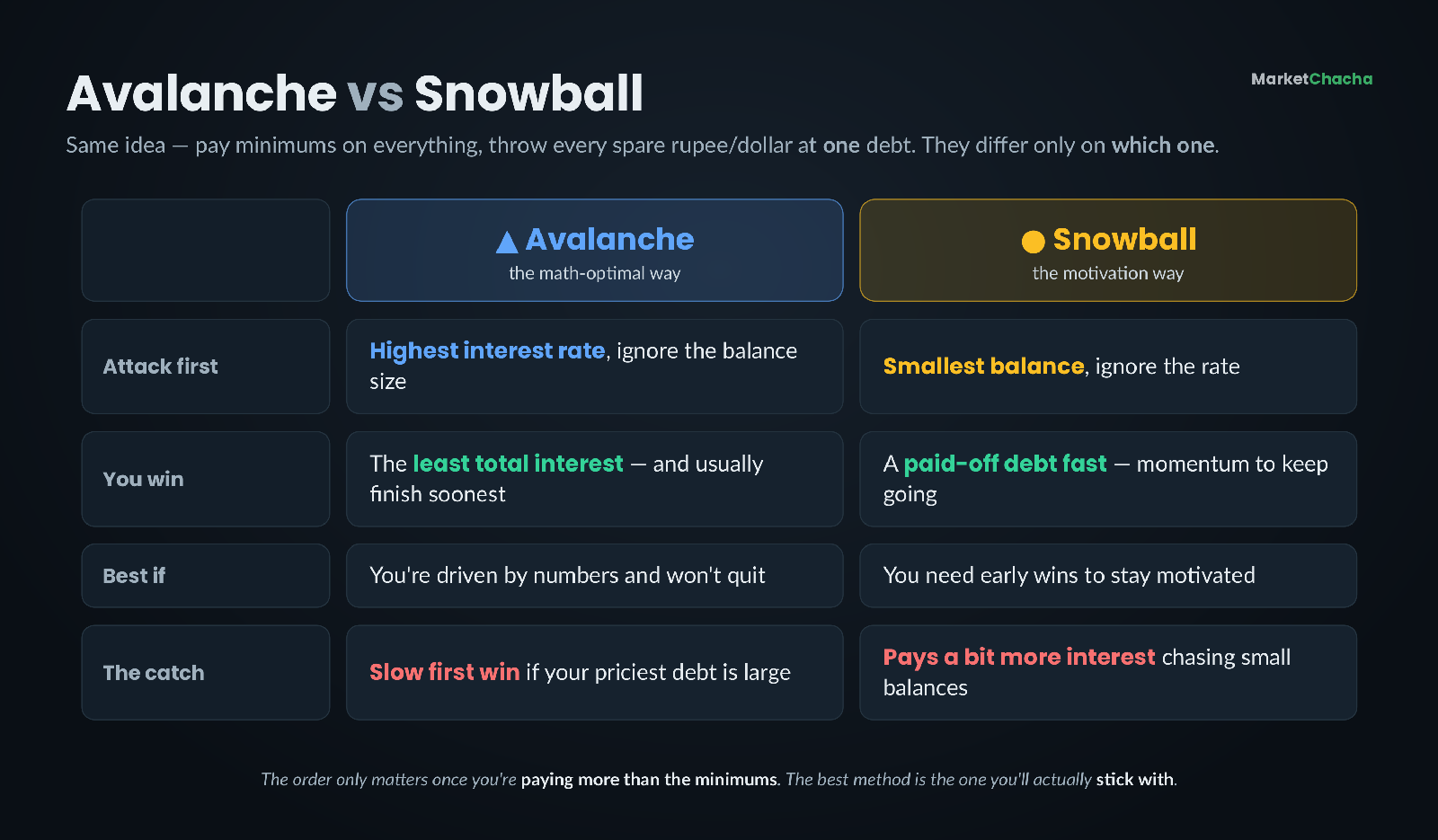
The avalanche method orders your debts by interest rate, highest to lowest, and ignores the balance sizes. You pay minimums on everything and pour every extra dollar into the debt with the steepest APR until it's gone, then move to the next-highest rate.
Why does this save the most money? Because your highest-rate debt is the one growing fastest. Every month it's alive, it piles on more interest than any other debt would. Killing it first shuts off the biggest leak. Mathematically, paying highest-rate-first always produces the least total interest and, dollar for dollar, usually gets you to zero the soonest. If you care only about the spreadsheet, the avalanche wins — every time.
Debt snowball: smallest balance first
The snowball method orders your debts by balance, smallest to largest, and ignores the interest rate. You knock out the tiniest debt first — even if it's a low-rate one — then roll into the next-smallest.
This looks mathematically "wrong," but it's built around human behaviour, not arithmetic. A 2012 study by David Gal and Blakeley McShane, published in the Journal of Marketing Research and using real consumer debt-repayment data, found that the strongest predictor of whether someone became fully debt-free wasn't their income or their interest rates — it was the proportion of accounts they had closed. Zeroing out a whole debt produces a visible win that keeps people going. A plan that saves $200 but gets abandoned loses to a plan that saves $0 but actually finishes.
A worked example: $9,000 across three debts
Say you owe (illustrative figures):
- A medical bill: $600 at 9% APR (minimum ~$25)
- Card A: $2,400 at 28% APR (minimum ~$70)
- Card B: $6,000 at 21% APR (minimum ~$150)
That's $9,000 total, and suppose you can put $350 a month toward debt. Notice the trap: your smallest balance (the medical bill) has the lowest rate, while your priciest rate (Card A, 28%) sits on a middling balance. So the two methods really do point in different directions.
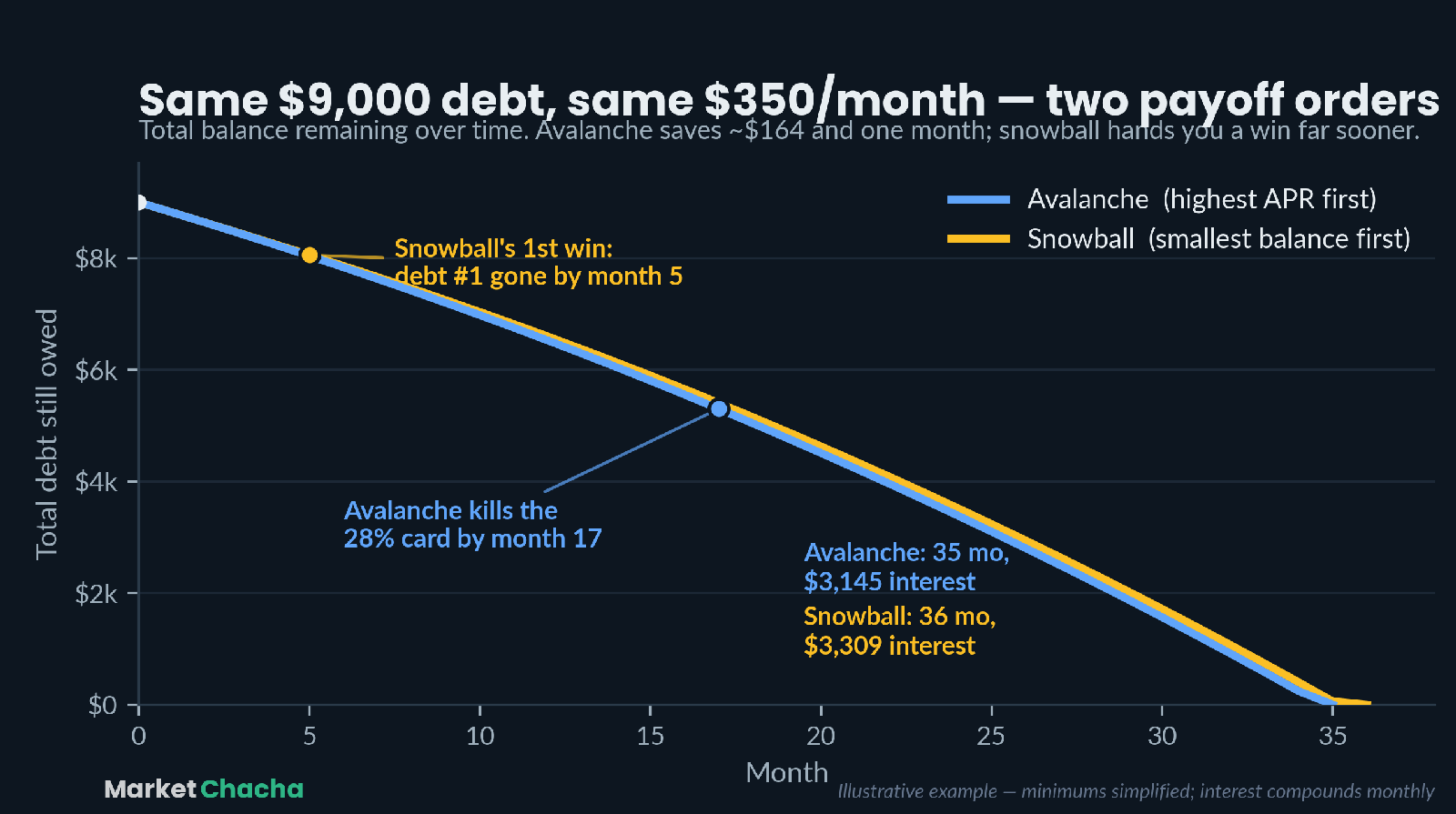
Running the numbers (interest modeled as compounding monthly, minimums simplified):
- Avalanche (attack Card A's 28% first): debt-free in about 35 months, paying roughly $3,145 in total interest. Your first debt-killed moment — that 28% card — arrives around month 17.
- Snowball (attack the $600 medical bill first): debt-free in about 36 months, paying roughly $3,309 in total interest. But your first debt is gone by month 5.
So here the avalanche saves about $164 and finishes one month sooner — while the snowball hands you a completed, closed debt a full year earlier. That trade-off, money versus momentum, is the whole decision in one picture.
Why the gap is small here — and when it's huge
A $164 difference on $9,000 might make you shrug. That's honest: on modest balances with similar rates, the two methods finish close together. But the avalanche's edge grows with two things — the size of your debt and the spread between your rates. On $30,000+ of debt where a large balance carries a punishing rate, choosing avalanche instead of snowball can save several thousand dollars. The reverse is also true: if your biggest debt also happens to be your highest-rate one, avalanche and snowball give the same order, and the debate disappears.
How to actually do it, step by step
- 1. List every debt with three columns: balance, interest rate (APR), and minimum payment. Include cards, personal loans, buy-now-pay-later, everything.
- 2. Pick your engine. Sort the list by rate (avalanche) or by balance (snowball). Be honest about whether you're a numbers person or someone who needs early wins.
- 3. Decide your total monthly budget for debt — the sum of all minimums plus whatever extra you can commit.
- 4. Pay every minimum, then dump the extra on target #1. This is the only step that changes the math.
- 5. When target #1 hits zero, roll its entire payment (minimum + extra) onto target #2. Keep your total monthly outlay constant.
- 6. Repeat until the last debt is gone — and don't add new debt while you're at it.
What it costs you — the catch
A few honest caveats before you commit:
- The order only matters if you pay more than the minimums. If you can only make minimum payments, neither method makes a real dent — the priority is finding extra money or lowering the rate.
- Avalanche can feel like nothing is happening. If your highest-rate debt is large, months can pass with no debt fully cleared. That invisible progress is exactly what makes some people quit — which is the snowball's entire argument.
- New debt cancels your progress. Running the card back up while paying it down is like bailing a boat without plugging the hole.
- A lower rate can beat both. A balance-transfer card or a consolidation loan attacks the interest rate directly, which can outrun either strategy — but watch the transfer fee and what the rate resets to when a promo ends. Whether that math works depends on the specific offer, so read the terms.
The average-rate reality check
Why does the avalanche obsess over rate? Because card rates are brutal. As of Q2 2026, the Federal Reserve's G.19 release put the average rate on card accounts assessed interest at about 22% (the average across all accounts was roughly 21%). One honest caveat: that ~22% applies to balances that carry over month to month. If you pay your statement in full within the grace period, you're charged no interest at all and that number never touches you. It's the people revolving a balance — the ones these methods are for — who feel the full weight of a 22–29% rate, which is precisely why killing the highest rate first matters.
Common mistakes beginners make
- Only paying minimums and expecting either method to work — the strategy lives entirely in the extra payment.
- Leaving a debt off the list (that forgotten store card or BNPL plan) so it quietly grows.
- Choosing avalanche for the "right" reason, then quitting because the first win never comes. If you know yourself, the snowball's momentum may be worth the small extra cost.
- Forgetting to roll the freed payment forward and letting your monthly budget shrink as debts clear.
- Paying interest you never needed to. If you can clear the full statement each month, do — the grace period makes it free.
How this works in India
The logic is identical, but the stakes are higher. Indian credit cards typically charge 2.5%–3.75% per month, which works out to roughly 30%–45% a year (RBI requires issuers to disclose these rates clearly). Because those rates are so steep, the avalanche's savings are usually bigger in India than the US example above — attacking a 42% card before a 12% education loan can save real money.
A typical Indian debt stack might mix a credit card (36–45%), a personal loan (around 11–24%), maybe a gold loan, and a home loan (roughly 8–9%). Avalanche order is almost always: credit card first, home loan last. The snowball still works the same way — smallest balance first — if you need the motivation. And the grace-period rule holds here too: pay your card's full statement by the due date and you owe no interest; carry even a rupee of the balance and most cards start charging from the transaction date, wiping out the interest-free window. As always, check your specific card's "how we calculate interest" terms, since the exact method varies by issuer.
FAQ
Which is better, the debt snowball or the debt avalanche? The avalanche saves more money because it kills your highest-rate debt first. The snowball is easier to stick with because it clears a whole debt sooner. If the dollar gap is small, pick the one you'll actually finish.
Does the avalanche method really pay off debt faster? In total interest and usually in time, yes — paying the highest rate first is mathematically optimal. But on similar-sized debts with close rates, the difference over the snowball can be modest, as our $9,000 example showed (about $164 and one month).
What's the difference between the snowball and avalanche methods? Both pay minimums on everything and pour extra at one debt. The avalanche points that extra at the highest interest rate; the snowball points it at the smallest balance.
Should I pay off my smallest debt or highest interest first? Highest interest first saves the most money. Smallest first gives you a faster, motivating win. Choose based on whether money or momentum keeps you going.
Do these methods work if I can only pay the minimums? Not really — the order of attack only matters when you're paying extra above the minimums. If you can't, focus first on freeing up cash or lowering your interest rate.
Is it worth switching a balance to a lower-rate card? It can beat both methods by cutting the rate directly, but only if the transfer fee and the post-promo rate still leave you ahead. Read the offer's terms before you move a balance.
Educational content only — not financial advice, and not a recommendation of any product. Rates, fees and rules change — always check current terms with the provider. Sources: Federal Reserve G.19 Consumer Credit, Gal & McShane (2012), via Kellogg School of Management, Reserve Bank of India. Always do your own research.
This article is for educational and informational purposes only. It is not financial advice, investment recommendation, or a solicitation to buy or sell securities. Investing involves significant risks. I am not a SEBI-registered investment advisor. Readers should consult their own financial advisor and conduct their own research before making any investment decisions.
Comments
Join the conversation
Sign in to join the conversation.
Follow replies, add your view, and take part in the discussion.
Sign in to commentLoading comments...