

Deductible, copay, coinsurance and out-of-pocket max: what do they actually mean?
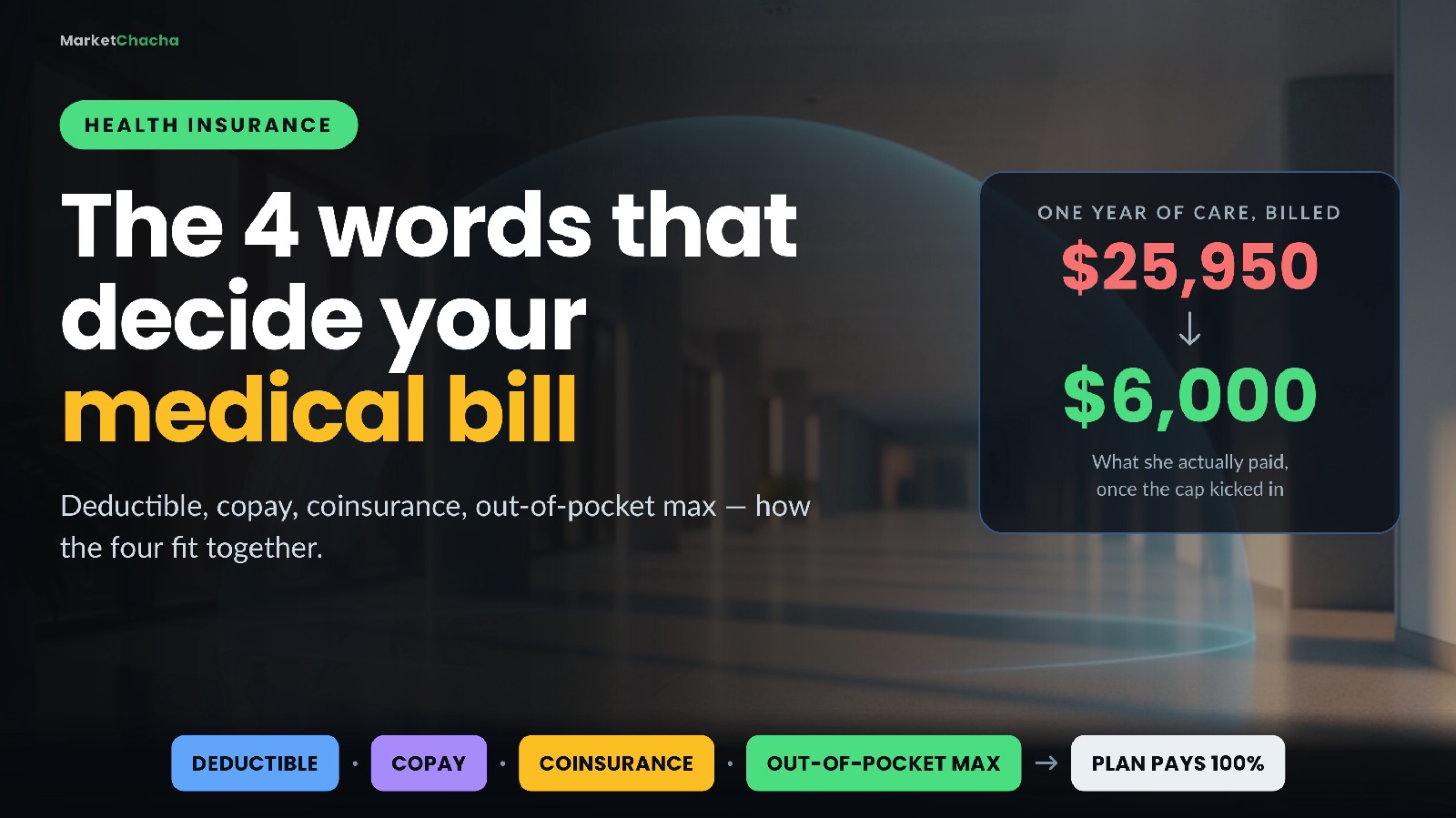
Four numbers decide what a year of medical care actually costs you: the deductible (what you pay in full before the plan starts sharing), the copay (a flat fee per visit or prescription), the coinsurance (your percentage share after the deductible), and the out-of-pocket maximum (the hard ceiling — once you hit it, the plan pays 100% of covered in-network care for the rest of the year). The deductible, coinsurance and cap stack in that sequence over the year; copays typically run alongside them from day one. Every one of these numbers sits on page 1 of your plan documents.
Below: what each term means precisely, a full worked example with the arithmetic, what does and doesn't count toward the cap, how to read your own plan in ten minutes, and the Indian equivalents at the end.
The four terms, in one sentence each
Deductible. The amount you pay for covered services each plan year before your insurer starts paying its share. On a $2,000 deductible plan, the first $2,000 of covered care is yours. One important exception in the US: ACA-compliant plans must cover a list of in-network preventive services — annual wellness visits, many screenings, routine immunisations — at no cost to you, before the deductible.
Copay. A fixed dollar amount for a specific service — $30 for a primary-care visit, $60 for a specialist, $15 for a generic prescription. It doesn't scale with the size of the bill.
Coinsurance. Your percentage of the bill after the deductible is met. "20% coinsurance" means you pay 20% and the plan pays 80% — of the allowed amount, the discounted rate your insurer has negotiated with that provider, not the hospital's sticker price.
Out-of-pocket maximum. The most you can be required to pay for covered in-network care in a plan year. Deductible payments, copays and coinsurance all count toward it. When you reach it, your cost for further covered in-network care drops to zero until the plan year resets.
A worked example: a $25,950 year that cost her $6,000
Maya has a self-only employer plan: $2,000 deductible, 20% coinsurance, $30 primary-care copay, $6,000 out-of-pocket maximum. Here is her year, in order.
March — annual physical. An in-network preventive visit. Cost to Maya: $0, paid fully by the plan before the deductible. Running total: $0.
April — primary-care visit for a persistent cough. Allowed amount $150. She pays her $30 copay; the plan pays $120. Running total: $30.
June — specialist visit and an MRI. Allowed amount $1,800. Her deductible is untouched, so she pays the full $1,800 and the plan pays nothing. Deductible progress: $1,800 of $2,000. Running total: $1,830.
September — outpatient surgery. Allowed amount $24,000. Two things happen inside this one bill:
- The first $200 finishes her deductible. Running total: $2,030.
- The remaining $23,800 is now subject to 20% coinsurance. Her 20% share would be $4,760 — but she only has $3,970 of room left under the $6,000 cap ($6,000 − $2,030). She pays $3,970 and the plan absorbs the other $790 of what would have been her share.
Her cost for the surgery: $200 + $3,970 = $4,170. The plan pays $19,830. Running total: $6,000 — the cap.
October onward. Any further covered in-network care — a follow-up, physiotherapy, another scan — costs her $0 for the rest of the plan year.
The year in totals: $25,950 in allowed charges. Maya paid $6,000; the plan paid $19,950. Note what did the heavy lifting: not the deductible, but the cap. Without it, her 20% share of that surgery alone would have run to $4,760 on top of everything else.
One plan-dependent detail worth flagging: on Maya's plan the $30 copay counts toward the out-of-pocket maximum but not toward the deductible. That's the common design, but it isn't universal — some plans apply copays to the deductible too, and some charge coinsurance instead of a copay for office visits. Your Summary of Benefits and Coverage says which.
The three phases of a plan year
Strip out the copays and the mechanic is a clean three-stage curve. In phase one you pay 100% of the allowed cost. In phase two you pay your coinsurance percentage. In phase three you pay nothing.
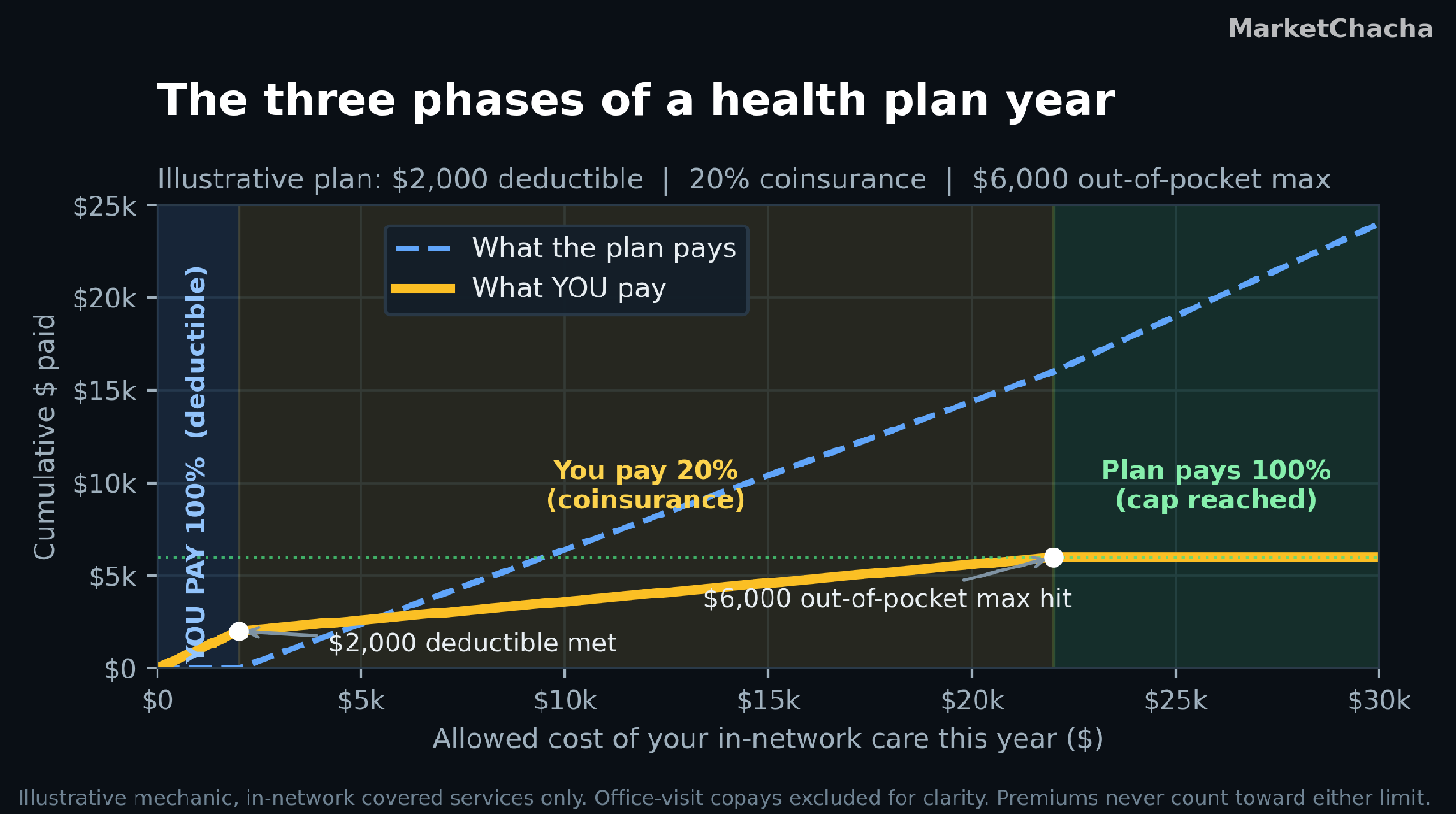
The x-axis is what your care costs at negotiated rates; the y-axis is who pays. Notice how far right the cap sits: on this plan you'd need roughly $22,000 of allowed charges in a single year to reach the $6,000 ceiling. Most years, most people never leave phase one — which is exactly why the deductible feels like the whole story until the year it isn't.
What actually counts toward the cap — and what doesn't
This is where people get an unpleasant surprise. The out-of-pocket maximum is not a limit on everything you spend on health care. It's a limit on your cost-sharing for covered, in-network services.
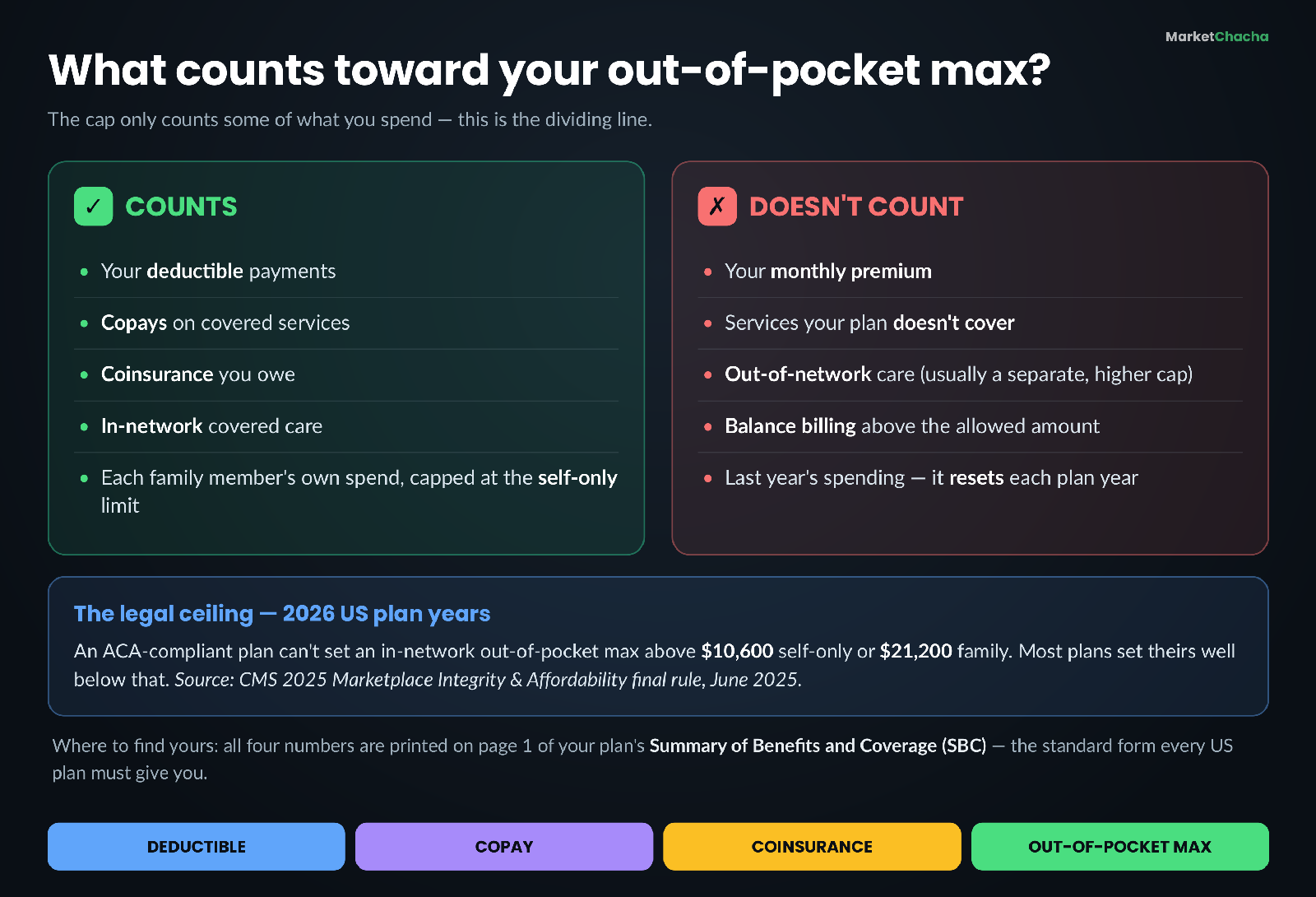
Two of those exclusions cause the most damage. Out-of-network care usually runs on a completely separate — and much higher — deductible and cap, and on some plans there's no out-of-network cap at all. And balance billing, where a provider bills you for the gap between their charge and the allowed amount, sits outside the cap entirely. The federal No Surprises Act (in force since 2022) protects you from balance billing in specific situations — most emergency care, and non-emergency care delivered by out-of-network providers at an in-network facility — but it doesn't cover every scenario.
One protection that works in your favour: since 2016, ACA-compliant plans must apply an embedded individual cap inside family coverage. No single family member can be made to pay more than the self-only limit, even if the family's combined ceiling is higher and nowhere near being met.
Why a low deductible isn't automatically the better plan
A lower deductible is bought with a higher premium, and premiums are money you spend whether or not you use any care. The honest comparison is premium + expected cost-sharing, run against two scenarios: a quiet year, and a bad one.
Take a $2,000-deductible plan costing $80 more per month than a $5,000-deductible plan. That's $960 a year of certain extra cost to save at most $3,000 of uncertain cost. If you go a year using only preventive care, the high-deductible plan wins by $960. If you have a $30,000 hospital year, both plans land you at their out-of-pocket maximum, and the difference between the two caps — not the deductibles — decides the outcome. Compare the caps as carefully as you compare the deductibles.
For context on what's typical: among US covered workers with a deductible, the average single-coverage deductible was $1,886 in 2025 (KFF Employer Health Benefits Survey, 2025).
There's also a tax angle. If a plan qualifies as a high-deductible health plan — for 2026, a deductible of at least $1,700 self-only or $3,400 family, with out-of-pocket expenses not exceeding $8,500 or $17,000 respectively — you can fund a Health Savings Account, contributing up to $4,400 self-only or $8,750 family in 2026, plus $1,000 more if you're 55 or older (IRS Rev. Proc. 2025-19). HSA money goes in pre-tax, grows tax-free and comes out tax-free for qualified medical expenses, and unlike an FSA it's yours to keep year after year.
How to actually do it: read your own plan in 10 minutes
Every US health plan must give you a standardised Summary of Benefits and Coverage (SBC). Pull yours up and do this:
- Read the four numbers off page 1 — deductible, out-of-pocket maximum, and both again for out-of-network. Write them down.
- Check whether the deductible is embedded or aggregate if you're on family coverage. Embedded: each person has their own smaller deductible. Aggregate: nobody's care is covered until the whole family deductible is met.
- Find what's exempt from the deductible. Office visits, generic drugs and preventive care are often carved out and charged as a copay from day one.
- Look up the coinsurance percentage — and note it applies to allowed amounts, so the number that matters is the negotiated rate, not the sticker price.
- Confirm your providers are in-network for the specific plan, not just "with the insurer". Networks differ between an insurer's own plans.
- Estimate a bad year. Add twelve months of premium to the out-of-pocket maximum. That's your realistic worst case — the number that actually tells you whether you can absorb this plan.
Common mistakes beginners make
- Assuming the premium counts toward the deductible. It never does, in any plan.
- Treating the out-of-pocket maximum as a cap on all spending. Non-covered services and out-of-network bills sit outside it.
- Forgetting the reset. Surgery in late December and follow-up in January means paying the deductible twice, in two plan years. Where the timing is genuinely elective, it's worth knowing.
- Choosing on premium alone. The cheapest premium often carries the highest cap — the two move in opposite directions.
- Skipping free preventive care because you haven't met your deductible. On an ACA-compliant plan, in-network preventive services are covered at no cost to you before the deductible.
- Not asking for the allowed amount in advance. For planned procedures, insurers and providers can give you a cost estimate. Your coinsurance is a percentage of that number.
How this works in India
Indian health insurance is built around a different primary number. Instead of a deductible you start with a sum insured — the maximum the insurer will pay in a policy year. There's usually no deductible on a standard retail policy, so cover starts from rupee one on an admissible claim, but the cost-sharing shows up elsewhere.
Co-payment is the closest cousin to coinsurance: a fixed percentage of every admissible claim you bear yourself, commonly 10-20%, and frequently mandatory on senior-citizen policies. Sub-limits cap specific items — a per-day room rent limit, or a ceiling on cataract surgery. The room-rent cap is the one that quietly costs people the most: on many policies, choosing a room above your eligible category triggers a proportionate deduction, where the insurer scales down the associated hospital charges, not just the room bill. Whether your policy does this is written into the terms — check before you're standing at an admissions desk.
Waiting periods are the other structural difference. Pre-existing conditions have a waiting period that IRDAI's Master Circular on Health Insurance Business (29 May 2024) capped at 36 months, down from 48. That circular also set a 60-month moratorium: after five continuous years of coverage, an insurer can't contest a policy or claim on grounds of non-disclosure or misrepresentation, except for established fraud. It also tightened claim service — insurers must decide on a cashless authorisation request within one hour, and grant final discharge authorisation within three hours.
Practically, the Indian equivalents of "read your four numbers" are: sum insured, co-pay percentage and the age at which it kicks in, room-rent limit or room category, sub-limits by procedure, PED and disease-specific waiting periods, and whether the network hospitals near you support cashless. On tax: premiums paid for health insurance can qualify for deduction under Section 80D of the Income-tax Act, subject to limits and conditions, and note that these deductions are available under the old tax regime — confirm current rules for your situation before relying on them.
FAQ
What is the difference between a deductible and an out-of-pocket maximum? The deductible is the amount you pay before the plan starts sharing costs; the out-of-pocket maximum is the ceiling on your total cost-sharing for the year. Your deductible payments count toward the out-of-pocket maximum, so the deductible is the start of the journey and the cap is the end of it.
Do copays count toward my deductible? Usually not — on most plans copays count toward your out-of-pocket maximum but not your deductible. This is plan-dependent, so check the "does this count toward the deductible?" column on your Summary of Benefits and Coverage.
Does my monthly premium count toward the out-of-pocket maximum? No. Premiums never count toward either the deductible or the out-of-pocket maximum, on any plan. Your realistic worst-case annual cost is twelve months of premium plus the out-of-pocket maximum.
What happens after I hit my out-of-pocket maximum? Your plan pays 100% of covered in-network services for the remainder of the plan year — no copays, no coinsurance. You'd still owe for anything the plan doesn't cover, and out-of-network care typically runs under a separate, higher limit.
How high can my out-of-pocket maximum legally be? For 2026 US plan years, an ACA-compliant plan can't set an in-network out-of-pocket maximum above $10,600 for self-only coverage or $21,200 for a family, per the CMS final rule issued in June 2025. Most plans set theirs well below the ceiling.
Does the deductible reset every year? Yes — the deductible and the out-of-pocket maximum both reset at the start of each plan year, which is not always 1 January. Check your plan year start date, because care spanning that date is effectively two separate deductible years.
Is a low-deductible plan always better? No. A lower deductible is paid for with a higher premium, which you owe whether or not you use care. Compare premium plus expected cost-sharing across both a quiet year and a bad one, and compare the out-of-pocket maximums as closely as the deductibles.
Educational content only — not investment, tax or insurance advice, and not a recommendation of any product or plan. Rates, fees, limits and rules change, and plan terms vary by insurer and jurisdiction — always check current terms with the provider and your own plan documents. [Sources: HealthCare.gov glossary, CMS 2025 Marketplace Integrity and Affordability final rule, IRS Rev. Proc. 2025-19, KFF 2025 Employer Health Benefits Survey, IRDAI Master Circular on Health Insurance Business, 29 May 2024] Always do your own research.
This article is for educational and informational purposes only. It is not financial advice, investment recommendation, or a solicitation to buy or sell securities. Investing involves significant risks. I am not a SEBI-registered investment advisor. Readers should consult their own financial advisor and conduct their own research before making any investment decisions.
Comments
Join the conversation
Sign in to join the conversation.
Follow replies, add your view, and take part in the discussion.
Sign in to commentLoading comments...