

Term life vs whole life insurance: which do you actually need?

Term life insurance is pure protection: you pay a small, level premium for a set number of years, and if you die during that window your family gets a tax-free lump sum. That's it — no savings, no cash to build up. Whole life insurance is one type of permanent insurance: it never expires as long as you keep paying, and it bundles a savings pot (a "cash value") on top of the death benefit — which is exactly why it can cost roughly ten times as much for the same payout. For most people with a temporary need — a mortgage, young kids, working years to replace — term is the simple, cheap answer. Whole life is a specialist tool for a handful of lifelong situations. This guide walks through what each one actually is, the real cost gap with a worked example, how much cover you need, when whole life genuinely fits, the common traps, and how the same choice plays out in India.
What term life insurance actually is
Term life is a contract for a fixed period — commonly 10, 20 or 30 years. You choose a coverage amount (the "death benefit," say $500,000) and pay a level premium that stays the same for the whole term. If you die while the policy is active, the insurer pays the death benefit to your beneficiaries, usually income-tax-free. If you outlive the term, the coverage simply ends and you walk away — you paid for protection you thankfully didn't need, the same way you pay for car insurance in a year you don't crash.
Because it only pays out if you die during a defined window — and statistically most healthy young people don't — term is remarkably cheap. There's no savings component and nothing to cash in. Many term policies also include a conversion rider that lets you switch to a permanent policy later without a new medical exam, and level term can usually be renewed at the end (though at a much higher age-based price).
What whole life insurance actually is
Whole life is permanent insurance: it's designed to last your entire life, so there's no expiry date as long as premiums are paid. It has two moving parts. First, a guaranteed death benefit. Second, a cash value — a savings account inside the policy that grows at a guaranteed minimum rate and is tax-deferred. Some "participating" whole life policies also pay non-guaranteed annual dividends, which you can take as cash, use to reduce premiums, or reinvest to buy more coverage.
Here's the nuance most people miss: in the early years, a large share of your premium goes to the insurer's costs and commissions, so the cash value grows slowly and can take a decade or more to become meaningful. And with a traditional level whole life policy, when you die your beneficiaries generally receive the death benefit — not the death benefit plus the cash value. The cash value is a "living benefit": something you tap while alive by borrowing against it or withdrawing from it (which reduces the death benefit if not repaid), or by surrendering the policy for its cash surrender value. So the savings pot and the payout aren't simply additive the way many buyers assume.
The 10× cost gap: a worked example
The single biggest practical difference is price. As of 2025, a healthy 30-year-old non-smoker can buy $500,000 of 20-year term for roughly $25–$30 a month (Guardian, Progressive). The same person buying $500,000 of whole life would typically pay several hundred dollars a month — whole life generally runs 5 to 15 times the cost of comparable term (NerdWallet, Experian). Let's use round, illustrative numbers to see the gap.
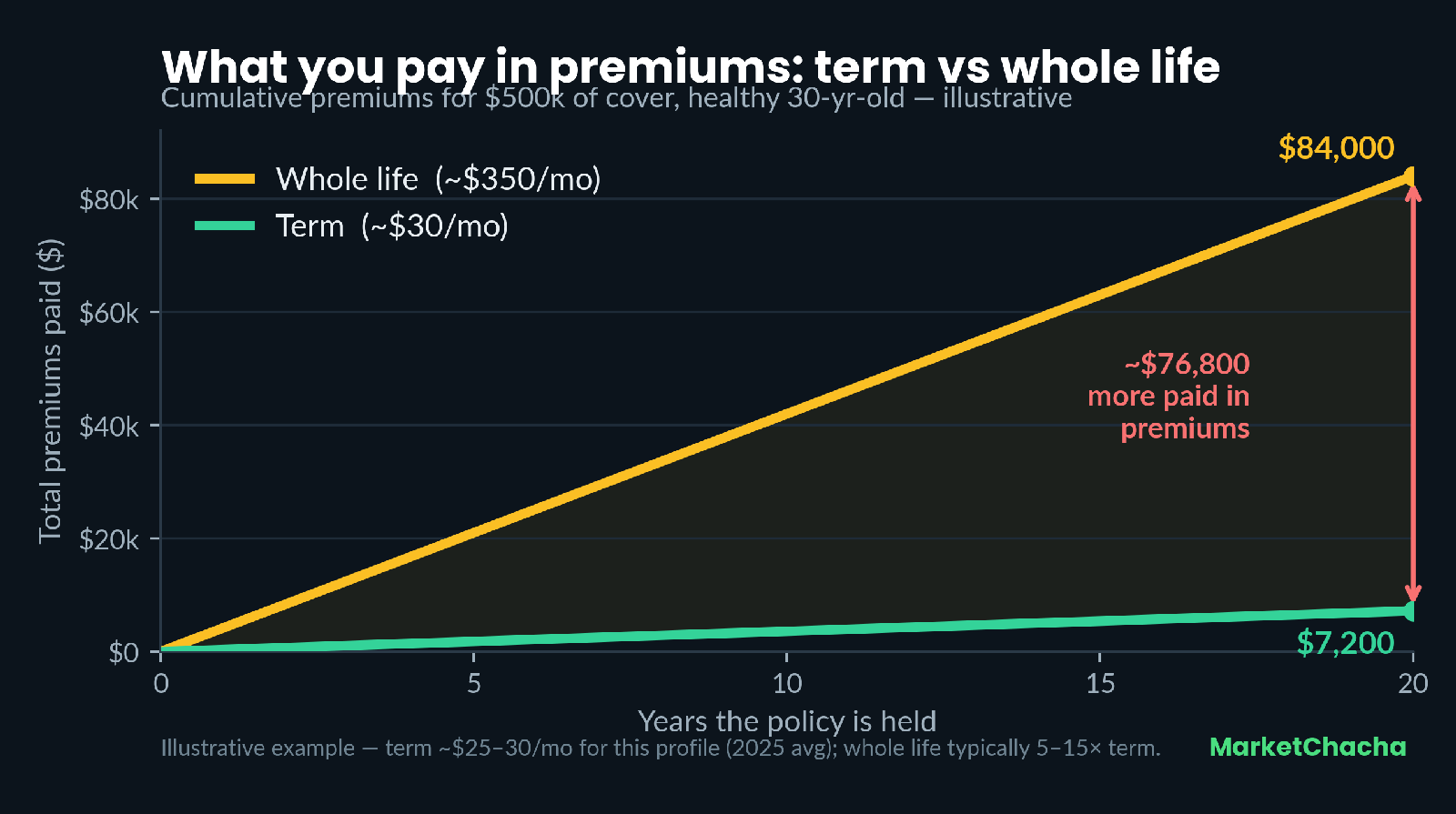
Say term costs $30/month and whole life costs $350/month for that $500,000. Over 20 years:
- Term: $30 × 12 × 20 = $7,200 total.
- Whole life: $350 × 12 × 20 = $84,000 total.
- Difference: $76,800 more paid into the whole life policy over those two decades.
You do get something for that extra money — lifelong coverage and a growing cash value — but the cash value in a whole life policy usually grows far more slowly than a low-cost index fund would, especially in the early years when fees are highest. That trade-off is the heart of the whole debate.
"Insurance is not an investment"
The most useful idea a beginner can hold is that protection and investing are two different jobs, and mixing them into one product usually makes both more expensive. This is where the classic phrase "buy term and invest the difference" comes from. Using the numbers above, instead of paying $350/month for whole life you could pay $30/month for the same $500,000 of term and consciously invest the remaining $320 a month in a low-cost index fund or retirement account.
Whether that beats whole life depends on the returns you actually earn, the fees you pay, and — crucially — whether you have the discipline to invest the difference every month rather than spend it. It is not guaranteed. But the framework is what matters: separate the cheap protection from the investing, so you can see and control the cost of each. Whole life's appeal is that it forces the saving automatically and adds tax and estate features; its drawback is the price and the slow, opaque returns.
How much cover do you actually need?
Getting the amount right matters more than the type. Two beginner-friendly methods:
- Income-multiple rule. A common starting point is 10 to 15 times your annual income (Policygenius, Guardian). A 35-year-old earning $80,000 would look at roughly $800,000–$1.2 million of cover. Families with young children, a big mortgage, or a single earner usually sit at the higher end.
- The DIME method. Add up Debts (excluding mortgage), Income to replace (annual income × years until your kids are independent), Mortgage balance, and Education costs for your children. The total is a needs-based coverage target.
Because term is so cheap, buying enough of it is usually affordable — which is a strong argument for term over a small, pricey whole life policy that leaves your family under-covered.
How to actually buy a policy, step by step
1) Decide the need: how much cover (income-multiple or DIME) and for how long (until the mortgage is paid and the kids are independent — often a 20- or 30-year term). 2) Get your health basics ready; premiums are set mainly by age and health, so buying young and healthy locks in the lowest rate. 3) Compare quotes from several insurers or through a broker — identical coverage can be priced very differently. 4) Check the insurer's financial-strength rating (AM Best, Moody's) so you trust they'll pay decades from now. 5) Read what's excluded and whether a conversion rider is included. 6) Complete the application and any medical exam honestly — misstatements can void a claim later.
When whole life can actually make sense
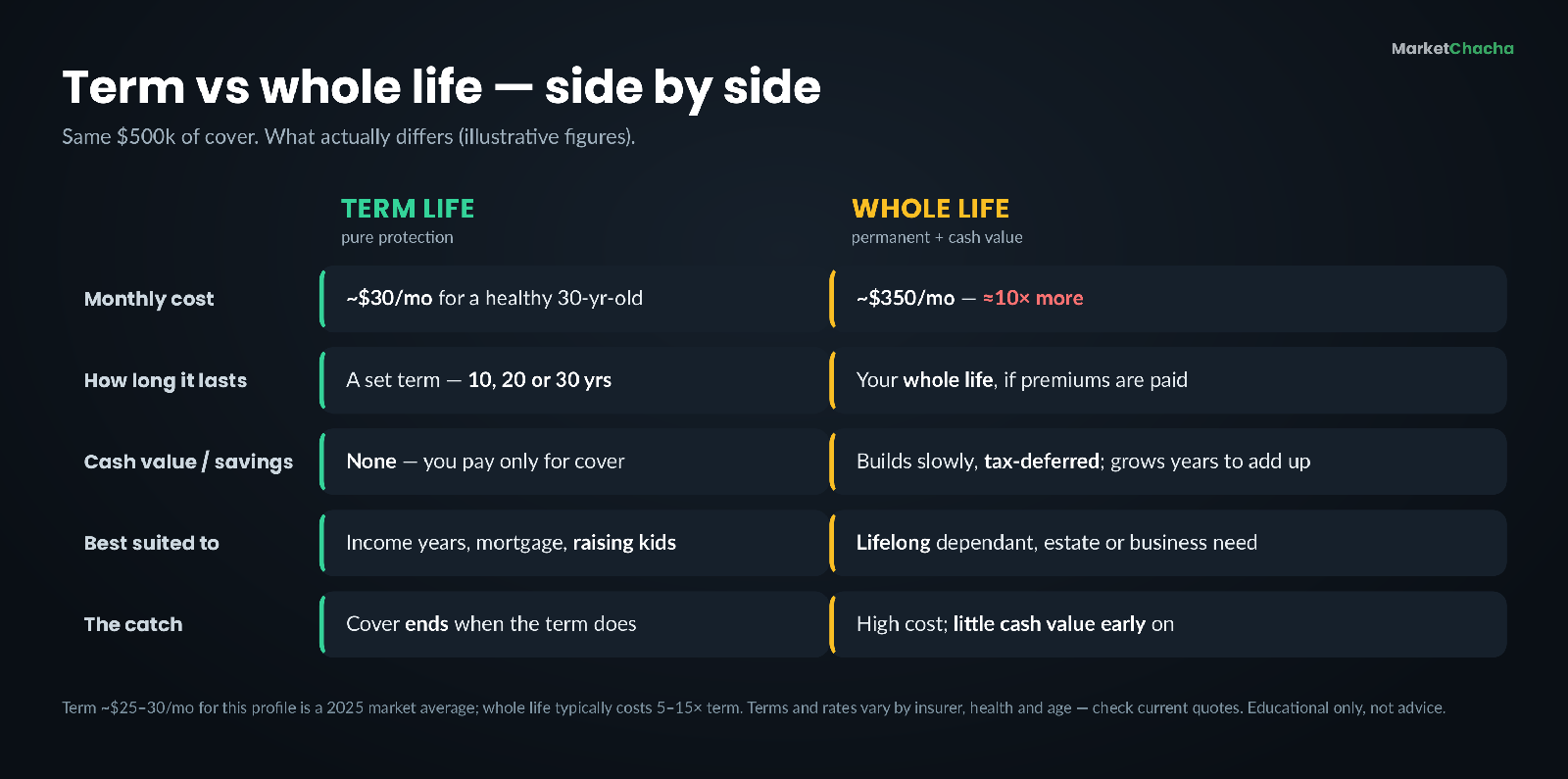
Term isn't automatically "right" for everyone. Whole life earns its keep in specific, lasting situations: providing for a dependant who will need support for life (for example, a child with special needs); creating guaranteed estate liquidity so heirs can pay estate taxes or settle a business without a fire-sale; funding a buy-sell agreement between business partners; or, for a high earner who has already maxed out tax-advantaged accounts, adding another pool of tax-deferred growth. The common thread is a need that never ends and a willingness to pay a premium for guarantees. For a typical young family whose big obligations disappear once the mortgage is paid and the kids are grown, that permanent structure is usually more than they need.
The catch with each
Term's catch: the coverage ends when the term does. If you still need protection at 65 and only bought a 20-year term at 40, renewing or buying new cover then will be far more expensive. The fix is to match the term length to how long your dependants actually rely on you. Whole life's catch: the high premium and the slow start. Surrender the policy in the early years and surrender charges can leave you with little or no cash value, so an "affordable" whole life policy that you later cancel can be the worst of both worlds — you overpaid for cover and got little savings back.
Common mistakes beginners make
- Treating life insurance as an investment. If you want growth, an investment account is usually cheaper and clearer; if you want protection, term is cheaper. Bundling both often does neither well.
- Buying too little cover to keep the premium low. Under-insuring defeats the purpose — term is cheap enough to buy an amount that actually protects your family.
- Insuring the wrong people. You insure an income that others depend on, not a life. Buying large policies on young children (who earn nothing) is rarely money well spent.
- Waiting to buy. Premiums rise with age and any new health issue. The cheapest policy is almost always the one you buy while young and healthy.
- Feeling term was "wasted" because you didn't die. You were protected the whole time — that's the product working, not failing.
How this works in India
The same logic maps almost perfectly. A pure term plan in India is extremely cheap for the cover it provides, while endowment and ULIP plans bundle savings or market-linked investing with insurance — and charge for it. ULIPs carry premium-allocation, fund-management, policy-administration, mortality and surrender charges that can drag heavily on returns in the early years, far more than a plain mutual fund's expense ratio. So the Indian version of "insurance is not an investment" is: buy a large term plan for protection, and invest separately through PPF, EPF, NPS, ELSS or index/mutual funds for growth.
Insurance in India is regulated by IRDAI. Buyers often look at an insurer's claim settlement ratio (CSR) — many private life insurers report figures above 99% and LIC around 98%+ on recent IRDAI data — but read it carefully: the published CSR is an aggregate across all of a company's policies, not a term-plan-specific number, so treat it as one signal among several (turnaround time, complaints) rather than a guarantee. On tax, life-insurance premiums have historically qualified for deductions under Section 80C (and health premiums under 80D) — but under the newer default tax regime most of these deductions are unavailable, so check which regime you're in before counting on a tax break. As always, rules and limits change — verify current terms before buying.
FAQ
Is whole life insurance a good investment? Whole life is primarily insurance with a savings feature, not a high-return investment. Its cash value grows slowly, especially early on, and typically trails what a low-cost index fund has returned over long periods. It can suit specific lifelong or estate needs, but for pure growth a dedicated investment account is usually cheaper and more flexible.
Do I get my money back at the end of a term policy? No — with standard term life, if you outlive the term you don't get the premiums back. You paid for protection during the years your family was most exposed. (A "return of premium" term variant exists but costs significantly more.)
How much life insurance do I need? A common rule of thumb is 10 to 15 times your annual income, adjusted up for young kids, a large mortgage or being the sole earner. The DIME method — adding debts, income to replace, mortgage and education costs — gives a more tailored number.
Can I have both term and whole life? Yes. Some people hold a large term policy to cover their working years cheaply and a smaller permanent policy for a lifelong need, such as final expenses or estate planning. The key is buying each for a clear reason rather than by default.
What happens to the cash value when I die? With a traditional whole life policy, beneficiaries usually receive the death benefit, and the insurer retains the cash value — you don't normally get both. The cash value is meant to be used while you're alive (through loans, withdrawals or surrender). Some policy designs and riders can increase the death benefit using the cash value, so check the specific contract.
Is term insurance a waste of money if I never claim? No more than any insurance you don't end up using. Term gave your family financial protection for the years they depended on your income; not needing to claim is the best possible outcome.
Educational content only — not investment, tax or insurance advice, and not a recommendation of any product. Rates, fees and rules change — always check current terms with the provider. [Sources: Guardian, Progressive, NerdWallet, Experian, Policygenius, IRDAI/PolicyBazaar]. Always do your own research.
This article is for educational and informational purposes only. It is not financial advice, investment recommendation, or a solicitation to buy or sell securities. Investing involves significant risks. I am not a SEBI-registered investment advisor. Readers should consult their own financial advisor and conduct their own research before making any investment decisions.
Comments
Join the conversation
Sign in to join the conversation.
Follow replies, add your view, and take part in the discussion.
Sign in to commentLoading comments...