

How do you read a balance sheet? Assets, liabilities and equity explained (Beginner's In-Depth Guide)
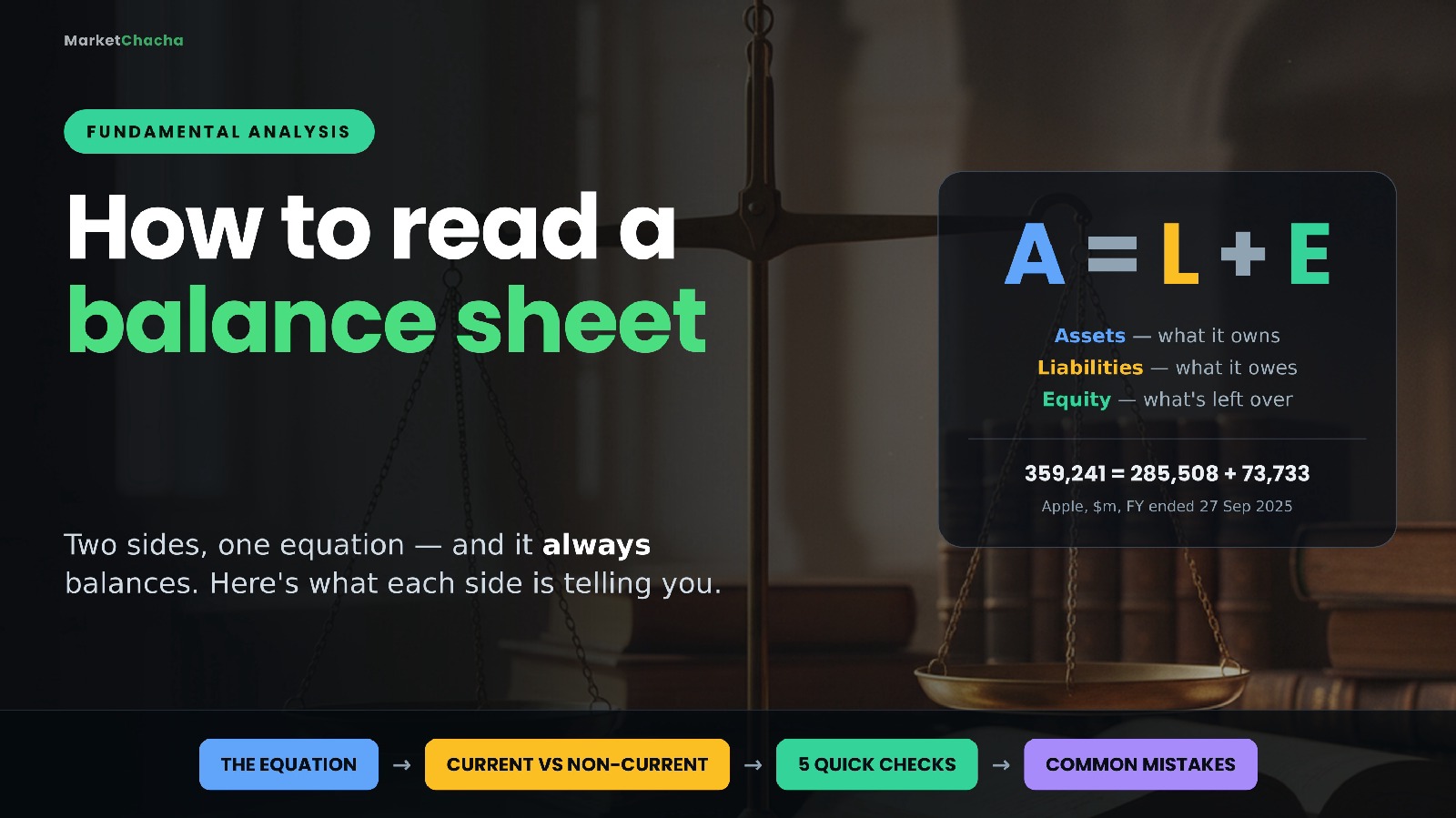
A balance sheet is a snapshot of everything a company owns and everything it owes on one single day. It has two sides, and they must be equal: Assets = Liabilities + Equity. The left side lists what the business controls; the right side says who has a claim on it — lenders and suppliers first, shareholders last. Unlike the income statement, which covers a period ("the year ended…"), the balance sheet is frozen at one date, like a photograph rather than a film.
This guide walks through both sides line by line, works through a real example using Apple's audited FY2025 balance sheet, shows you five checks you can run in five minutes, and explains what the statement quietly leaves out. At the end there's a section on how the same statement is laid out in India.
Why it's called a "balance" sheet
The name is literal. Every rupee or dollar of value a company controls came from somewhere: either someone lent it, or the owners put it in, or the business earned it and kept it. So the total of what a company holds must equal the total of the claims against it. There is no third possibility.
That's the accounting equation:
- Assets — resources the company controls that are expected to produce future benefit (cash, stock, machines, buildings, patents).
- Liabilities — obligations to outsiders (suppliers, banks, bondholders, tax authorities).
- Equity — the residual. What would theoretically be left for shareholders if every asset were sold at its book value and every liability settled.
Rearranged, Equity = Assets − Liabilities. That's why equity is often called net assets or book value. It is a leftover, not a pot of money sitting somewhere.
Side one: assets, split by how soon they turn into cash
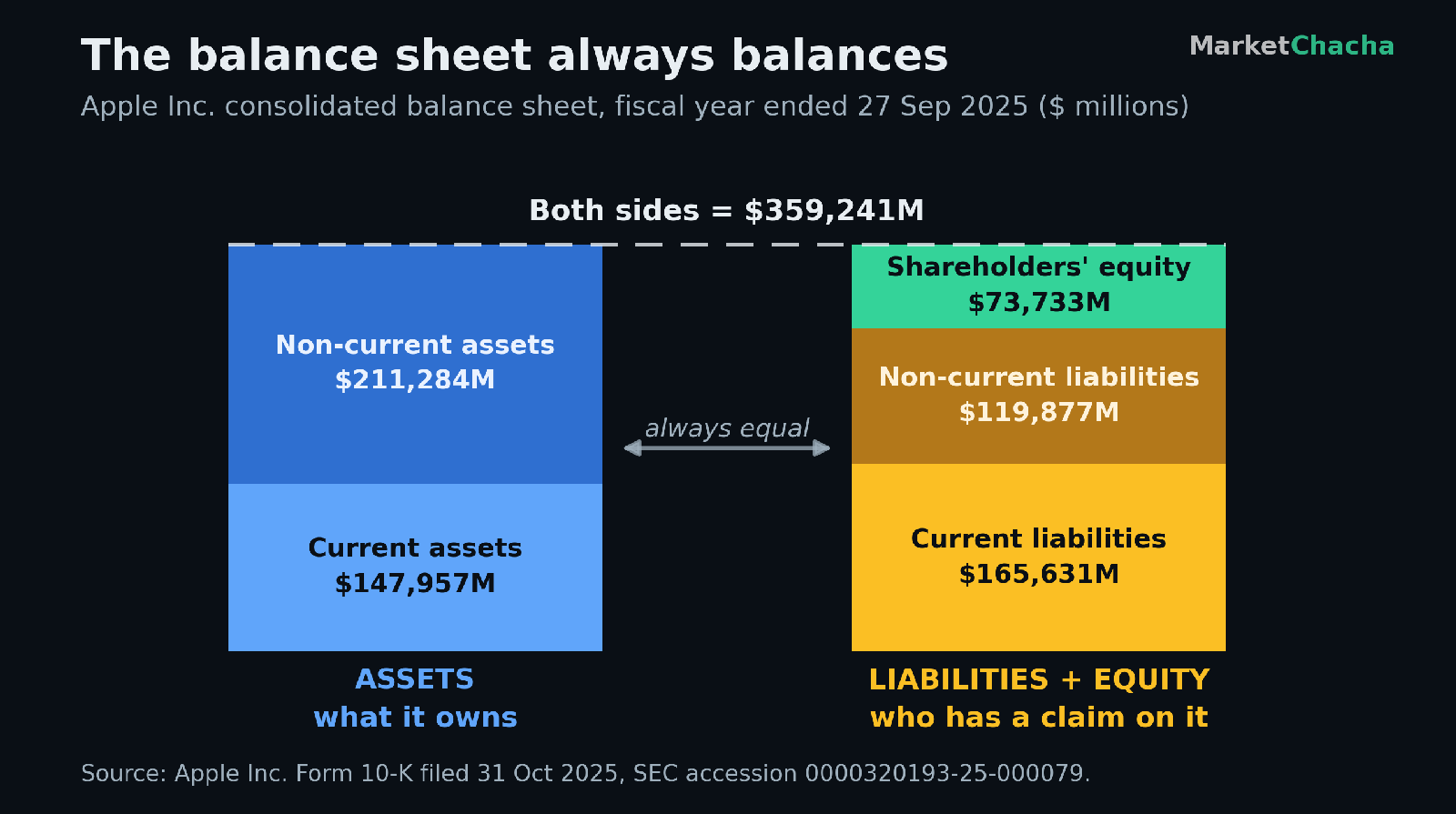
Assets are grouped by time. Current assets are expected to be used up or converted to cash within twelve months. Non-current assets are everything longer-term.
In Apple's balance sheet at 27 September 2025, current assets totalled $147,957 million — cash and cash equivalents of $35,934m, short-term marketable securities of $18,763m, receivables of $39,777m, and inventories of just $5,718m. Non-current assets came to $211,284 million, including $77,723m of longer-dated marketable securities and $49,834m of property, plant and equipment, net of depreciation.
Two things are worth noticing straight away. First, inventory is about 1.6% of total assets — a clue that this is a company that turns stock over extremely fast, not one sitting on warehouses. Second, "cash" alone understates liquidity: add the marketable securities on both parts of the sheet and you get $132,420m of cash and investments. Reading only the top line would have misled you.
Side two: liabilities and equity, ranked by who gets paid first
The right-hand side follows the same current/non-current split. Current liabilities fall due within a year; non-current liabilities later.
Apple's current liabilities were $165,631 million — mostly accounts payable of $69,860m, plus commercial paper of $7,979m and $12,350m of term debt maturing within the year. Non-current liabilities were $119,877 million, including $78,328m of long-term term debt. Total liabilities: $285,508 million.
Equity was $73,733 million, made up of common stock and additional paid-in capital of $93,568m, an accumulated deficit of $(14,264)m, and accumulated other comprehensive loss of $(5,571)m. And the check that must always work: 285,508 + 73,733 = 359,241, exactly the total assets figure.
A worked example: how a company earns $112 billion and still shows a deficit
Here is the single most useful thing a beginner can learn from a balance sheet — retained earnings are not cumulative profit. They are cumulative profit minus everything paid out to shareholders.
Apple's retained earnings line was negative in FY2025, described as an accumulated deficit. It did not get there by losing money. Walk the year through:
- Opening balance at 28 Sep 2024: $(19,154)m
- Plus net income for the year: +$112,010m
- Less dividends and dividend equivalents declared: −$15,413m
- Less share repurchases charged against retained earnings: −$90,052m
- Less shares withheld to settle tax on employee equity awards: −$1,655m
- Closing balance at 27 Sep 2025: $(14,264)m
Check it: −19,154 + 112,010 − 15,413 − 90,052 − 1,655 = −14,264. The company earned $112.0 billion and returned roughly $105.5 billion of it to shareholders in buybacks and dividends in the same year. The deficit is a record of capital returned, not losses made. A beginner who sees "accumulated deficit" and assumes distress has misread the statement completely.
Five checks you can run in five minutes
You don't need to model a company to get value from its balance sheet. Four quick measures and one sanity check will tell you most of what a first look should tell you.
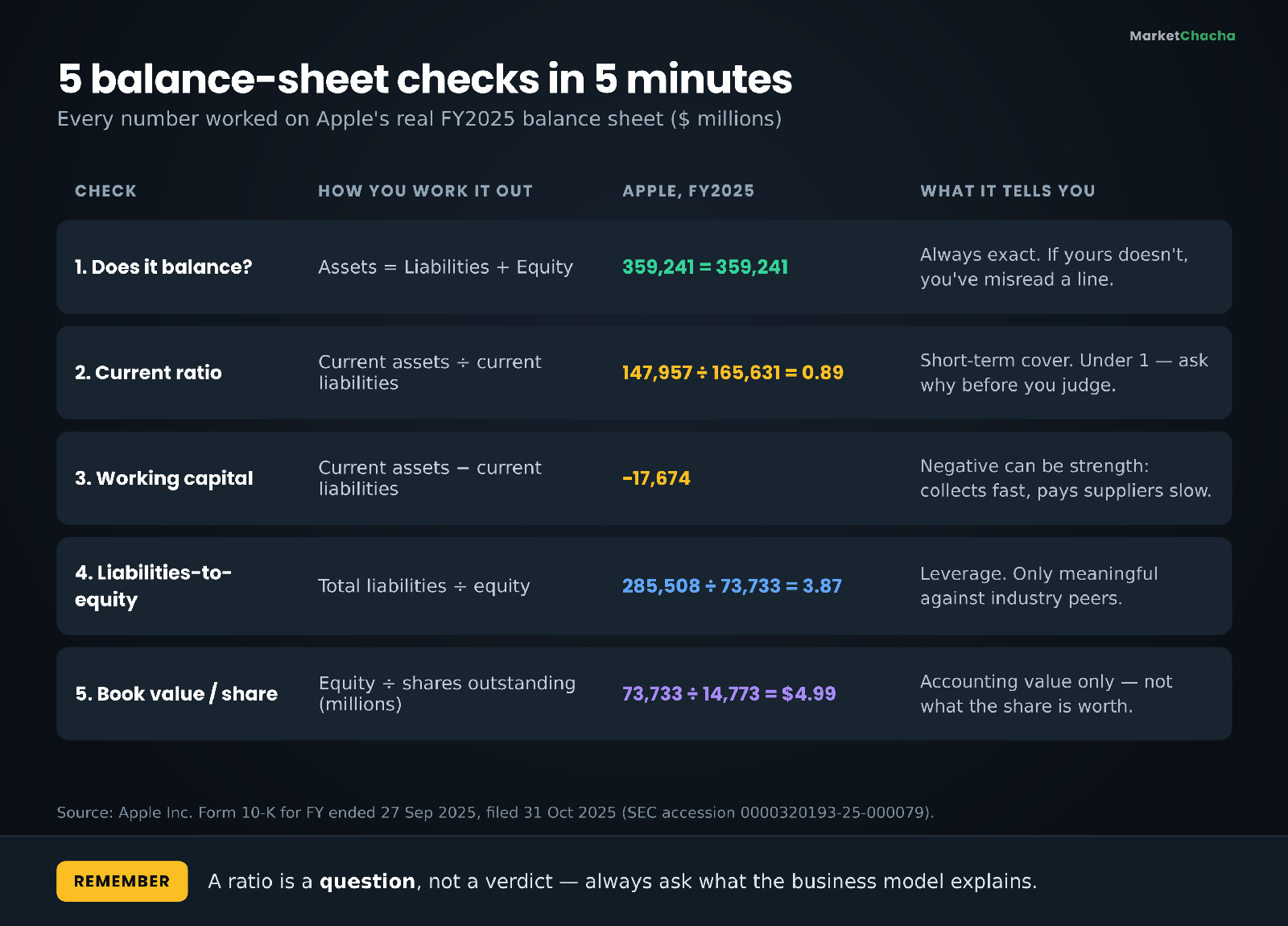
Apple's current ratio was 147,957 ÷ 165,631 = 0.89, and working capital was negative $17,674m. In a textbook that reads as a warning: fewer short-term assets than short-term bills. In reality it reflects a business with enormous bargaining power that collects from customers almost immediately while paying suppliers on long terms — and which holds another $77.7bn of marketable securities just outside the "current" boundary. The ratio raises a question; the business model answers it. That is exactly how ratios should be used.
One caution on the leverage check, because the label is used loosely. Dividing total liabilities by equity gives 285,508 ÷ 73,733 = 3.87. But many analysts use "debt-to-equity" to mean only interest-bearing debt — for Apple, commercial paper of $7,979m plus term debt of $12,350m and $78,328m, or $98,657m in total, which against equity of $73,733m gives 1.34. Both are legitimate; they measure different things, and the second excludes trade payables that carry no interest. Whenever you see a debt-to-equity figure quoted, check which definition produced it before comparing it with anything.
What a balance sheet doesn't tell you
Book value is an accounting measure, not a market one. Apple's equity of $73,733m across 14,773 million shares works out at about $4.99 of book value per share — obviously nowhere near what the share trades for. That gap is not an error. Accounting rules generally record assets at what was paid for them, less depreciation, and they largely exclude internally-built intangibles: a brand developed over decades, a customer base, software written in-house, and research spending are usually expensed as they occur rather than capitalised as assets.
This is why book value works far better for banks, insurers and property companies — whose assets really are financial or physical and repriced regularly — than for software, pharma or consumer-brand companies, where the most valuable things the company owns never appear on the sheet at all.
Common mistakes beginners make
- Treating equity as cash. Equity is a residual calculation, not a bank balance. A company can have large equity and no money.
- Judging a ratio without the industry. A current ratio of 0.9 is normal for a retailer and alarming for a construction firm. Compare like with like.
- Reading "accumulated deficit" as failure. As shown above, buybacks and dividends can drive it negative at a highly profitable company.
- Ignoring the notes. Debt maturity schedules, lease commitments, contingent liabilities and pledged assets live in the notes, not on the face of the sheet.
- Looking at one date only. A single snapshot tells you the position; two or three years side by side tell you the direction, which usually matters more.
- Forgetting that assets are recorded at cost. Land bought in 1975 still sits at its 1975 price.
How this works in India
The logic is identical — the layout is not. Indian company balance sheets follow the format prescribed by Schedule III of the Companies Act, 2013, and which version applies depends on the accounting standards the company uses.
Listed Indian companies report under Ind AS and therefore use Division II of Schedule III. That format opens with ASSETS — non-current first, then current — and then moves to EQUITY AND LIABILITIES, where equity is shown as two lines, "Equity Share capital" and "Other Equity", followed by non-current and then current liabilities, closing with "Total Equity and Liabilities". Companies still on the older accounting standards use Division I, which reverses the order: it begins with "EQUITY AND LIABILITIES" and captions equity as "Shareholders' funds", split into "Share capital" and "Reserves and surplus".
Two differences catch people out. First, Indian formats list non-current before current within each section, the opposite of the most-liquid-first habit used in the US — so the cash line sits near the bottom of the assets block, not the top. Second, Indian shares carry a meaningful face value (commonly ₹1, ₹2 or ₹10). Share capital is recorded only at that face value, and everything investors paid above it sits separately in the securities premium account within reserves. So "share capital" in an Indian balance sheet is not the amount shareholders contributed — you have to add the premium.
On timing: you don't have to wait for the annual report. Under SEBI's LODR regulations, a listed entity must submit a statement of assets and liabilities, and a statement of cash flows, as a note to its financial results for each half-year — so an Indian investor gets a fresh balance sheet twice a year.
FAQ
What are the three main things on a balance sheet? Assets (what the company owns), liabilities (what it owes to others) and shareholders' equity (the residual claim of the owners). Assets always equal liabilities plus equity.
Why must a balance sheet balance? Because every asset a company holds was funded by something — borrowing, money put in by owners, or profits retained. Totalling the funding sources must give back the total of the assets. If it doesn't balance, something has been recorded incorrectly or you've read a subtotal as a total.
Is a negative retained earnings figure always bad? No. It means cumulative payouts to shareholders have exceeded cumulative profits. That can signal years of losses, but at a mature, cash-generating company it often just reflects large buybacks and dividends — Apple's FY2025 accumulated deficit of $(14,264)m came alongside $112,010m of net income for the year.
What is a good current ratio? There is no universal number. Above 1.0 means current assets cover current liabilities, and many analysts like 1.5-2.0, but strong businesses with fast collection and slow supplier payment routinely run below 1.0. Judge it against direct competitors and against the same company's own history.
What's the difference between a balance sheet and an income statement? The balance sheet shows the financial position at a single date; the income statement shows performance over a period. Profit from the income statement flows into retained earnings on the balance sheet, which is where the two connect.
Where can I find a company's balance sheet for free? For US companies, in the annual Form 10-K on the SEC's EDGAR database. For Indian listed companies, in the annual report and the half-yearly results filed with the stock exchanges (NSE and BSE) and posted on the company's investor relations page.
Educational content only — not investment, tax or insurance advice, and not a recommendation of any product or security. Company figures cited are historical and change with each reporting period; always check the latest filing. [Sources: Apple Inc. Form 10-K for the fiscal year ended 27 September 2025, filed 31 October 2025 (SEC accession 0000320193-25-000079), SEC XBRL company facts, Schedule III, Companies Act 2013, SEBI (LODR) Regulations, 2015 — Regulation 33] Always do your own research.
This article is for educational and informational purposes only. It is not financial advice, investment recommendation, or a solicitation to buy or sell securities. Investing involves significant risks. I am not a SEBI-registered investment advisor. Readers should consult their own financial advisor and conduct their own research before making any investment decisions.
Comments
Join the conversation
Sign in to join the conversation.
Follow replies, add your view, and take part in the discussion.
Sign in to commentLoading comments...