

How does a 0% balance transfer actually work — and when does the interest bite?
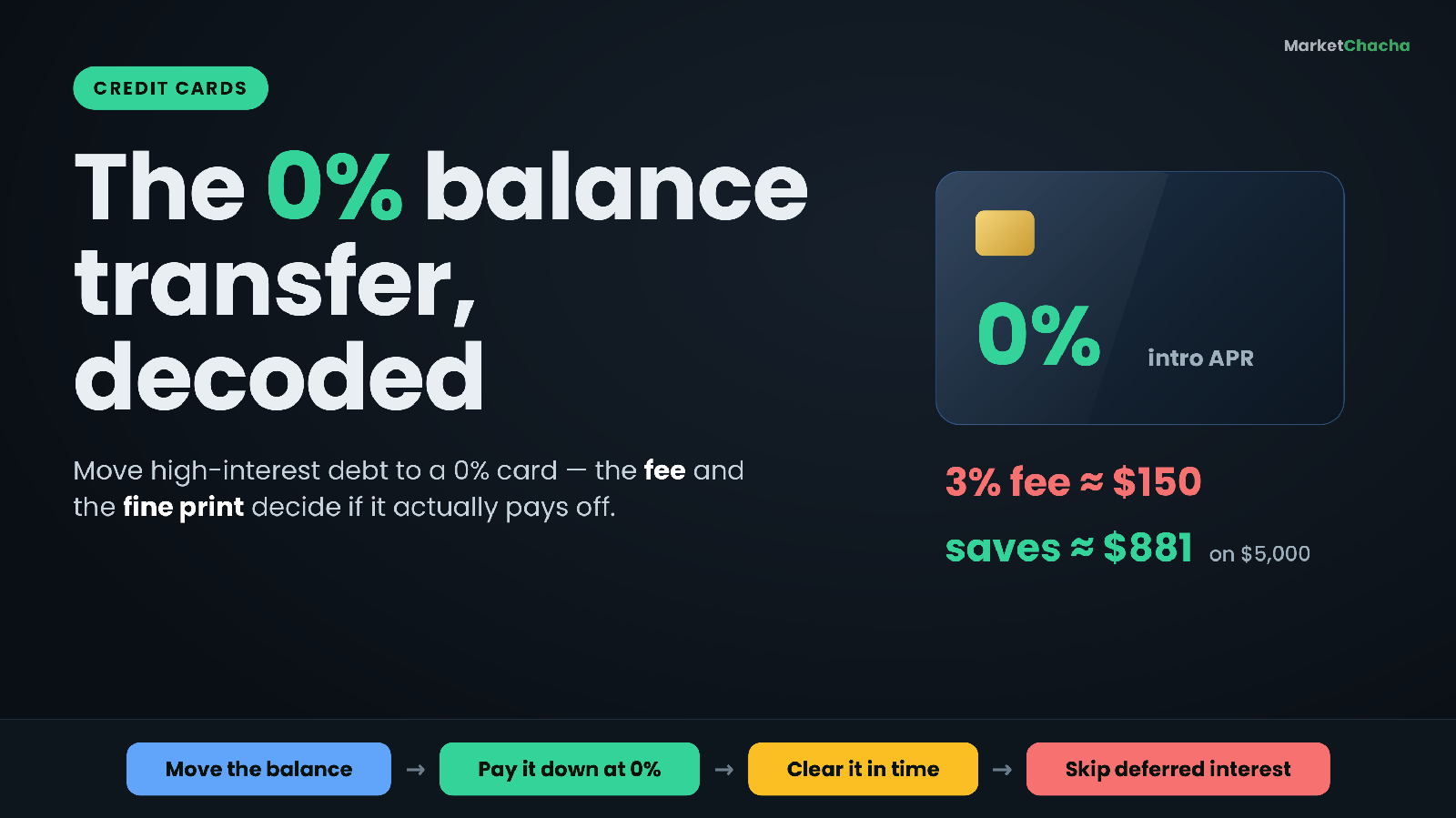
A 0% balance transfer is when you move debt from a high-interest credit card to a new card that charges no interest for a set promotional window — usually 12 to 21 months — so that every rupee or dollar you pay goes straight to knocking down the balance instead of feeding interest. In exchange, the new issuer charges a one-time transfer fee, typically 3%–5% of the amount you move. Used well, it can save you hundreds of dollars and shave months off your payoff. Used carelessly, the fee, the fine print and a couple of easy mistakes can quietly cancel the benefit. This guide explains exactly how the mechanic works, walks through the arithmetic, shows you the one trap people confuse it with, and covers how the same idea plays out in India.
What a 0% balance transfer actually is
Think of it as refinancing your card debt. You apply for a card that advertises a 0% introductory APR on balance transfers. Once approved, you tell the new issuer which balance to pay off on your old card. The new issuer pays your old card, and that debt now sits on the new card at 0% for the promo period. You keep making monthly payments — but because the interest rate is zero, 100% of each payment reduces the principal.
Two features define the offer. First, the promotional period: by U.S. law an intro rate must last at least six months, and in practice good balance-transfer cards run 12 to 21 months (per the CFPB and card issuers, as of Aug 2026). Second, the go-to APR: whatever balance is left when the promo ends starts accruing interest at the card's regular rate — and here is the crucial part — only from the promo-end date forward, and only on the balance that remains. You are never charged interest retroactively on a true 0% offer. Keep that sentence in mind; it is what separates this from the trap we cover below.
A worked example: what a transfer really saves you
Say you owe $5,000 on a card at about 22% APR (the mid-2026 U.S. average for accounts carrying a balance was 22.15%, per the Federal Reserve's G.19 report), and you can afford $300 a month.
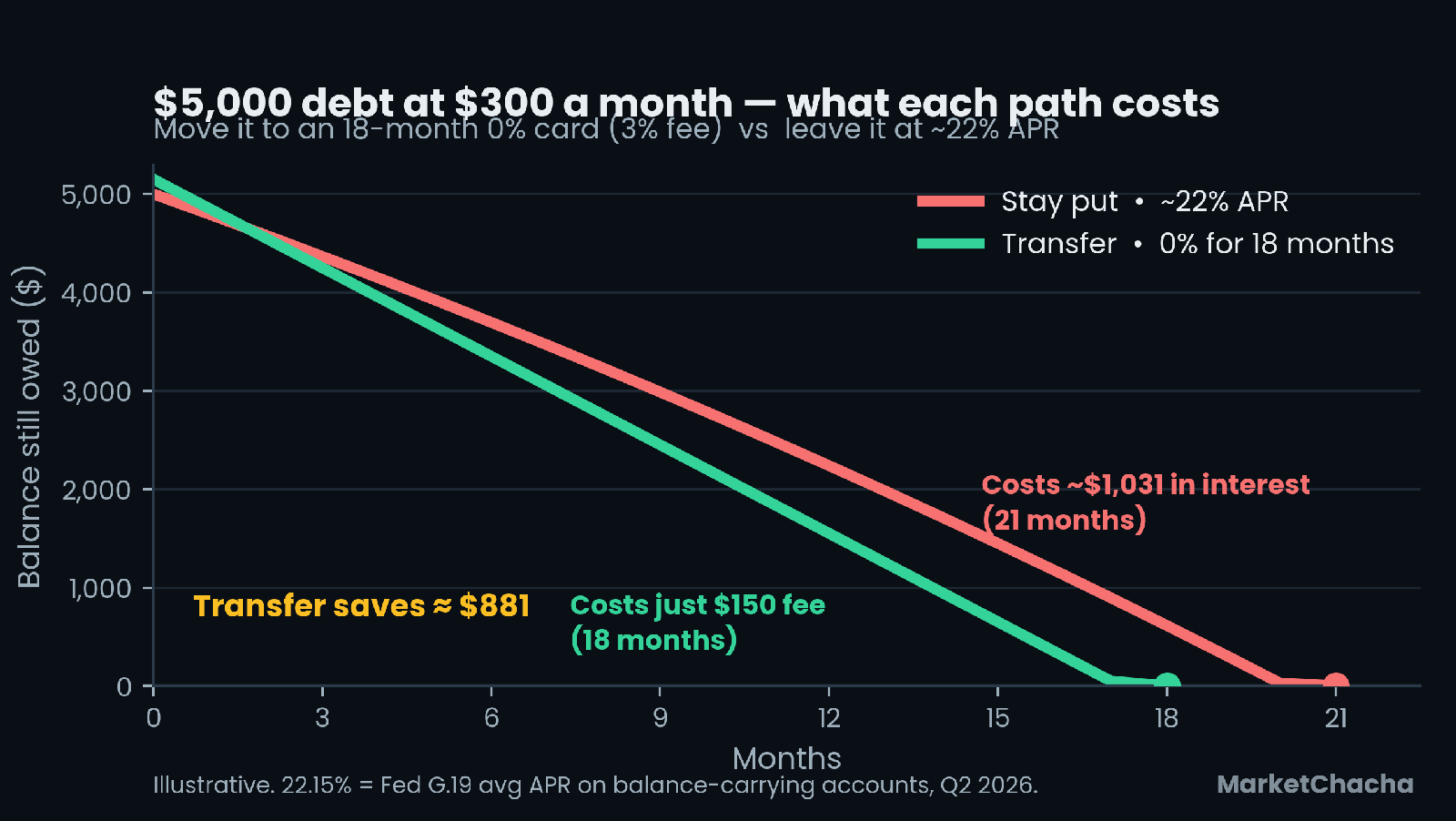
Do nothing. At 22.15% APR, $300 a month clears the $5,000 in 21 months and costs you about $1,031 in interest — you pay roughly $6,031 in total.
Transfer it. Move the $5,000 to a card offering 0% for 18 months with a 3% transfer fee. The fee is $150, added to the balance, so you start at $5,150. At $300 a month you clear the whole thing within the 18-month window, so your only cost is the $150 fee. (In practice, aim to leave yourself a month or two of buffer before the 0% ends.)
Same debt, same monthly payment — the transfer saves you about $881 and gets you debt-free three months sooner. The chart below shows the two payoff paths side by side.
The fee is the catch — here's the break-even maths
The transfer fee is not free money the bank hands you; it is the price of the 0% window. So the real question is: will the interest you avoid be bigger than the fee you pay? On a $5,000 balance at 22.15% APR, one month of interest is about $92. A 3% fee is $150 — roughly 1.6 months of interest. In plain terms: if it will take you more than about two months to clear the debt, the interest you dodge almost always dwarfs the fee. The transfer only fails to pay off if you could have wiped the balance almost immediately anyway, or if you never actually pay it down.
A simple rule of thumb: multiply the balance by the fee rate to get the fee, then compare it to one or two months of interest at your current APR. If the payoff will stretch across many months, the transfer wins comfortably.
0% APR is NOT "deferred interest" — know the difference
This is the single most misunderstood point, so read it twice. A true 0% intro APR (the kind on mainstream balance-transfer cards) waives interest during the promo. If a balance is left when the promo ends, you owe interest only on that leftover amount, going forward. Nothing is charged for the months that already passed.
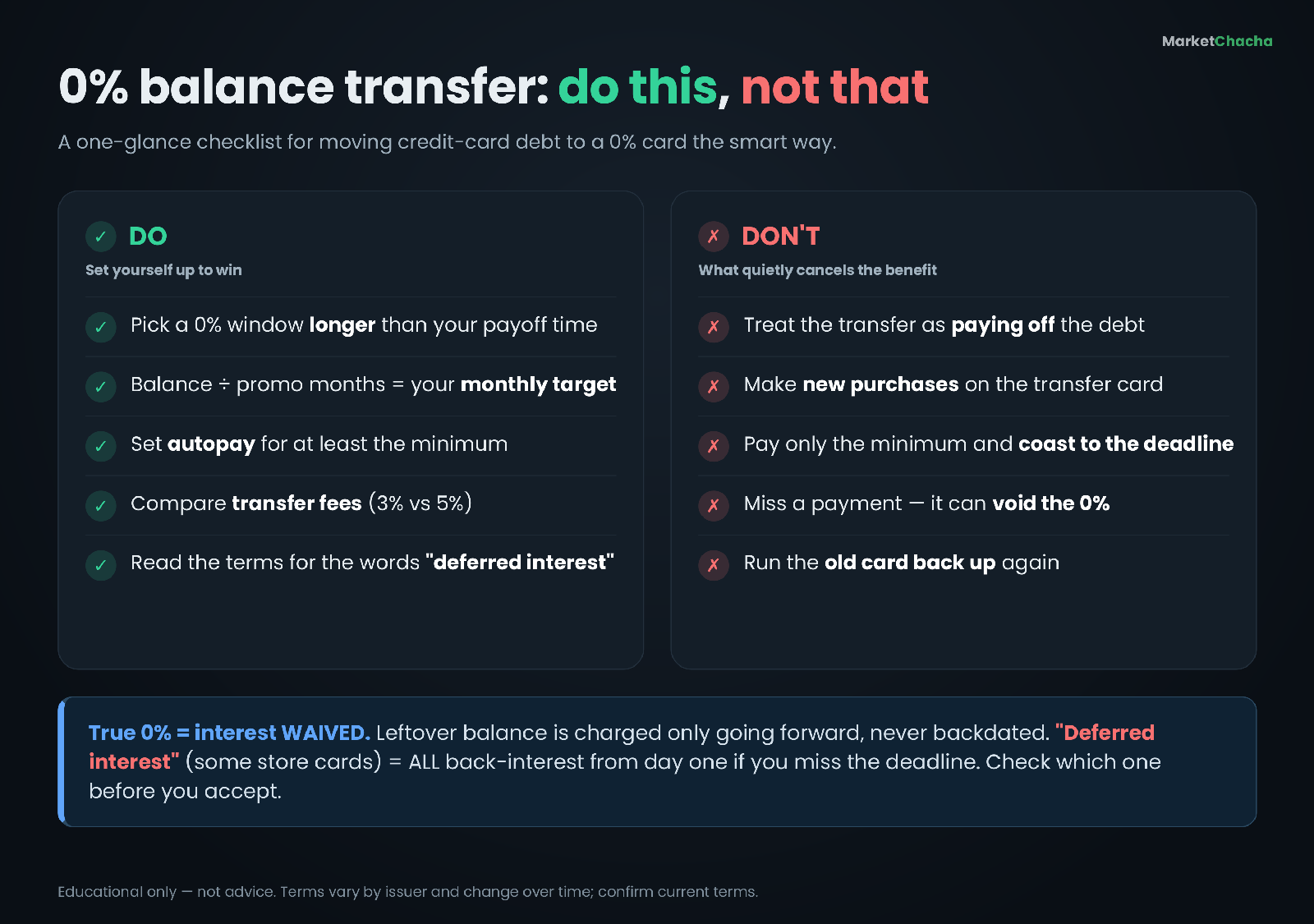
Deferred interest is a different, more dangerous animal — you meet it on some store cards and "no interest if paid in full in 12 months" financing for furniture, electronics or medical bills. There, interest is quietly accumulating in the background the whole time at a high rate (often 20%+). If you pay the balance off in full by the deadline, that interest is forgiven. But miss the deadline by even one dollar, and the issuer charges you all the back-interest on the entire original purchase, from day one. The CFPB has repeatedly flagged deferred-interest promotions as confusing and risky and urged issuers toward transparent 0% offers instead. The two are mutually exclusive: one waives interest, the other only postpones it. Before you accept any "0%" or "no interest" offer, find the phrase in the terms — "deferred interest" is the red flag.
How to actually do a balance transfer, step by step
The process is more paperwork than magic:
- 1. Check your numbers. Note your current balance, your APR, and how many months of payments it will realistically take you to clear it.
- 2. Shop for a card whose 0% promo is longer than your expected payoff time, and compare transfer fees (3% vs 5% matters on a big balance).
- 3. Apply. Approval and your credit limit depend on your credit profile — you may not be approved to transfer the whole balance.
- 4. Request the transfer within the issuer's window (often 60–120 days of opening the card) — the 0% usually applies only to transfers made in that window.
- 5. Keep paying your old card until the transfer clears (it can take one to two billing cycles). Never assume the old balance is gone.
- 6. Set an autopay for at least the minimum, and divide your balance by the number of promo months so you have a payment target that clears it before the 0% ends.
One structural limit: you generally cannot transfer a balance between two cards from the same bank, so the new card must be from a different issuer.
What it costs you — the fine print that bites
Beyond the fee, three things quietly erode the benefit:
New purchases usually don't get the 0%. The promo typically covers only the transferred balance. Worse, once you're carrying a balance you often lose the "grace period," so new purchases can start accruing interest immediately at the regular APR. The clean move is to not spend on the transfer card at all until the balance is cleared.
A slip can kill the promo. Per the CFPB, missing a payment or going over your credit limit can end the promotional rate early and trigger a penalty APR. Autopay for the minimum is your insurance policy.
Your credit score wobbles, then usually recovers. Opening a new card adds a hard inquiry and lowers the average age of your accounts (small, temporary dings). But the new card's limit increases your total available credit, which lowers your utilisation ratio — often a net positive over time. The key truth: a transfer moves debt, it doesn't erase it. The score benefit only shows up if you actually pay it down and don't run the old card back up.
Common mistakes beginners make
- Treating the transfer as a payoff. The debt is still yours; the 0% is just a runway to clear it.
- Running the old card back up to a new balance — now you have two debts.
- Making only the minimum payment and reaching the promo's end with a big balance that suddenly starts accruing interest.
- Ignoring the fee on a balance you could have cleared in a month or two anyway.
- Confusing it with deferred interest and getting hit with retroactive charges on a store-card offer.
How this works in India
India has two close cousins of the U.S. balance transfer, and both deserve the same scrutiny. First, a genuine credit card balance transfer: most major issuers let you move an outstanding balance from another bank's card onto theirs at a low or 0% promotional rate for 3–6 months, in return for a processing fee. Because standard Indian card revolving interest is brutal — commonly around 3%–3.75% a month, which annualises to roughly 36%–45% a year — a short 0% window can still save a lot if you clear the balance inside it.
Second, and far more common, is "no-cost EMI" at checkout on Amazon, Flipkart and the like. The name is misleading. As multiple Indian finance sources note (Paisabazaar, ClearTax, as of 2026), even on a "no-cost" EMI the bank charges a processing fee (about ₹99–₹500) and, critically, 18% GST applies to the interest component and processing fee — GST that a normal one-shot purchase wouldn't attract. On a ₹30,000 purchase the real extra cost often works out to ₹500–₹1,200. There's a second catch: the full purchase amount is blocked against your credit limit for the entire EMI tenure, which pushes up your credit-utilisation ratio. And from mid-2026, RBI's move to weekly credit-bureau reporting means a single missed EMI can show up on your CIBIL report within about a week. The lesson is identical to the U.S. one: "0%" or "no-cost" is never quite free — read the fee and tax line before you tap "confirm."
FAQ
Does a 0% balance transfer hurt my credit score? There's usually a small, temporary dip from the hard inquiry and the younger average account age, but the extra credit limit lowers your utilisation, which often helps over time — provided you actually pay the balance down and don't rack the old card back up.
Is a balance transfer fee worth it? Almost always, if you'll take more than a couple of months to clear the debt. On a $5,000 balance at ~22% APR, a 3% ($150) fee is only about 1.6 months of interest, so the interest you avoid over a longer payoff far outweighs it.
What happens to my remaining balance when the 0% period ends? On a true 0% offer, only the leftover balance starts accruing interest, at the card's regular APR, from the promo-end date forward — never retroactively. Aim to have it at zero before the promo ends.
Is 0% APR the same as deferred interest? No. A true 0% offer waives interest entirely. Deferred interest (common on store cards) only postpones it — miss the payoff deadline and you're charged all the back-interest on the whole original purchase from day one.
Can I transfer a balance between two cards from the same bank? Generally no. Issuers don't let you move a balance between their own cards, so a balance-transfer card has to come from a different bank.
Can I keep using the card for new purchases during the 0%? You can, but you usually shouldn't — new purchases typically don't get the 0% rate and can start accruing interest immediately once you carry a balance. Keep the transfer card for the debt only.
Educational content only — not investment, tax or insurance advice, and not a recommendation of any product. Rates, fees and rules change and vary by issuer and jurisdiction — always check current terms with the provider. [Sources: CFPB, Federal Reserve G.19, NerdWallet, Paisabazaar, ClearTax]. Always do your own research.
This article is for educational and informational purposes only. It is not financial advice, investment recommendation, or a solicitation to buy or sell securities. Investing involves significant risks. I am not a SEBI-registered investment advisor. Readers should consult their own financial advisor and conduct their own research before making any investment decisions.
Comments
Join the conversation
Sign in to join the conversation.
Follow replies, add your view, and take part in the discussion.
Sign in to commentLoading comments...