

Why did Vodafone Idea jump ~8% today? SBI finally said yes — with a catch
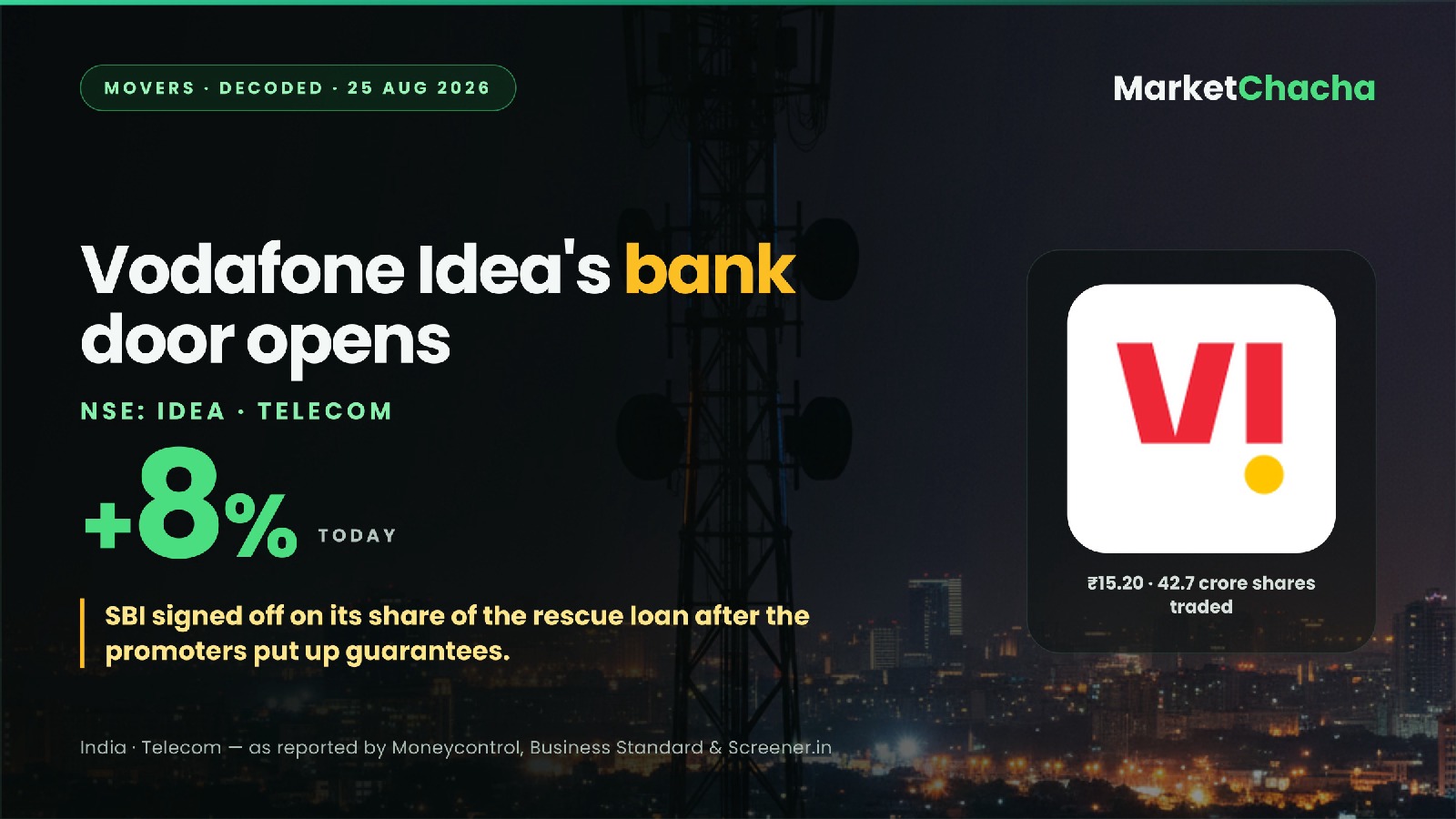
Vodafone Idea rose as much as 8.3% to ₹15.24 intraday on Tuesday, in a market that was otherwise flat-to-weak. Moneycontrol reports the trigger: State Bank of India has agreed to sanction its share of the long-pending rescue loan, after the promoter companies agreed to give guarantees. Business Standard reports 42.7 crore shares changed hands across NSE and BSE — enormous even for a stock this widely held.
What actually changed today
Nothing about Vi's subscribers, tariffs or spectrum changed on Tuesday. What changed is the sequence of a loan. Vi has been trying to close bank funding for over a year, and lenders kept refusing because the company's balance sheet is negative — there is no equity cushion behind the loan. The reported unlock is that the promoters (the Aditya Birla Group and Vodafone Group) said they'd guarantee the borrowing. A guarantee moves the credit risk off Vi's broken balance sheet and onto the promoters' healthier ones. That's what let SBI say yes.
Why a bank loan is the whole ballgame
Vi has already raised ₹6,400 crore in initial financing and ₹1,183 crore from Aditya Birla Group warrants. It has also placed network equipment orders worth over ₹9,000 crore with Nokia, Ericsson and Samsung. Look at those two numbers together and the problem is obvious: the orders are bigger than the money in hand. Bank debt is what pays for the gear that gets 4G into circles where Vi's network is thin and 5G switched on where it isn't. Without it, the equipment orders are paper.
The business, in plain terms
Vi is India's third mobile network, behind Jio and Airtel. It sells prepaid and postpaid mobile voice and data, plus broadband and enterprise connectivity — one business, not a conglomerate, so this loan touches all of it. Screener.in shows TTM sales of ₹45,539 crore. Business Standard reports Q1FY27 revenue of ₹11,689 crore, up 6% YoY, cash EBITDA of ₹2,475 crore, up 13.5%, and 193.1 million subscribers, with the 4G/5G share of that base at 67.4%, up from 64.4% a year earlier. The operating business is slowly improving. The capital structure is the wound.
Is it expensive?
Vi has no meaningful P/E, and readers should know why. Screener.in shows a headline TTM net profit of ₹37,406 crore — but that includes ₹60,812 crore of one-off "other income" booked in March 2026 from the government's dues relief. That is an accounting write-back, not cash from selling mobile plans. Strip it and the underlying business is still loss-making, with ROCE of −1.72% and a book value of −₹3.30 per share — the company owes more than it owns.
So price it on scale instead. Market cap is ₹1.64 lakh crore on ₹45,539 crore of sales, roughly 3.6x sales — and that ignores ₹1.92 lakh crore of debt that a buyer of the whole company would inherit. Compare Bharti Airtel: P/E 38.7, market cap ₹12.08 lakh crore, TTM sales ₹2.20 lakh crore, net profit ₹36,413 crore, ROCE 17.6%. Airtel carries a similar absolute debt load (₹2.14 lakh crore) on nearly five times the revenue and real profits. That's the honest frame: Vi is not a cheap telecom, it's a leveraged option on a turnaround. No target, no call — just the arithmetic.
Who else this touches
- Nokia, Ericsson, Samsung — the ₹9,000 crore-plus of orders only convert to revenue once Vi can pay.
- Indus Towers — Vi is one of its largest tenants; a funded Vi is a tenant that pays rent on time.
- SBI and the PSU banks — they take on the exposure, softened by promoter guarantees rather than Vi's own credit.
- Bharti Airtel and Jio — a funded third player slows the flow of Vi's subscribers to them, and makes an industry-wide tariff hike easier to push through.
- The government — it holds 49.02% of Vi after converting dues into equity, so it is the largest shareholder in the outcome.
What to watch
SBI's sanction is not the same as money landing. Moneycontrol reports disbursement is conditional on Vi also closing the private-bank and external commercial borrowing legs of the package. Vi is negotiating with roughly six to seven PSU banks led by SBI, alongside Indian private lenders and foreign lenders. Watch for those signatures, not more "in advanced talks" headlines.
The one thing that flips it
If the private-sector and foreign lenders don't come in, SBI's yes is worth nothing — the condition fails and no money moves. That is the specific risk in this stock today: it is a conditional approval on a loan that still needs two other lender groups to sign. Analysts also expect industry tariff hikes only around December 2026, so Vi has to fund itself through several more quarters before pricing helps.
As of 21:15 IST, 25 Aug 2026. Prices, volumes and financial figures are as reported by the sources cited, not MarketChacha's own data feed. Sources: Business Standard, Moneycontrol, Screener.in (IDEA), Screener.in (Bharti Airtel). For discussion and education only — not investment advice. Verify before acting.
This article is for educational and informational purposes only. It is not financial advice, investment recommendation, or a solicitation to buy or sell securities. Investing involves significant risks. I am not a SEBI-registered investment advisor. Readers should consult their own financial advisor and conduct their own research before making any investment decisions.
Comments
Join the conversation
Sign in to join the conversation.
Follow replies, add your view, and take part in the discussion.
Sign in to commentLoading comments...