

India's factory output rose 6.7% in July — but June just got revised to 8.8%. That changes the story.
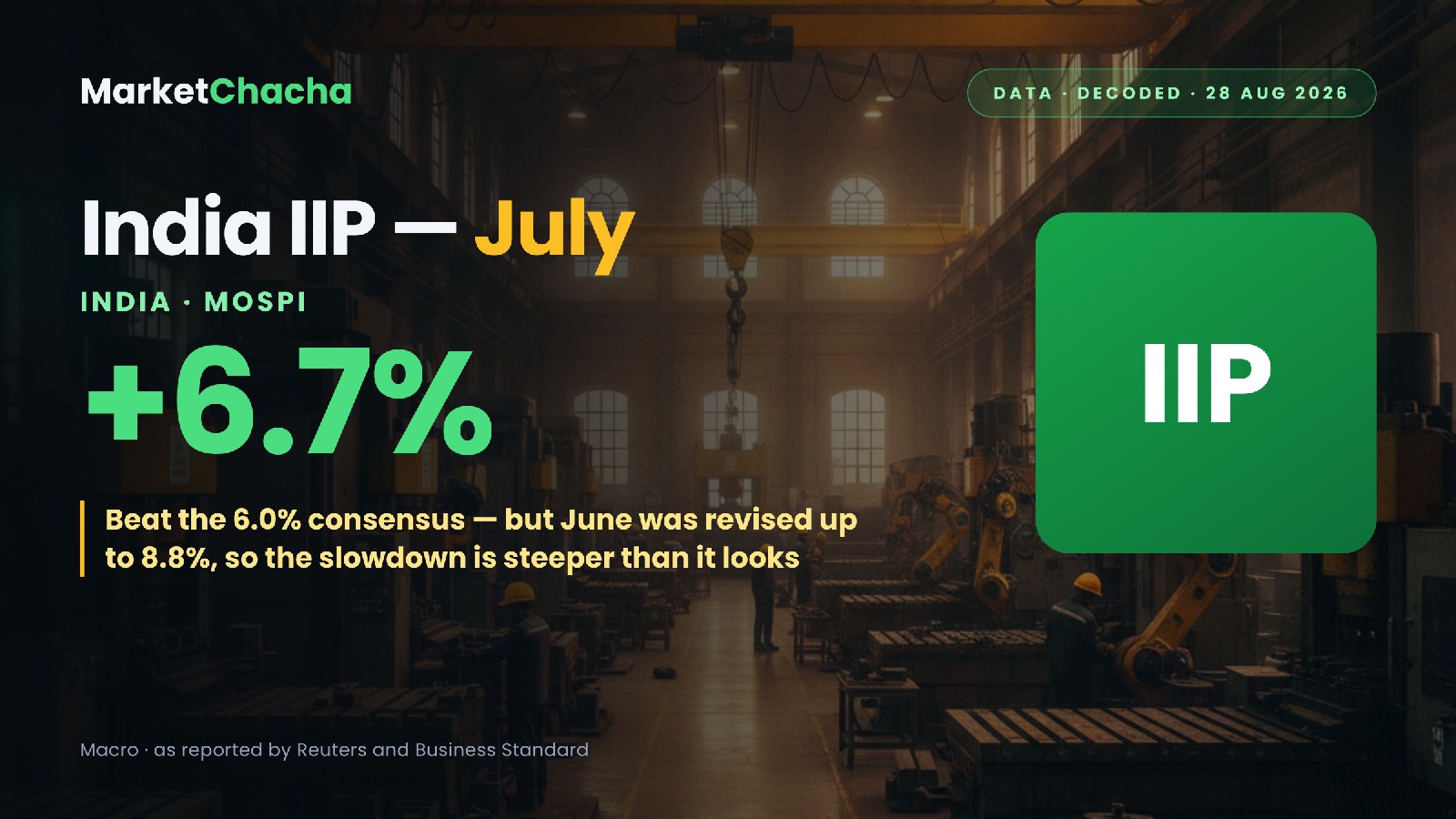
India's factory output grew 6.7% year-on-year in July 2026, MoSPI reported on Friday. A Reuters poll had penciled in 6.0%, so on paper this is a beat. Then you look at what happened to June's number, and the story flips.
The numbers
The Index of Industrial Production stood at 124.8 in July, against 117.0 a year earlier — the 6.7% headline. June, first published at 7.3%, has now been revised up to 8.8%, as reported by Reuters and Business Standard. So the month-on-month deceleration isn't 60 basis points. It's 210.
Sector-wise, against those same revised June figures:
- Manufacturing: +7.3% (June: +9.5%) — 19 of 23 industry groups still grew
- Electricity & gas: +8.7% (June: +11.3%)
- Mining & quarrying: −0.9% (June: +1.6%) — the only sector actually shrinking
- Water supply, sewerage, waste: +7.4%
The use-based split is where it gets interesting. Capital goods +16.1%, intermediate goods +10.0%, consumer durables +10.5%, infrastructure and construction goods +6.9%, primary goods +4.1% — and consumer non-durables −1.0%, reversing June's +5.6%. Inside manufacturing, motor vehicles and trailers rose 22.2%, electrical equipment 28.3% and machinery 12.1%. Cumulatively, April–July of FY27 is running at 6.3% versus 4.0% in the same stretch a year ago.
What it means
Here's the thing most headlines skip. MoSPI publishes a quick estimate, then revises it a month later as more factory returns come in. Almost every write-up compares this month's print to last month's originally published number. That's how "7.3% to 6.7%, a mild cooling" gets written when the actual comparison is 8.8% to 6.7%. Same data, very different sentence.
The second thing: consumer non-durables are the everyday stuff — soap, biscuits, packaged food, the things households buy whether or not they feel rich. That line contracted while consumer durables — fridges, ACs, two-wheelers — grew 10.5%. Mining contracting in the same month usually owes something to the monsoon — heavy rain slows open-cast extraction — so read that line with the season in mind. The non-durables number isn't weather, though. It's demand.
So the shape of this print is capex-led: machinery, electrical equipment, vehicles and intermediate goods carrying the index, mass consumption sitting it out. A beat on the headline, an uncomfortable split underneath.
Who it touches
- Capital goods and industrials — at +16.1%, this is the strongest use-based category in the print, and it's the cleanest official read on whether the private capex cycle is actually spending.
- FMCG and mass-market consumption — a negative non-durables print is the volume signal analysts watch ahead of quarterly commentary on rural and urban demand.
- Autos and auto ancillaries — motor vehicle production up 22.2% is an output number, not a retail-sales number. Watch whether September's SIAM and FADA data confirm the demand behind it or flag inventory build.
- Rates and bonds — growth holding above 6% gives the RBI less urgency to cut. Weak mass consumption argues the other way. This print alone doesn't settle it.
- Metals and mining — the −0.9% contraction feeds directly into domestic ore supply and input costs downstream.
What to watch
Monday, 31 August, 5:30 PM IST: India's Q1 FY27 GDP, against 7.8% in Q4 FY26. That's the print that either confirms this industrial momentum or exposes it as narrow. Then 1 September brings August manufacturing PMI (previous 53.5) plus GST collections and monthly auto sales. August IIP lands 14 September — and it will also carry July's first revision, so today's 6.7% is itself provisional.
As of 28 Aug 2026, 7:00 PM IST. Sources: Reuters via Business Recorder, Business Standard, The Tribune / MoSPI data, Free Press Journal. For discussion and education only — not investment advice. Verify before acting.
This article is for educational and informational purposes only. It is not financial advice, investment recommendation, or a solicitation to buy or sell securities. Investing involves significant risks. I am not a SEBI-registered investment advisor. Readers should consult their own financial advisor and conduct their own research before making any investment decisions.
Comments
Join the conversation
Sign in to join the conversation.
Follow replies, add your view, and take part in the discussion.
Sign in to commentLoading comments...