

Why did CEAT tyres crash ~9% today? A 96% profit wipeout, decoded
What happened
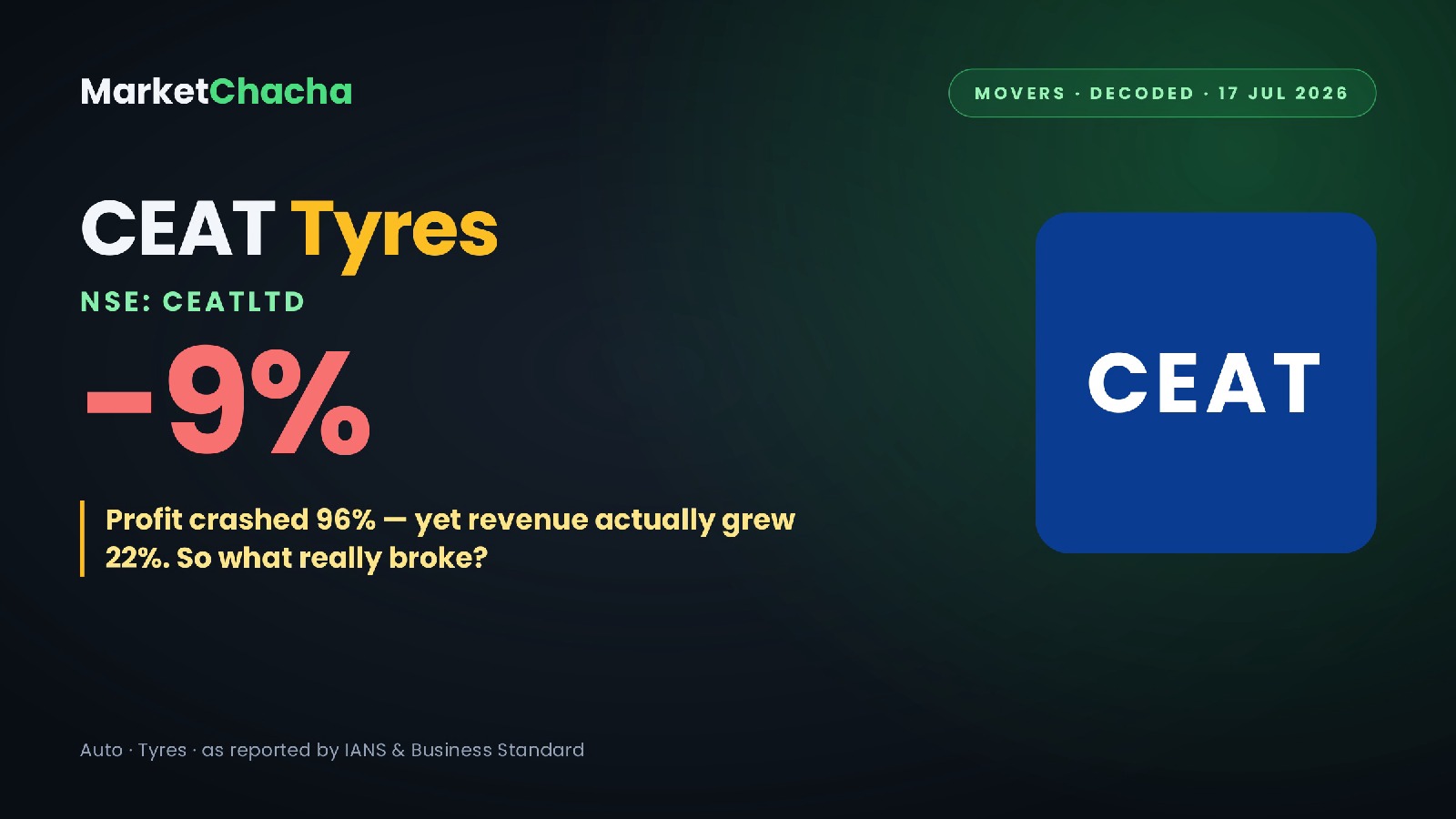
CEAT, one of India's big-four tyre makers, fell as much as ~9% on Friday to an intraday low near ₹3,473 on the BSE, down from Thursday's close of ₹3,829, after its June-quarter results landed with a jaw-dropping headline: net profit crashed 96.4% from a year ago to just ₹4 crore. For a company this size, that's less than a single quarter's profit shrinking to pocket change — hence the double-take.
Why it moved (and the part the headline hides)
Here's the twist most people miss: CEAT's revenue actually grew 22.4% to ₹4,318 crore. It sold more tyres, not fewer. So why did profit almost vanish? Three reasons — and only one is really about tyres.
- A ~₹50 crore forex hit. CEAT has an overseas subsidiary carrying dollar-denominated debt. The Sri Lankan rupee weakened, which pushed up the rupee value of that debt — a paper (non-cash) loss that slams reported profit but changes nothing about how many tyres got sold. This is an accounting event, not a demand problem.
- Start-up losses from newly bought businesses. CEAT is still absorbing recently acquired operations — new warehouses and infrastructure tied to its off-highway expansion — which run at a loss early before they scale.
- Costlier raw material. This is the real one. Natural rubber plus crude-derived inputs like synthetic rubber and carbon black got pricier, partly because the West Asia conflict has kept crude elevated. That squeezed EBITDA margin to 8.5%, and margin compression is what genuinely worries the market.
So the ₹4 crore figure overstates the damage — but the margin squeeze is a real, operating problem. The market split the difference and knocked ~9% off.
The business — the whole company, or one slice?
It's the whole company, and that matters. CEAT isn't a one-product bet: roughly half its sales are replacement tyres (people swapping worn tyres — steady, higher-margin), with the rest split between OEM (fitted on new vehicles) and exports. By vehicle it spans two-wheelers (where CEAT is strong), trucks & buses, passenger cars, and off-highway/farm tyres via CEAT Specialty. Today's pain — forex plus input costs — hit the shared bottom line, not one segment.
Is it expensive?
Coming into this quarter, CEAT traded around a P/E in the low-30s, with a market cap near ₹14,200 crore and a price-to-book around 3.7 — a fairly full valuation for a cyclical, capital-heavy tyre maker. For context on peers: Apollo Tyres sits near a similar ~30x but is bigger (~₹24,700 crore), MRF commands a premium ~37x (~₹55,800 crore) as the market leader, and Balkrishna Industries is around ~29x. So CEAT is mid-pack — not cheap, not the priciest. One catch to remember: a near-zero profit quarter will inflate its trailing P/E for the next few quarters until it rolls off, so the headline multiple will soon look scarier than the ongoing business really is.
Who it touches
- Tyre peers — Apollo Tyres, MRF, JK Tyre, Balkrishna, Goodyear India — face the same rubber and crude-linked cost pressure, so watch their margins this season too.
- Auto makers (Hero, TVS, Bajaj, Maruti) — tyres are an input cost; sustained rubber inflation nudges vehicle costs up.
- Natural-rubber growers in Kerala and the Northeast actually benefit from firmer rubber prices, even as tyre makers wince.
What to watch
The one thing that flips the story: costs cooling. If crude eases from its West Asia-driven highs and the currency moves don't repeat next quarter, that ₹4 crore becomes an artificially low base and profit can snap back fast. If rubber and crude stay hot, then the margin squeeze — not the one-off forex noise — is what lingers.
As of ~11:15 IST, 17 Jul 2026. Sources: IANS, Business Standard, Business Today. Peer valuations per Screener/BlinkX comparison data. For discussion and education only — not investment advice. Verify before acting.
This article is for educational and informational purposes only. It is not financial advice, investment recommendation, or a solicitation to buy or sell securities. Investing involves significant risks. I am not a SEBI-registered investment advisor. Readers should consult their own financial advisor and conduct their own research before making any investment decisions.
Comments
Join the conversation
Sign in to join the conversation.
Follow replies, add your view, and take part in the discussion.
Sign in to commentLoading comments...