

What is a Series I savings bond (I bond) — and how do you actually make money from it?
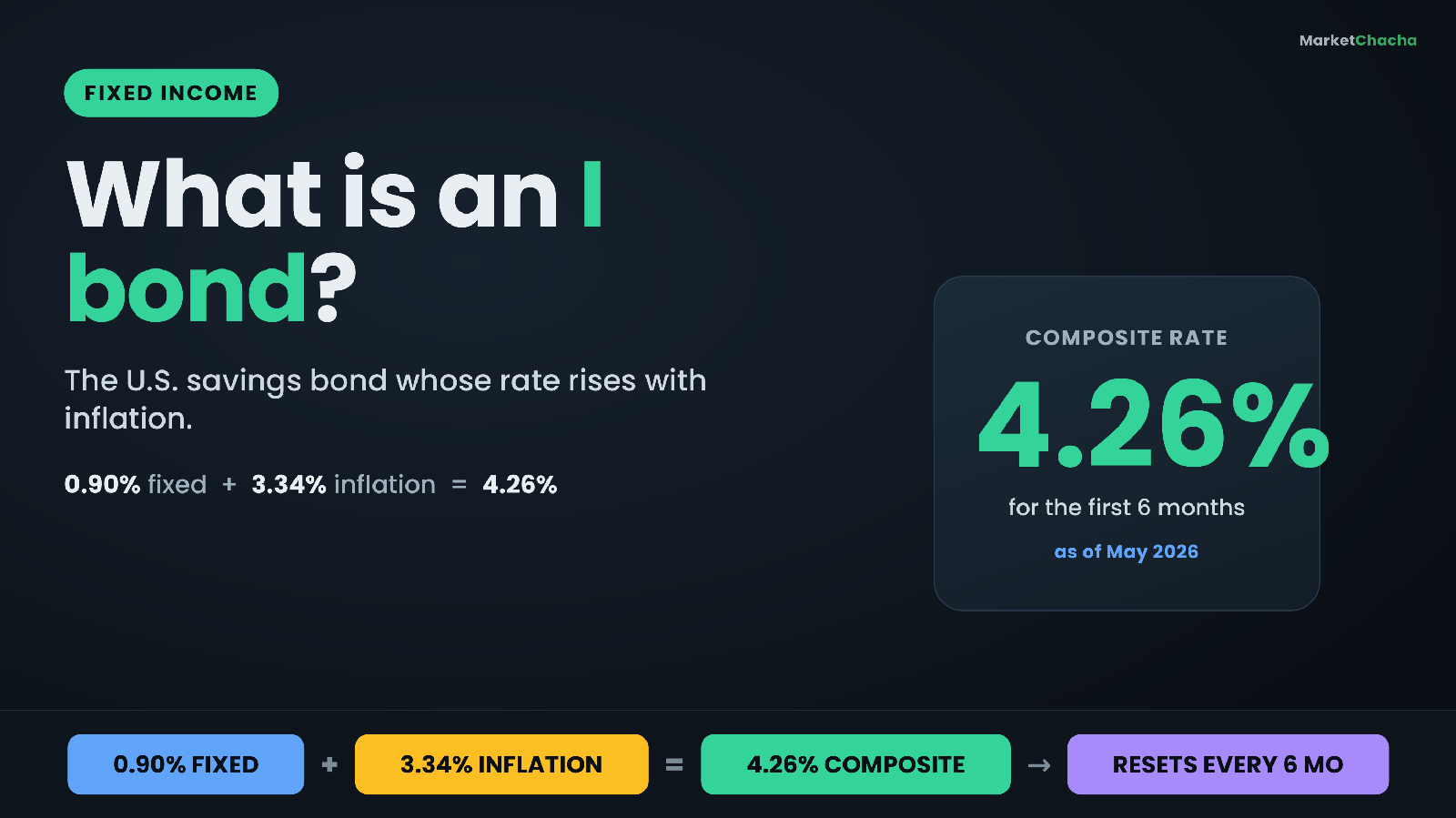
A Series I savings bond — an "I bond" — is a savings bond sold by the U.S. Treasury whose interest rate rises and falls with inflation, so the money you park in it keeps its buying power. You lend the government a small amount (as little as $25), and it pays you a rate that is rebuilt twice a year to track the Consumer Price Index. As of May 2026, a newly bought I bond pays a 4.26% annualised composite rate for its first six months, and it is backed by the full faith and credit of the U.S. government — about as safe as a place to put cash gets. This guide explains exactly how the rate is built, walks through what $10,000 actually earns, shows you how to buy one, spells out the catches, and ends with how the same idea works in India.
What exactly is an I bond?
An I bond earns interest from two parts added together, and understanding this split is the whole game:
- A fixed rate. This is locked in on the day you buy and never changes for the entire 30-year life of that bond. For bonds bought between May and October 2026, the fixed rate is 0.90%.
- An inflation rate. The Treasury resets this every six months — each May and November — based on the change in the (non-seasonally-adjusted) CPI-U. For the current period the semiannual inflation figure is 1.67%, which the Treasury quotes as an annualised 3.34%.
Blend the two and you get the composite rate — the headline 4.26% number. The fixed part is yours to keep no matter what inflation does; the inflation part floats. That combination is what makes an I bond different from a normal savings account: when inflation jumps, your rate follows it up at the next reset, so you are not left earning 0.5% while prices climb 5%.
A worked example: what $10,000 actually earns
Say you buy $10,000 of I bonds today at the 4.26% composite rate. The composite is an annual rate, and interest is credited every six months, so for the first six months you earn half of it — 2.13%:
- $10,000 × 2.13% = $213 in interest over the first six months.
- Your bond is now worth $10,213.
At your bond's six-month mark, a new composite rate kicks in (built from your same 0.90% fixed rate plus whatever the newest inflation figure is). Whatever that next rate is, it applies to the $10,213, not the original $10,000 — that is what "compounds semiannually" means. If, hypothetically, the next composite rate were also around 4.26%, the second six months would add roughly $10,213 × 2.13% ≈ $218, taking you to about $10,431 after a full year. The exact figure depends on the inflation reset, but the mechanic is fixed: earn half the composite each six months, then compound.
How the composite rate is actually built (the formula)
The Treasury does not simply add the fixed and inflation rates. The official formula is:
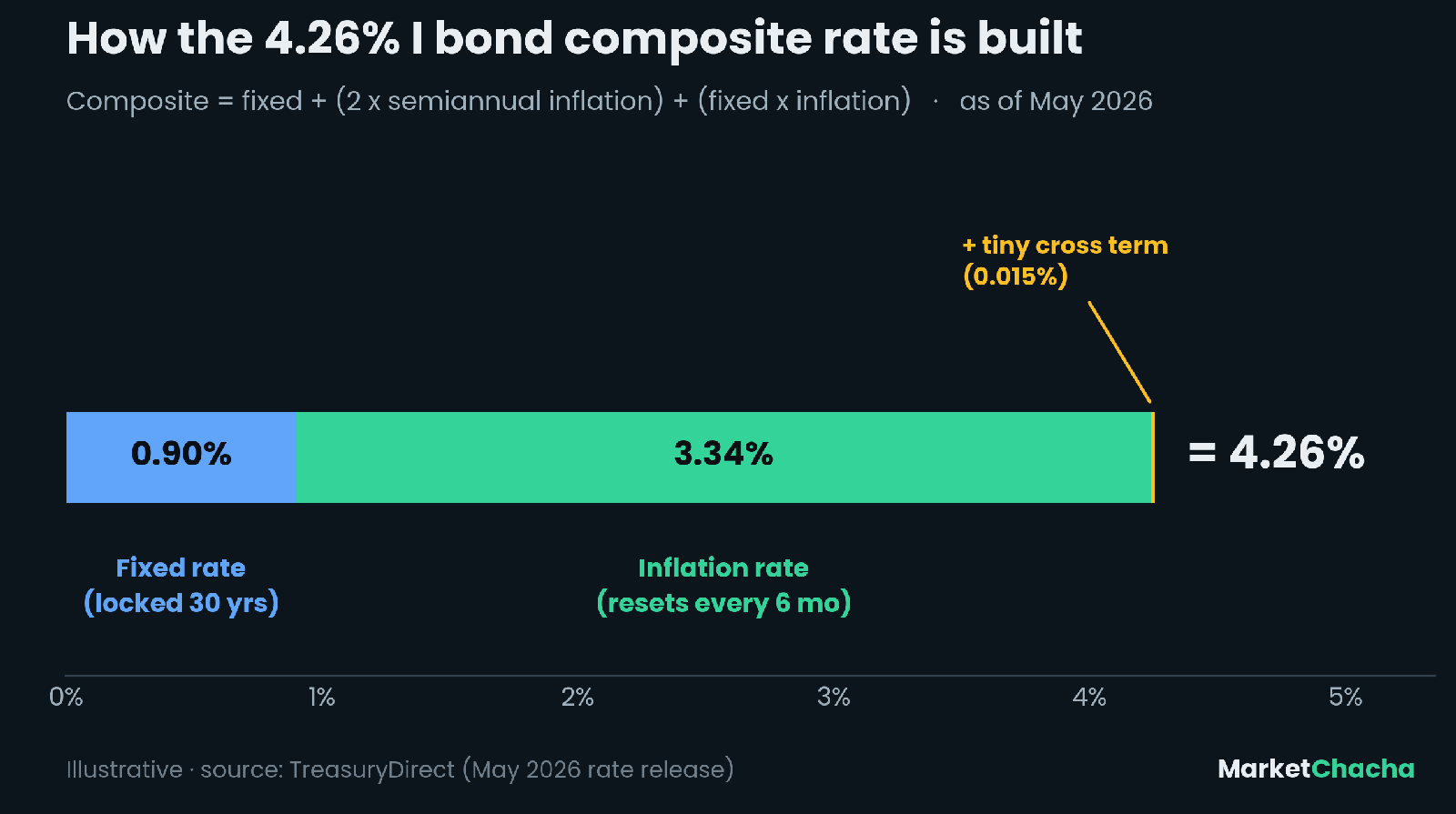
Composite = fixed + (2 × semiannual inflation) + (fixed × semiannual inflation)
Plugging in the current numbers: 0.0090 + (2 × 0.0167) + (0.0090 × 0.0167) = 0.0090 + 0.0334 + 0.00015 = 0.04255, which rounds to the 4.26% you see quoted. The tiny middle term (0.00015) is a cross-product; it is small, but it is why the composite is not exactly "fixed plus annualised inflation."
One crucial protection: the composite rate can never fall below 0%. In a deflationary stretch the inflation component can go negative, but the Treasury floors the composite at zero, so an I bond's redemption value never drops. You cannot lose principal.
How to actually buy an I bond, step by step
Since January 1, 2025, I bonds are electronic only — the old option to buy up to $5,000 in paper bonds with your tax refund has ended. Here is the route:
- Open a TreasuryDirect account at treasurydirect.gov. You will need a U.S. Social Security number, a bank account and a U.S. address.
- Link your bank so the purchase can be funded by electronic transfer.
- Buy the I bond — choose any amount from $25 up to $10,000 per person per calendar year. You can gift bonds to others and buy in a spouse's or a child's name to stack the annual limits across a household.
- Hold and track. Interest accrues automatically inside the account; there is nothing to reinvest and no fee.
There is no secondary market — you buy directly from and redeem directly to the Treasury.
The catch: lock-up, penalty and the limit
I bonds are safe, but they are not a checking account. The trade-offs:
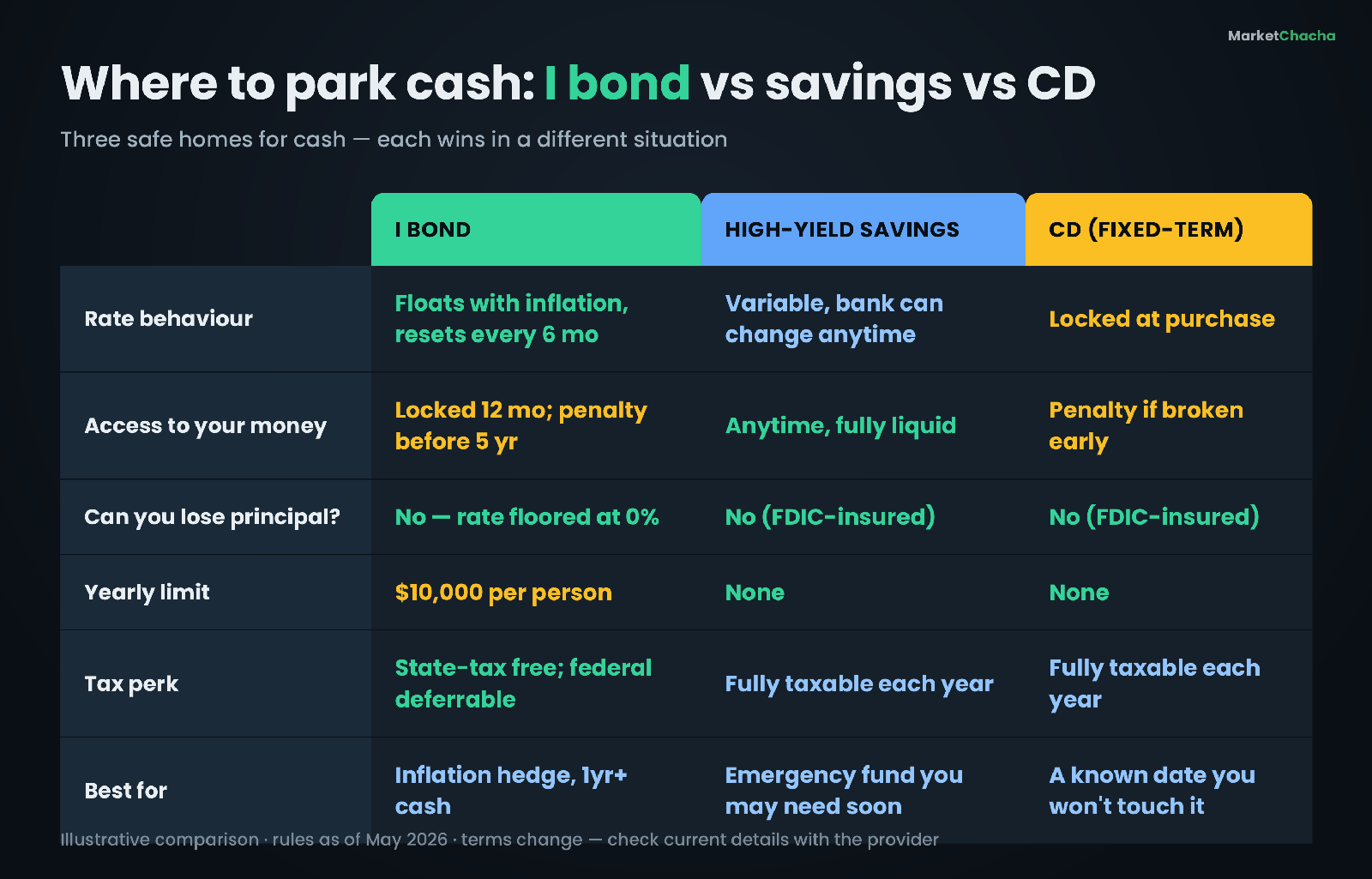
- You cannot touch it for 12 months. An I bond is completely locked for the first year — no early exit for any reason.
- A three-month interest penalty before five years. Redeem any time between year 1 and year 5 and you forfeit the most recent three months of interest. Cash out after five years and there is no penalty at all.
- A $10,000 annual cap per person. This makes I bonds a great slice of an emergency fund or cash pile, not a place to move a large lump sum all at once.
- They stop earning at 30 years. Interest is credited for 30 years, then the bond stops growing — a reminder to redeem eventually.
How I bonds are taxed
The tax treatment is one of the quiet advantages:
- Exempt from state and local income tax — useful if you live in a high-tax state.
- Federal tax applies, but only as ordinary income on the interest, and you can defer it until you cash the bond or it hits 30-year maturity (whichever comes first). No annual 1099 to deal with while you hold.
- A possible education exclusion. If you use the proceeds for qualified higher-education expenses and your income is under the limit, the interest can be fully tax-free. For 2026 that benefit phases out between a modified AGI of $101,800 and $116,800 (single) and $152,650 and $182,650 (married filing jointly).
When an I bond makes sense (and when it doesn't)
Think of an I bond as a medium-term inflation hedge for cash you won't need for at least a year. It shines for the "second layer" of an emergency fund, a house down-payment you're saving toward in a few years, or simply cash you want protected from inflation without stock-market risk. It is a poor fit for money you might need next month (the 12-month lock), or for a large lump sum you want deployed immediately (the $10,000 cap). Compared with a high-yield savings account, an I bond can lag when inflation is low and its fixed rate is small — but it automatically keeps pace when inflation spikes, which a fixed-rate CD cannot.
Common mistakes beginners make
- Treating it like a savings account. The one-year lock is absolute — never put next month's rent in an I bond.
- Ignoring the fixed rate. Two bonds with the same composite rate today are not equal: the one with the higher fixed rate wins for decades, because that part never resets.
- Forgetting the three-month penalty. Redeeming at year 2 or 3 quietly costs you a quarter's interest; if you can wait to five years, you keep all of it.
- Chasing the headline rate. The 4.26% only guarantees the first six months. The rate will change at your next reset, so don't assume it's locked.
How this works in India
India does not sell an exact CPI-linked retail savings bond today, but the closest government-backed, floating-rate cousin is the RBI Floating Rate Savings Bond, 2020 (Taxable). Like an I bond, its rate is reset every six months — but instead of tracking inflation directly, it is pegged to the National Savings Certificate (NSC) rate plus 0.35%. For July–December 2026 that works out to 8.05% (7.70% NSC + 0.35%). Interest is paid out semi-annually rather than compounding inside the bond, the lock-in is seven years, the minimum is ₹1,000 with no upper cap, and — unlike the U.S. bond's tax perks — the interest is fully taxable as ordinary income, with TDS deducted.
For a shorter horizon, Indian savers usually compare this with a bank fixed deposit (fixed rate, laddered) or the PPF (tax-free but a 15-year commitment). The key mental model is the same as the I bond: a floating rate protects you when rates and prices climb, while a fixed FD locks you in — good if rates then fall, painful if they rise.
FAQ
What is the current I bond rate? For I bonds issued from May through October 2026, the composite rate is 4.26% annualised for the first six months, made up of a 0.90% fixed rate and a 3.34% annualised inflation rate. It resets at each bond's six-month anniversary.
Can you lose money on an I bond? No. The composite rate is floored at 0%, so even in deflation the bond's value never falls — your principal and previously earned interest are protected.
How much can I buy in I bonds per year? Up to $10,000 per person per calendar year in electronic bonds through TreasuryDirect, with a $25 minimum. The old $5,000 paper option via a tax refund ended on January 1, 2025.
When can I cash out an I bond? Not in the first 12 months at all. Between year 1 and year 5 you can redeem but lose the last three months of interest. After five years there is no penalty, and interest accrues for up to 30 years.
Are I bonds taxed? The interest is exempt from state and local tax and can be deferred from federal tax until you redeem or the bond matures. It may be fully tax-free if used for qualified higher-education expenses within the income limits.
Is there an I bond equivalent in India? The nearest is the RBI Floating Rate Savings Bond, 2020, currently paying 8.05% (NSC + 0.35%), reset every six months, with a seven-year lock and fully taxable interest — floating like an I bond, but pegged to the NSC rate rather than to inflation directly.
Educational content only — not investment, tax or insurance advice, and not a recommendation of any product. Rates, fees and rules change — always check current terms with the provider. Sources: TreasuryDirect (I bond rates), TreasuryDirect May 2026 rate release, TIPS Watch, IRS Topic 403, RBI. Always do your own research.
This article is for educational and informational purposes only. It is not financial advice, investment recommendation, or a solicitation to buy or sell securities. Investing involves significant risks. I am not a SEBI-registered investment advisor. Readers should consult their own financial advisor and conduct their own research before making any investment decisions.
Comments
Join the conversation
Sign in to join the conversation.
Follow replies, add your view, and take part in the discussion.
Sign in to commentLoading comments...