

Why did Diamond Power Infrastructure lock a 5% upper circuit today?
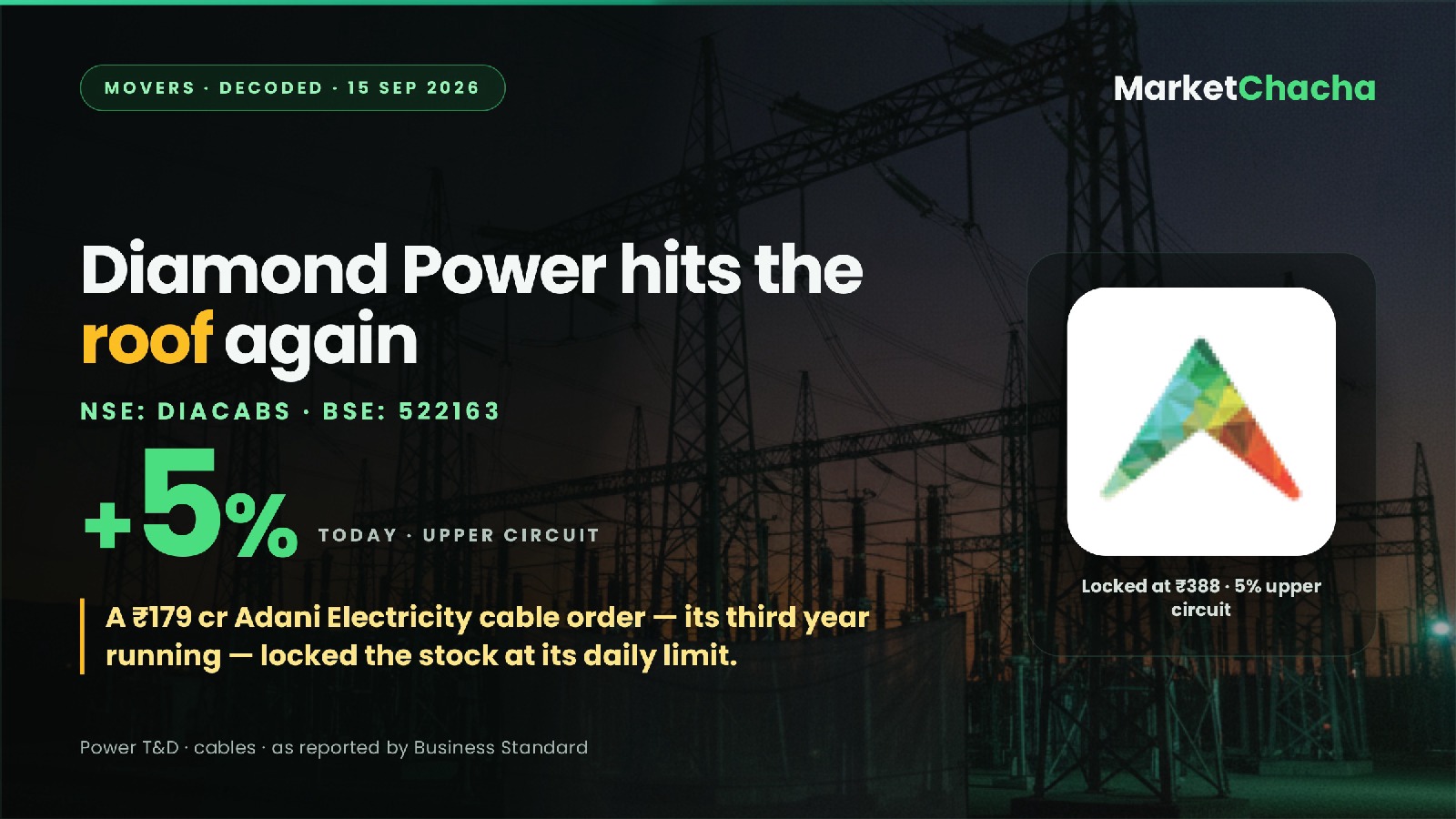
A small-cap cable maker just got locked at its daily ceiling before most people finished their morning chai. Diamond Power Infrastructure (NSE: DIACABS) was frozen in a 5% upper circuit at ₹388 today after telling the exchanges it had bagged a fresh order from the Adani group. Here's what's actually going on — and why the reaction is bigger than the order.
What happened
Diamond Power received a Letter of Award worth ₹179.43 crore from Adani Electricity Mumbai (AEML) to supply power cables — roughly 871 km of 33 kV and 11 kV medium-voltage cable plus associated 1.1 kV low-voltage cable, using water-tree-retardant TR-XLPE insulation (the kind built to survive years buried in damp Mumbai soil). The stock hit its 5% band and stayed locked, meaning buyers massively outnumbered sellers and there was simply no one willing to sell at the day's cap.
Why it moved
An "upper circuit" isn't a normal 5% up-day — it's a scarcity signal. When a stock locks limit-up, the exchange won't let it trade higher that session, so the queue of unfilled buy orders is the real story. Two things drove that queue. First, ₹179 crore is meaningful for a company that did ₹1,910 crore of revenue in all of FY26 — this single order is about 9% of a full year's sales. Second, and more telling, this is the third year running that AEML has handed Diamond Power this cable mandate — repeat business from a marquee buyer is what the market pays up for, because it signals the order book is sticky, not a one-off.
The business
Diamond Power isn't a pure-play on this one order. It's a Vadodara-based, fully integrated transmission-and-distribution equipment maker under the DICABS brand, spanning three things: power cables from 1.1 kV all the way to 550 kV extra-high-voltage, conductors (the aluminium and alloy wires strung between towers), and transmission towers plus turnkey EPC. So today's cable win is one slice of a wider grid-equipment story, not the whole company. Its total order book was ₹3,688 crore as of 11 August — nearly two years of FY26 revenue already booked.
Is it expensive?
Bluntly, yes. Diamond Power trades at a P/E of roughly 148 on a market cap near ₹21,000 crore (as reported by Screener.in in early September). A P/E near 150 means the market is already paying for many years of rapid growth — FY26 profit did jump about 355%, but that's off a small base after the company's turnaround from its earlier debt troubles. For context, sector heavyweight Polycab India trades around a P/E of 44–50 (market cap ~₹1.35 lakh crore) and KEI Industries around 48. Diamond Power is priced at roughly three times the multiple of the two most obvious, far larger listed peers. That's not a buy or sell call — it just means there's very little room for disappointment baked into the price.
Who it touches
- Cable and conductor peers — Polycab, KEI Industries, Apar Industries and R R Kabel all ride the same grid-capex wave; order-win headlines like this keep the whole pack in focus.
- The Adani group — this is Diamond Power's third recent Adani mandate, alongside a ₹185 crore conductor order from Adani Energy Solutions and a smaller Adani Power cable LoI. Adani's distribution and transmission capex is quietly feeding a chain of mid-cap suppliers.
- Metals — cables and conductors are aluminium- and copper-heavy, so input costs (and hedging) matter to the margin on orders like this.
The one risk
Customer concentration. A striking share of Diamond Power's recent wins carry the Adani name — great while Adani's grid spending is booming, but it ties the order book to one buyer's capex cycle. Pair that with a P/E near 150, and any quarter where execution slips or a large order is delayed could hit the stock hard, because an order book is signed intent, not booked revenue — cables still have to be made, delivered and paid for before it shows up in the P&L.
As of 1:30 pm IST, 15 Sep 2026. Sources: Business Standard, Business Standard (LoA detail), Screener.in. For discussion and education only — not investment advice. Verify before acting.
This article is for educational and informational purposes only. It is not financial advice, investment recommendation, or a solicitation to buy or sell securities. Investing involves significant risks. I am not a SEBI-registered investment advisor. Readers should consult their own financial advisor and conduct their own research before making any investment decisions.
Comments
Join the conversation
Sign in to join the conversation.
Follow replies, add your view, and take part in the discussion.
Sign in to commentLoading comments...