

What is a credit score and how is it actually calculated? (FICO explained — plus CIBIL in India)
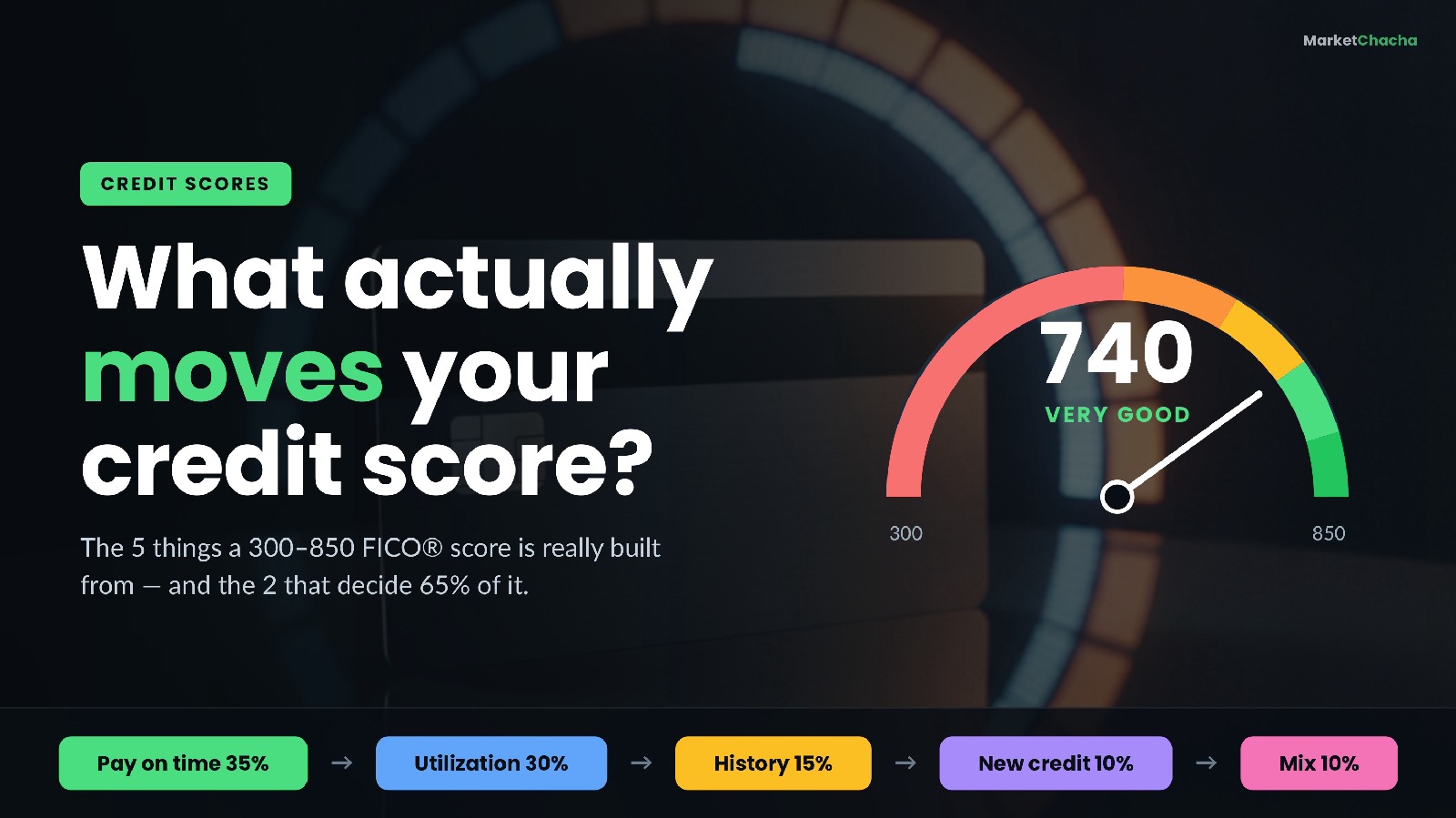
A credit score is a three-digit number — most commonly on a 300 to 850 scale in the US — that lenders use to estimate how likely you are to pay back money you borrow. It is not a judgement of you as a person or a measure of your income or savings. It is a statistical summary of your track record with borrowed money: how reliably you have paid past debts, how much you currently owe, and how you have handled credit over time. This guide explains exactly what goes into that number, walks through a worked example so you can see how one habit moves it, shows what a "good" score really means, and closes with how the same system works in India through your CIBIL score.
So what exactly is a credit score?
Behind the scenes, the three big US credit bureaus — Equifax, Experian and TransUnion — each keep a file on you called a credit report. That report lists your credit cards, loans, payment history, balances and any defaults. A credit score is what you get when a scoring company runs a mathematical model over that report and boils it down to a single number.
The most widely used model is the FICO Score, which runs from 300 to 850. A rival model, VantageScore, uses the same 300 to 850 range but weighs things slightly differently. This is why you do not have one single "credit score" — you have several, depending on which bureau's data and which model a lender pulls. They usually land close together, but rarely identical. The key thing to remember: your report is the raw data, and your score is one interpretation of it.
The five things a FICO score is actually built from
FICO groups the data into five categories, each with an approximate weight. According to myFICO, the official source, they are: payment history (about 35%), amounts owed (about 30%), length of credit history (about 15%), new credit (about 10%) and credit mix (about 10%). These weights are the general importance for a typical profile; the exact impact shifts depending on everything else in your file.
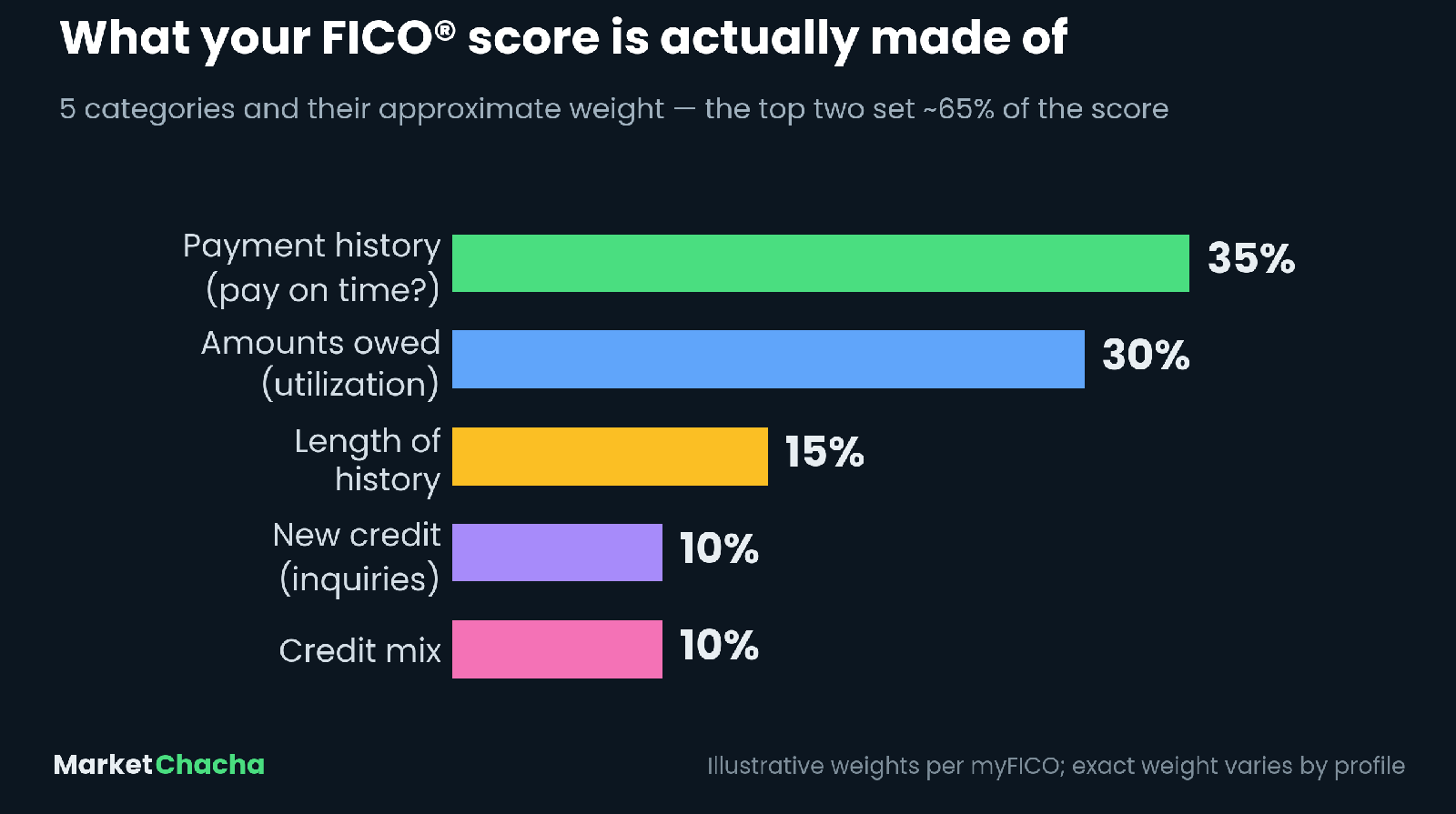
Payment history is the single biggest lever: do you pay on time? A useful nuance most people miss — lenders generally do not report a payment as "late" to the bureaus until it is 30 days past due. Paying a few days after the due date usually costs you a late fee but often does not hit your score. A payment that goes 30, 60 or 90 days late is what does real damage. Amounts owed is mostly about credit utilization — the share of your available card limit you are using — which we work through below. The remaining three build slowly: length of history rewards older accounts, new credit tracks how much new borrowing you have recently sought, and credit mix gives a small nod to handling different types of credit (cards plus an instalment loan) responsibly.
A worked example: how utilization moves your score
Utilization is the fastest lever you can pull, so it is worth seeing the arithmetic. Say you have two credit cards: Card A with a $4,000 limit and Card B with a $6,000 limit. Your total available credit is $10,000. This month you are carrying $3,500 in balances across the two.
Your utilization is $3,500 ÷ $10,000 = 35%. There is no magic cliff, but many scoring models start to weigh utilization more heavily as you climb past roughly 30%, and the highest scorers tend to sit below 10%. So a 35% reading is quietly holding your score back.
Now suppose you pay the balances down to $1,000 before your statements close. Utilization becomes $1,000 ÷ $10,000 = 10%. Here is the powerful part: utilization is a snapshot, usually taken from your statement balance each month, and it carries no memory. Unlike a late payment that lingers, a high-utilization month simply stops counting once you report a lower one. That is why paying a card down can lift your score within a single billing cycle — while "length of history" can only improve by waiting. One caveat: utilization is measured both overall and card-by-card, so a single maxed-out card can sting even if your total looks fine. And counter-intuitively, 0% is not the target either — showing a little activity is generally read more favourably than showing none.
What a "good" score actually means
FICO splits the 300 to 850 range into bands: Poor (300–579), Fair (580–669), Good (670–739), Very Good (740–799) and Exceptional (800–850). Crossing from one band toward the next matters because your score is a price tag: a higher score typically unlocks lower interest rates and better terms on mortgages, car loans and credit cards, while a lower score means you either pay more in interest or get declined. You do not need a perfect 850 — once you are comfortably in the "very good" range, most lenders already offer their best pricing, and the marginal benefit of chasing the last few points is small.
Hard vs soft inquiries: does checking your score hurt it?
This is one of the most common fears, and the answer is reassuring. When you check your own score, or a lender peeks for a pre-approved offer, that is a soft inquiry — it is invisible to scoring and does not lower your number. You can check as often as you like. A hard inquiry happens when you formally apply for credit and a lender pulls your report to decide. According to Experian and myFICO, a single hard inquiry usually knocks off fewer than five points (more if your file is thin or already low), the effect fades within about 12 months, and it drops off your report entirely after two years.
There is a built-in protection for shopping smart: for recent FICO models, multiple hard inquiries of the same type — say, several auto or mortgage lenders within a roughly 45-day window — are bundled and counted as a single inquiry, so rate-shopping for one loan does not punish you five times over. Note this grouping is designed for loans; applying for several credit cards in quick succession is more likely to be read as separate inquiries and can add up.
How to actually build and check your score
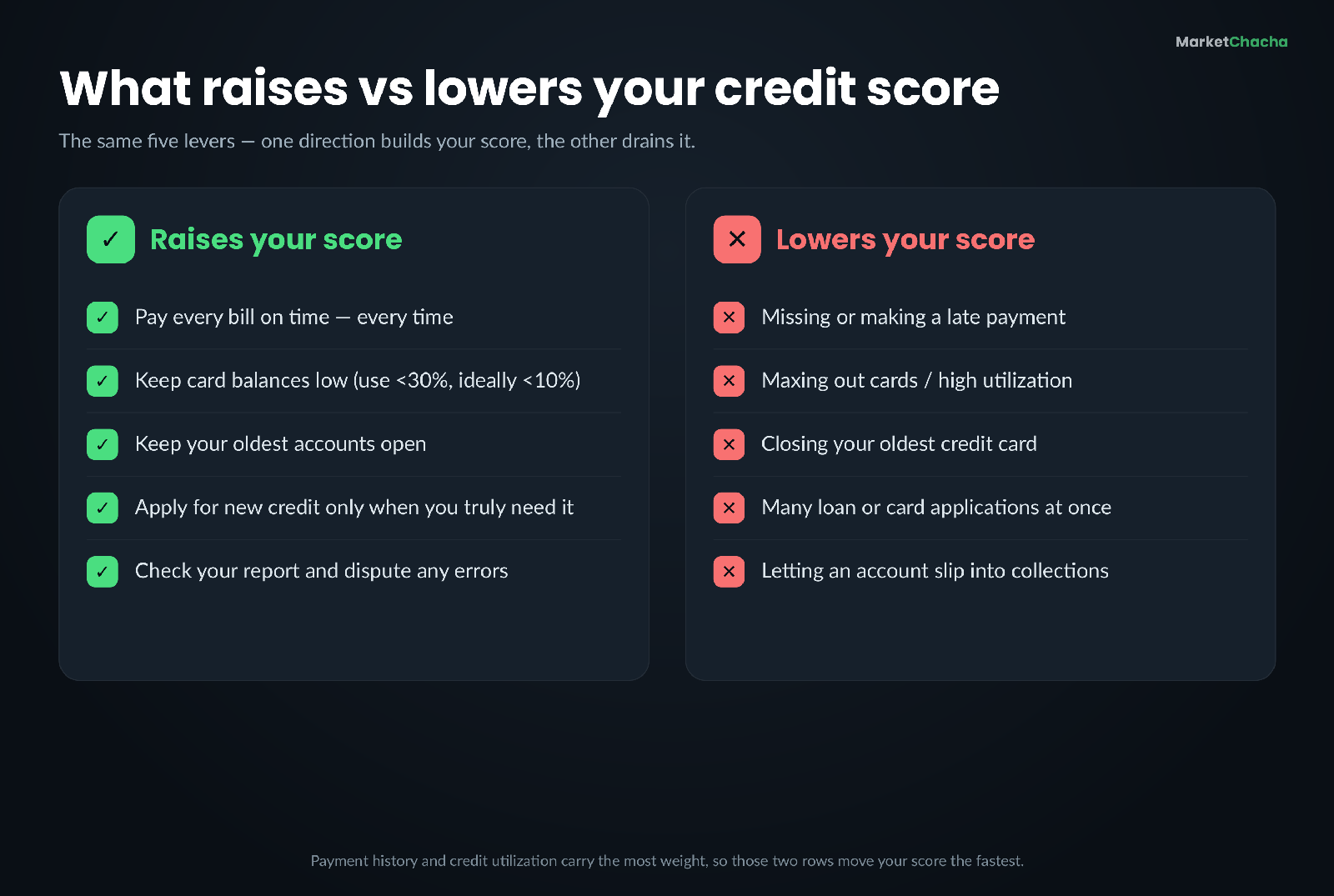
The mechanics reward boring consistency. A practical sequence for building or repairing a score: (1) Never miss a due date. Automate at least the minimum payment on every account so a slip never becomes a 30-day late mark. (2) Keep utilization low. Pay balances down before the statement closes, or ask for a higher limit you do not use, so your ratio drops. (3) Keep old accounts open. Closing your oldest card shortens your history and shrinks your total limit, nudging utilization up. (4) Apply only when you need to, and space out applications. (5) Check your report for errors and dispute anything wrong — a mistaken late payment or an account that is not yours can drag your score down unfairly.
To see your data, you can get free copies of your reports from all three bureaus at AnnualCreditReport.com — the official, federally authorised site — and many banks and card issuers now show you a free FICO or VantageScore in their app. Because pulling your own report is a soft inquiry, monitoring it costs you nothing in points.
Common mistakes beginners make
Three misconceptions cause the most avoidable damage. First, carrying a balance to "build credit" — you do not need to pay interest to build a score; paying your statement in full every month builds payment history just as well and costs nothing. Second, closing a card you no longer use — this can backfire by cutting your available credit and eventually your history length; often it is better to keep it open with a small recurring charge. Third, believing checking your own score hurts it — it does not, so monitoring regularly is pure upside. A fourth: assuming a good income guarantees a good score. Lenders never see your salary in the score itself; a high earner who pays late will score worse than a modest earner who pays on time.
How this works in India
India runs on the same logic with different labels. The most quoted score is the CIBIL Score (from TransUnion CIBIL), and there are three other RBI-licensed bureaus — Experian, Equifax and CRIF High Mark. The CIBIL scale runs 300 to 900 rather than 300 to 850, and most Indian lenders treat 750 and above as a strong score. The ingredients mirror FICO: your repayment history on EMIs and credit-card dues carries the most weight, followed by credit utilisation, the age of your accounts, your credit mix of secured and unsecured loans, and the number of recent enquiries. People new to credit sometimes see "NA" or "NH" (not available / no history) instead of a number — that is not a bad score, just an empty file that fills in once you use credit responsibly. The RBI requires each bureau to give you one free full credit report per calendar year, and checking your own score counts as a soft enquiry that does not hurt it.
FAQ
What is a good credit score? On the FICO 300–850 scale, 670–739 is "good", 740–799 is "very good" and 800+ is "exceptional"; below 670 is where borrowing gets more expensive. In India, most lenders treat a CIBIL score of 750 or above as strong.
Does checking my own credit score lower it? No. Checking your own score is a "soft inquiry" that is invisible to scoring models. Only a "hard inquiry" from actually applying for credit can shave off a few points.
How is credit utilization calculated? Divide the total balance on your revolving accounts (mostly credit cards) by your total credit limit. $3,500 owed against a $10,000 limit is 35% utilization. Keeping it below about 30% — ideally under 10% — is generally best.
How long does a hard inquiry stay on my report? A hard inquiry stays on your report for two years, but typically only affects your score for about 12 months, and usually by fewer than five points.
Why do I have more than one credit score? Because different companies (FICO and VantageScore) score different bureaus' data with different models. A lender might pull any one of these, so your numbers vary slightly depending on the source.
Will carrying a balance on my credit card improve my score? No. Paying your statement in full each month builds payment history just as effectively and avoids interest. You never need to pay interest to build credit.
Educational content only — not investment, tax or credit advice, and not a recommendation of any product. Scoring models, ranges and rules change and vary by lender and jurisdiction — always check current terms with the provider or bureau. Sources: myFICO, Experian, CFPB, AnnualCreditReport.com, TransUnion CIBIL. Always do your own research.
This article is for educational and informational purposes only. It is not financial advice, investment recommendation, or a solicitation to buy or sell securities. Investing involves significant risks. I am not a SEBI-registered investment advisor. Readers should consult their own financial advisor and conduct their own research before making any investment decisions.
Comments
Join the conversation
Sign in to join the conversation.
Follow replies, add your view, and take part in the discussion.
Sign in to commentLoading comments...