

What is a 401(k) and how does the employer match actually work? (Beginner's guide)

A 401(k) is a retirement savings account offered through your job, where money is taken straight from your paycheck and invested for the long term — and its single most valuable feature is the employer match: extra money your company adds to your account for free when you contribute. If your employer matches 100% of the first 5% you save, every dollar you put in is instantly met by a dollar from them. That is a 100% return before the market does anything, which is why skipping the match is widely considered the biggest avoidable mistake in personal finance. This guide explains, from scratch, what a 401(k) is, exactly how the match works, how vesting and taxes fit in, the 2026 contribution limits, how to actually set one up, the catches to watch for, and the closest Indian equivalents.
What a 401(k) actually is
A 401(k) — named after the section of the US tax code that created it — is an employer-sponsored, tax-advantaged retirement account. You decide what percentage of each paycheck to contribute, your employer deducts it automatically, and the money is invested in funds you choose from the plan's menu (usually a handful of index funds and target-date funds). The account is yours: if you change jobs, you take it with you by rolling it into your new employer's plan or into an IRA.
Two things make a 401(k) special versus a normal brokerage or savings account. First, tax advantages — depending on the type you pick, you either skip tax now or skip it later (more on that below). Second, and more importantly for beginners, the employer match — an amount of money you simply cannot get anywhere else.
The employer match: the closest thing to free money you will ever get
An employer match is compensation your company pays into your 401(k) on top of your salary, but only if you contribute yourself. The match is defined by a formula. Two very common ones are:
- Dollar-for-dollar up to a cap — e.g. "100% match on the first 5% of pay." Save 5%, they add 5%.
- Partial match up to a cap — e.g. "50% match on the first 6% of pay." Save 6%, they add 3%. This is often called "50 cents on the dollar."
The key rule: you only get the match if you contribute enough to earn it. If the match caps at 5% and you only save 3%, you leave the last 2% of free money on the table. Contributing at least up to the full match should be the very first goal of anyone with a 401(k) — before paying down low-interest debt, before investing anywhere else. No stock, bond, or savings account reliably hands you an instant, guaranteed 100% (or even 50%) return on your money the way a match does.
A worked example: how the match doubles your pot
Say you earn $60,000 and your employer matches 100% of the first 5% you contribute.
- You contribute 5% of pay = $3,000 a year ($250 a month).
- Your employer adds another $3,000 to match it.
- So $6,000 goes into your account each year — half from you, half free.
Now let it compound. Using a 7% illustrative average annual return (not guaranteed — markets go up and down), here is roughly what 30 years looks like:
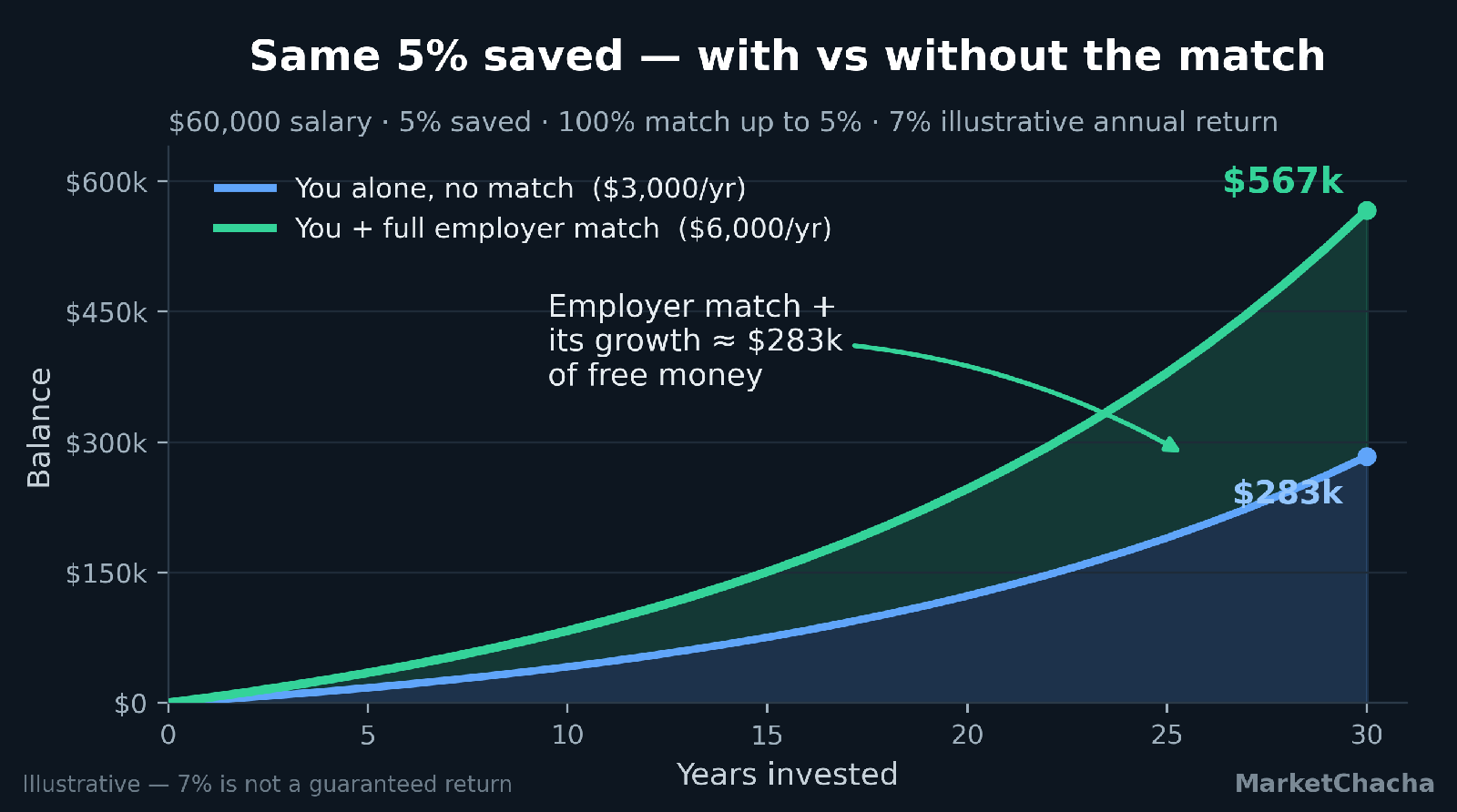
Your own $3,000 a year grows to about $283,000. Add the match and the same 5% habit grows to about $567,000. That extra ~$283,000 came entirely from your employer's contributions and their growth — money you would have forfeited by not contributing. The match doesn't just add a little; over a career it can roughly double what you end up with.
Vesting: when the match actually becomes yours
Here is the catch beginners miss. Your own contributions are always 100% yours immediately. But the employer's match may be subject to a vesting schedule — a waiting period before that money is truly yours to keep if you leave. Federal law (ERISA) lets employers use up to a 3-year cliff or a 6-year graded schedule for matching contributions:
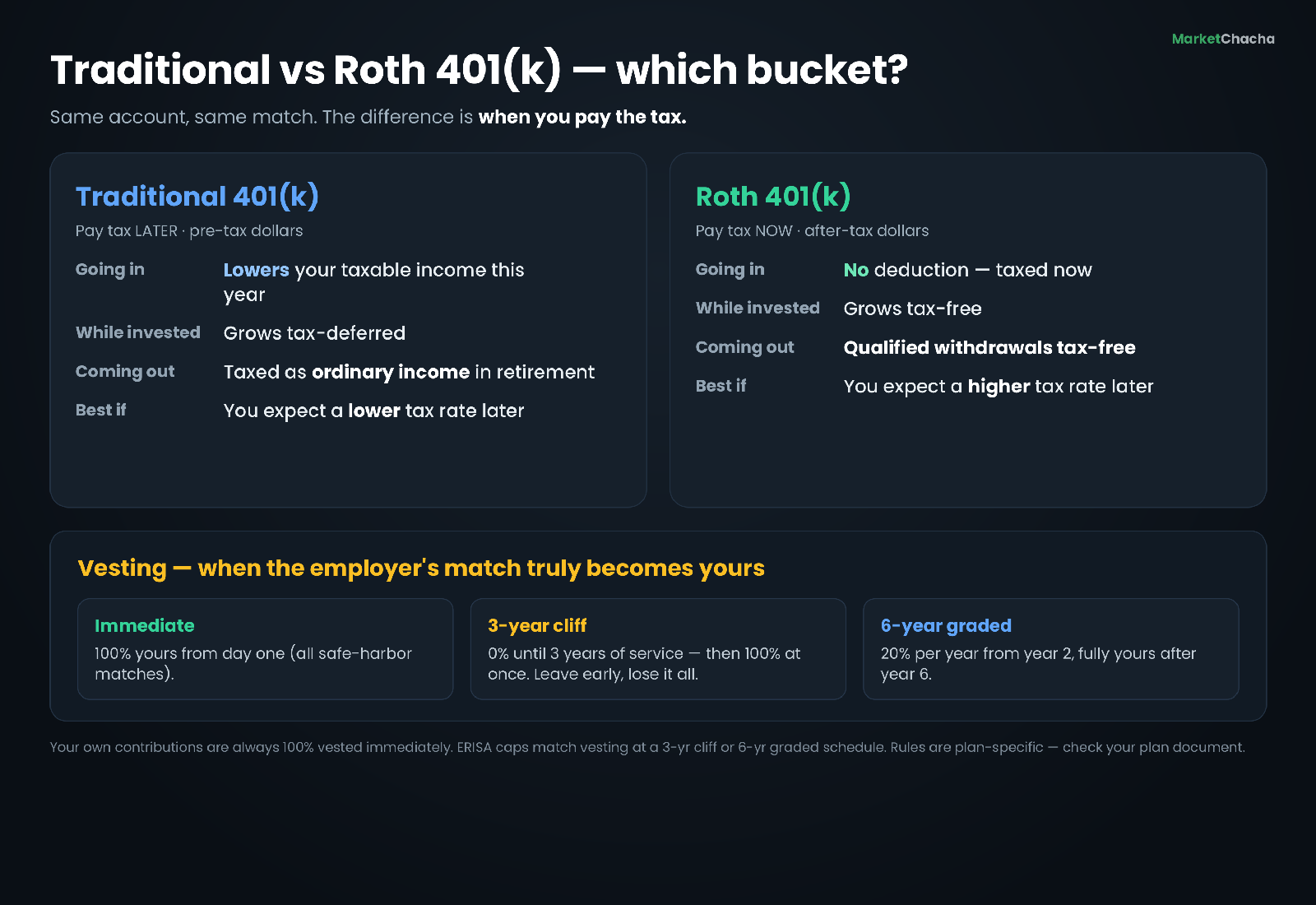
- Immediate — the match is 100% yours from day one. All "safe harbor" matches are immediately vested.
- 3-year cliff — you're 0% vested until you hit 3 years of service, then jump to 100% at once. Leave at 2 years and 11 months and you can forfeit the entire match.
- 6-year graded — you vest 20% per year starting in year 2, reaching 100% after 6 years.
Check your plan document so you know your schedule. It rarely justifies staying in a bad job, but it's worth knowing what walking away costs.
Traditional vs Roth 401(k): when do you pay the tax?
Many plans let you choose between two "buckets." The difference is simply when you pay income tax:
- Traditional (pre-tax) — contributions come out before tax, lowering your taxable income this year. The money grows tax-deferred, and you pay ordinary income tax when you withdraw it in retirement. Good if you expect a lower tax rate later.
- Roth (after-tax) — contributions are taxed now, so there's no upfront deduction, but qualified withdrawals in retirement are completely tax-free. Good if you expect a higher tax rate later, which is common for younger workers early in their careers.
One nuance: employer matching contributions have traditionally gone into the pre-tax bucket regardless of which bucket you choose. Since the SECURE 2.0 Act, plans may now offer a Roth employer match, but only if the plan opts in and you're fully vested — and if you elect it, the match is taxable to you the year it's made. Whether your plan offers this is plan-specific, so don't assume either way.
The 2026 contribution limits
The IRS caps how much you can put in. For 2026 (per IRS Notice 2025-67, announced 13 Nov 2025):
- Employee contributions: up to $24,500 of your own salary (up from $23,500 in 2025).
- Age 50+ catch-up: an extra $8,000, for $32,500 total.
- Ages 60–63 "super" catch-up: an extra $11,250 instead of $8,000, for $35,750 total.
- Total including employer money: combined employee + employer contributions can reach $72,000 (the Section 415(c) limit), or more with catch-ups.
Crucially, the employer match does not count against your $24,500 employee limit — it only counts toward the higher combined cap. So the match is genuinely additional. Note also that from 1 Jan 2026, if you earned more than $150,000 in wages the prior year, your catch-up contributions must be made as Roth.
How to actually set up and fund your 401(k)
- Enroll. Ask HR or your plan provider (Fidelity, Vanguard, Empower, etc.) how to sign up. Many employers auto-enroll new hires — check that you're actually in.
- Find your match formula. The single most important number: what percentage do you have to contribute to get the full match? Set your contribution rate to at least that.
- Pick your bucket. Traditional, Roth, or a split — based on your current vs expected future tax rate.
- Choose low-cost investments. If you're unsure, a target-date fund matched to your retirement year is a reasonable one-click, diversified default. Watch the expense ratio.
- Automate and increase over time. Contributions come straight from payroll, so it's automatic. Bump your rate by 1% each year, or whenever you get a raise, until you're saving 10–15% of pay.
What it costs you — the catch
A 401(k) is powerful, but it isn't free of trade-offs:
- Your money is locked up. Withdraw before age 59½ and you generally owe income tax plus a 10% early-withdrawal penalty (some exceptions exist). This is long-term money.
- It's invested, so it can fall. The 7% used above is illustrative; real returns vary and some years are negative. The match, however, is a guaranteed return the moment it lands.
- Fees drag on growth. Plan administration fees and fund expense ratios quietly eat returns over decades. Favor low-cost index and target-date funds.
- Limited menu. You can only invest in the funds your plan offers.
- Required withdrawals later. Traditional 401(k)s require minimum distributions (RMDs) starting at age 73.
Common mistakes beginners make
- Not contributing enough to get the full match — the costliest mistake, and the easiest to fix.
- Assuming auto-enrollment maxes the match. Default rates (often 3%) are frequently below the match cap, so you may be leaving money behind without realizing it.
- Cashing out when changing jobs instead of rolling the balance over — triggering taxes, penalties, and lost compounding.
- Leaving contributions in the default low-return option (like a money-market fund) instead of a diversified fund.
- Ignoring vesting and forfeiting an unvested match by leaving just short of the cliff.
How this works in India
India's closest parallel to the "employer match" is the Employees' Provident Fund (EPF). You contribute 12% of your basic pay + dearness allowance, and your employer contributes 12% too — functionally a built-in match. Of the employer's 12%, 8.33% is routed to the Employees' Pension Scheme (EPS, subject to a wage ceiling of ₹15,000) and the remaining 3.67% goes into your EPF. The balance earns a government-declared rate — 8.25% for FY 2024–25, per the EPFO. EPF contributions also qualify for a deduction under Section 80C (old tax regime).
Beyond EPF, the National Pension System (NPS) is India's market-linked retirement account, closer in spirit to a US 401(k): you and (optionally) your employer contribute, you choose the equity/debt mix, and Tier I money is largely locked until age 60. Employer NPS contributions get a separate deduction under Section 80CCD(2), and you can claim an extra ₹50,000 under Section 80CCD(1B). Want to save more into EPF voluntarily? The Voluntary Provident Fund (VPF) lets you contribute beyond 12% at the same interest rate — though your employer isn't obliged to match the extra. As with the US, the golden rule holds: contribute at least enough to capture every rupee your employer will add.
FAQ
What is a 401(k) in simple terms? It's a retirement account offered by your employer that takes money from your paycheck, invests it for the long run, and gives it tax advantages — often topped up with free matching money from your company.
How does an employer 401(k) match actually work? Your employer adds money to your account based on a formula tied to what you contribute, such as 100% of the first 5% of your pay. You must contribute enough yourself to earn the full match, or you forfeit the rest.
Is the 401(k) match really free money? Yes — it's extra compensation you only get by contributing. Matching, say, 100% of your contribution is an instant 100% return before any market gains, which is why financial guidance says to capture the full match first.
What is the 401(k) contribution limit for 2026? Employees can contribute up to $24,500 of their own salary in 2026, plus an $8,000 catch-up at 50+ (or $11,250 at ages 60–63). Employer matching money doesn't count against your $24,500 limit.
What does vesting mean for my employer match? Vesting is how long you must stay before the employer's match is permanently yours. Your own contributions are always 100% yours; the match may take up to 3 years (cliff) or 6 years (graded) to fully vest.
Should I choose a Traditional or Roth 401(k)? Traditional gives a tax break now and is taxed in retirement; Roth is taxed now but withdrawn tax-free later. If you expect to be in a higher tax bracket in the future, Roth often makes sense; if lower, Traditional does.
What is the Indian equivalent of a 401(k)? The EPF is the closest, with a built-in 12% employer contribution alongside your 12%, while the NPS is a market-linked retirement account more similar to a 401(k) in how it's invested.
Educational content only — not investment, tax or retirement advice, and not a recommendation of any product or provider. Rates, limits and rules change and are plan-specific — always check your plan document and current terms. [Sources: IRS (IR-2025-111, Notice 2025-67), IRS 401(k) limits, EPFO]. Always do your own research.
This article is for educational and informational purposes only. It is not financial advice, investment recommendation, or a solicitation to buy or sell securities. Investing involves significant risks. I am not a SEBI-registered investment advisor. Readers should consult their own financial advisor and conduct their own research before making any investment decisions.
Comments
Join the conversation
Sign in to join the conversation.
Follow replies, add your view, and take part in the discussion.
Sign in to commentLoading comments...