

What is a municipal bond — and how does tax-equivalent yield tell you if it's worth it?
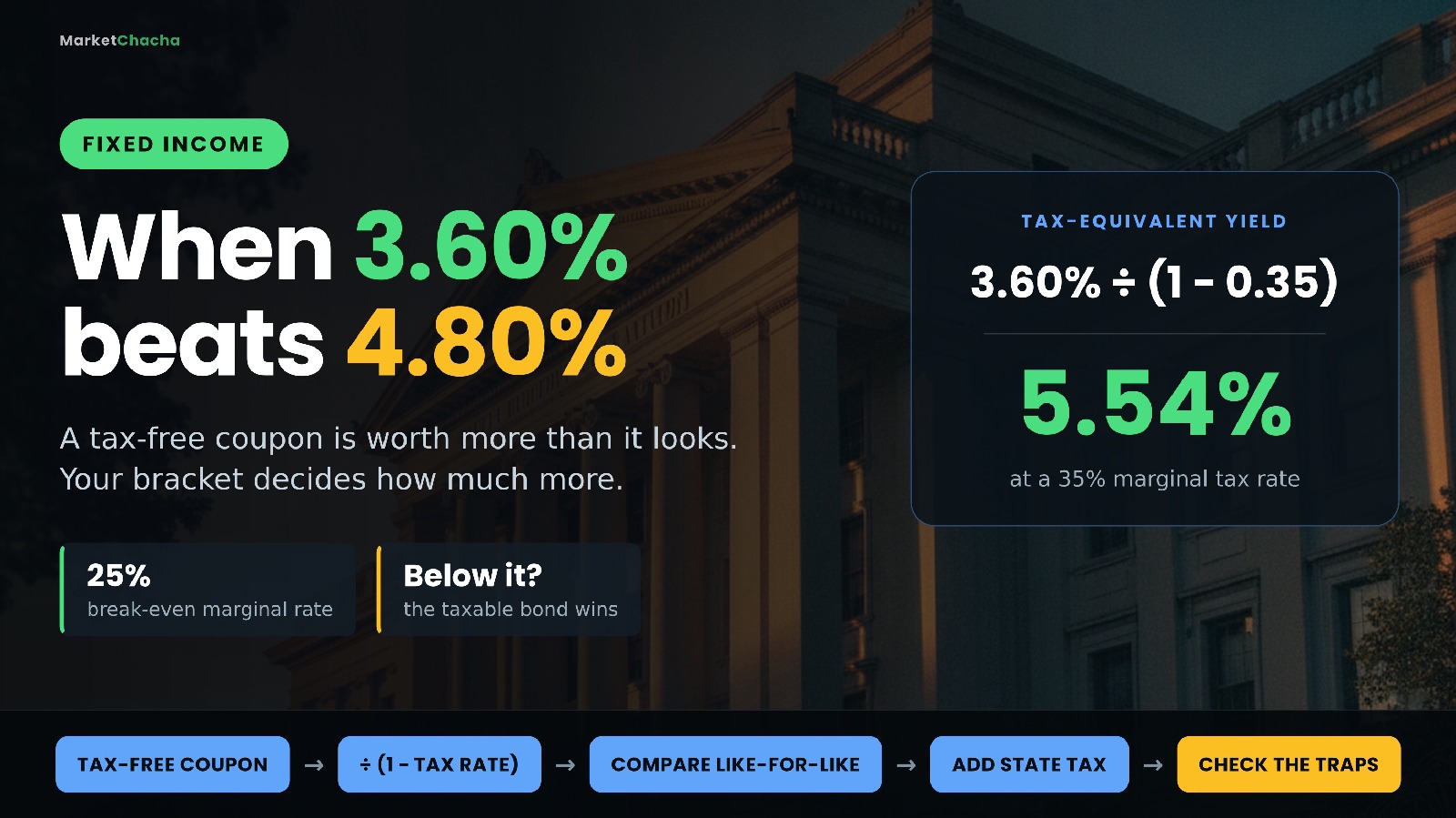
A municipal bond (a "muni") is a loan you make to a US state, city, county, school district or public agency. It pays you interest on a fixed schedule and returns your money at maturity — and the important part is that the interest is usually exempt from federal income tax, and often from your own state's income tax too. That exemption is why a muni advertising 3.60% can leave you with more money than a taxable bond advertising 4.80%. Tax-equivalent yield is the one calculation that lets you compare the two honestly.
This guide covers what a muni actually is, how the tax exemption really works, the tax-equivalent yield formula with the arithmetic worked out in dollars, how to buy one, what the exemption quietly costs you — and how the same idea maps onto India's tax-free bonds and municipal bonds.
What is a municipal bond, and who issues one?
When a city needs a new water treatment plant or a school district needs to rebuild a high school, it can raise the money by issuing bonds. You buy one, the issuer pays you interest (usually semi-annually), and at maturity you get your principal back — the same mechanic as a Treasury or a corporate bond, only the borrower is a unit of government. The SEC splits munis into two families, and the difference tells you where the money to repay you comes from:
- General obligation (GO) bonds are backed by the issuer's taxing power — its "full faith and credit". Repayment comes from general tax revenue.
- Revenue bonds are repaid out of one specific stream of money: toll receipts, water bills, airport landing fees, stadium lease payments. Some are non-recourse, meaning if that revenue stream dries up, the issuer is not obliged to pay you from anywhere else.
A GO bond from a large, diversified state and a revenue bond tied to a single parking garage are both "municipal bonds", and are nowhere near the same risk.
What "tax-free" actually means (and what it doesn't)
Three layers, and beginners routinely mix them up.
Federal. Interest on most municipal bonds is not subject to federal income tax. The IRS still wants to see it: tax-exempt interest is reportable on your return, but as the IRS puts it, reporting it "doesn't convert tax-exempt interest into taxable interest."
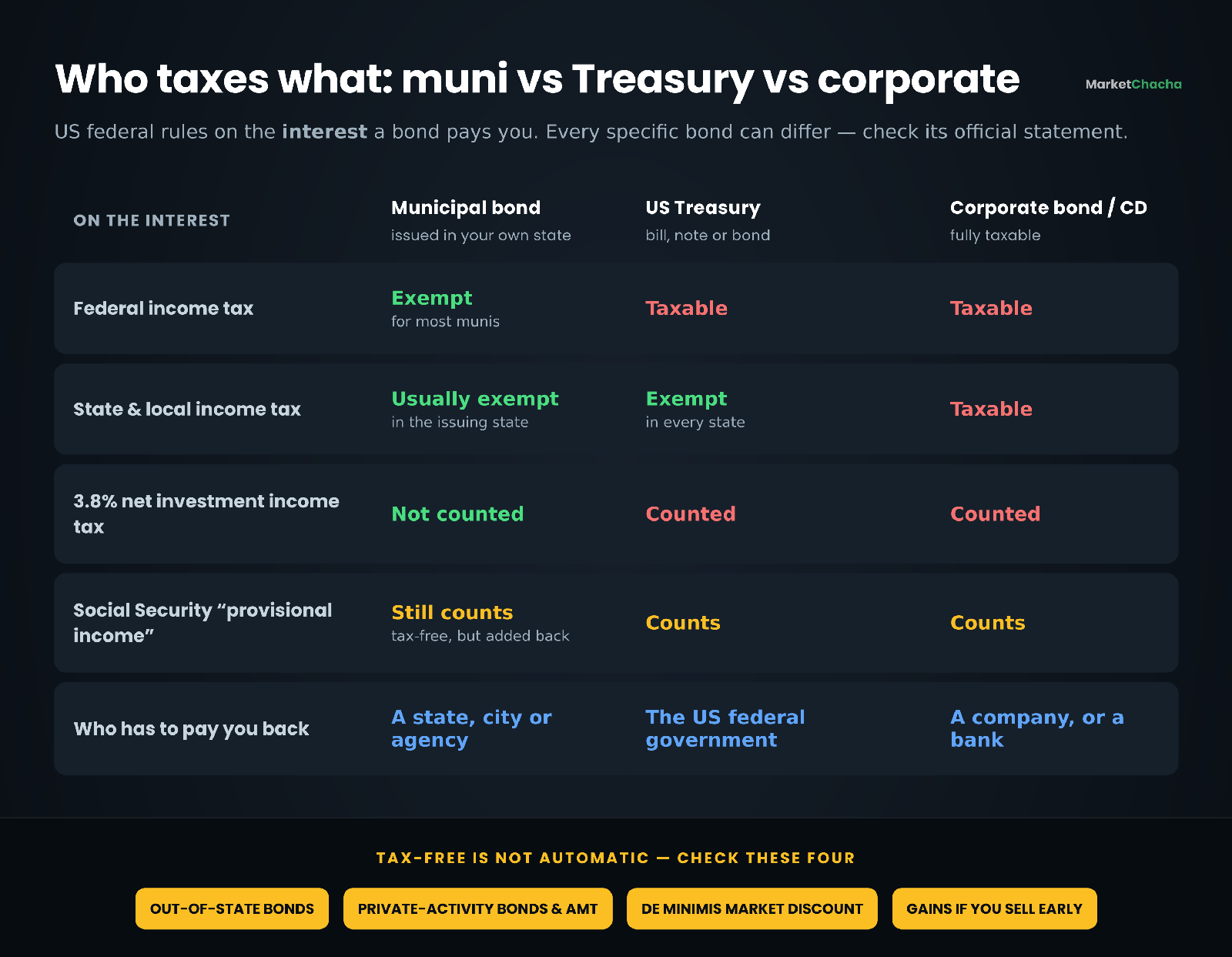
State and local. Your state generally exempts interest on bonds issued within that state, and taxes interest on out-of-state munis. A few states handle this differently, so check your own state's rules rather than assuming.
The 3.8% net investment income tax. Tax-exempt muni interest is not counted as net investment income, so it escapes the 3.8% surtax that applies to taxable interest, dividends and capital gains above the income thresholds.
What is never exempt. The exemption covers the interest, not your profit on the bond. If you sell a muni for more than you paid, that gain is a taxable capital gain like any other.
Tax-equivalent yield: the formula that makes the comparison fair
A tax-free 3.60% and a taxable 4.80% are not comparable numbers: you keep all of the first and only part of the second. Tax-equivalent yield (TEY) converts the tax-free yield into the taxable yield you would need to end up in the same place:
Tax-equivalent yield = tax-free yield ÷ (1 − your marginal tax rate)
Two things people get wrong here. First, use your marginal rate — the rate on your next dollar of income — not your effective rate, because the interest stacks on top of your existing income. Second, this is your federal marginal rate unless you deliberately add state tax (below).
Worked example: does a 3.60% muni beat a 4.80% taxable bond?
Say you are choosing between a muni yielding 3.60% tax-free and a fully taxable corporate bond or CD yielding 4.80%. You invest $10,000 in one of them.
In the 24% federal bracket:
Muni: $10,000 × 3.60% = $360, and you keep all of it.
Taxable: $10,000 × 4.80% = $480, minus 24% tax ($115.20) = $364.80.
The taxable bond wins — by $4.80. Check it with the formula: 3.60% ÷ (1 − 0.24) = 4.74%, which is less than 4.80%.
In the 35% federal bracket:
Muni: still $360.
Taxable: $480 minus 35% tax ($168) = $312.
Now the muni wins by $48 a year. Formula check: 3.60% ÷ (1 − 0.35) = 5.54%, comfortably above 4.80%.
The switchover point is exactly where TEY equals 4.80%, which is a marginal rate of 1 − (3.60 ÷ 4.80) = 25%. Below a 25% marginal rate the taxable bond wins; above it, the muni does. That break-even is not a universal law — it comes from this pair of yields. Change either yield and the break-even moves.
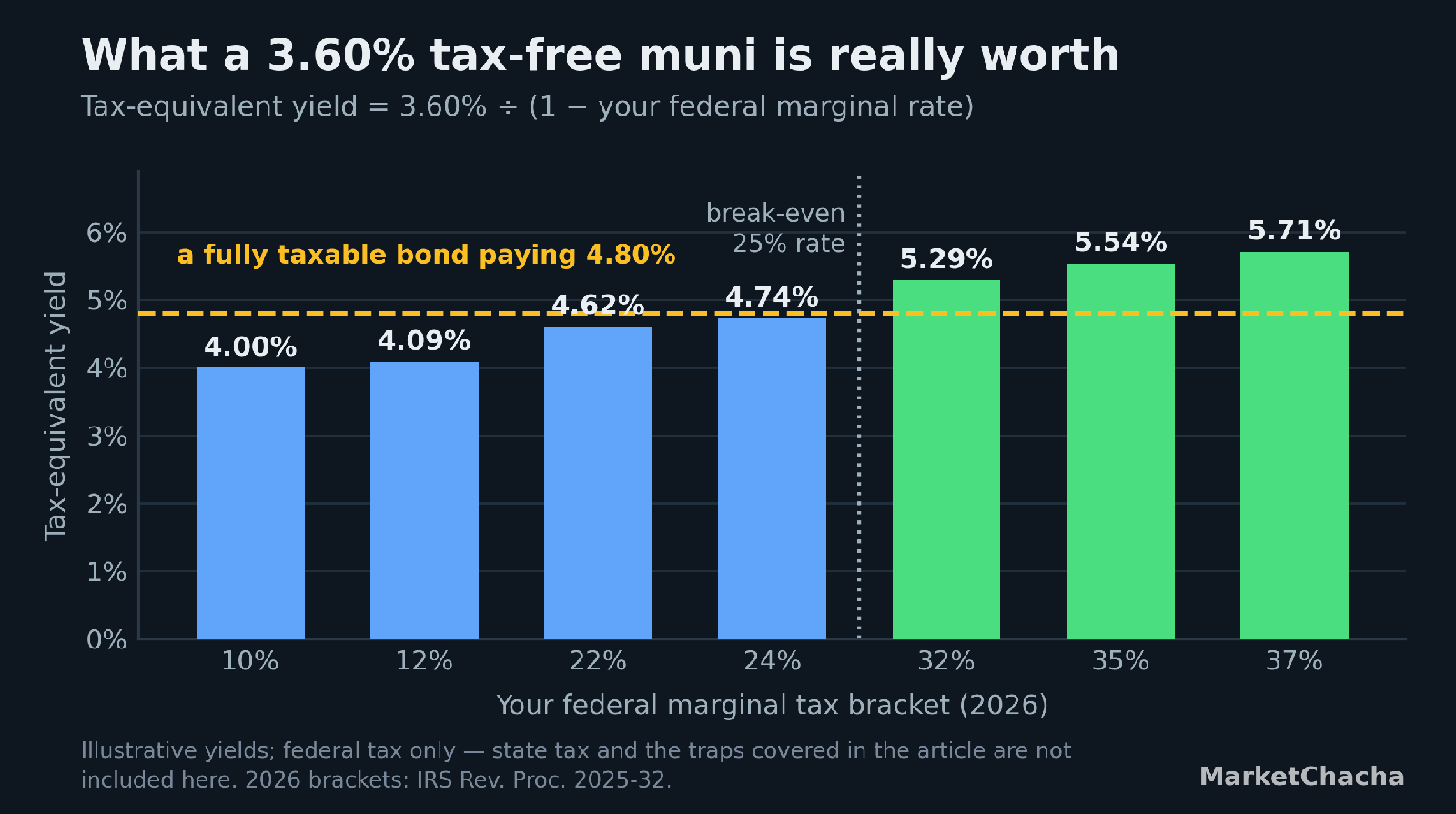
The 2026 federal brackets run 10, 12, 22, 24, 32, 35 and 37 percent (IRS Revenue Procedure 2025-32). With a break-even at 25%, this particular muni is worse for anyone up to the 24% bracket and better from 32% up. That is the general shape of the market: tax-free yields get bid down to a level that mainly rewards high-bracket buyers.
Adding state tax
If the bond was issued in your own state and your state exempts it, you can run the formula against your combined rate. On a 35% federal rate plus an illustrative 5% state rate: 3.60% ÷ (1 − 0.40) = 6.00%. Treat that as an approximation — the simple addition ignores interactions like deducting state tax on a federal return — but it shows why in-state munis are worth hunting for in high-tax states.
How to actually buy a municipal bond
- Decide: individual bonds or a fund. A muni fund or ETF diversifies across hundreds of issuers for a small expense ratio, but has no maturity date, so its price moves with rates indefinitely. An individual bond matures at par on a known date, if you hold it.
- Use a regular taxable brokerage account. Individual munis are bought through a broker, new-issue or secondary. There is no TreasuryDirect-style government portal for munis.
- Read the disclosure. Every muni's official statement, continuing disclosures, ratings and actual past trade prices are free on the MSRB's EMMA site. Look up the exact CUSIP before you buy.
- Check the specifics: maturity, coupon, whether it is callable, whether it is subject to AMT, whether it is a GO or revenue bond, and the rating.
- Compare on tax-equivalent yield, not headline yield — and compare against what a Treasury, CD or corporate bond of similar maturity pays you after tax.
Two structural points: individual munis are typically issued in $5,000 minimum denominations, and dealer compensation is usually built into the price rather than shown as a commission. EMMA's trade history is how you sanity-check a quote.
What it costs you: the catches
- You accept a lower headline yield. That is the trade. If you are not in a high enough bracket, you have simply taken less money.
- The AMT. Interest on certain private activity munis — bonds financing airports, stadiums and similar quasi-commercial projects — is a preference item for the alternative minimum tax. Offering documents flag whether a bond is "AMT" or "AMT-free".
- Social Security and Medicare. Tax-exempt interest is added back when working out the "provisional income" that decides how much of your Social Security benefit is taxable, and it counts toward the income used for Medicare IRMAA surcharges. Tax-free is not invisible.
- The de minimis rule. If you buy a muni in the secondary market at a discount bigger than 0.25% for each remaining full year to maturity, the discount is taxed as ordinary income, not capital gain. On a bond with 10 years left, the threshold price is 100 − (0.25 × 10) = $97.50 per $100 of face value.
- Interest-rate and call risk. Prices fall when rates rise, exactly like any other bond, and a callable muni can be redeemed early by the issuer — usually when rates have fallen and reinvesting is least attractive.
- Credit risk is real but historically small. Moody's, which has tracked municipal defaults since 1970, consistently finds default rates on rated munis far below comparably rated corporates. "Far below" is not "zero" — individual issuers have defaulted.
Common mistakes beginners make
- Comparing a muni yield with a Treasury or CD yield directly. Always convert to tax-equivalent yield first.
- Using an effective tax rate instead of a marginal one. This understates the muni's value, often badly.
- Holding munis inside an IRA or 401(k). Those accounts are already tax-sheltered, so the exemption you paid for — in the form of a lower yield — buys you nothing there.
- Assuming every muni is tax-free everywhere. Out-of-state bonds, AMT bonds and outright taxable munis all exist.
- Reaching for yield. A muni yielding far above its peers is priced that way for a reason. Read the official statement.
How this works in India
India has two different things that both get called "tax-free bonds", and mixing them up is the main source of confusion.
PSU tax-free bonds. Between roughly 2012 and 2016, government-backed entities such as NHAI, REC, PFC, IRFC, HUDCO and NABARD issued bonds whose interest is fully exempt under Section 10(15) of the Income Tax Act, with no TDS. These are the closest Indian cousin of a US muni. No fresh issues have come since then, so the only route in is the secondary market on the NSE or BSE — which means your actual yield depends on the price you pay, not the printed coupon. Interest stays exempt; a capital gain if you sell before maturity does not.
Actual Indian municipal bonds. Civic bodies including Pune, Ahmedabad, Indore, Lucknow and Ghaziabad have issued bonds under SEBI's regulations for municipal debt securities. Unlike the US model, the interest on these is generally taxable at your slab rate unless a specific issue has been notified as tax-free. So the American reflex — "municipal bond, therefore tax-free" — does not transfer.
The tax-equivalent yield formula transfers perfectly, though. Under the new regime for FY 2026-27, the top slab is 30%, and a 4% health and education cess makes the effective top rate 31.2% before any surcharge. An illustrative tax-free bond yielding 5.5% is therefore worth 5.5% ÷ (1 − 0.312) = about 8.0% from a fully taxable alternative such as a bank fixed deposit, whose interest is taxed at slab and subject to TDS. For someone in the 5% slab, the same bond is worth only about 5.8% — the identical bracket logic as in the US.
FAQ
Are municipal bonds really 100% tax-free? No. Interest on most munis is exempt from federal income tax and often from your home state's tax, but private-activity bonds can trigger the AMT, some munis are issued as fully taxable, out-of-state bonds are usually taxed by your state, and any capital gain when you sell is taxable.
How do I calculate the tax-equivalent yield of a municipal bond? Divide the muni's yield by (1 minus your marginal tax rate). A 3.60% muni for someone in the 35% bracket is 3.60% ÷ 0.65 = 5.54%. That is the taxable yield you would need to match it.
Are municipal bonds worth it if I'm in a low tax bracket? Usually not. Muni yields are already discounted to reflect the tax break, so in a low bracket you are accepting a smaller payment for an exemption worth little to you. Work out the break-even rate for the two specific yields in front of you and compare it with your bracket.
Do I have to report tax-exempt interest on my tax return? Yes. The IRS treats it as an information-reporting requirement; reporting it does not make it taxable. It also feeds the Social Security provisional-income and Medicare IRMAA calculations.
Are municipal bonds safer than corporate bonds? Historically, rated municipal bonds have defaulted far less often than comparably rated corporate bonds, per Moody's long-running default studies. That is an average across a huge market, not a guarantee for any single issuer — and munis carry the same interest-rate and call risk as other bonds.
What is the Indian equivalent of a US municipal bond? The closest match on tax treatment is the PSU tax-free bond (NHAI, REC, PFC and others) issued up to about 2016, now only available on the secondary market. India's actual municipal bonds, issued by city corporations under SEBI rules, generally pay taxable interest.
Educational content only — not investment, tax or insurance advice, and not a recommendation of any product or issuer. Rates, yields, fees and tax rules change — always check current terms and current tax law before acting, and confirm any specific bond's treatment in its official statement. Yields used above (3.60%, 4.80%, 5.5%) are illustrative, not quotes. [Sources: IRS Topic 403, IRS Publication 550, SEC Investor.gov: Municipal Bonds, MSRB EMMA, Tax Foundation / IRS Rev. Proc. 2025-32 (2026 brackets), Schwab: municipal bond tax traps, Fidelity: net investment income tax, Moody's: US municipal bond defaults and recoveries, ClearTax: India income tax slabs]. Always do your own research.
This article is for educational and informational purposes only. It is not financial advice, investment recommendation, or a solicitation to buy or sell securities. Investing involves significant risks. I am not a SEBI-registered investment advisor. Readers should consult their own financial advisor and conduct their own research before making any investment decisions.
Comments
Join the conversation
Sign in to join the conversation.
Follow replies, add your view, and take part in the discussion.
Sign in to commentLoading comments...