

What is an emergency fund — how much do you actually need, and where should you keep it?
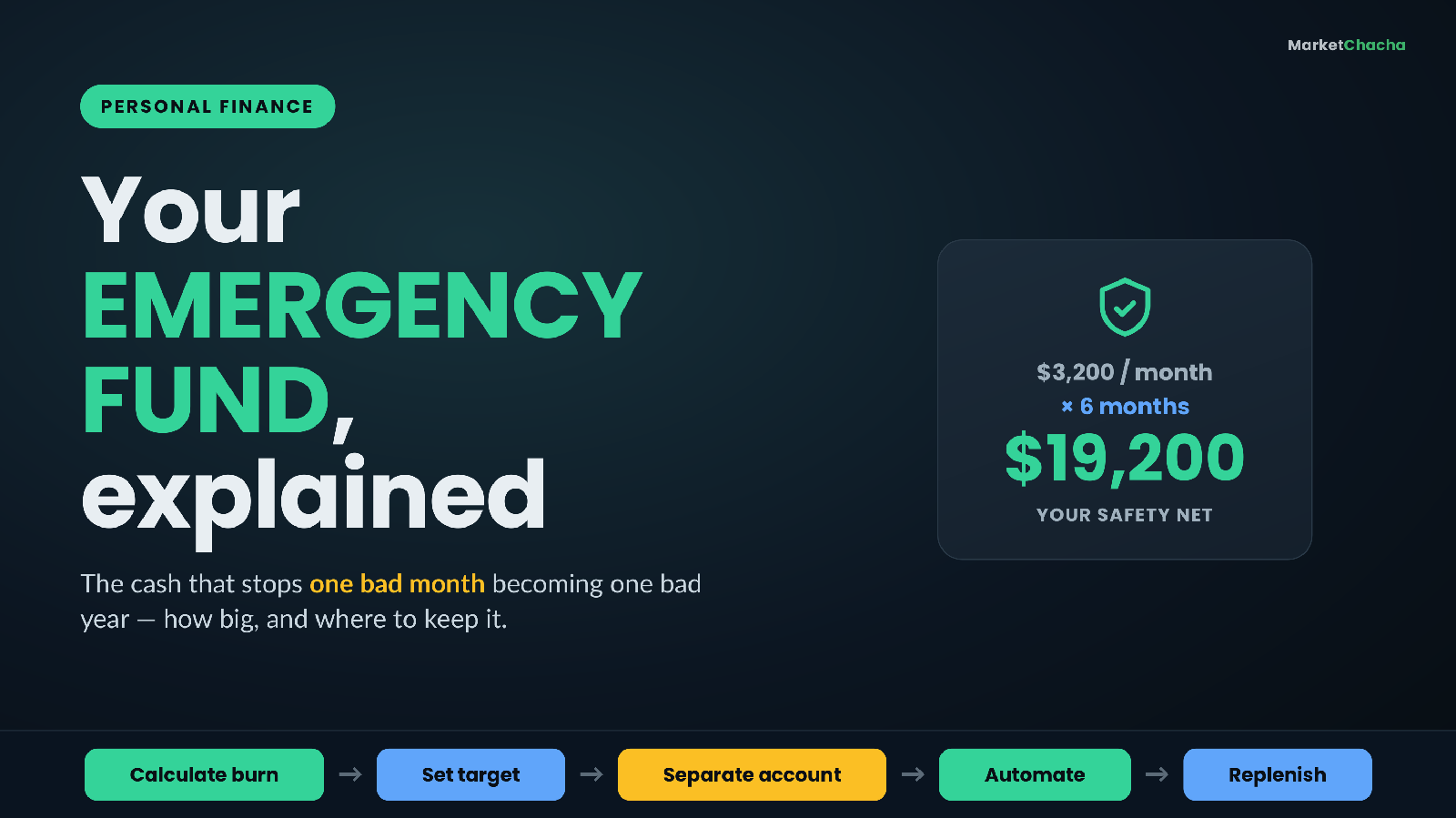
An emergency fund is a stash of cash you keep separate from your everyday money and can reach in a day or two, sized to cover your essential living costs for a few months. Its whole job is to absorb a sudden shock — a job loss, a medical bill, a car that dies, a broken boiler — so that shock doesn't force you into high-interest credit card debt or into selling your investments at the worst possible moment. The benchmark you'll hear everywhere is three to six months of essential expenses, but as you'll see, the right number is personal, and where you keep it matters almost as much as how big it is. This guide walks through what actually counts, the exact maths of sizing one, where to park it so it stays safe and liquid, why you should never invest it, and how the same idea works in India.
What an emergency fund actually is — and what it isn't
An emergency fund is insurance you pay to yourself. It is not an investment, and it is not meant to grow your wealth — it's meant to stop a bad month from turning into a bad year. Three features define it: it's liquid (you can get to it fast, without penalties), it's safe (the balance won't drop when you need it), and it's separate (out of sight of your day-to-day spending so you don't quietly drain it).
It's also not the same as a sinking fund — money you're deliberately saving for a known, planned cost like a holiday, an annual insurance premium, or a new phone. Those are expected; an emergency fund is for the unexpected. And crucially, a credit card is not an emergency fund. A card is a bill that arrives later with interest attached; the fund exists precisely so you never have to reach for that card.
How much do you actually need? The maths
Start from the wrong number that most people use: your total monthly spending. That includes restaurants, subscriptions, and shopping — things you'd cut instantly in a real crisis. What you actually need to cover is your essential monthly burn: rent or mortgage, utilities, groceries, insurance premiums, transport to work, and the minimum payments on any debts. Add those up and ignore the rest.
Worked example. Say your essentials come to $3,200 a month:
- A one-month starter cushion = $3,200
- A three-month fund = 3 × $3,200 = $9,600
- A six-month fund = 6 × $3,200 = $19,200
Notice the target is built on essentials, not your full lifestyle. Someone who spends $5,000 a month but whose essentials are $3,200 needs a fund based on the $3,200 — the fund keeps the lights on and the roof overhead while they sort things out, not the takeaways.
Three months or six (or twelve)? How to choose your number
The 3-to-6-month range is a rule of thumb, not a law. The U.S. Consumer Financial Protection Bureau deliberately avoids a single figure, saying the right amount depends on your situation — and it notes that most people don't even have one month saved. Use these factors to pick your point on the scale:
- Income stability. A tenured salaried worker can lean toward three months; a freelancer, contractor, or commission earner with lumpy income should lean toward six to twelve.
- One income or two. A dual-income household where both jobs would rarely vanish at once can hold less; a single-income household (or the sole earner for a family) should hold more.
- Dependents and fixed obligations. Kids, a mortgage, or anyone relying on you pushes the number up.
- How replaceable your job is. If your skills take months to re-hire in your city, size for that gap, not a fantasy of landing a new role in two weeks.
If you're just starting and the six-month number feels impossible, don't be paralysed. A $1,000-or-one-month starter fund covers the majority of everyday emergencies and is a huge upgrade over zero. Build that first, then grind toward the full target.
Where should you keep it? (Safe, liquid, and actually earning something)
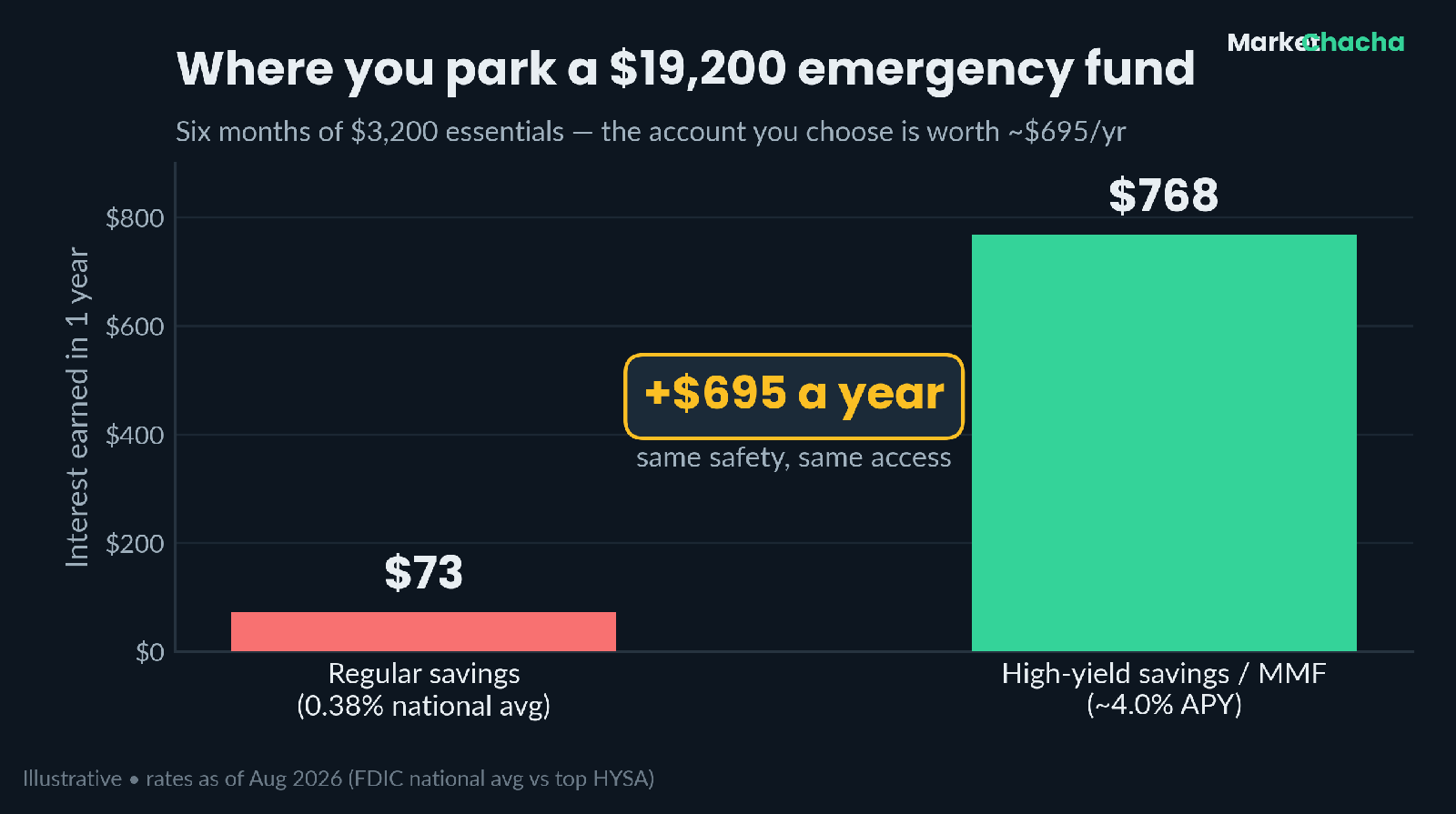
Here's the mistake that quietly costs people hundreds of dollars a year: leaving the fund in a regular checking or savings account. As of August 2026, the FDIC's national average savings rate is about 0.38%, while the best high-yield savings accounts (HYSAs) were paying roughly 4.0%–4.5% APY — more than ten times as much for identical protection. On our $19,200 six-month fund, 0.38% earns about $73 a year; ~4% earns about $768. That's roughly $695 extra a year for money that is just as safe and just as reachable. (Rates move with the Fed and change often — check current terms; the mechanic is what matters, not today's exact number.)
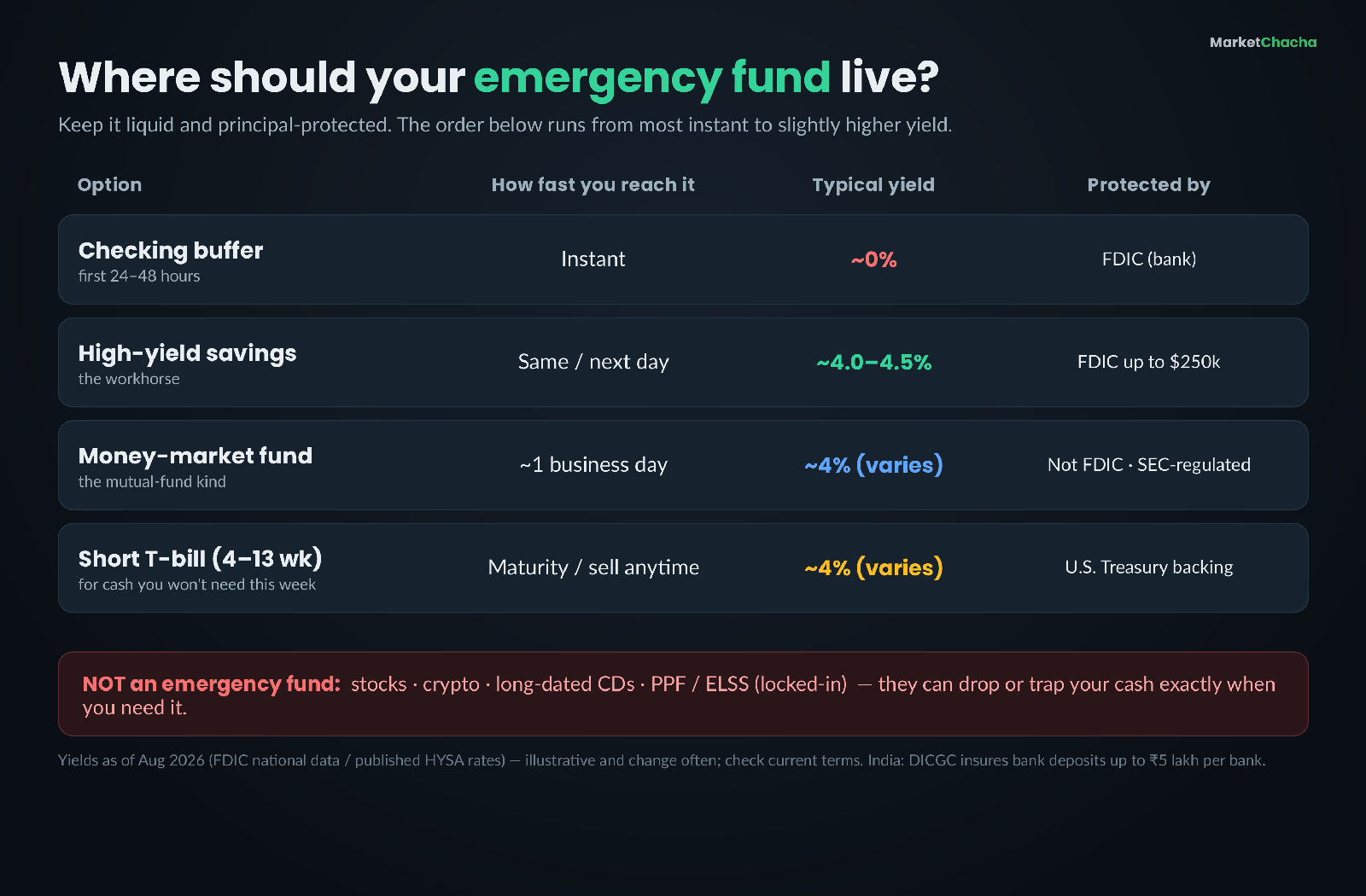
Keep it in something that is liquid and principal-protected. Good homes, roughly in order of how instantly you can reach the cash:
- A small checking buffer for the first 24–48 hours of any emergency.
- A high-yield savings account at an FDIC-insured bank — the workhorse for most of the fund.
- A money-market fund or short Treasury bill for a portion you're unlikely to need this week, to squeeze a little more yield.
One accuracy point beginners miss: FDIC insurance covers bank deposit products — checking, savings, CDs, money-market deposit accounts — up to $250,000 per depositor, per insured bank, per ownership category. It does not cover money-market mutual funds or Treasury bills. Those aren't unsafe — a T-bill is backed by the full faith and credit of the U.S. Treasury and is considered about the safest thing there is — they're just protected by a different mechanism, not by the FDIC. Don't assume the letters "money market" mean FDIC-insured; a bank money-market account is, a money-market mutual fund isn't.
Why you should never invest your emergency fund
It's tempting to think, "cash earns 4% but stocks earn more — why not put the fund in the market?" Because emergencies have terrible timing. Job losses cluster in recessions, and recessions are exactly when the stock market is down. Picture your six-month fund sitting in an index fund that drops 30% in a downturn — right as you get laid off. Now you're forced to sell at a 30% loss to pay rent, possibly triggering a tax bill on top, and locking in a loss you'd otherwise have waited out. The purpose of the fund is certainty: the exact dollars, available the exact day you need them. Chasing an extra couple of percent destroys the one property that makes it work.
How to actually build one, step by step
- 1. Calculate your essential burn. List rent/mortgage, utilities, food, insurance, transport, and minimum debt payments. That monthly total is your building block.
- 2. Set a starter goal first. Aim for $1,000 or one month of essentials before anything else.
- 3. Open a separate high-yield savings account. A different bank from your checking adds useful friction so you won't dip in casually.
- 4. Automate it. Schedule a fixed transfer every payday. Money you never see is money you don't spend.
- 5. Feed it windfalls. Tax refunds, bonuses, and cash gifts accelerate the target painlessly.
- 6. Build to your full number, then stop adding and let the rest of your money go to investing.
- 7. Replenish after any use. If you spend it, refilling the fund becomes your next priority.
The catch: what an emergency fund costs you
Holding several months of expenses in cash has a real price, and it's honest to name it. First, opportunity cost: that money earns ~4% in a HYSA while a diversified stock portfolio has historically earned more over long periods. The gap is the premium you pay for safety and instant access — think of it as an insurance cost, not a loss. Second, inflation: if your fund earns less than prices rise, its purchasing power slowly erodes, which is exactly why a HYSA or money-market fund beats cash under the mattress or a 0.38% account. Third, the high-interest-debt trade-off: if you're carrying credit card debt at around 20%+ APR, most planners suggest building only a small starter fund first, then throwing everything at the debt (see our debt avalanche vs. snowball guide), because guaranteed 20% "returns" from clearing debt beat 4% in savings — while the starter fund still stops you re-borrowing the next time life happens.
Common mistakes beginners make
- Investing it in stocks, crypto, or long-dated bonds — reintroducing exactly the volatility the fund exists to avoid.
- Leaving it in the spending account, where it quietly gets absorbed into normal life.
- Counting a credit card or overdraft as the fund. Available credit is a liability, not savings.
- Locking it away in long CDs, PPF, or anything with penalties or waiting periods — liquidity is the point.
- Over-funding it — sitting on twelve months of cash while carrying 20% debt or never investing — so the money underperforms for years.
- Forgetting to replenish after you use it, leaving yourself exposed for the next shock.
How this works in India
The idea is identical; the wrappers differ. In India, bank deposits are insured by the DICGC (a subsidiary of the RBI) up to ₹5 lakh per depositor, per bank, covering principal and interest together — a limit raised from ₹1 lakh in 2020, with a further increase under discussion as of 2026. Because the cap is per bank, splitting a large fund across two banks widens your cover.
For where to actually keep it, Indians typically use: a sweep-in / flexi fixed deposit, which automatically parks surplus savings into an FD at FD interest rates but breaks in small units the moment you withdraw, so you stay liquid without giving up yield; a liquid or overnight mutual fund, which invests in very short-term debt and often allows instant redemption up to a regulator-capped amount (around ₹50,000 per day per scheme), with the rest settling the next working day; or a plain savings account for the first slice you might need instantly. Note that liquid funds are market instruments, not DICGC-insured — their risk is very low but not zero. The classic Indian mistake is parking the emergency fund in equity, ELSS, or a locked-in PPF: PPF has a 15-year lock and ELSS a 3-year lock, so neither is reachable in a real emergency. Keep the safety money boring and liquid; let PPF, NPS, and equity do the long-term wealth-building.
FAQ
How much should I have in my emergency fund? Three to six months of your essential monthly expenses is the common benchmark. Lean toward three months if you have stable income and two earners, and toward six-plus if your income is variable, you're the sole earner, or you have dependents. If you're starting from zero, a $1,000 or one-month starter fund comes first.
Where is the best place to keep an emergency fund? Somewhere liquid and principal-protected — most often a high-yield savings account at an insured bank, optionally with a slice in a money-market fund or short Treasury bill for a little extra yield. Avoid anything with penalties, lock-ins, or price swings.
Should I invest my emergency fund to earn more? No. Emergencies tend to strike when markets are down, which could force you to sell at a loss exactly when you need the cash. The fund's value is certainty, not growth — keep it in cash-like accounts.
Emergency fund or pay off debt first? Usually both, in order: build a small starter fund (about $1,000 or one month) so you stop re-borrowing, then aggressively clear high-interest debt like credit cards, then finish building the full fund. Clearing 20%+ APR debt beats the ~4% a savings account pays.
Is a high-yield savings account safe for my emergency fund? Yes — at an FDIC-insured U.S. bank (or a DICGC-covered Indian bank) your deposits are protected up to the coverage limit, and the balance doesn't move with the market. It's one of the safest places to keep cash you may need on short notice.
What actually counts as an emergency? A genuine, urgent, unexpected cost you can't cover from normal income — job loss, an essential medical bill, a critical car or home repair. A sale, a holiday, or a planned purchase is not an emergency; save for those separately.
Educational content only — not investment, tax or insurance advice, and not a recommendation of any product. Rates, fees and rules change — always check current terms with the provider. [Sources: FDIC — Deposit Insurance, U.S. Consumer Financial Protection Bureau, DICGC — Guide to Deposit Insurance.] Always do your own research.
This article is for educational and informational purposes only. It is not financial advice, investment recommendation, or a solicitation to buy or sell securities. Investing involves significant risks. I am not a SEBI-registered investment advisor. Readers should consult their own financial advisor and conduct their own research before making any investment decisions.
Comments
Join the conversation
Sign in to join the conversation.
Follow replies, add your view, and take part in the discussion.
Sign in to commentLoading comments...