

Is a credit card annual fee actually worth it? The break-even math, step by step

A credit card annual fee is worth paying only when the extra value the card gives you — extra rewards, plus credits and perks you would genuinely have paid for anyway — comes to more than the fee itself. The word doing all the work there is extra. Extra compared to what? Compared to a no-fee card you could have carried instead. Almost everyone who gets this decision wrong makes the same mistake: they add up all the rewards the fee card earned, see a number bigger than the fee, and conclude they came out ahead. But a free card would have earned rewards on that same spending too. The only honest question is how much more the fee card earned.
This guide walks through the arithmetic step by step: how to set your baseline, how to count credits honestly, a full worked example with the numbers, how to audit your own card, and how the same logic maps onto Indian credit cards at the end.
What an annual fee actually buys
An annual fee is a flat charge an issuer bills you, usually once every twelve months, for holding the card. It is not interest, it has nothing to do with your APR, and you pay it whether you spend $50 or $50,000 on the card. In exchange, issuers typically offer some combination of a higher rewards rate (often in specific categories), statement credits tied to particular merchants or categories, and access perks such as lounges, insurance cover or elevated status.
Annual fees are a minority feature, and increasingly a top-of-market one. In the CFPB's Consumer Credit Card Market Report published December 2025 (using 2024 data), the share of cardholders paying an annual fee has drifted down over the past decade from roughly 18% to 16% — but among the highest-scoring "superprime" cardholders it rose from about 14% to nearly 20%, and issuers' annual fee revenue tripled over the same decade. Fewer people pay a fee; the ones who do pay a bigger one. That is exactly why the maths matters.
Set your baseline first: the free card you could have carried
Before you can measure "extra", you need something to measure against. Your baseline is the best no-annual-fee card you could realistically hold on the same spending. In the US market, flat-rate cash-back cards with no annual fee are common and easy to use as a yardstick — CNBC Select reported, for example, on a no-annual-fee card paying unlimited 2% cash rewards on purchases. Terms on any specific card change, so treat that as an illustration of what the category offers, not a recommendation, and check current terms yourself.
A sensible baseline for most people is somewhere between 1.5% and 2% flat on everything, at a $0 fee. Once you fix that number, every comparison becomes simple.
The break-even formula
Here is the whole thing in one line:
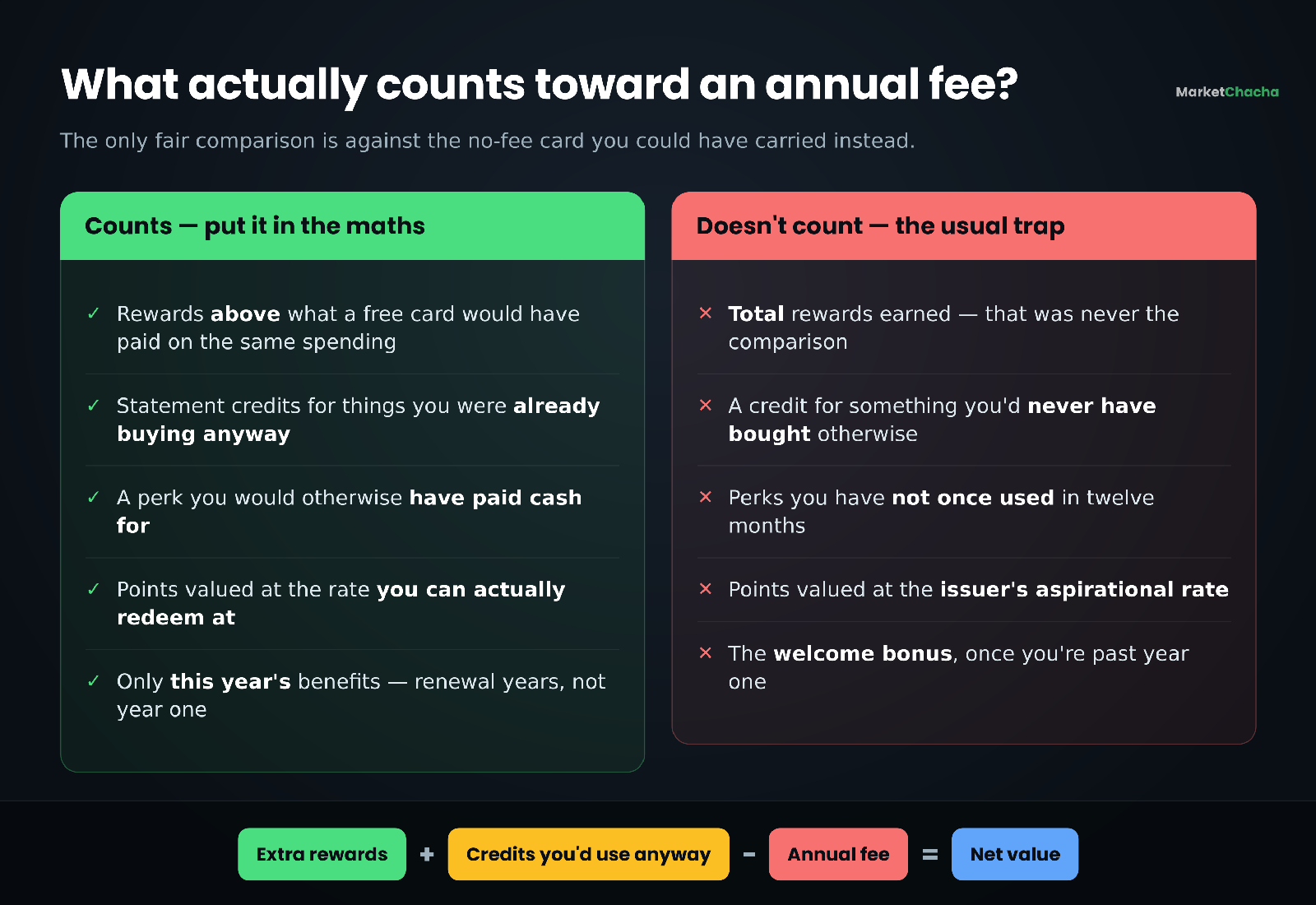
Net value = (Rewards on the fee card − Rewards the baseline card would have paid) + Credits and perks you'd have bought anyway − Annual fee
If that number is positive, the fee is earning its keep. If it is negative, you are paying for the privilege of earning fewer rewards. And the break-even is simply the amount of bonus-category spending at which the number hits exactly zero.
A worked example, line by line
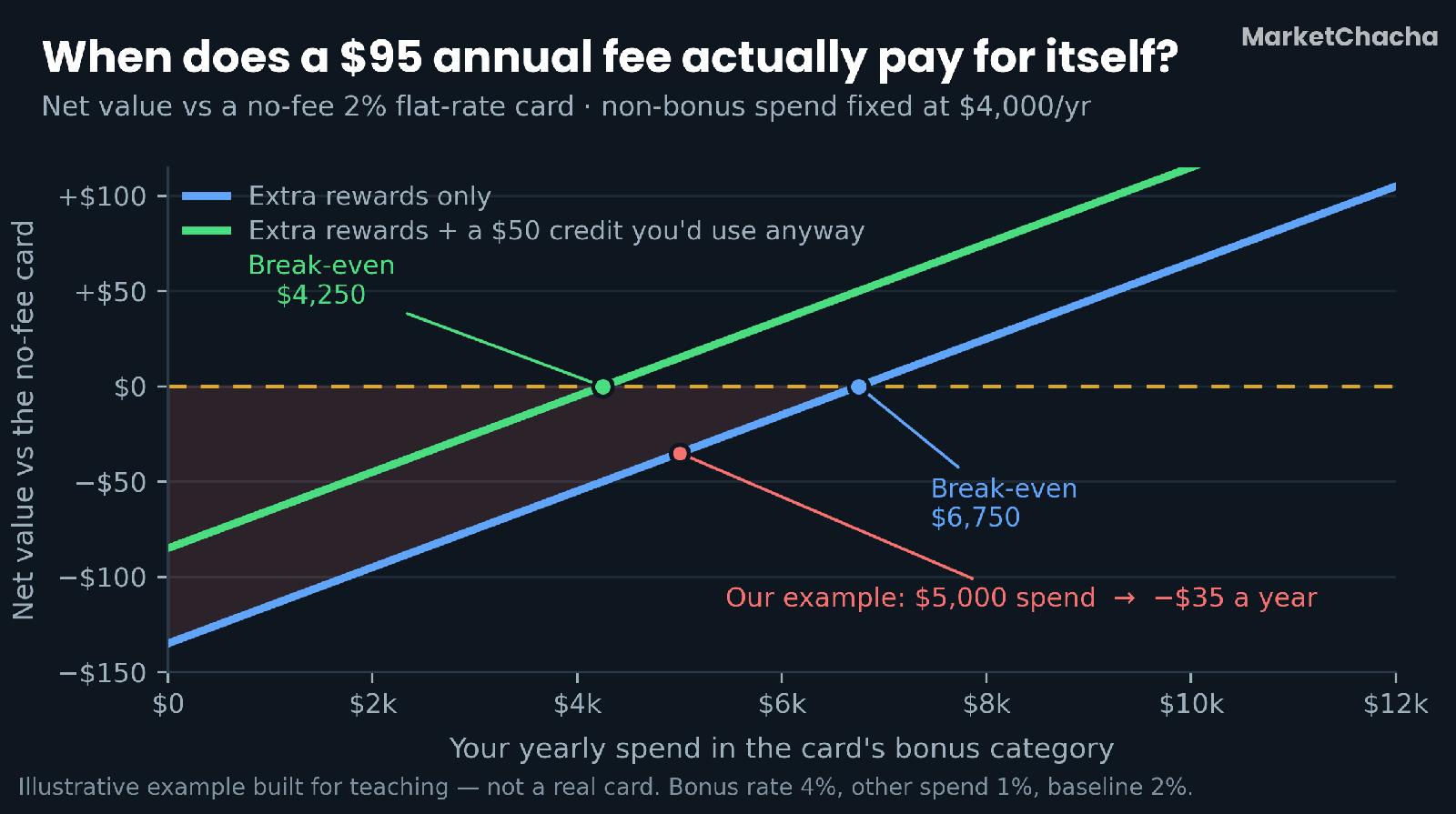
Take an illustrative card — not a real product, built purely so you can follow the arithmetic. It charges a $95 annual fee, pays 4% on dining and groceries and 1% on everything else. Your baseline is a $0-fee card paying a flat 2%. Say you spend $9,000 a year: $5,000 on dining and groceries, $4,000 on everything else.
- Baseline card: $9,000 × 2% = $180 in rewards. Fee: $0. Net: $180.
- Fee card: ($5,000 × 4%) + ($4,000 × 1%) = $200 + $40 = $240 in rewards.
- Extra rewards: $240 − $180 = $60.
- Minus the fee: $60 − $95 = −$35.
The fee card earned $240 and the fee was only $95, so it "looks" like a $145 win. It is not. Against the free card you could have held, you are $35 a year worse off. That $240 headline number is the single most misleading figure in this entire decision.
Now solve for break-even. Holding the $4,000 of non-bonus spending fixed (where the fee card actually loses you $40 a year, because 1% is worse than 2%), you need your dining-and-grocery spend D to satisfy: D × (4% − 2%) − $40 − $95 = 0. That gives D × 0.02 = $135, so D = $6,750 a year — about $562 a month on dining and groceries, every month, just to draw level. Below that, the fee card loses.
Credits and perks: count only what you'd have bought anyway
Statement credits are where most people's maths quietly falls apart. A credit is worth its face value only if it reimburses something you were already going to buy. If a card hands you a $50 credit for a service you'd never have subscribed to, spending $50 to reclaim $50 leaves you exactly where you started — the credit is worth $0, not $50.
Applied honestly, though, credits move the answer a lot. Add a $50 credit you genuinely use to the example above and the sum becomes $60 − $95 + $50 = +$15, and break-even drops from $6,750 to $4,250 of bonus spend. That is the second line on the chart above: the same card can be a bad deal or a good one depending on one honest judgement about your own behaviour.
The same discipline applies to points. Value them at what you actually redeem for — if you cash out at one cent per point, that is your rate, not the aspirational figure in a blog post about business-class flights.
How to actually do it: audit your own card in 20 minutes
- 1. Pull twelve months of statements and total your spending by category. Do not estimate — people badly misjudge their own category mix.
- 2. Pick your baseline: a no-fee card at 1.5% or 2% flat. Multiply your total annual spend by that rate. That is the number to beat.
- 3. Add up what the fee card actually paid you over those twelve months, at your real redemption rate.
- 4. Subtract the baseline from it. That difference is your extra rewards.
- 5. Add credits you genuinely used for things you'd have bought regardless — and honestly write $0 next to the ones you didn't.
- 6. Subtract the annual fee. That is your net.
- 7. Ignore the welcome bonus unless you are still in year one. A sign-up bonus is a one-off; the renewal decision is about years two, three and four.
What it costs you: the catch
The fee is charged whether you use the card or not. A card sitting in a drawer still bills you every twelve months. This is the most common way people lose money on annual fees — not by choosing badly, but by choosing once and never revisiting.
The benefits can change; the fee is contractual. The CFPB's May 2024 rewards issue spotlight found that "many of the largest credit card issuers reserved the right to change their rewards program at any time, for any reason, and in many cases without notice", and documented devaluations where the points needed for a redemption simply rise. The CFPB received over 1,200 rewards-related complaints in 2023, more than 70% above pre-pandemic levels. The value you bought is not guaranteed to stay bought.
You do get warning if the fee itself rises. Under Regulation Z, an increase in an annual fee is a "significant change in account terms", and the issuer must send written notice at least 45 days before it takes effect, telling you how to reject the change (12 CFR §1026.9(c)(2)). Separately, §1026.52(a)(1) caps the total fees you can be required to pay in the first year after opening at 25% of your initial credit limit (late, over-limit and returned-payment fees are excluded from that cap).
Refunds on cancellation are issuer policy, not federal law. Some issuers refund the fee in full if you close or downgrade within a window after it posts; others prorate; others refund nothing. There is no single national rule, so read your cardholder agreement rather than assuming.
And if you carry a balance, none of this matters much. The CFPB reported an average APR of 25.2% on general-purpose cards in 2024, the highest since 2015 — and roughly half of cardholders carry a balance in a given year. To be precise about who that applies to: if you pay in full every month, your APR is irrelevant to you and rewards are real income. If you revolve, interest at that rate will swamp any rewards rate on the market, and optimising an annual fee is the wrong problem to be solving.
Common mistakes beginners make
- Comparing the fee to total rewards instead of to the extra over a free card. This is the big one.
- Counting the welcome bonus every year. You get it once.
- Valuing points at someone else's redemption rate rather than the one you actually use.
- Counting credits for things you'd never buy. A credit that forces new spending is not free money.
- Chasing a bonus category you don't spend in. A 5% category on 3% of your spending changes almost nothing.
- Setting and forgetting. Your spending changes; the card's benefits change; re-run the numbers each renewal.
- Cancelling on autopilot. Closing the account removes that card's limit from your total available credit, which mechanically raises your credit-utilisation ratio. Asking whether the issuer will "product change" you to a no-fee card in the same family often keeps the account, and its history, alive — availability is issuer-dependent.
How this works in India
The arithmetic is identical; only the vocabulary and the rules change. Indian issuers usually charge a joining fee in year one and a renewal fee each year after. Your baseline is the same idea: the best genuinely lifetime-free card you could hold on the same spending.
A rupee version of the sum: suppose a card charges a ₹1,000 renewal fee and pays 5% on online spends where your free card pays 1%. The gap is 4 percentage points, so break-even is ₹1,000 ÷ 0.04 = ₹25,000 of online spending a year. Below roughly ₹2,100 a month online, the fee card is behind. (Illustrative rates, for the method only.)
The distinctly Indian wrinkle is the spend-based fee reversal: many issuers waive or refund the renewal fee once your annual spends cross a stated threshold. If you would comfortably cross that threshold anyway, your effective fee is zero and the decision becomes easy. If you would have to stretch your spending to reach it, you are spending real money to save a fee — which is the same trap as an unusable statement credit, in a different costume.
The RBI's Credit Card and Debit Card — Issuance and Conduct Directions, 2022 give you concrete rights here. Joining fees and annual membership fees for both primary and add-on cards must be disclosed in the Most Important Terms and Conditions (para 30(a)) — that MITC document, not the marketing page, is where you check the real fee and any waiver condition. Issuers "shall not levy any charge that was not explicitly indicated to the cardholder at the time of issue of the card and without getting his/her explicit consent" (para 24(c)), and changes in charges may be made "only with prospective effect giving prior notice of at least one month" (para 9(b)(vi)). Unsolicited upgrades are prohibited outright, with a penalty of twice the value of the charges reversed (para 6(a)(iv)).
And if you decide the fee isn't worth it, closure is time-bound: a request to close a credit card "shall be honoured within seven working days", subject to clearing dues, with a penalty of ₹500 per day of delay payable to you if the issuer drags its feet (para 8(a)).
FAQ
Is a credit card annual fee ever worth it? Yes — when the extra rewards over a no-fee card, plus credits and perks you'd have paid for anyway, exceed the fee. That is entirely a function of your own spending pattern, not of how good the card looks.
How do I calculate the break-even on an annual fee? Divide the annual fee by the difference in reward rates between the fee card and your no-fee baseline, then adjust for any spending where the fee card pays less than the baseline. In the worked example above, a $95 fee with a 2-point rate advantage and a $40 drag elsewhere breaks even at $6,750 of bonus-category spending a year.
Should I count the sign-up bonus when deciding whether to keep a card? No. The welcome bonus is a one-time payment that belongs to year one only. The renewal decision should be judged purely on the ongoing rewards, credits and perks you will actually use in the coming year.
Can I get my annual fee refunded if I cancel the card? Sometimes, but it is issuer policy rather than federal law in the US. Some issuers refund in full within a window after the fee posts, some prorate, some refund nothing — check your cardholder agreement or ask the issuer directly before you close anything.
What happens if my issuer raises the annual fee? In the US, Regulation Z treats an annual fee increase as a significant change in account terms, so the issuer must give you written notice at least 45 days before it takes effect and explain how to reject it (12 CFR §1026.9(c)(2)). In India, the RBI directions require at least one month's prior notice and only prospective effect.
Does an annual fee card make sense if I carry a balance? Generally no. With an average general-purpose APR of 25.2% in 2024 per the CFPB, interest costs dwarf any rewards rate available. If you revolve a balance, paying that down is the higher-value problem; the annual fee question can wait.
Educational content only — not investment, tax or insurance advice, and not a recommendation of any product. Rates, fees and rules change — always check current terms with the provider. All card figures used in the worked examples are clearly labelled illustrations, not real products. [Sources: CFPB Consumer Credit Card Market Report 2025, CFPB Credit Card Rewards Issue Spotlight (May 2024), 12 CFR §1026.9, 12 CFR §1026.52, RBI Credit Card and Debit Card — Issuance and Conduct Directions, 2022, CNBC Select] Always do your own research.
This article is for educational and informational purposes only. It is not financial advice, investment recommendation, or a solicitation to buy or sell securities. Investing involves significant risks. I am not a SEBI-registered investment advisor. Readers should consult their own financial advisor and conduct their own research before making any investment decisions.
Comments
Join the conversation
Sign in to join the conversation.
Follow replies, add your view, and take part in the discussion.
Sign in to commentLoading comments...