

If I move into a higher tax bracket, do I take home less? Marginal vs effective tax rate explained
Your marginal tax rate is the rate charged on your last dollar of income; your effective tax rate is the total tax you pay divided by your total income. They are almost never the same number, and mixing them up is behind the most common tax myth in the world — the fear that earning a bit more, or "crossing into the next bracket," can leave you with less money in your pocket. It can't. This guide explains exactly why, with a full worked example using the official 2026 US federal brackets, the arithmetic of a pay raise, and a closing section on how the identical logic works in India.

Marginal vs effective rate: the one-sentence difference
A progressive income tax doesn't tax your whole income at one rate. It slices your income into bands (called brackets) and taxes each band at its own rate. The marginal rate is the rate on the top band your income reaches — the tax on your next dollar earned. The effective rate (also called your average rate) is what you actually pay overall: your total tax bill divided by your income. Because the lower bands are always taxed at their lower rates, your effective rate is always lower than your marginal rate. If someone says "I'm in the 22% bracket," that is their marginal rate — it does not mean 22% of everything they earn goes to tax.
How the brackets actually stack — a worked example
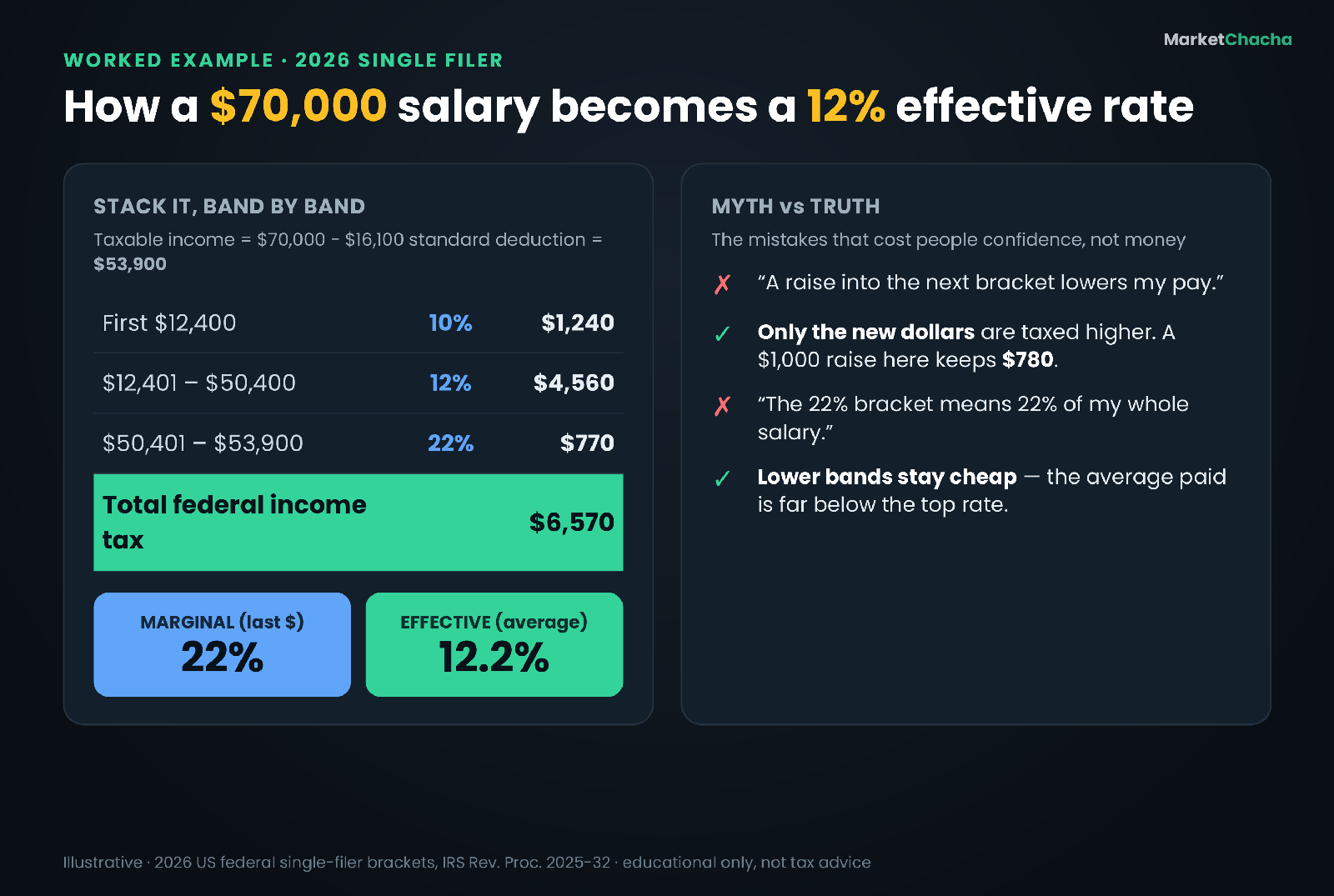
Let's use a single filer in the 2026 US tax year (the return filed in early 2027). Say you earn a $70,000 salary. First, you subtract the standard deduction, which is $16,100 for a single filer in 2026 (per the IRS). That leaves $53,900 of taxable income — and this is a key point many beginners miss: brackets apply to taxable income after deductions, not to your gross salary.
Now stack that $53,900 through the 2026 single-filer brackets, one band at a time:
- 10% on the first $12,400 = $1,240
- 12% on the next band ($12,401 up to $50,400 — that's $38,000) = $4,560
- 22% on the remainder ($50,401 up to $53,900 — that's $3,500) = $770
Total federal income tax = $1,240 + $4,560 + $770 = $6,570. So this person's marginal rate is 22% (the rate on their last dollar), but their effective rate is $6,570 ÷ $53,900 = 12.2% of taxable income — or just 9.4% measured against the full $70,000 salary. The gap between "I'm in the 22% bracket" and "I actually pay about 9-12%" is the whole point of this article.
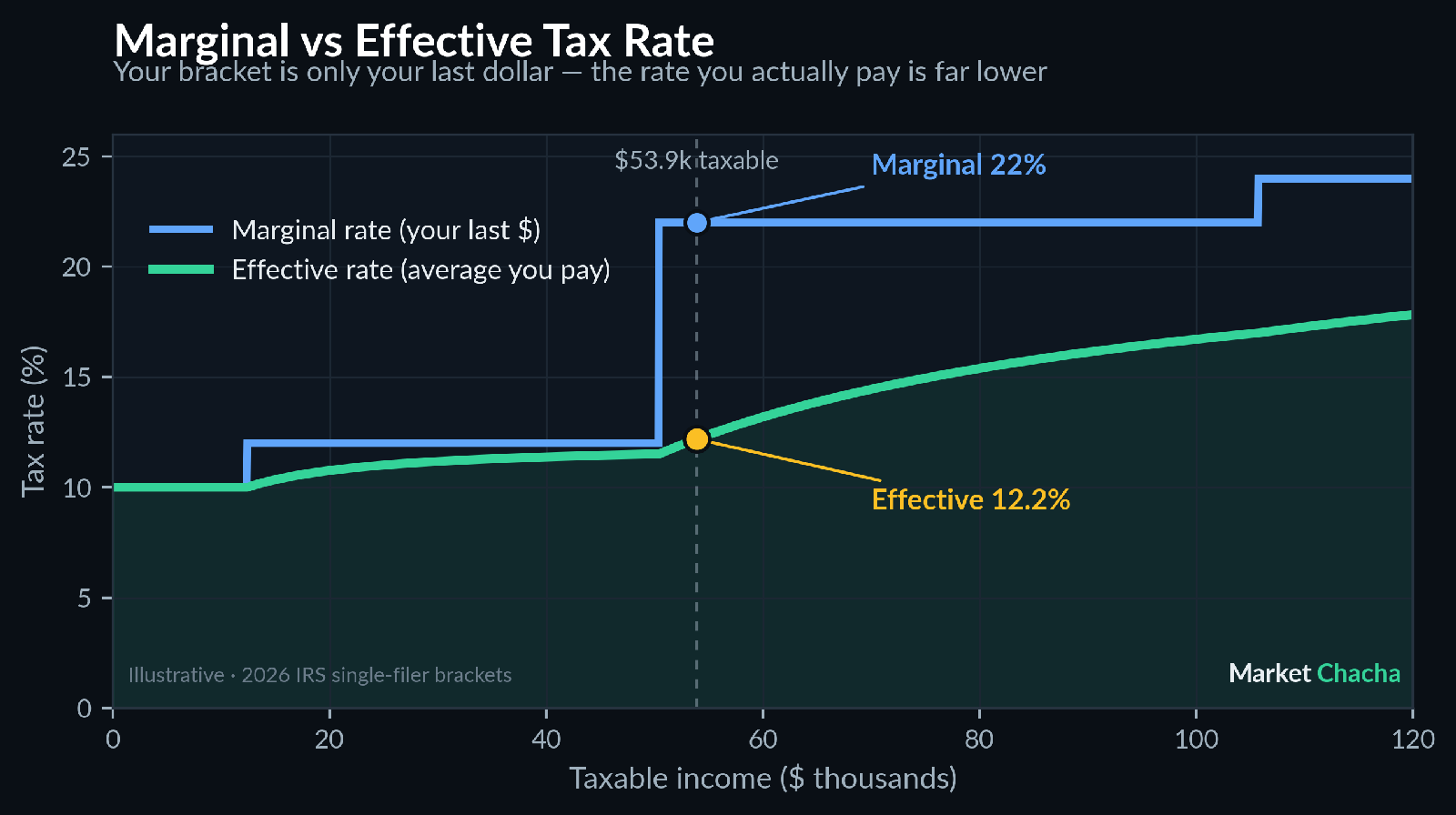
"Will a raise push me into a higher bracket and cost me money?" — the big myth
This is the fear that will not die: "If my raise bumps me into the next bracket, I'll take home less." It is mathematically impossible under a bracket system, because only the dollars inside the higher band are taxed at the higher rate — not your whole income.
Take the same single filer sitting with taxable income of exactly $50,400 (the very top of the 12% band). Their tax is $1,240 + $4,560 = $5,800. Now they get a $1,000 raise, lifting taxable income to $51,400. Only that new $1,000 crosses into the 22% band, so the extra tax is $1,000 × 22% = $220. Their new total tax is $6,020 — and their take-home rose by $1,000 − $220 = $780. Their marginal rate jumped from 12% to 22%, but their effective rate barely moved, and they are unambiguously better off. A raise into a higher bracket always increases your take-home pay. The higher rate never reaches back and re-taxes the money you already earned.
Why the effective rate is the number that actually matters
When you compare your real tax burden year to year, or against someone else, the marginal rate is misleading — it only describes your last dollar. The effective rate tells you the true share of your income going to tax, which is what matters for budgeting, comparing job offers, or judging whether a deduction is worth chasing. A useful habit: use your marginal rate for decisions about the next dollar (Is this overtime worth it? How much does a $1,000 retirement contribution save me?), and your effective rate to understand your overall burden.
What pulls your effective rate below your marginal rate
Two forces keep the effective rate down. First, the bracket structure itself — the lower bands are always taxed at their lower rates, so a big chunk of your income is taxed cheaply no matter how high you climb. Second, deductions and credits, which are not the same thing. A deduction (like the standard deduction) reduces the income that gets taxed, so it saves you money at your marginal rate. A credit reduces your tax bill dollar-for-dollar, which is far more powerful. Both lower your effective rate, but through different doors. This is also why two people with identical salaries can have very different effective rates.
Common mistakes beginners make
- Thinking the whole salary is taxed at the top rate. "I'm in the 22% bracket so I lose 22% of everything" — no; only the slice inside that band is.
- Turning down a raise or overtime to "avoid the next bracket." There is no cliff in ordinary brackets — you always keep most of the extra dollar.
- Applying brackets to gross salary. Brackets apply to taxable income, after subtracting deductions.
- Confusing your tax bracket with your refund. Your refund is just the difference between what was withheld and what you owed — it says nothing about your rate.
- Forgetting payroll taxes. In the US, Social Security and Medicare (FICA) are separate from income tax, so your total take-home hit is higher than the income-tax effective rate alone.
How to find your own marginal and effective rate — step by step
You can do this in five minutes with last year's tax return:
- Step 1 — find taxable income. Start with gross income, subtract the standard deduction (or your itemized deductions) and any above-the-line adjustments. This is your taxable income.
- Step 2 — find your marginal rate. Look up which bracket that taxable income lands in for your filing status. That top rate is your marginal rate.
- Step 3 — find your total tax. This is the tax-liability figure on your return.
- Step 4 — divide. Effective rate = total tax ÷ income. Divide by taxable income to see your rate within the tax system, or by gross income to see the share of your paycheck.
- Step 5 — sanity-check. Your effective rate should come out below your marginal rate. If it doesn't, you've mixed up a number somewhere.
The catch: where a rate threshold really does bite
Ordinary brackets never create a cliff, but some things nearby do — and this is where the honest nuance lives. Certain credits, subsidies and phase-outs can shrink or disappear once your income crosses a specific line, which can create a small "cliff" effect that ordinary brackets never do (for example, losing eligibility for an income-tested benefit). Separately, the scary-sounding top rate of 37% applies only to taxable income above roughly $640,600 for a single filer in 2026 — and even then, only to the dollars above that line, not the whole income. A headline top rate is never anyone's effective rate. And remember three things ride alongside federal income tax: state income tax (varies widely, and some states have none), payroll taxes, and — for investors — long-term capital gains, which are stacked on top of your ordinary income and taxed on their own 0%/15%/20% schedule.
How this works in India
The Indian system is progressive in exactly the same way, so the marginal-vs-effective distinction is identical. Under the new tax regime for FY 2025-26 (AY 2026-27), income is sliced into slabs: nil up to ₹4 lakh, 5% from ₹4-8 lakh, 10% from ₹8-12 lakh, 15% from ₹12-16 lakh, 20% from ₹16-20 lakh, 25% from ₹20-24 lakh, and 30% above ₹24 lakh. Just like the US, each slab rate applies only to the income within that slab — your "30% slab" is a marginal rate, not a rate on your whole income.
India adds one twist worth understanding: the Section 87A rebate. Under the new regime, a rebate of up to ₹60,000 makes taxable income up to ₹12 lakh effectively tax-free (and with the ₹75,000 standard deduction for salaried people, a salary up to about ₹12.75 lakh can pay zero tax). This does create a genuine edge effect near ₹12 lakh — which is exactly why the law provides marginal relief, capping the tax so that earning slightly above ₹12 lakh never costs you more than the extra income itself. Under the old regime, the 87A rebate instead makes income up to ₹5 lakh tax-free, with slabs of nil to ₹2.5 lakh, 5% to ₹5 lakh, 20% to ₹10 lakh and 30% above. In both regimes, your effective rate stays well below your top slab — the same lesson as the US example.
FAQ
What is the difference between marginal and effective tax rate? Your marginal rate is the rate on your last dollar of income (the top bracket you reach). Your effective rate is your total tax divided by your income — the true average share you pay. The effective rate is always lower.
Does moving into a higher tax bracket mean I take home less money? No. Only the income inside the higher bracket is taxed at the higher rate; the rest keeps its lower rates. A raise into a higher bracket always increases your take-home pay.
Is my whole salary taxed at my tax bracket's rate? No. Brackets are applied band by band, and only to your taxable income after deductions. Being "in the 22% bracket" means your top dollar is taxed at 22%, while your overall effective rate is typically far lower.
How do I calculate my effective tax rate? Divide your total tax by your income. Use taxable income to see your rate within the tax system, or gross income to see the share of your paycheck going to income tax.
Why is my effective rate lower than my bracket? Because the first bands of your income are taxed at the lowest rates (10%, 12%, and so on), and deductions shrink your taxable income before the brackets even apply.
Are payroll and state taxes included in these brackets? No. The federal income-tax brackets are only part of the picture. Payroll taxes (Social Security and Medicare) and any state income tax are charged separately, so your total take-home hit is larger than the federal effective rate alone.
Educational content only — not investment, tax or insurance advice, and not a recommendation of any product. Tax rates, brackets and rules change every year and vary by filing status and jurisdiction — always check current figures with the provider or a qualified tax professional. Figures are for the US 2026 tax year (IRS Revenue Procedure 2025-32) and India FY 2025-26. [Sources: IRS, Tax Foundation, Income Tax Department, India] Always do your own research.
This article is for educational and informational purposes only. It is not financial advice, investment recommendation, or a solicitation to buy or sell securities. Investing involves significant risks. I am not a SEBI-registered investment advisor. Readers should consult their own financial advisor and conduct their own research before making any investment decisions.
Comments
Join the conversation
Sign in to join the conversation.
Follow replies, add your view, and take part in the discussion.
Sign in to commentLoading comments...