

How does a Health Savings Account (HSA) work? The triple tax advantage explained

A Health Savings Account (HSA) is a tax-advantaged account you can open only if you have a qualifying high-deductible health plan (HDHP), and it is the single most tax-efficient account in the US system. It carries a "triple tax advantage": the money goes in tax-free, grows tax-free, and comes out tax-free when you spend it on medical care. No other account — not a 401(k), not a Roth IRA — gets all three at once. This guide explains exactly how each of those three tax breaks works, walks through the arithmetic with a worked example, shows why an HSA can quietly become one of the best retirement accounts you own, tells you how to open and use one, covers the catches, and ends with what an Indian reader can do instead.
What is an HSA, and what does "triple tax advantage" actually mean?
An HSA is a personal savings account earmarked for health costs. You own it, it is not tied to your employer, and unused money never expires — it rolls over year after year and follows you if you change jobs. The "triple tax advantage" is three separate tax breaks stacked on the same dollar:
- Tax-free in. Contributions are deductible from your income (or taken pre-tax straight from your paycheck), so you never pay income tax on that money.
- Tax-free growth. Interest, dividends and investment gains inside the account are never taxed while they compound.
- Tax-free out. Withdrawals are completely tax-free as long as you spend them on qualified medical expenses — at any age.
Compare that to a Roth IRA (taxed going in, free coming out) or a traditional 401(k) (free going in, taxed coming out). Each of those skips one tax. The HSA skips all three, which is why financial planners sometimes call it the most under-used account in America.
Who can open one? The HDHP rule and the 2026 numbers
You cannot just open an HSA on a whim — you must be covered by a high-deductible health plan and have no other disqualifying coverage. For 2026, per IRS Revenue Procedure 2025-19, a plan counts as an HDHP if it has a minimum deductible of at least $1,700 for self-only coverage or $3,400 for family coverage, and an out-of-pocket maximum no higher than $8,500 (self-only) or $17,000 (family). If your plan qualifies, the most you can put in for 2026 is $4,400 (self-only) or $8,750 (family), plus an extra $1,000 catch-up contribution if you are 55 or older.
Two more rules matter: you cannot contribute once you enrol in Medicare (though you can keep spending the balance), and you cannot be claimed as someone else's tax dependent. These thresholds are indexed and change yearly, so always confirm the current year's figures.
A worked example: where the tax savings actually come from
Say you have self-only HDHP coverage in 2026 and you contribute the full $4,400. Suppose your marginal federal tax bracket is 24%.
- Because the contribution is deductible, you avoid income tax on it: 24% of $4,400 = $1,056 saved.
- If you contribute through your employer's payroll, the money also escapes the 7.65% FICA (Social Security + Medicare) payroll tax — another 7.65% of $4,400 = about $337. An IRA does not give you that FICA break; a payroll HSA does.
So a $4,400 payroll contribution can cut your tax bill by roughly $1,393 in year one — before the money has earned a cent. Spend it later on a doctor's visit, prescription or dental work and you pay zero tax on the way out. That is the whole engine: you funded a medical bill with dollars that were never taxed at all.
The stealth retirement account: why an HSA can beat an IRA
Here is the part most people miss. You do not have to spend your HSA the year you contribute. If you can afford to pay small medical bills out of pocket, you can leave the HSA invested and let it compound for decades — many HSA providers let you invest the balance in index funds once you clear a minimum cash threshold.
Because the growth is tax-free, that compounding is unusually powerful. The chart below illustrates the gap between the same yearly contribution growing tax-free in an HSA versus in an ordinary taxable brokerage account that loses a slice of its return to tax each year.
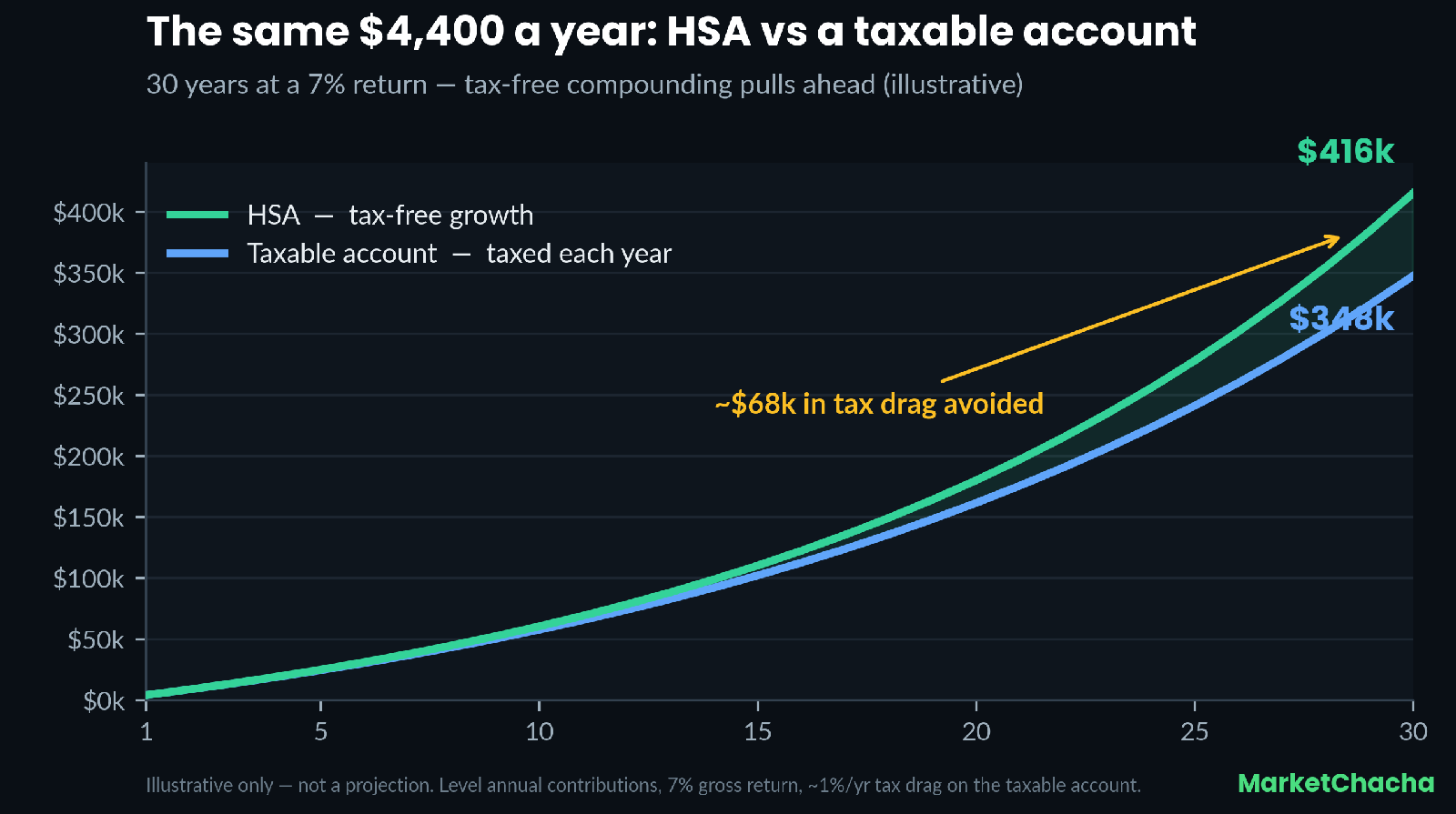
There is a second twist that turns the HSA into a retirement account. After age 65, if you withdraw HSA money for a non-medical reason, you simply pay ordinary income tax on it and there is no penalty — exactly like a traditional IRA. Before 65, a non-medical withdrawal is taxed and hit with a stiff 20% penalty, so the account is meant to be left alone. But from 65 onward it works as a medical account (tax-free) and a backup retirement account (taxed, no penalty) at the same time. It also has no required minimum distributions, unlike a traditional IRA.
A well-known tactic makes this even better: keep the receipts for medical bills you pay out of pocket today, leave the HSA invested, and reimburse yourself tax-free years later. As long as the expense was incurred after you opened the HSA, there is no deadline to claim it — your invested balance grows in the meantime.
How to actually open and use an HSA (step by step)
- Confirm you have an HDHP. Check your insurance card or plan summary for the deductible; compare it to the year's HDHP thresholds above.
- Open the account. If your employer offers one, payroll contributions are best (they dodge FICA). Otherwise open one at a bank or HSA specialist — you are free to use a different provider than your employer's.
- Fund it. Contribute by payroll deduction or transfer money in yourself and claim the deduction at tax time. You have until the tax-filing deadline to contribute for the prior year.
- Decide: spend or invest. Use the debit card for current medical costs, or — if you can pay those from cash flow — invest the balance and let it grow.
- Keep every medical receipt. You need proof the withdrawal was for a qualified expense (see IRS Publication 502 for what counts), and receipts also enable the reimburse-yourself-later strategy.
What it costs you — the catches
An HSA is not free of trade-offs. To get one you must accept a high-deductible health plan, which means you pay more out of pocket before insurance kicks in — a bad fit if you have heavy, predictable medical needs. Some HSA providers charge monthly maintenance or investment fees, so compare them. Money withdrawn for non-medical reasons before 65 is taxed and penalised 20%. And record-keeping is on you: if you cannot prove a withdrawal was for a qualified expense, the IRS can tax and penalise it. The HSA rewards people who can leave it alone; it punishes those who dip into it early for non-medical spending.
HSA vs FSA — don't confuse the two
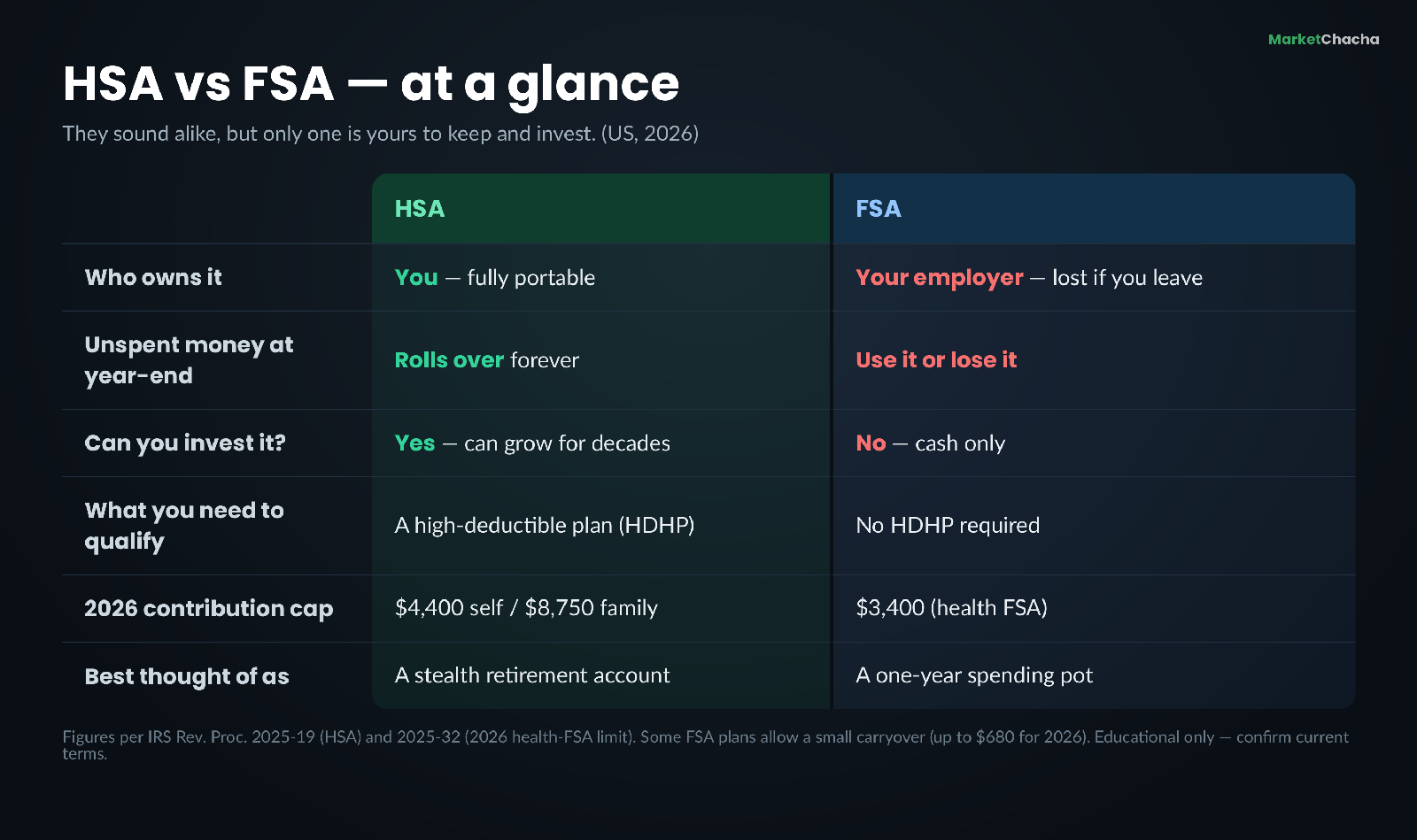
Beginners constantly mix up the HSA with the Flexible Spending Account (FSA). They sound similar but behave very differently: an FSA is generally "use it or lose it" within the plan year, is owned by your employer (you lose it if you leave), and cannot be invested. An HSA rolls over forever, is yours to keep, and can be invested. The reference card below lays the differences side by side.
Common mistakes beginners make
- Treating it as a spending account only. Draining it every year for routine costs forfeits the tax-free compounding that makes it special.
- Leaving it all in cash. Many people never turn on the investment option, so a would-be retirement account earns near-zero interest.
- Contributing while on Medicare. Once enrolled you can no longer contribute; doing so triggers a tax penalty.
- Losing receipts. Without documentation you cannot prove withdrawals were qualified — or reimburse yourself later.
- Confusing it with an FSA and assuming the balance disappears at year-end. It does not.
How this works in India
India does not have a direct HSA equivalent — there is no account where medical savings go in untaxed, grow untaxed, and come out untaxed. The nearest levers are different tools used together. Under Section 80D of the Income Tax Act (available only under the old tax regime, as of FY 2025-26), you can deduct health-insurance premiums of up to ₹25,000 a year for yourself and family, rising to ₹50,000 if you are insuring senior-citizen parents, with up to ₹5,000 of that usable for preventive check-ups. Note the new tax regime removes 80D in exchange for lower slab rates, so the benefit only helps old-regime filers.
Because there is no tax-free medical-savings vehicle, the practical Indian playbook is to (1) buy a solid health-insurance policy and claim the 80D premium deduction, and (2) build a separate dedicated medical emergency fund in a liquid fund or fixed deposit so a large hospital bill does not derail you — while using PPF, NPS and ELSS (Section 80C) for retirement. The mechanic is split across products rather than stacked in one account the way an American HSA stacks all three tax breaks.
FAQ
What is the triple tax advantage of an HSA in plain words? The same dollar gets three tax breaks: it goes in without income tax, grows without tax on interest or gains, and comes out without tax when spent on qualified medical costs. No other US account gives all three.
Can I use my HSA for non-medical expenses? Yes, but before age 65 a non-medical withdrawal is taxed as income and hit with a 20% penalty. After 65 the penalty disappears and you just pay ordinary income tax, so it behaves like a traditional IRA for non-medical use.
What happens to my HSA if I change jobs or don't spend it? Nothing bad — the account is yours, not your employer's, and unspent money rolls over indefinitely. It follows you between jobs and there is no "use it or lose it" deadline.
How much can I contribute to an HSA in 2026? Up to $4,400 for self-only coverage or $8,750 for family coverage, plus a $1,000 catch-up if you are 55 or older, provided you have a qualifying high-deductible health plan.
What is the difference between an HSA and an FSA? An HSA is portable, rolls over forever and can be invested; an FSA is usually "use it or lose it," is owned by your employer, and cannot be invested. You need an HDHP to have an HSA; you do not for an FSA.
Is there anything like an HSA in India? No direct equivalent. The closest is the Section 80D deduction for health-insurance premiums (old tax regime only) combined with a self-built medical emergency fund; medical savings do not grow and withdraw tax-free the way they do in a US HSA.
Educational content only — not investment, tax or insurance advice, and not a recommendation of any product. Rates, limits and rules change — always check current terms with the provider and a qualified tax professional. Sources: IRS Rev. Proc. 2025-19 (2026 HSA/HDHP limits), IRS Publication 969 (HSAs), IRS Publication 502 (Medical Expenses), Section 80D overview. Always do your own research.
This article is for educational and informational purposes only. It is not financial advice, investment recommendation, or a solicitation to buy or sell securities. Investing involves significant risks. I am not a SEBI-registered investment advisor. Readers should consult their own financial advisor and conduct their own research before making any investment decisions.
Comments
Join the conversation
Sign in to join the conversation.
Follow replies, add your view, and take part in the discussion.
Sign in to commentLoading comments...